The Mathmagics of Media Princesses: Informal STEM Learning, STEM Rhetorics, and Animated Children’s Movies

The movie Moana (2016) took a stance on an academic mathematical debate. Set on a fictional Polynesian Island, the movie follows the title character as she prepares to become her people’s leader. Told that she must not travel too far beyond the geographical boundaries of her island, Moana still decides to investigate the ecological devastation of her home through making a long ocean journey, finding a demigod, facing demons, and learning to navigate along the way. In her navigational education, she finds she needs to recognize that her ancestors were “voyagers,” a term that has been debated in academic scholarship. Used by mathematicians and anthropologists, “voyaging” can refer to the long-distance navigation of not just the Polynesian peoples but also the peoples of the nearby Marshall Islands, as Sara Hottinger has recently reviewed (125-158). The ethnomathematical research about the practice has been variously praised for demonstrating complex mathematical practices of non-Western peoples and criticized for being a non-mathematical ritual at best. Through using a modified version of “voyaging,” instead of navigating or calculating, and through framing the practice as cultural and remembered, the movie Moana mirrors broader rhetorics of mathematical success, which tend to limit female characters’ performances of math.


Moana follows a history of similarly missed opportunities. From the 1950s until now, many children’s movies have focused on heroines who, though often excited about learning, are nevertheless not presented as interested in mathematics. An adherence to such omissions leads to surprising outcomes. For example, the 1951 movie Alice in Wonderland jettisons mathematical material in favor of the linguistic jokes of the original Victorian stories. The following 1959 movie Donald in Mathmagic Land returns to the mathematical content of the Alice stories, except Donald does so through a male narrative and a male character who acts in ways that reinforce his gender presentation. The portrayals matter, as Jack Halberstam has argued about related movies, because they reflect and reinforce ways of being in the world. Children’s movies, for Halberstam, reflect narratives of success and failure, and the heterogeneous, cooperative acts of Pixar misfits present a “queer” alternative to the heteronormative, capitalist fairy tales of Disney (21-22). According to feminist scholar Sara Hottinger, building on the work of British sociologists Valerie Walkerdine, Heather Mendick, Melissa Rodd, and Hannah Bartholomew, such narratives especially matter in math (5). Walkerdine and Mendick separately came to the conclusion that British girls of the late-1990s and early-2000s could not reconcile mathematical success with normative femininities. Rodd and Bartholomew, writing slightly later, found that female math students were more likely to say that their achievement was the result of hard work, while their male counterparts often claimed their successes came from natural ability. Arguing that “our culture” considers “femininity and mathematical talent…discursively incompatible” (5), Hottinger focuses on the textbooks and articles that either reinforce or begin to subvert such associations. The following paper focuses on the media portrayals of mathematical success, especially the absence of stories of math achievement for female characters and even their creators. In doing so, I follow Halberstam in arguing for the importance of studying media portrayals of success along with discursive and ethnographic examples. Children’s movies importantly have participated in the broader rhetorics of mathematical success, twisting narratives in order to preserve the absence of female mathematical knowers.


Drawing attention to the participation of children’s movies in academic debates, this paper additionally seeks to add to our understandings of STEM rhetorics. STEM, after all, stands for “science, technology, engineering, and mathematics,” though the mathematical M often receives poor coverage. The recent technical communication articles about “quantitative literacy” show the trickiness of defining math skills from rhetorical perspectives (Colombini & Hum 380; Grawe and Rutz 3-5). Furthermore, G. Mitchell Reyes’s review essay “Stranger Relations” indicates some theoretical frameworks that could explain the perceived disconnect between (modern) rhetoric and mathematics and that could provide some opportunities going forward. As Reyes has noted, rhetoric scholarship already exists that explores the relationship between the seemingly distinct fields. The work of Giovana Cifoletti, Jessica Mudry, Jordynn Jack, and James Wynn, in particular, all show that rhetoric and math can be considered together because of their historical interconnections. This article shifts focus, investigating the implications of math rhetorics for the recent past. Specifically, I use explicitly feminist scholarship to uncover how female characters (and by extension, women) have been rendered silent in the context of mathematical conversations.


The patterns of silence and omission become especially pressing when considered with respect to the recent Peitho articles about STEM rhetorics. Though American science education developed gendered tracks slowly, as historian Kim Tolley has shown (1-12), we do face their enduring legacy today. Many messages—subtle and profound—now reinforce the presentation of STEM disciplines as “male, technical, and insular” (Brewer 251-252). Drawing attention to the history of STEM’s gendered expectations in America, Jordynn Jack has analyzed collections of children’s toys. Though the emergent marketing of girls’ scientific toys might lead some to claim gender parity in STEM, Jack notes that “scientific and technical elements” of the toys are “feminized” in order to “limit the disruptive potential of these toys, confining them safely within the pink world girls are used to” (“Objects in Play” n.p.). STEM messages matter, according to Brewer and Jack, because they concern who will be the nation’s future scientists and engineers, and they thus affect many Americans even beyond the children who are encouraged to see themselves as future STEM professionals (or not). As I will argue, children’s movies similarly participate in making possible certain visions of future STEM workers. They limit the pool of role models for mathematically-inclined young people, which limits their entrance into math professions or broadly STEM professions. STEM exclusion is not just the concern of girls and women, too, as extensive research has confirmed that limited visions of STEM promote exclusivity far beyond gender expression (Hacker 10). Moreover, as I will explain in the final section, such messages affect our views of the present as well as the future, leading to the omission of female mathematicians who are working today.


In focusing on animated children’s movies, this article indicates how rhetorical scholarship can provide perspectives on “informal STEM learning.” Defining informal STEM learning, the National Science Foundation recognizes how “learning occurs across the lifespan and in places and spaces beyond schools or the school day.” Examples of the major “sectors” of the field include “mass media, museums/zoos/aquaria, after school, science outreach, citizen science, cyber-enhanced learning, science communication, among others,” which all “have particular potential for supporting learners from underrepresented groups” (NSF “AISL” n.p.). Movies, in particular, provide a means of addressing large numbers of children, implicitly teaching them social expectations even beyond the classroom. As part of the larger project, the Center for Advancing Informal STEM Learning (CAISE) has compiled and collated a lot of evidence to show how film, among many environments, contributes to STEM understanding at some level. Mirroring how rhetoric scholars have argued that visual representations influence gender expectations (David, 2001; Gigante, 2015; Gigante, 2018), CAISE indicates how films shape expectations surrounding science and math. Still, further scholarship is needed in the broader project of informal STEM learning because of how common such situations are: they might occur in various places with varying expectations, audiences, personnel, and oversight. This article brings informal STEM learning to the attention of scholars in feminist rhetorics, who have much to add to the project of compiling “research findings that articulate what works, for whom, why, and in what contexts” (NSF “AISL” n.p.). In fact, this article shows how explicitly feminist perspectives can allow us to draw attention to what has and has not worked in informal STEM learning.


In order to indicate considerations of informal as well as formal learning environments, this paper has three parts. The first indicates how the 2016 movie Moana intervened in an academic mathematical debate through subtly taking a stance on the subfield of “ethnomathematics,” defined as the study of the mathematical practices of diverse (usually non-Western) cultures. The second section argues that the history of omissions relates to the presentation of female characters as well as non-Western ones, through analyzing the 1950s movies Alice in Wonderland and Donald in Mathmagic Land. The paper ends through considering the presentation of the mathematicians behind Moana’s computer animation, pointing out the consistent omission of female mathematicians from media coverage, confirming broader cultural messages. Following Halberstam, I also mention one potential alternative, an animated children’s movie that focused on a female math student and political activist, Flatland (2007), though the movie had a limited release and limited viewership, compared to the other examples. Throughout, this article argues that children’s movies have mirrored broader American rhetorics of mathematical success, which tend to omit female mathematical knowers. In doing so, the article adds to research on STEM rhetorics through showing how a grounding in informal STEM learning is possible but also how the project should involve questions about what counts as both STEM and learning.

Moana, the Mathematician

At face value, Moana seems to have little to do with math, beginning with a heavily modified story of the creation of the Polynesian islands, explaining how the demigod Maui stole the heart of the creator goddess Te Fiti. The narrator is revealed to be Moana’s grandmother, teaching the children of the island the stories of their people. After the class ends, the toddler Moana wanders the shore, and the ocean reveals a stone with the same pattern as Te Fiti’s missing heart. Before she can touch it, Moana’s father (revealed to be the chief of their people) takes her away, and her parents raise her away from (but within sight of) the ocean. As a young woman, Moana begins to recognize the ecological devastation of her island and suggests going beyond their geographical barrier (a reef) for more fish. Though her father forbids it, she still tries with her boat, and the tides overpower it. Back on shore, her grandmother shows her a secret cave with ancient ships, large enough to show that her people once did not stay close to their island. Handing over the ocean’s stone, her grandmother explains that Moana must leave and convince Maui to restore Te Fiti’s heart in order to save her people. Moana spends the rest of the movie learning navigation from Maui and her ghostly ancestors, gradually gaining the skill to use the stars, her hand, and the tides to sail, steer, and plot the course to Te Fiti. All ends happily: Moana’s island is restored, and the movie ends with her teaching navigational skills to her people on what appears to be a long-distance voyage. A story of cultural heritage and ecological salvation, Moana is also therefore about learning navigation, an important task but not an explicitly mathematical one here. The movie subtly argues against the ethnomathematical scholarship about the heavily mathematical content of Pacific Islander navigation, making Moana seem to be successful though not through mathematics.


Ethnomathematics, as a field, has been constructed to resist many Euro-American assumptions about mathematical success, though with limited results. Math rhetorics in Euro-American contexts usually assume Western mathematics to be universal, value-free, and singular, i.e. the only mathematics. There is only one route to success in those mathematical contexts (and broadly STEM contexts): finding the singular, right answer within the singular, right mathematics. Yet ethnomathematics reveals the variety of maths within the variety of cultural groups and communities in the world, and does so using the techniques of anthropology, history, psychology, education, and (Western) mathematics. According to ethnomathematics, there must be many paths to success, even within Western mathematics, because the world contains so many ways to, in the terms of Crystal Broch Colombini and Sue Hum, “explore, translate, visualize, and express” (383). Despite the global potential of the field, ethnomathematics has not been an entire success. Even when administrators and colleagues approve of the field (which happens rarely), ethnomathematics scholarship often debates the field’s status, definition, knowledge, disciplinary basis, purpose, and interdisciplinarity. It should be noted that ethnomathematics’s status has some parallels to rhetoric and composition.


Even beyond intradisciplinary debates, there are some who question the entire construct. Sara Hottinger’s interpretation of ethnomathematics echos Jordynn Jack’s arguments about the “pink world” of girls’ science toys. In analyzing gender expectations in textbooks from elementary school to college, Hottinger devotes special chapters to two classes often required of college-level math majors: history of mathematics and ethnomathematics. Drawing on a combination of discourse analysis and education, her chapters argue that textbooks in the history of mathematics construct a normative (Western, male) sense of mathematical success. Ethno-mathematics, for Hottinger, “despite its liberatory purpose, actually reinforces the dominance of Western mathematics and its construction as both universal and value-free” (125). Because math classes and textbooks consider “non-Western” or “cultural” mathematics as separate from Western mathematics, ethnomathematics reinforces students’ sense of the boundaries of the presumed one and only mathematics. In particular, its separation from history of mathematics (and other math classes) makes ethnomathematics seem like something else, present though marginal. Extending Hottinger’s analyses from textbooks to children’s movies, this section follows the ways that Moana took a stance on an ethnomathematical debate through presenting Moana as a navigator though not explicitly a mathematician.


Marshallese navigation, a counterpart of the Polynesian navigation depicted in Moana, has been a contentious area of research in ethnomathematics. Foundationally, American mathematician Marcia Ascher included an overview of the navigation of the Marshall Islands within her ethnomathematics textbook Mathematics Elsewhere: An Exploration of Ideas Across Cultures (2002). Called “Models and Maps,” Ascher’s chapter aimed to expand Western ideas of mathematical modeling through considerations of the Marshallese “stick charts” needed for long-distance voyaging (95). The Marshall Islands, made of twenty-nine atolls and five coral islands in two chains, have proven a unique navigational challenge because of the northwest-southeast orientation of the island chains, which breaks the swell of the northeast trade wind across the Pacific. So, in order to navigate the unique wave patterns and land masses, Marshallese peoples have developed navigational charts, which Ascher calls “stick charts” because of their weaving from palm “sticks” (95-97). Because of the oppressive colonial rule of the islands, by European entities, Japan, and then the United States, Marshallese navigators were reluctant to share their maps with Ascher and other Westerners, which leads her to present them as historical. A recovery of the maps/models is also not exactly her focus. Rather, the chapter locates Marshallese mathematical practices within the map traditions of the West, emphasizing the ways that the “non-Western” mapping practices diverge from Western traditions and giving reasons why (89-126). By doing so, Ascher does expand notions of global mathematical practices, though only through rough, comparative interpretations, i.e. establishing a “mathematical Other” (Hottinger 126).


Though Ascher presents such navigational practices as historical, (pseudo) mathematical, and “improperly” saved by the Pacific Islanders themselves—because of their “lack” of “writing systems,” museums, and archival collections (122)—more recent scholars frame Marshallese navigation as cultural practice. American anthropologist Joseph Genz, in his 2009 dissertation and a subsequent 2011 article, frames Marshallese navigation as a practice in need of collaborative, (post)colonial recovery. Working with Marshallese navigator Captain Korent Joel, Genz explains how colonial rule prohibited what he calls “voyaging” because the German and Japanese administrations assumed the local navigational practices were dangerous and costly (10). The subsequent U.S. rule only made problems worse, as the nuclear tests on the atolls caused massive relocation, disease, and ecological devastation, including the sudden destruction of a navigation school. Captain Korent, according to Genz, started the recovery efforts in response to the revitalization of indigenous canoe building—incidentally, a movement that directly “inspired” the animators of Moana (Garcia et al. n.p.). Still, Genz found the research on Marshallese navigation equally challenging because the knowledge was prized for its specific techniques, which one elder said he would rather “take…to the grave” than share with outsiders (19). Viewing such interactions as “cultural…reluctance” (19), Genz nevertheless argues for the value of the “revival of voyaging in the Marshall Islands” (1). In a 2016 re-interpretation of Genz’s work, Sara Hottinger follows the work of Gayatri Chakrovarty Spivak and Roi Wagner, and notes that the silence in Genz’s work reinforces the sense of Marshallese navigation as ethnomathematically Other, specifically a matter of cultural anthropology, not mathematics.


In fact, Moana does follow anthropological literature in presenting Pacific Islander navigation as cultural practice. Throughout the movie, Moana repeats that her ancestors were “voyagers,” using a modification of the term “voyaging” from Genz, his mentors, and his collaborators’ descriptions. Through song and musical montage, Moana has visions of her ancestors navigating, which frames the practice as about the identity of her people and her self.  Following a generous reading of ethnomathematics, Moana here appreciates herself as a mathematician—and her people as mathematicians. After all, as the chorus of ancestors sing, they could plot courses, develop systems of astronomical terminology, and perform meteorological readings, in order to learn about their place and identity. Still, the depicted practices have little specificity, not only in lyrics but also in montages where Moana ties knots, repairs sails, and holds her hand to the night sky. (There is nothing approaching the characteristic maps and charts.) Overall, Moana presents Pacific Islander navigation as vaguely cultural, a matter of heritage and ancestry, remembered in song and native language. Given the frequent presentation of Western mathematics as universal, beyond culture, beyond peoples and language, Moana’s navigation therefore makes little sense within Western STEM knowledge systems.


Likewise, the statements of Moana’s creative team do not demonstrate ethnomathematical scruples. In news interviews, directors Ron Clements and John Musker claim to be inspired by stories of Polynesian mythology and later research trips to Fiji, Samoa, and Tahiti (Sarto n.p.). As Westerners, they were particularly fascinated by the idea of the “lost” knowledge of “voyaging,” though they did not acknowledge the importance of colonialism for causing the loss. Putting together an Ocean Story Trust, they worried more about potentials for their “story” to cause offense instead (Giardina n.p.; Robinson n.p.; Ito n.p.).


Polynesian navigation became a bigger part of the story as Moana’s gendered experiences were less emphasized through script drafts. Though Taika Waititi initially wrote Moana’s journey about her finding a place among a family of brothers, later versions emphasized her recovery of her cultural heritage. Consistently conceptualized as a heroic tale of “the ocean,” it was less important that the drafts keep the same character as the advocate of navigation, which meant that role passed among the chief/father, grandmother, and eventually Moana (Giardina n.p.; Topel n.p.). In final stages of production, Aaron Kandell and Jordan Kandell joined the writing team, suggesting the ancestors’ chorus and what the Kandells, following the relevant anthropological literature, called “the Cave of Wayfinders” (V. n.p.). The terminology of “wayfinders” and “wayfinding,” though important academic concepts for describing systems of geographical knowledge, ultimately did not appear in the movie, and the entire navigation system was systematically simplified with the borrowing of techniques from throughout many and varied peoples of the Pacific Islands. As news outlets have attested, the studio’s portrayal of navigation follows the broader pattern of Moana’s appropriation, simplification, and commodification of Polynesian cultures (Constante n.p.; Grandinetti n.p.). As in the case of the boats depicted in the movie, which animators claimed as “their” re-discovery (Garcia et al. n.p.), Moana’s creators ultimately did not respect elders’ intellectual rights or the status of navigation as prized for its specific techniques (Madigibuli n.p.).


Such a treatment of Polynesian navigation follows a history of Disney’s commodification of non-white peoples. The 1946 Song of the South famously included offensive stereotypes of African-American English and African American people (Watts 276-277), leading one journalist to call the movie “propaganda for white supremacy” (qtd. in Gevinson 956). Understandably, given Song of the South, some critics of Moana have worried about the encouragement of “brownface” among audiences (BBC News n.p.). Interestingly, the 2009 movie The Princess and the Frog, an earlier project of Moana’s creative team, has not been so heavily criticized, though a Black Louisianan is the core Princess. Given the mixed responses, it would be helpful to have more research about Moana’s participation in depictions of non-white peoples in animated children’s movies. Without losing sight of ethnocentric dynamics, this article continues through outlining a history of the omission of female characters from explicitly mathematical stories.


Along the lines of informal STEM learning, what is being taught in Moana? Pacific Islander navigation does relate to academic research in a subfield of mathematics, though it’s difficult to tell from the movie. Moana’s presentation makes the navigational techniques seem general, ancestral, and remembered. Emphasizing anthropological terminology and assumptions, Moana is unlikely to be recognized as a repository of math learning at all. Though Moana holds the promise of “supporting learners from underrepresented groups” through presenting non-Western mathematicians and mathematical practices (NSF “Mathematics and Statistics” n.p.), the movie instead follows Disney’s broader history of separating female characters from explicitly mathematical stories.


Moana begins to indicate what research on STEM rhetorics can learn from texts of informal learning, as well as vice versa. As opposed to texts generated from laboratories, field work sites, military installations, and hospitals, Moana allows us to see some of the limits in considering a text to be scientific/mathematical or not. It has been made clear, for instance in Jack’s work (Science on the Home Front 127-137), that such considerations of marginality and periphery face projects of feminist science, which infuse STEM practices with greater attention to gender, reflexivity, genre, and contextual knowledge. Moana and children’s animated movies generally urge us to see beyond texts incorporated into traditional STEM classrooms, to the possibilities that could exist in the recognition of informal STEM learning and its bounds. Overall, Moana and similar texts point out how STEM rhetorics should be careful to note the limitations of understanding STEM content within Western contexts.

Alice’s Mathmagics?

The earlier history of animated children’s movies also allows for the investigation of the demarcation of explicitly classroom texts from informally educational ones, questioning the status of education even beyond Western STEM. Particularly in the case of Donald in Mathmagic Land (1959), animated children’s movies have gone to great lengths to prevent the depiction of mathematical women. As film scholar Martin F. Norden has argued, Donald in Mathmagic Land depended heavily on the earlier Alice in Wonderland (1951) and more broadly on Lewis Carroll’s original Alice stories (119-121). Carroll, after all, was the pseudonym of the Oxford mathematician Charles Lutwidge Dodgson, and many mathematical references and jokes famously appeared in Alice’s Adventures in Wonderland, Through the Looking-Glass, and The Hunting of the Snark. As mathematician Robin Wilson recovers in the 2008 book Lewis Carroll in Numberland, not all of the jokes were at Alice’s expense and in fact Alice consistently attempts to talk about arithmetic with the Mock Turtle, the Gryphon, Humpty Dumpty, the Red Queen, the White Queen, and the Cheshire Cat (1-8). In fact, rather than making fun of Alice, it seems the math jokes prove more in line with the metatextual references to recitation, spelling, and the medium of the book itself (Fiss 258-260). That said, the mathematical references did not appear in the animated movie Alice in Wonderland, despite its reliance on the original stories, making Donald in Mathmagic Land possible. Alice and Donald ultimately reinforced American math rhetorics of the time (and since), in which women are rarely portrayed as mathematically successful, especially in explicitly educational films.


The production of the movie Alice in Wonderland waffled between attempts to create a story more like the studio’s triumphs and one more like the original Alice books. Initially conceptualized as a live-action movie in the 1930s, the plot and vision grew through the creative teams’ worries about literary reputation and studio expectations. According to the documentary Through the Keyhole (2011), the early versions appeared too serious and too indebted to the literary originals, while the later versions centered on fictional persecution of Alice and Carroll/Dodgson with new art and new stories. The colorful artwork stayed, though the plot proved variously vexing. As Walt Disney’s biographer Bob Thomas implied, it seemed there was a sense that Alice needed to have a hero/rescuer like the princes in Snow White and Cinderella. Though Disney considered casting the White Knight as Alice’s “prince,” he ultimately dropped the idea because “he was intimidated by the threats of Lewis Carroll purists” (Thomas 220). In the end, the movie was accused of “Americanizing” a British classic (Thomas 221), but Alice in Wonderland did not satisfy American “cartoon” fans either, since it seemed to be too much about a girl who learned for herself. The story of Alice’s learning did come from the books, though American audiences of the time generally did not find the plot satisfactory. Alice in Wonderland seemed less about a female character’s need for saving and more about her education.


Despite the educational focus, Alice’s creative team also left out the math. The movie Alice in Wonderland follows the picaresque style of the original stories, though in an even more episodic fashion. Framed with depictions of Alice daydreaming on the banks of an Oxford river, Alice in Wonderland follows a series of short conversations between Alice and other beloved Carroll characters: the Doorknob, the Dodo, Tweedle Dee and Tweedle Dum, the White Rabbit, the Flowers, the Caterpillar, the Cheshire Cat, the Mad Hatter (and other Tea Party guests), and the Queen of Hearts. Though the original stories featured nonsensical calculations and discussions of arithmetic with a few characters, none of those reappeared, in favor of conversations about language, stories, poetry, singing, manners, education, and the law. The closest approximation of a mathematical discussion appeared in the Mad Hatter’s Tea Party, in the explanation of “unbirthdays.” In dialogue wholly made up by the Disney creative team, the Mad Hatter begins through stammering an explanation of the number of unbirthdays: 365 minus 1. Alice then realizes the Tea Party marks her unbirthday, too. Presenting subtraction, as well as knowledge of the number of days in a typical year, the Unbirthday scene does not feature Alice; the other Tea Party guests explain the concept. Though Alice does catch on to the categorization of birthdays and unbirthdays, which relates to a “key developmental indicator” of “data analysis” in preschool mathematics (HighScope 1), the scene is one in which she is fundamentally taught—and taught far below the level of her expressed age. Moreover, the conversation is far from the sophisticated mathematical jokes of Carroll/Dodgson about modular arithmetic, non-Euclidean geometries, and alike. The movie Alice distinctly omits mathematics, by comparison.


Soon after Alice’s box-office flop, Donald in Mathmagic Land allowed the creative team to return to the omitted conversations. As Martin Norden observes, Donald in Mathmagic Land brought back senior animators from Alice, Wolfgang Reitherman, Les Clark, and Joshua Meador, who served as sequence directors for Donald. Furthermore, Hamilton Luske, one of Alice’s three listed directors (of many more unlisted directors), served as supervising director for Donald. And Milt Banta, one of the eventual scriptwriters for Alice, became a story contributor in the development of Mathmagic Land. Donald’s creative team included so many overlapping employees that its production served as a rough reunion for most of the Alice contributors. Inspired by Mary Blair’s artwork from Alice, Donald in Mathmagic Land was constructed in a way that “practically guaranteed a visual and thematic bond between the two films” (Norden 119). Still, unlike Alice, the characters visit the “Wonderland of mathematics,” exploring Pythagorean music, the golden section, Western architecture, human proportions, chess, mental games, and the concept of infinity.


Ultimately, Donald in Mathmagic Land follows a very abbreviated history of Western mathematics, confirming the presentation of the Western mathematical system as creative though still universal, i.e. the only “correct” mathematics in the world. Donald begins through a game of tic-tac-toe between Donald and the Pencil Bird from Alice, continuing through visual jokes about division (where a stream of numerals breaks into smaller numbers when they hit rocks) and square roots (where the branches/roots of trees bend at ninety-degree angles). Once the Spirit of Adventure explains to Donald where he is, he expresses frustration, saying “Mathematics? That’s for eggheads” (n.p.). The Spirit corrects him, explaining the mathematical origins of music with stories about Pythagoras and the Pythagoreans of Ancient Greece. After a jam session, the Spirit returns to the use of proportion in Greek, then Roman, and Renaissance architecture. Explaining that mathematics is universal, extending in centuries of architecture and many specimens from nature, the Spirit nevertheless argues “the rules are always the same” (n.p.). Lest the lesson remain unclear, the Spirit introduces a variety of games from chess, baseball, football, basketball, and billiards, and he concludes with a host of inventions, showing how the mathematical mind leads to scientific innovation. Through visual and verbal references, the Spirit implies that Western math built the inventions since the Renaissance: the wheelbarrow, car, train, and airplane; the spring, the clock, and the telephone; and the record player. He concludes that only math will open the possibilities of such inventions for “the curious and inquiring minds of future generations” (n.p.). Donald in Mathmagic Land waffles between the presentation of mathematics as a creative product of Western cultures and as a universal, singular system: the only truly “clean” mental system for any past, present, and future innovation.


In explicit comparisons with Alice, Donald in Mathmagic Land reinforces not only expectations surrounding Western math but also Donald’s gender presentation. Famously a character with a very short temper, he does not have a tantrum when forced to enter Alice’s world. The Spirit, in explaining chess, first talks about Lewis Carroll’s use of the board as a setting for Through the Looking Glass. Then, faced with the chess pieces annoyed at Alice, Donald is accused of being a pawn, a situation he detests. The Red King and Red Queen listen to his protestations that he’s really Donald Duck, but they talk about how that name is really just arbitrary. Mentioning that Donald could just as easily be “an Alice” (n.p.), he finds himself diving off the board and ultimately eating baked goods that make him grow to gigantic size. The Spirit continues talking about chess until Donald’s clear boredom causes the Spirit to change topics to baseball. As explored earlier, Donald’s Alice scene reinforces the mathematical content generally missing from the earlier Alice movie. More surprisingly, throughout the scene, Donald wears a wig and Alice’s outfit (a light-blue dress, a white apron, and a headband). Initially in his usual sailor suit and cap, Donald is transformed when the Spirit first says the word “Alice,” and he remains in the dress until the narrator changes topics, saying the word “baseball,” which gives Donald a (male) baseball uniform. Because of the frame, it’s clear that the Donald/Alice character of the scene is not an attempt at a female character but instead a decidedly male character cross-dressing. As in other elements of mid-century American popular culture, including a “university cross-dressing phenomenon” in California and elsewhere, Donald’s Alice scene seemed “to promote the same notion” from 1950s writing and culture “that only a truly masculine man can be trusted to embody and represent womanhood” (Wilkie 234). In other words, appearing in a dress just reinforces Donald’s masculinity.


Because of the educational legacy of Donald in Mathmagic Land, it is important to acknowledge what precisely is being taught. Its theatrical release placed Donald with Darby O’Gill and the Little People, but Donald in Mathmagic Land was more educational from the outset. From a post-war studio that had spent “the war years…making instruction and technological films in which abstract and obscure things had to be made plain and quickly and exactly applicable” (qtd. in Norden 122), Donald in Mathmagic Land was an attempt to explore how instructional cartoons could be entertainment. Speaking to reporters after the premiere, Walt Disney noted how “the cartoon” was “a good medium to stimulate interest,” saying “we have recently explained mathematics in a film and in that way excited public interest in this very important subject” (qtd. in Smith 198). In various re-releases (on TV, VHS, and DVD) and in attempts at tie-in materials (including at least one comic book), Donald in Mathmagic Land became the studio’s most popular educational film for the STEM classroom and one of the best-known educational movies of any distributor.


In educating audiences, however, the movie did little to resist the math rhetorics of its time. Donald framed mathematics as a product of Western culture, though singular and universal: invented by people stretching back to the Ancient Greeks and yet the only, one, true mathematics, fundamentally applicable to all things (and people) everywhere. Though more recent research in ethnomathematics would question the assumptions, Donald did repeat normative (Western) understandings of mathematics through its depiction. Furthermore, the absence of female characters allowed the studio to resist portraying girls’ achievements of mathematical success, making it seem merely a matter of male students and male knowers. Overall, the movie Donald in Mathmagic Land supports the construction of what Sara Hottinger calls “a normative mathematical subjectivity” common in the United States “that limits the way marginalized groups are able to see themselves as practitioners of mathematics” (11). From then until now, Donald has seemed to present mathematics as the realm of Western men. In doing so, Donald in Mathmagic Land has not lived up to the promise of informal STEM learning.


With respect to informal STEM learning, the movies Donald in Mathmagic Land and Alice in Wonderland encourage us to pay attention to omissions, particularly about success. Previous analyses of feminist rhetorics have established the importance of silence for our work. Organizing our work around Peitho, as an allegorical figure, already brings new possibilities, as Michele Kennerly and Carly S. Woods have argued, because Peitho (as opposed to Rhetorica) already brings together “the delectation aroused by beautiful speech” and “coming together deliberately”: “private and public…verbal and corporeal” (23). A string of Peitho articles, especially about digital rhetorics, similarly have analyzed “silence” and being “silenced” (Gutenson and Robinson; Beemer). This article follows theirs in asserting how STEM rhetorics need to consider moments of omission as well as moments of speech. After all, the feminist implications of Donald in Mathmagic Land and Alice in Wonderland cannot be fully explained without attention to what is not said and not portrayed. As Jack Halberstam has observed, such moments matter for constructions of success and failure. Halberstam analyzes similar omissions, ones having to do with political action, noting that there are alternatives in CGI animation (especially Pixar movies): diverse characters coming together in “political allegory” and “queerness,” locating success in “anarchy and anti-familial bands” (21-22). Particularly when placed in an animated educational film centering on a character meant to embody children’s immaturity, the omission of female characters can lead Donald’s “future generations” to not see themselves in the story, against the optimism of informal STEM learning, reinforcing limited notions of mathematical success and promoting the exclusivity of math and STEM broadly.


Furthermore, the examples of Alice in Wonderland and Donald in Mathmagic Land present another consideration for grounding STEM rhetorics with instances of informal STEM learning: their differences not only emphasize expectations surrounding (Western) STEM but also assumptions about the limits of explicitly educational texts. Though Donald in Mathmagic Land had a box-office release, the movie was designed to “explain[]” and “excite[] public interest” from the start (qtd. in Smith 198), and its subsequent marketing strongly encouraged classroom uses. Alice in Wonderland, though about education, was neither used in STEM classrooms nor discussed as instructional. In the case of Donald vs. Alice, the explicitly educational text—first informally, then formally—was the one that reinforced expectations surrounding Western STEM content and assumptions about Western learning, including the absence of female characters learning math. In other words, instances of informal STEM learning can encourage our consideration of what counts as Western education as well as what counts as Western STEM.

STEM Rhetorics and Informal STEM Learning From the Future to the Present

Through the cases of Moana, Donald in Mathmagic Land, and Alice in Wonderland, this article shows how animated children’s movies can add to the project of researching informal STEM learning, what has and has not worked, and what considerations emerge from grounding visions of feminist STEM rhetorics in informally educational texts. For STEM rhetorics, the example of the 2016 movie Moana shows the limitations of judging STEM content within Western contexts. Likewise, the comparison of the 1950s movies Alice in Wonderland and Donald in Mathmagic Land demonstrates the importance of considering expectations surrounding learning in both formally and informally educational texts. In terms of informal STEM learning, all movies demonstrate the viciously pervasive omission of female characters performing mathematics. Though the three examples come from one movie studio, this article is not about individual failures, the specific lack of female characters doing math from one institution. Rather, Moana, Alice in Wonderland, and Donald in Mathmagic Land lead us to consider the broader narratives of mathematical success that appear and reappear in Euro-American cultures, especially the historical absence of broader frameworks for acknowledging and promoting female mathematicians and math students.


Though Halberstam notes the importance of computer-generated animation for making possible queer and collective stories, the media portrayals of CGI also reinforce the lack of female mathematicians, as in the case of Moana again. As a heroic story of “the ocean,” Moana’s development funded mathematical research into computational fluid dynamics. Building on previous academic publications, some of which were made possible by previous, studio-funded research, teams of mathematicians at the University of California at Los Angeles (UCLA) created new models in order to make the Ocean appear as a more expressive, interactive character. Though some news articles peripherally mentioned the involvement of a senior female mathematician in the research program, most focused on the ways that a team of young men (a young professor and his graduate students) made possible the mathematical bases of the character. Following a UCLA News story, dozens of media outlets picked up on the idea that “[male] mathematicians brought the ocean to life” (Wolpert n.p.). Such media responses have been explained through the under-representation of women in academic mathematics; as of 2014, according to the National Science Foundation, only 28.9% of all Ph.D. degrees in math went to women. However, under-representation is not a good excuse for complete omission. Rather, the media responses seem to be a way of confirming broader views of mathematical success, ones that restrict the possible roles that women can occupy. We need to keep analyzing exclusionary views for the sake of our present, as well as our future.


This article urges that we at least notice exclusions in American math rhetorics, and that we work toward greater inclusivity at least as part of our projects to build better STEM rhetorics. Sara Hottinger speculates that exclusionary dynamics might have kept her out of mathematics (1-5), and her book has started to inspire similar stories. I too did not pursue graduate work in mathematics; though I don’t regret that choice, I do find I often have to explain why those campus visits made me uncomfortable. Because of these reasons and more, I am especially interested in alternatives to the usual narratives of white, male mathematical success. Flatland: The Movie (2007) makes one such attempt, casting a small, orange hexagon with a female voice as the most talented math student and most powerful political activist of her world. (Hers is a nonsensical, intensely satirical, world, existing in a geometrical plane, where everyone is a shape, which determines their role in society.) Despite intriguing choices, the movie Flatland was limited in its reach, in part because the movie was self-distributed and in part because another adaptation with the same name came out that year. In arguing for greater inclusion of female characters who do math, far greater than blockbuster movies can provide, I am hoping that mathmagics (the magical worlds of math ideas) can be more accessible to more people. Since informal STEM learning exists beyond individual institutions, beyond schools and even beyond movie studios, we all can participate in the critical reshaping of STEM rhetorics.

Acknowledgements

The author wishes to thank colleagues, family, Peitho’s editors, and anonymous reviewers for helpful feedback throughout. The child development center Little Huskies provided resources, perspective, and, as always, their extraordinary expertise in childcare and education.

Works Cited

Alice in Wonderland. Directed by Clyde Geronimi, Wilfred Jackson, and Hamilton Luske, Disney, 1951.

Ascher, Marcia. Mathematics Elsewhere: An Exploration of Ideas Across Cultures. Princeton UP, 2004.

BBC News. “Disney Accused of ‘Brownface’ over Moana Costume.” BBC News, 21 Sept. 2016 . Accessed 1 July 2018.

Beemer, Cristy. “From the Margins of Healthcare: De-mythicizing Cancer Online.” Peitho 19.1 (2016): 93-127.

Brewer, Meaghan. “Practical Genius: Science, Technology, and Useful Knowledge in Godey’s Lady’s Book.” Peitho 19.2 (2017): 251-281.

Center for Advancing Informal STEM Learning. “Informal Science,” CAISE. Accessed 2 July 2018.

Cifoletti, Giovana. “Mathematics and Rhetoric. Introduction.” Early Science and Medicine 11.4 (2006): 369-389.

Colombini, Crystal Broch, and Sue Hum. “Integrating Quantitative Literacy into Technical Writing Instruction.” Technical Communication Quarterly 26.4 (2017): 379-394.

Constante, Agnes. “Critics Accuse Disney of ‘Culture Theft’ Ahead of ‘Moana’ Release.NBC News, 18 Nov. 2016. Accessed 1 July 2018.

David, Carol. “Investitures of Power: Portraits of Professional Women.” Technical Communication Quarterly 10.1 (2001): 5-29.

Donald in Mathmagic Land. Directed by Hamilton Luske, Les Clark, Wolfgang Reitherman, and Joshua Meador, Disney, 1959.

Fiss, Laura Kasson. “Pushing at the Boundaries of the Book: Humor, Mediation, and Distance in Carroll, Thackeray, and Stevenson.” The Lion and the Unicorn 38.3 (2014): 258-278.

Flatland: The Movie. Directed by Dano Johnson and Jeffrey Travis, Flat World Productions, 2007.

Gabler, Neal. Walt Disney: The Triumph of the American Imagination. Vintage Books, 2006.

Garcia, Jonathan, et al. “Rigging the oceans of Disney’s ‘Moana.’” SIGGRAPH ASIA Technical Briefs (2016): Article 30.

Genz, Joseph. “Navigating the Revival of Voyaging in the Marshall Islands: Predicaments of Preservation and Possibilities of Collaboration.” The Contemporary Pacific 23.1 (2011): 1-34.

Gevinson, Alan. Within Our Gates: Ethnicity in American Feature Films, 1911-1960. U of California P, 1997.

Giardina, Caroline. “‘Moana’ Directors Reveal How the Story Changed.” The Hollywood Reporter, 25 Nov. 2016. Accessed 1 July 2018.

Gigante, Maria E. “A Portrait of Exclusion: The Archetype of the Scientist at Work in Life Magazine.” Rhetoric Review 34.3 (2015): 292-314.

—. Introducing Science through Images: Cases of Visual Popularization. Columbia: The University of South Carolina Press, 2018.

Grandinetti, Tina. “Moana might be great for representation but it’s not all heartwarming for Hawaii.” The Guardian, 12 Jan. 2017. Accessed 1 July 2018.

Grawe, Nathan, and Carol Rutz. “Integration with Writing Programs: A Strategy for Quantitative Reasoning Program Development.” Numeracy 2.2 (2009): 1-18.

Gutenson, Leah DiNatale, and Michelle Bachelor Robinson. “Race, Women, Methods, and Access: A Journey through Cyberspace and Back.” Peitho 19.1 (2016): 71-92.

Hacker, Andrew. The Math Myth: And Other STEM Delusions. The New Press, 2016.

Halberstam, Jack. The Queer Art of Failure. Duke UP, 2011.

HighScope. “Preschool Curriculum Content: A Framework for Understanding and Supporting Children’s Learning.” HighScope. Accessed 2 July 2018.

Hottinger, Sara. Inventing the Mathematician: Gender, Race, and Our Cultural Understanding of Mathematics. SUNY Press, 2016.

Ito, Robert. “How (And Why) Maui Got So Big in ‘Moana.’New York Times, 15 Nov. 2016. Accessed 1 July 2018.

Jack, Jordynn. Science on the Home Front: American Women Scientists in World War II. Urbana: University of Illinois Press, 2009.

—. “Objects in Play: Rhetoric, Gender, and Scientific Toys.” Peitho 18.1 (2015): n.p.

Kennerly, Michele, and Carly S. Woods. “Moving Rhetorica.” Rhetoric Society Quarterly 48.1 (2018): 3-27.

Madigibuli, Ana. “Disney Uses Our Camaku.” Fiji Times, 27 Oct. 2014. Archived at Pacific Heritage Pub Facebook. Accessed 1 July 2018.

Mendick, Heather. “A Beautiful Myth? The Gendering of Being/Doing ‘Good at Maths.’” Gender and Education 17.2 (2005): 89-105.

Moana. Directed by Ron Clements and John Musker, Disney, 2016.

Mudry, Jessica J. Measured Meals: Nutrition in America. Albany: SUNY Press, 2009.

National Science Foundation. “Advancing Informal STEM Learning (AISL) Program Solicitation.” Directorate for Education & Human Resources, Research on Learning in Formal and Informal Settings. Accessed 2 July 2018.

—. “Mathematics and Statistics – Field of Degree: Women.” Women, Minorities, and Persons with Disabilities in Science and Engineering. Accessed 2 July 2018.

Norden, Martin F. “‘A Journey Through the Wonderland of Mathematics’: Donald in Mathmagic Land.” Learning from Mickey, Donald, and Walt: Essays on Disney’s Edutainment Films, edited by A. Bowdoin Van Riper, McFarland, 2011, pp. 113-126.

Reyes, G. Mitchell. “Stranger Relations: The Case for Rebuilding Commonplaces between Rhetoric and Mathematics.” Rhetoric Society Quarterly 44.5 (2014): 470-491.

Robinson, Joanna. “How Pacific Islanders Helped Disney’s Moana Find Its Way.” Vanity Fair, 16 Nov. 2016. Accessed 1 July 2018.

Rodd, Melissa, and Hannah Bartholomew. “Invisible and Special: Young Women’s Experiences as Undergraduate Mathematics Students.” Gender and Education 18.1 (2006): 35-50.

Sarto, Dan. “The Irascible Ron Clements and John Musker Talk ‘Moana.’Animation World Network, 23 Nov. 2016. Accessed 1 July 2018.

Smith, Dave. Disney A to Z: The Official Encyclopedia. Disney, 2006.

Thomas, Bob. Walt Disney: An American Original. Disney, 1976.

Through the Keyhole: A Companion’s Guide to Alice in Wonderland. Included with Alice in Wonderland: 60th Anniversary Edition, Directed by Clyde Geronimi, Wilfred Jackson, and Hamilton Luske, Disney, 2011.

Tolley, Kim. The Science Education of American Girls: A Historical Perspective. Routledge, 2003.

Topel, Fred. “Moana Directors Talk The Films [sic] Influences and Fun References.” Den of Geek!, 21 Nov. 2016. Accessed 1 July 2018.

V., Billy. “Hawaii Brothers Write For Disney’s ‘Moana.’Hawaii News Now, 18 Nov. 2016. Accessed 1 July 2018.

Walkerdine, Valerie. Counting Girls Out. Routledge, 1998.

Watts, Steven. The Magic Kingdom: Walt Disney and the American Way of Life. U of Missouri P, 2001.

Wilkie, Laurie. The Lost Boys of Zeta Psi: A Historical Archeology of Masculinity at a University Fraternity. U of California P, 2010.

Wilson, Robin. Lewis Carroll in Numberland: His Fantastical Mathematical Logical Life. W.W. Norton, 2008.

Wolpert, Stuart. “UCLA mathematicians bring ocean to life for Disney’s ‘Moana.’” UCLA Newsroom, 3 Jan. 2017. Accessed 2 July 2018.

Wynn, James. Evolution by Numbers: The Origins of Mathematical Argument in Biology. West Lafayette: Parlor Press, 2012.

return to top

Review of Robbins’s Learning Legacies: Archive to Action through Women’s Cross-Cultural Exchange

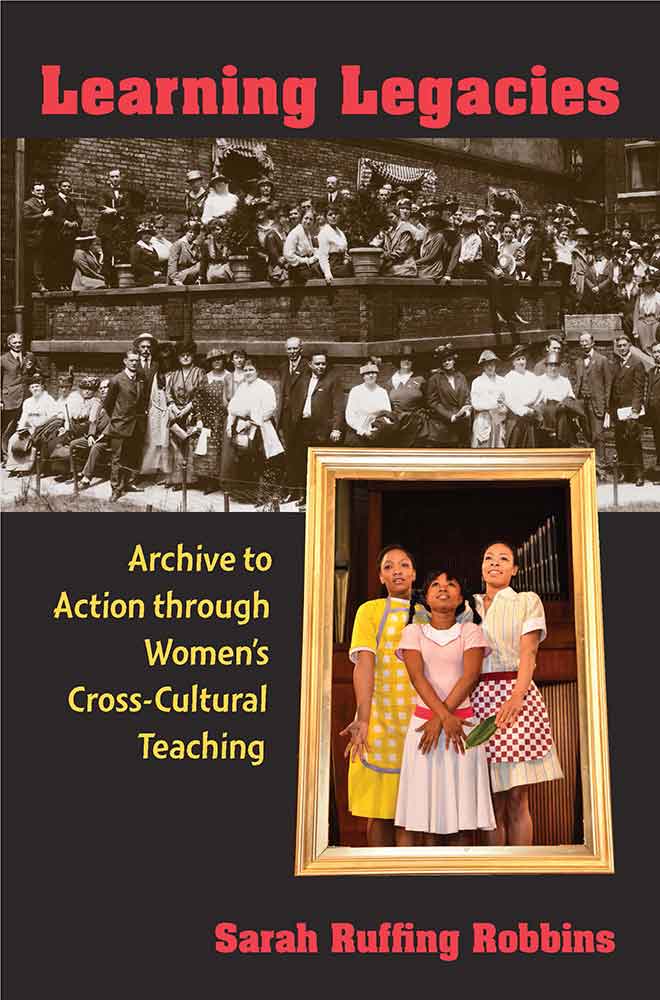
Robbins, Sarah Ruffing. Learning Legacies: Archive to Action through Women’s Cross-Cultural Exchange. U of Michigan P, 2017. 372 pages.

Cover of Robbins's book. The background is black with the title in red and subtitle in yellow bold typeface. The top half features an on old photograph of women and men who are wearing dresses, hats, and suits and standing along a brick wall. The bottom half features a more recent-looking photograph of three African American young women wearing dresses and aprons and posing together.
Image from University of Michigan Press website.

Part of my work as a writing program administrator at my institution over the past year has been to lead a committee in which our goal is to reinvent our first-year writing course so that it better and more capaciously engages issues of diversity and inclusion and prompts students towards community engagement and social justice. It’s an exciting, and, I’ll admit, intimidating task, as I will spend the next few terms working with instructors in my program thinking about how our students can and should explore perspectives other than their own, interrogate their standpoints, and consider how they might become active participants in their worlds. As I toggle between composing this review and thinking through the work ahead of me, I realize how fortuitous it is that I have had the opportunity to read Sarah Ruffing Robbins’s excellent book Learning Legacies: Archive to Action though Women’s Cross-Cultural Exchange. Her book is just the text I need, and that I’d wager many Peitho readers need, as we redouble our scholarly, administrative, and pedagogical efforts to make diversity and inclusion central to our work and to embolden our dedication to social justice.


The main project of Learning Legacies is to consider how pedagogical pasts have, can, and should inflect our pedagogical present and future. Robbins’s main chapters examine three turn-of-the-twentieth century educational sites: the HBCU Spelman College in Atlanta, Georgia; Jane Addams’s Hull-House settlement in Chicago, Illinois; and the Carlisle Indian School in Carlisle, Pennsylvania. Throughout her chapters, Robbins investigates the pedagogical activism that took place at these sites, exploring the cross-cultural teaching and learning that happened between (often) white women educators and African American, immigrant, and Native students. Critical to note, and as I discuss below, Robbins frames the case studies of Spelman and Hull-House as positive examples of intercultural teaching and learning, and Carlisle as a negative example of an assimilationist educational program that Native teachers like Zitkala-Ša resisted. Robbins does not, however, isolate and study these moments only within their historical context. Rather, Robbins’s goal is to trace how these moments have become “legacies” for those who followed, tracking interlocutors’ engagements with these teaching moments and the “meaningful intercultural work” they created in response (5). That is, her goal is to investigate how legacies are not just made but also how they are received, considering the ways the “self-conscious heirs” to these historical narratives have taken up these stories of teaching and learning, reanimating them for their own purposes (5).


Important for Peitho readers, Learning Legacies is decidedly feminist in its orientation. To be sure, Robbins’s historiographic focus is on sites where women teachers engaged in cross-cultural teaching and learning with their marginalized students. More specifically, Robbins highlights Sophia Packard and Harriet Giles from Spelman, Jane Addams at Hull-House, and, as noted, Zitkala-Ša at Carlisle. But Robbins’s feminist project goes much deeper than her treatment of these women as historical subjects. Critically, and what I found be to most compellingly, Robbins adopts a feminist research method of narrative inquiry and performs a feminist rhetoric of collaboration in her writing. Readers discern her research method of narrative inquiry through Robbins’s work to identify, craft, and reflect on the layered storytelling that stands at the center of the book’s work. As she notes, each case study has three narrative layers: “a historical narrative about a specific learning legacy”; “a story about how those cultural resources are being used in social action today”; and a “personal narrative about [her] own learning process” (6). Thus, Robbins’s investigation hinges on the stories that have been told at and about Spelman, Hull-House, and Carlisle, as well as the story of her own research and writing—stories marked by Robbins’s critical reflection on her role as the storyteller.


By telling these stories in this way, Robbins carries out the imperatives of feminist standpoint theory, articulated by figures such as Adrienne Rich and Jacqueline Jones Royster, in which the scholar does not pretend that their research is objective or conducted by an all-knowing, omniscient observer, but instead the scholar makes clear how the research is produced by a human agent whose identificatory categories inflect what they see (and do not see), what they find important, and what they interpret and how. Robbins marks her interpretive position as a white woman educator throughout all of her chapters, by stepping back and articulating how her standpoint shapes her analyses and argument. As Robbins makes her presence and practice known throughout Learning Legacies, she also and importantly includes aspects of her research that often go unarticulated in scholarly writing: conversations with archivists and museum curators as well as scholars and teachers within and outside rhetorical studies.


This latter point leads to yet another major benefit of Robbins’s method of narrative inquiry: her explicit discussions of the deep and necessary collaborations that sit at the heart of cross-cultural research and pedagogy. Robbins’s writing demonstrates what she calls the “epistemic value of collaboration,” as she describes in great detail how her large- and small-scale interactions have enabled and guided her work as a scholar and as a teacher (231). Robbins’s overt explication of her collaborative work with archivists and museum curators, as well as scholars, teachers, and students, also indicates the pivotal role that deep listening, self-reflexivity, empathy, and humility play when researchers both investigate intercultural learning legacies and respond to them by creating teaching practices of their own.


The main chapters of Robbins’s book dive into the specific case studies and the learning legacies they inspired. After a thorough and thoughtful introduction to the project of the book in chapter one, chapter two, “‘That my work may speak well for Spelman’: Messengers Recording History and Performing Uplift,” engages Spelman College as a revolutionary example of an HBCU dedicated to black women’s education. Here, Robbins tells the story of how her collaborations with Spelman archivists Deborah Mitchell and Taronda Spencer enabled her to examine the efforts of Packard, Giles, and their Spelman students to enact a “cross-racial, cross-gender, and cross-region partnership” that cultivated the school’s growth “despite structural forces aligned against them” (44). Robbins uncovers these partnerships through her close reading of Spelman’s newspaper the Messenger, exploring how this text did the work of addressing external audiences (50), identifying Spelman’s own celebrities (55), and enabling communal agency (61). To conclude the chapter, Robbins traces how these early efforts created a legacy for those who followed, including Robbins herself. For example, Robbins examines Founders’ Day celebrations in the 2010s in which Spelman teachers and students commemorated the transformative work of the college’s early years with the goal of directing and inspiring their contemporary work. Robbins also moves on to “illustrat[e] in the concrete terms of syllabus construction” how she has brought the Spelman archival documents and the Messenger into her classroom at Texas Christian University (75). Robbins prompts her students to conduct intersectional feminist analysis by asking them to read and juxtapose contemporaneous writings by collegiate women. Students thus analyze and compare the narratives found in the Messenger with a collection of poems by a TCU teacher—Ida Jarvis’s Texas Poems (1895) (75). Robbins explains that through this pedagogy she “think[s] critically about how [she] can teach those texts comparatively, including highlighting white privilege inherent in the TCU-based woman writer of the same era as the Messenger authors” (75).


In chapter three, “Collaborative Writing as Jane Addams’s Hull-House Legacy,” Robbins turns attention to Jane Addams’s settlement that created collaborative opportunities between middle-class white and working-class immigrant women living in Chicago. Robbins studies the stories Addams told about Hull-House work through examining understudied texts such as My Friend, Julia Lathrop (1935). These overlooked texts reveal how middle-class leaders of the settlement house “supported the growth and agency of working-class women” (106) and how both groups of women took part in “collaborative knowledge-making” (89). Acknowledging critiques of Addams and her Hull-House endeavors, Robbins does not pretend the settlement project was perfect, but instead explores how those who followed Addams have engaged, remembered, and built on the work of the Hull-House. Robbins turns attention to the present-day efforts of the Jane Addams Hull-House Museum, under the direction of Lisa Lee, Lisa Junkin Lopez, and Heather Radke, and the collection Jane Addams in the Classroom, with David Schaafsma and Todd Stigter serving as editors. Here, Robbins explicates in rich detail how both the museum and the teachers cited in the collection have built inventive practices from Addams’s investment in “collaboration, shared learning, community-building, [and] intercultural work” (132). Of particular note is Lee’s “Rethinking Soup” program at the Jane Addams Hull-House Museum. This program invites the public not just to remember how Addams “welcomed…diverse visitors” to dine, discuss, and debate contemporary concerns at Hull-House but also to participate in similar kinds of conversation and connection in the contemporary museum space (123).


Chapters four and five examine the learning legacies generated from the assimilationist teaching at the Carlisle Indian School in particular and off-reservation boarding schools for Native students more generally. Chapter 4 “Reclaiming Voices from Indian Boarding School Narratives” examines how Carlisle promoted its assimilationist program through its own publications, Indian Helper and Red Man, as well as through publishing essays like “Indian Education” (1884) in Frank Leslie’s Illustrated Magazine and novels such as Stiya: A Carlisle Indian Girl at Home, Founded on the Author’s Actual Observations (1891). Robbins then explores how teachers and writers responded to this debilitating propaganda for Native students through composing counternarratives that protested boarding school culture. Robbins examines criticisms contemporary to Carlisle’s time such as Native teacher Zitkala-Ša’s autobiographical essays published in the Atlantic Monthly in 1900 as well as more contemporary responses to Carlisle’s educational program such as Esther G. Belin’s From the Belly of My Beauty (1999), Laura Tohe’s No Parole Today (1999), and N. Scott Momaday’s play “The Indolent Boys” (2007).


Chapter five “Learning from Natives’ Cross-Cultural Teaching” considers responses to Carlisle’s educational program that move beyond critique to examine “positive counter-narrative[s] of intercultural learning” and identify “cross-cultural alliance builders” (183). Robbins focuses attention on sites like the National Museum of the American Indian (NMAI) and the activist work of such figures as K. Tsianina Lomawaima and Teresa L. McCarty (To Remain an Indian, 1995), Diane Wilson (Beloved Child: A Dakota Way of Life, 2011), Amanda J. Cobb (Listening to Our Grandmother’s Stories, 2000), Ruth Maskrat Bronson (Indians Are People Too, 1944),as well as Lisa King, Rose Gubele, and Joyce Rain Anderson (Survivance, Sovereignty, and Story: Teaching American Indian Rhetorics, 2015). To conclude the chapter, Robbins circles back to her own pedagogical responsibility to “draw on studies of that painful history” of Native schooling and “build alliances with accomplished Native educators today” as a way “to improve [her] own cross-cultural work” (191). Robbins here underscores the value of listening to Native teachers and taking in their expert teaching practices. Specifically citing the excellent work and insights of figures like King, Namorah Byrd, Kimberli Lee, and Malea Powell, Robbins highlights the pedagogical goals of scholar-teachers like Powell who teach with the aim of “carrying tradition” (224). As Powell notes in an interview with Robbins, Powell’s goal is to “pass culture on” through teaching Native rhetorics and other “practices of making” so that these practices are “useful for the future generations” (223).


I cannot close this review without highlighting two final critical aspects of Learning Legacies. First, as should be clear from this review, Robbins’s investment in collaboration and listening is made real through her citation practices and her deep engagement in the work of others. Throughout the book, Robbins shines light on and explores an amazing array of scholars and scholarship, modeling for all of us what it means to build on the work others in positive and productive ways. Second, throughout all of her chapters, Robbins identifies the key role the archive plays in creating possibilities for cross-cultural teaching and learning. As this review should indicate, Robbins consults not only primary texts like the Messenger; My Friend, Julia Lathrop; and Indian Helper but she also showcases and analyzes those “texts”—from performances and museum exhibits to edited collections and novels—that have responded to these original materials by articulating and enacting new forms of activism. Key features of this book, then,are both the robust archive Robbins builds as she studies and tracks legacies of learning as well as her demonstration of the critical part archives play in catalyzing pedagogical endeavors aimed at social change. The subtitle of her book promises, and Robbins demonstrates this critical connection through each chapter, that we can move from archive to action.


Thus, as I take on my administrative work and endeavor to deepen pedagogical connections at my institution among writing, diversity, community engagement, and social change, I am invigorated by Robbins’s excellent book, Learning Legacies. She makes clear how examples from the past have inspired pedagogical practices aimed at social justice for those who followed. Indeed, what is likely the most important aspect of Robbins’s book is her implicit invitation for readers like me to become part of the intercultural learning legacies she showcases in her book. I’ll do my best to accept this invitation, and I hope other Peitho readers do as well. We should all craft our own unique responses to these pedagogical examples, participating in and perpetuating the learning legacies Robbins cites.


return to top

Review of Shaver’s Reforming Women: The Rhetorical Tactics of the American Female Moral Reform Society, 1834-1854

Shaver, Lisa. Reforming Women: The Rhetorical Tactics of the American Female Moral Reform Society, 1834-1854. U of Pittsburgh P, 2018. 184 pages.

Cover of Shaver's book. The top half features artwork of 1800s women waiting in line outside a wine and liquor store. The bottom half has the title written in decorate white and yellow typeface on a green background.
Image from University of Pittsburgh Press website.

Since the publication of Carol Mattingly’s Well Tempered Women, feminist rhetoricians have begun to appreciate the discourse of women who engaged in reform that might not seem appealing through a 21st century lens. Though female temperance advocates might, at first glance, seem to be finger-wagging intolerants worthy of mockery, Mattingly convincingly illustrates how these women used their credibility to address the abuses of alcohol that were wreaking havoc on the lives of women and children. So, too, does Lisa Shaver bring into focus another such group, the American Female Moral Reform Society (AFMRS), a group that condemned forms of sexuality that harmed women. Though these women, too, could be perceived as self-righteous moralists, Shaver convincingly brings to light the important rhetorical work done by the organization and its leaders who took on the task of ending both prostitution and the double standards that punished women, but not men, for their sexuality.


Shaver’s focus answers Lindal Buchanan’s call for further recognition of specifically feminine methods of delivery by outlining ways in which leaders of AFMRS used and taught their members to use a variety of resources and strategies—including gender, the periodical, anger, presence, auxiliary societies, and institutional rhetoric—to achieve their ends. Noting, as does Wendy Sharer, that much scholarship on women’s organizations has privileged the individual speaker without exploring how collectives functioned, Shaver makes clear that the strong women who led AFMRS had a huge impact on white, middle-class American women. With over 50,000 members (including Lucretia Mott, Lucy Stone, and Antoinette Brown Blackwell) and with its publication being one of the most widely distributed reform periodicals, AFMRS most likely influenced the rhetoric of many other nineteenth-century reformers.


Shaver demonstrates that, unlike previous organizations that had addressed licentiousness, AFMRS was more than a benevolent society that tried to fix the harms done by society: AFMRS worked to address systemic problems. In so doing, AFMRS confronted enormous resistance, and, ultimately, their rhetoric did not achieve the members’ goals. Shaver makes this lack of success clear from her introduction’s epigraph—citing the sixth resolution of the Seneca Falls’ Declaration of Sentiments that observes the double standard for men’s and women’s “transgressions” of “virtue, delicacy, and refinement of behavior”—to the book’s conclusion, which repeats the resolution. With Shaver’s emphasis on this persistent contradiction, Shaver makes two important points:

  1. rhetoric that may not have been “successful” in achieving its purpose has nonetheless been influential and is worthy study, and
  2. women of the 21st century could learn much from the rhetorical approaches of AFMRS.

A running theme within Shaver’s analysis is her exploration of what she terms “gendering”: “women’s strategic use of societal gender distinctions assigned to them to garner ethos and power” (14). From AFMRS’s inception, its members used gendering to directly address the taboo subjects of sexuality and prostitution. AFMRS called out men who patronized brothels even as they ventured into the brothels, tracked men from brothels to their homes or places of business, rebuked those civic and religious leaders who refused to condemn these men, and even lambasted women who continued to support them. When censured for venturing into territory improper for women, members of AFMRS claimed their moral superiority: if no one else was going to address the problem, they had to in order to preserve women’s virtue. Claiming they took on the task of reform reluctantly and using the appropriately feminine medium of the periodical, members argued that it was their womanly Christian duty to protect society and women from widespread licentiousness. Additionally, Shaver discusses how AFMRS used “righteous anger” as a rhetorical tactic. While discussion of licentiousness in order to rid the world of it might be considered appropriately feminine, anger was usually denied women. However, with licentiousness run rampant, AFMRS argued that women had the exigence to get angry.


Another tactic Shaver discusses is “presence,” by which she means the strategy of inhabiting unlikely places and thus drawing societal attention to these places. Focusing within the third chapter on AFMRS first female missionary, Margaret Prior, Shaver illustrates how Prior’s background within the Methodist church gave her a situated ethos that enabled her to participate in the typically feminine practice of “visiting” homes. Though this chapter spotlights an individual, Shaver’s purpose is to use existent texts to extrapolate common practices within AFMRS. She argues that AFMRS members’ presence in places where “good” women would not normally venture enabled these women to hear and see the realities of licentiousness’s evils and report on them; specifically, Prior wrote regularly on these evils via AFMRS’s various publications. In other words, women’s situated ethos allowed AFMRS to extend its credibility by giving its members the means to report firsthand on these evils.


Shaver also discusses AFMRS’s use of auxiliary societies. These organizations, which were typically developed to support men’s organizations, served various rhetorical purposes for AFMRS. In the first place, these auxiliaries provided AFMRS with additional means of advocacy and financial assistance. Perhaps more importantly, they provided the auxiliary members a kind rhetorical education. With leaders in the national organization acting as mentors, auxiliary members were taught how to campaign door-to-door, petition, engage in correspondence regarding organization business, compose constitutions, present essays on the topic, and lead discussions about morality.


Within her analysis of this rhetorical education, as well as of Prior’s and other AFMRS member’s rhetoric, Shaver notes how AFMRS continually used pathos in combination with ethos to move audiences. The more heart-rending the tale of victims of prostitution, the more likely it would move a reader and give AFMRS legitimacy for venturing into otherwise inappropriate territory. In its efforts to educate audiences about the many snares awaiting innocent women, AFMRS preferred telling of long-suffering women and children instead of happy resolutions that resulted from AFMRS’s efforts: the tales of suffering garnered more support than did those of success.


Though these rhetorical tactics granted women ethical means to discuss debauchery, Shaver makes clear AFMRS was not terribly successful in achieving its ends. Particularly troubling to AFMRS was the use of the word “morality” and the word’s implied self-righteousness. As Shaver lays out, the organization changed both its name and approaches in the latter part of its existence. Morphing into the American Female Guardian Society, the organization focused less on moral reform than on providing direct aid to victims of prostitution. Establishing the Home for the Friendless, this new organization continued many of its previous tactics but abandoned righteous anger and confrontation as it gained support from people who had shied away before. The new logic of the organization was that the Home could prevent moral corruption of innocent women and children. As institutional managers of the Home, the organization continued to tell pathetic tales of hardship as it also attempted to save the innocent—but it no longer confronted members of society about their hypocrisies. However, the organization did not entirely abandon an activist role, as it argued for more employment opportunities for women and for the protection of street children.


Within her discussions of the problems with AFMRS’s views of morality, one area that Shaver might have explored further is how the rhetorical tactics utilized by AFMRS were not only gendered but clearly reflected middle-class, Christian, white perspectives. While Shaver does acknowledge that she is examining the “rhetorical means available to white, middle-class women” (7), she does not sufficiently consider how their discourse impacted non-white, non-Christian women. For example, in discussing the institutionalized rhetoric of AFMRS after it morphed into the American Female Guardian Society, Shaver observes that an African American woman sought the advice of the organization when she was forced to give up her children. According to Shaver, the woman was advised that she could turn to the Colored Orphan Asylum, but Shaver does not explore what it meant for a black woman to give up her children when slave kidnappers where a constant threat to antebellum people of color in the Northern states. Similarly, in discussing how the Home for the Friendless enhanced its ethos by assisting women “worthy of assistance,” Shaver does note the fraught nature of determining such a characteristic; however, she could further explore how this judgment impacted non-white, non-Christian women. For instance, did AFMRS consider the many nineteenth-century Asian women who lived in New York as “worthy of assistance,” or did the societal hyper-sexualization of these women limit the aid they could receive from AFMRS because of their perceived unworthiness? Another element that would be worth exploring is the rhetoric AFMRS members utilized in their discussions of “worthiness.”


AFMRS’s move to utilize institutional rhetoric also raises the question of whether the organization continued to be one that required tactics rather than strategies. Throughout the text, Shaver relies on deCerteau’s distinctions between tactics and strategies, observing how the women within AFMRS were without power and therefore needed to find means to adapt the structures created by those with more power. In other words, they relied on tactics rather than strategies. However, with AFMRS’s move to institutional rhetoric and its practice of defining whom was “worthy of assistance,” the organization appears to have become a part of hegemonic power structures and its rhetoric less “timely, opportunistic, and agile” (7). Shaver’s use of deCerteau’s definitions, therefore, would be more compelling with an exploration of how an organization’s status moves its tactics to more hegemonic and less agile strategies.


Shaver’s discussion of an ethos of presence is one of the most unique contributions of this book, and it fits well with recent theories regarding feminist ecological rhetoric. According to Shaver, AFMRS missionary Margaret Prior best exemplifies this ethos of presence as Prior utilized and built on her credibility by going to physical locations where other white, middle-class women were loath to go. Prior’s goal of bringing Christian assistance to these locations legitimized both her visits to these places and her explicit descriptions of what she observed there. While Shaver’s analysis of Prior’s ethos is important, that analysis at times seems to grant Prior too much credibility. For example, in noting Prior’s attempts to build her ethos and garner emotional support for the women she served, Shaver quotes from Prior’s memoir where Prior describes her attempts to convert a man to Christianity. After Prior tries and seems to fail with the conversion, she notes that “on opening the door, the conviction was so strong that the Lord would have me pray with him,” and when she returned a few days later, the man had totally changed and repented (81). Certainly, this example illustrates how an ethos of presence legitimized such narratives: Prior was in the location with the man so people should believe what she said. However, Shaver’s discussion of Prior’s successes seems to grant too much credibility to Prior’s “conversion,” when Shaver could instead acknowledge how the narrative, with its ethical and pathetic elements, was constructed strategically to persuade Prior’s contemporaries.


Despite these concerns, Shaver’s text is a welcome addition to the growing literature on previously unconsidered groups of women who used “available means” of persuasion to advance their goals. Shaver’s book is especially compelling at this kairotic moment, as women again need to use all available means to address the systemic incongruities that limit women and their bodies even as men are granted license to women’s bodies. Though the rhetoric of AFMRS may not have succeeded, rhetoricians of the modern day can learn from Shaver’s analysis as they consider how to modify AFMRS’s rhetoric and continue the work of our brave foremothers.

Works Cited

Buchanan, Lindal. Regendering Delivery: The Fifth Canon and Antebellum Women Rhetors. Southern Illinois UP, 2005.

Mattingly, Carol. Well-Tempered Women: Nineteenth-Century Temperance Rhetoric. Southern Illinois UP, 1998.

Sharer, Wendy B. Vote and Voice: Women’s Organizations and Political Literacy, 1915-1930. Southern Illinois UP, 2004.


return to top

Hard Labor

Pregnancy and childbirth have been shrouded by both men and women in mystery and fear. We have been forced into thinking that most physical discomfort and pain resulting from pregnancy is our “lot.” So we submit to the experience and don’t feel altogether legitimate in expressing questions, hesitations or fears. Or perhaps we never learned how.

(Women and their Bodies 110)

Because I am usually even-tempered and cheerful, I react to most of life’s tribulations, major as well as minor, with a short memory and a long fuse. But the circumstances of our second son’s birth, over a half century ago, remain as sharp and painful as walking over broken glass. Savage neon erupts whenever I recall the conditions under which Laird was born, in one of the best university hospitals in the country. Although I was a healthy mother, in labor and delivery I had no voice, no agency, no comfort, no reachable allies, and no recourse. If I could have known in 1964 what OBOS would have told me in 1976 (the edition, now tattered, that I have carried through numerous moves and from which I quote throughout) the events of Laird’s birth could have been a cause for celebration instead of the anger that to this day remains incendiary. OBOS could have given me the agency that I craved during my pregnancy as well as during labor and delivery, agency that I had tried to promote for other women by co-authoring The New Assertive Woman (1975)—a self-help manual on “How to know what you feel, say what you mean, and get what you want.”


At 29, I had been in robust health throughout a completely normal pregnancy, as I had been during my pregnancy with Bard, our first child, born two years earlier. Both were much wanted babies. My husband, Martin, and I figured that our lives could stretch to accommodate two youngsters. So I continued writing the biography of one of the 20th century America’s most significant people, Benjamin Spock, MD.1 His powerful, iconoclastic opening words of Baby and Child Care, “Trust yourself. You know more than you think you do,” resonated with millions of mid-century Americans and could indeed have been the mantra for nearly every page of OBOS: “Most important, by preparing ourselves for childbirth we will be giving ourselves more control over our experience. We will be able to make educated choices about the way we want to deliver our babies” (266).


Yet despite my assertive credentials and feminist orientation—I did trust myself  to have common sense as a citizen, wife, and mother—during labor and delivery I ceded that authority to my male obstetrician and the medical staff of Case Western Reserve University Hospital, in whom I had placed total trust. As I now realize from rereading OBOS in preparation for this essay, that trust was betrayed. If there were feminist alternatives available through midwives or birthing centers, neither I nor any of my friends (we were all having babies) knew about them, and we never thought to ask.


In my innocence, I collaborated in the betrayal of my own wishes by agreeing to induced labor. On a hot afternoon in mid-June, ordinarily in robust health, I nearly fainted as I climbed the hot stairs to the doctor’s office for my nine-month checkup. “You’re ready to deliver that baby,” said the doctor. “Why don’t you come in for an induction next Thursday? If we start the labor by 10, the baby will be born by 2, I guarantee it.” The obstetrician didn’t explain what an induction was beyond getting labor started, and I didn’t ask. In every other aspect of life I ask questions incessantly, and frequently question authority. Indeed, I had changed pediatricians after my first visit with my first child when the doctor kept calling me “Mommy” to one who addressed me as “Dr. Bloom.” But here my only thought was, “That will be so convenient. We can leave Bard with a neighbor and Martin can arrange to take a day off work.”


I had been studying every available manual on child-rearing in connection with my research on Dr. Spock, and was adept at sorting out the best information to use in mothering Bard. I had spent hours choosing perfect baby names, boy and girl. But it never occurred to me to read up on pregnancy, so I was clueless about induction. If OBOS had existed, as a combination of feminist manifesto, guardian angel, and wise midwife, I’d have looked up “Induction of labor” and discovered that induction meant “a pre-planned delivery in which labor is artificially started,” at the outset by artificially rupturing the membranes, then abetted by a jolt of Pitocin. I’d have also learned that “induced contractions… frequently do not follow the normal wave-like course but reach intensity instantly and remain intense for a long period,” often “much more painful than normal.” That information would have given me pause.  If a more gradual labor was natural, why speed it up if that meant being inflicted with more pain “than normal”? Even more important, given the possible risks involved with induction, “uterine rupture, hypertension, possible water intoxication, prolapse of the umbilical cord, and fetal distress”—all “potentially fatal complications” (284-5)—why endanger my life or the perfectly healthy baby I was anticipating? Having become aware of the risks, I’d have checked OBOS against other sources of information2 and decided against induction.


That my baby would be born in unnatural haste to accommodate the obstetrician’s mass production schedule rather than the timing of my own body was not apparent until we reached the hospital and learned that he was delivering nineteen other mothers concurrently. From the get-go, the entire labor and delivery became an adversarial processes, with the professionals (doctor, nurses, other aides) ganging up in opposition to the amateur (myself). Until I re-read OBOS in preparation for this essay, I had thought myself unique, but I was not. I believed that all the other women in labor were treated with compassion and consideration but that because the nurses and other staff were so busy taking care of other patients they had little time for me.


My usual assertiveness was overwhelmed by the effort of labor and I even believed that somehow I must have offended the medical staff by requiring attention at all. My husband—advocate, ally, and best friend—had been exiled with the promise, “When the [local] anesthetic takes, you can come back in to keep her company.” No palliative worked, and Martin was never allowed to see me until after the baby was born. So I had no support whatsoever. I was left alone for long periods of time in what seemed like total isolation, on a narrow bed in a narrow cell about the size of an MRI machine, devoid of art, music, beauty, or a view. I needed a coach for the breathing-and-pushing exercises I had practiced in a pre-delivery class, but no one was there. No one was there to hold my hand, offer a warm compress, or kindness of any sort. No one was there to talk to, or to laugh with, or to provide diversion if not respite from the pain. However, when I groaned softly, once, while I was pushing, a nurse appeared and snapped “Be quiet!” I wanted to say, “It’s my baby and I’ll have it my way,” but I was working too hard to speak. At intervals, pain relievers were administered—caudal, epidural, spinal, to no avail. “You could have had your baby this way in the jungle,” said the doctor when the baby came, in a rush. By the time Martin was allowed to see me I felt as if I were in shock, freezing cold, teeth chattering, trembling as I held the perfect baby who was whisked away too fast, too soon.


The authors of OBOS captured this Everywoman’s scenario as precisely as if they’d been hovering by my bedside. After asserting the fundamental truth, that “rather than being ordinary, [giving birth] is a profound experience, worthy of respect. That the process of labor and delivery is universal to all mothers, everywhere and at all times, dignifies our experience even further.” However, they acknowledge, although we expect “personal support,” answers to questions, and reassurance from “doctors, nurses, and clinic staff we are likely to be disappointed,” our insignificance signaled by long waits and superficial answers to profound questions. “We may even be made to feel that we are downright annoying to the doctor. Inside ourselves we may feel angry and yet powerless to do anything about what we know to be an affront to our dignity.” Although we would like to consider “the doctor as an ally who respects our entire birth process” this is “rarely possible” because “most doctors have been taught throughout their entire medical education to see patients as a class rather than as individual people with special needs. They have learned to treat us paternally; they have been taught that we want them to take care of us, and we as patients often play into that dependent role. The strength and anger that we may feel have no opportunity for expression in the usual doctor patient relationship. We, as pregnant women, are expected to put ourselves in the doctor’s hands, and he or she expects to take control of our birth experience” (267-8). Had I known in the 1960s what OBOS so clearly understood in the 1970s, that I was regarded paternally, as a member of a subaltern class (also true of women in American grad schools of the time), rather than as a unique mother anticipating a peak experience, I would have tried to assert what little individuality I could by insisting that Laird be born on his own sweet time, not the doctor’s. It’s hard to know whether this in itself would have nudged the labor and delivery process closer to the OBOS ideal.


Fast forward to 1985. After collapsing from months of menstrual hemorrhaging, I am spending a post-op night in the Williamsburg, Virginia, hospital’s OB-GYN wing. My capacious room has matching calico curtains and quilt, a rocking chair, a rag rug on the floor and rubber-ducky soap in the private bath. Through midnight grogginess I realize that a party is going on in the next room, presumably just like mine. I hear voices high and low, men’s and women’s. Although it sounds like a pre-game tailgater, through bursts of laughter I hear cries of “Push! Push!” and realize I am eavesdropping on a woman in labor. Silence. Then singing. “Push! Push!” Lulled in and out of sleep by the rhythm that never stops, I’m brought wide awake when a cheer erupts. Touchdown! OBOS has indeed changed the obstetrical world, one labor and delivery, at a time.

Endnotes

  1. Later published as Doctor Spock: Biography of a Conservative Radical.
  2. Nowadays this would be easy to do by consulting such clear, user-friendly websites as the Mayo Clinic’s advice on “Inducing labor: When to wait, when to induce,” which begins, “Nature controls most aspects of labor—but sometimes nature needs a nudge,” and focuses on factors exclusively affecting the health of the mother or baby (uterine infection, baby not growing as expected…) and none at all on expediency. In the early 1960s, if such information existed, we didn’t know where to find it.

Works Cited

Bloom, Lynn Z. Doctor Spock: Biography of a Conservative Radical. Indianapolis: Bobbs Merrill, 1972. 

Bloom, Lynn Z., Karen Coburn and Joan Pearlman. The New Assertive Woman. New York: Delacorte/Dell, 1975. 

Boston Women’s Health Book Collective. Our Bodies, Ourselves. New York: Simon and Schuster, 1976. 

Spock, Benjamin. The Pocket Book of Baby and Child Care. 2nd ed. New York: Pocket Books, 1957.

return to top

Clinical Relationships and Feminist Values: How OBOS Benefits Collaborative Relationships in Women’s Health

[D]octors insulate themselves from the rest of society by making the education process (indoctrination) so long, tedious, and grueling that the public has come to believe that one must be superhuman to survive it. (Actually, it is like one long fraternity “rush” after which you’ve made it and can do what you like. Only members of the club get to learn the secret, which is that doctors don’t know much to begin with and are bluffing a good deal of time.) Thus, a small medical elite preserves its own position through mystification, buttressed by symbolic dress, language, and education.

(Candib, 1970)

At a workshop on “Women and Their Bodies,” we discovered that every one of us had a “doctor story,” that we had all experienced feelings of frustration and anger toward the medical maze in general, and toward those doctors who were condescending, paternalistic, judgmental, and uninformative in particular. As we talked and shared our experiences, we realized just how much we had to learn about our bodies, that simply finding a “good doctor” was not the solution to whatever problems we might have.

(OBOS Founders, Judy Norsigian)

Introduction

In order to understand both the creation of Our Bodies, Ourselves (OBOS) and its impact on contemporary women’s health issues, this project develops two research threads, both focused on understanding collaboration and agency within clinical relationships. Beginning with the women writing OBOS, who took their personal stories and built them into recipes for action, we wanted to understand how OBOS was empowering to both the founders creating it and the women reading it for decades to come.


In writing OBOS, the women of the Boston Women’s Health Book Collective (BWHBC) created a living document, which transformed collaboration and agency within women’s health: medicine for women and by women. In this article, we take up the question: to what extent are these values of collaboration and agency enacted today in women’s health clinical practices? To answer that question, we integrate two research threads. In the first, we begin with an investigation into the archives of the BWHBC: the files of the women who ultimately created OBOS. We articulate how they created a new way of engaging health information for women. But in addition, the members of BWHBC utilized a methodology for engaging interdisciplinary work, allowing for both collaborative and individual goals to be expressed. In the second thread of our research, we interviewed women and clinicians on their working collaborations around birth. We conclude that the work started by OBOS, although not finalized, continues in modern birth practices and relationships.


Because OBOS was premised on a desire to empower women in clinical encounters and asked for women to encourage other women to work together/collaborate, we focus on the themes of both collaboration and agency. The women of BWHBC decided to work together towards shared goals. Interestingly, women when using contemporary OB/GYN services also speak of working with their clinical partners, articulating the goals of a “successful” birth experience. This work echoes the models of shared, collaborative expertise, which is part of the OBOS framework. In this way, OBOS opened up new spaces for women to participate in their overall health experiences, and in birth experiences specifically. We draw heavily upon the rhetorical concepts of critical imagination and social circulation, drawing new connections between the work of developing OBOS, and the resonance in contemporary doctor-patient relationships created for successful birth experiences (Royster, 2012). The power of OBOS resonating today is more than language or a mindset, “[m]embers developed ways of speaking their own embodied experience and of bracketing that experience as partial and local” (Wells 2008: 698). Wells helps us to see that OBOS is more than a medical teaching text—through the text, OBOS articulates new possible agency, both for clinicians seeking to center women in their care, and for women as active agents in their own health decisions. OBOS created such space by “creating vocabulary in which women could talk about their bodies, forging discursive styles and modes of argument, and inventing narrative forms that, but by building authority and solidarity, could establish health work as a field of practice for the women’s movement” (Wells, 2008, p. 698). We show how these textual foundations have received uptake in modern clinical practices.

The Writing of OBOS and Its Legacy

The women of the BWHBC came together to address problems in clinical medicine, long before they wrote—even planned to write—OBOS. The women of BWHBC were riding the waves of important changes from the 1960’s: the women’s movement, health technologies like the pill and IUD, which separated sex from reproduction. But today, it’s often difficult to put ourselves in those moments. It’s important to remember that BWHBC were meeting before the legalization of abortion, and decades before the internet brought health information to the tips of our fingers. In fact, access to health information—including women’s health, specifically—has come to be so easily accessible, OBOS will no longer be updated.


In this same period of writing, medicine itself was coming under greater scrutiny and critique. Academics were crystalizing the language to articulate what many women were experiencing within interactions with healthcare providers. “Medicalization” is often the theoretical lens describing how non-medical problems become taken up as medical problems, or problems that only clinicians can speak clearly about (Conrad). Feminist scholars have since argued that medicalization impacts women, people of color, and queer folks more frequently and with greater damage (Brubaker; Conrad and Angell; DeCoster; Garry; Halfmann; Riessman). Here, the creation of OBOS was a response to these medicalized systems.


Yet OBOS as a creative response did not aim to reject medicine, given that women needed the real benefits of healthcare systems. Instead, OBOS became a novel how-to manual for women as patients, but a new kind of patient: one who took a kind of control and agency over her own health, rather than leaving it to experts. Through the text, women were informed about their own bodies, a revolutionary tool. OBOS did not aim for women to become medical experts, independent of physicians. Instead, OBOS was to be a tool to improve the interactions between both women (as patients) and clinicians. Meant to be read by both ‘sides’ of the clinical relationship, OBOS reflected on the specific health needs, challenges, and responses needed to care for women, working to create “women’s health” as a new domain of study. OBOS drew from clinical research, making it accessible to women, allowing women to be active participants in their own health matters. But it also drew from non-biological determinants of health, clarifying for both women and physicians how social dimensions of health and the social situatedness of clinical responses were necessary in understanding overall health. While putting medical information into women’s hands was itself a political move, OBOS also wove the political into discussions of women’s health, rather than seeing these as separable aspects.


From today’s perspective, it is often a challenge to remind ourselves of what women’s health resources looked like prior to OBOS, and to articulate how this text shaped current clinical interactions. Resistance requires a kind of imagination, and OBOS was the product of the thoughtful and imaginative response of the BWHBC. These authors articulated new possibilities, new solutions, and new interactions for women with their physicians, and these goals are seen in today’s contemporary doctor-patient relationships as we navigate medical systems. Additionally, these women articulated ways of knowing themselves and their bodies that provided space for women’s agency to be an “equal knower” in a clinical space. In this project, we argue that the creative work of the women of the BWHBC has, in many ways, been given uptake, although it has not provided final solutions for women, especially those navigating their first birth experiences. Instead, OBOS has provided a model for an ongoing re-examining of the doctor-patient relationship, one that benefits women to allow for uptake in everyday life. “This is why uptake matters; uptake is relevant to the study and teaching of genre performance maintenance, and change and uptake compels us to pay attention to the historical-material conditions that shape genre performances” (Bawarshi 2012).


Reflected in the legacy of OBOS is the creation of both women as lay-individuals thinking about medicine and collaborative relationships as patients. These new engagements with medicine are connected and re-inscribed activities, what Emmons describes as “uptake.” For Emmons, uptake is the “bidirectional relation” that holds between genres or concepts (Emmons, 2009: 92). In the pre-OBOS writings—Women and Their Bodies: A Course—we see the textual connections that show how outsider/insider status works within medicine. As Candib writes on the first page, in early OBOS work, clinicians were seen by patients as “other” and elite—superhuman, fraternity members, or knowers of secrets. But this description is the beginning place for clinical relationships according to the BWHBC authors. “OBOS was a grand public telling of secrets. The collective raided medical libraries to collect the secrets of physicians and told them shamelessly: they demonstrated how doctors dismissed women’s problems and maintained their ignorance of women’s bodies…The collective insisted that these narratives were not just private matters, that they were not to be confined to either the consulting room or the kitchen table. They opened the public sphere to new issues and new agents…” (Wells, 2010, p. 55). Through the popular distribution of OBOS, women and clinicians found new language to think about women as they engaged them as health care consumers. Below, we explore this in two moments: the meetings to write OBOS, and modern clinical engagements of women with OB/GYNs.

Our Location as Authors

Our engagement with rhetoric theory as a tool for our analysis comes from the side, rather than straightforward as scholars of rhetoric. Given the themes of our paper, including the complex personal and professional interactions of the BWHBC and modern-day health care for childbirth, we want to take a moment to describe our own backgrounds and locations as researchers. Much like the members of BWHBC, we began this work as an interdisciplinary project grounded in shared academic curiosity. While we are both teaching at a health sciences school, our disciplinary homes and methods are rather different. Parker’s disciplinary home is in medical sociology, with a focus on health concerns for women and children. DeCoster is trained as a philosopher, with a focus on how gender and sexuality impact bioethics analysis and health improvement possibilities. Methods diverged: Parker’s empirical leanings means she relies on data; DeCoster’s normative methodology rarely relies on it. Our campus leans to the conservative end of the spectrum, and lab-based sciences are the most visible disciplines. While we were not the only folks who identify as “feminists”, frankly our feminist allies are limited. It also became clear that we were both teaching using feminist theory, and our collaborative connections began in those shared interests and shared language from our feminist training. This gave us a common location to work past seeing disciplinary differences and assumptions as barriers. Instead, this shared space gave us the foundation to work towards trust (not skepticism) of our disciplinary differences. We were able to eventually, with moments of interest, of humor, and frustration, develop this project.


We are interested in how the text of OBOS developed themes that have ripple effects on contemporary health care practice. As Wells (2010) writes, “As a rhetorician, I am as interested in how texts work as in what they say: I do not see the text as a transparent window into social reality, or primarily as a formal structure; rather I see it as a work of language that organizes social agency” (4). The language is itself a means to understand the political goals of its authors. So, we began with a shared interest in women’s health and in interdisciplinary collaboration. Although these were shared sentiments, these are not immediately obvious why they warrant further research and scrutiny around OBOS. For DeCoster, his first memory of OBOS was in a health class in grade school. For Parker, she was unaware of OBOS until her years in college. However, for both of us as researchers, it became clear that this text was pivotal in changing how we understood both women’s health (as an academic field) and our own personal lives. As such, the ongoing impact and uptake from this text is undeniable. We took on the work that Kirsh and Royster ask of us—to “tack out”—that is, in order to find meaning from what is both written and unwritten, explicit and unspoken, requires us to

use critical imagination to look back from a distance (from the present to the past, from one cultural context toward another, from one sociopolitical location to another and so on) in order to broaden our own viewpoints in anticipation of what might become more visible from a longer or broader view, where the scene may not be in fine detail but in broader strokes and deep impressions.

(Kirsch et al.)

We as researchers worked to articulate meaning, but at different levels: for the patients we studied, for the original BWHBC authors, and for ourselves.

Archival Work on BWHBC

Taking into consideration the guidance from Royster and others to approach this work methodologically in a way that allowed, in as much as is possible, for the participants to speak and to tell of their own lived experience, our project had two major aims. First, we spent 2 weeks working in the Schlesinger Library (Cambridge, MA), which holds the archives of the BWHBC. This is where much of the materials are held, both of the writing of OBOS, but even the paperwork prior to this, notes from the BWHBC and more recent publications stemming from the original OBOS (Boston Women’s Health Book Collective “Boston Women’s Health Book Collective Records”). Although this group ultimately authored Our Bodies, Ourselves, this was not their original aim. As they write on the Our Bodies, Ourselves website:

We never planned to write a book. We believed then as we do now that there is no substitute for a small group of women—in a spirit of mutual trust and respect—speaking and listening to the truth of our own lived experiences.

(OBOS Founders)

Using the tools of rhetorical analysis, we were influenced by several concepts of Kirsch and Royster as well Royster’s questions in her earlier book investigating literacy and social change for African-American women. Critical imagination, which according to Kirsch and Royster, is the art of educated guessing in historical and archival work and exploring: “How do we transport ourselves back to the time and context in which they lived, knowing full well that it is not possible to see things from their vantage point? How do they frame (rather than we frame) the questions by which they navigated their own lives?…How do we make that was going on in their context relevant or illuminating for the contemporary context?” (Kirsch et al.). In our project, we are interested in how the women of the BWHBC came together, trusted one another and began working towards OBOS and what evidence we can find of alliance building and collaboration in the archives of their origin. In other words, we were curious about the process of the creative collaboration that resulted in OBOS in phase 1 of our project and then carrying those ideas forward to retaining uptake in a contemporary moment. The hope is that this understanding of the lasting rhetorical impacts on clinical interactions for both women and providers during pregnancy and birth can continue the collaborative potential of the BWHBC and OBOS.


The other concept that for us was significant is that of social circulation (Royster et al.). In Royster’s earlier work she asks about literacy and the ways in which literacy was a tool of empowerment for African-American women. For her, and for us, this leads to our questions of what strategies, if any, were in place in those early BWHBC meetings and interactions? How did the personal relationships of the women influence the texts and the women then and now as they are read fifteen or twenty years later? Using the idea of social circulation that allows us to bridge from the past, present, and future to understand the influence and longevity of OBOS and BWHBC while forcing us to begin with the women and their written texts.


This led us to the second phase of our research, where we sought to understand how OBOS and the BWHBC have influenced modern medical interactions around pregnancy and birth, We completed 11 interviews with women who had recently given birth to at least one child along with OB/GYNs and midwives to understand the experience of giving birth from both the women (n=6) and the clinician perspective (n=5) to think about the lasting influences of OBOS on modern clinical practice and to review the differences in clinical care between midwives/doulas and OB/GYNs to better understand the way the clinical staff interact with women during pregnancy and labor.1 For both the interviews with women and clinicians we followed a similar guide of questions we wanted to cover in our interviews. For women, we started with their birth experiences and listened to their stories, both good and bad, about their interactions with clinical providers. We also asked them about a few words or concepts, from our archival work, which we thought were important to understand from their perspective (e.g., autonomy, empowerment, and collaboration). In our conversations with clinicians, we asked a similar series of questions to elicit the reasons why they became the type of provider they are, where they work, and how they engage with patients. They were also asked to define, in their own words, the concepts that we talked to women about, e.g., collaboration or empowerment. The transcript and interviewer notes were used for analysis using a grounded theory approach (Strauss et al.) to create themes from the re-reading and review of the transcripts using the conceptual framework and outline from our archival project. The goal here is to allow for the women and clinicians to speak for themselves and their experiences and for us as researchers to utilize the actual words of the participants to describe the complexity of the situations and interactions that they experienced.


In “A Good Story” BWHBC members articulate their own struggles over power dynamics. The BWHBC chose a consensus model for decision-making and had a fluid-leadership model, similar to many other women’s health organizations (Morgen). As they grew they fought to maintain personal relationships and sharing, but some felt that this limited growth and efficiency because they were not always on the same page. “But adaptation had a price: paradoxically, the more the group developed medical knowledge and skill, the less access they had to vernacular bodily experience or to the lay experience of medical care” (Wells, 2008, p. 699). Wells helps to remind us that as BWHBC grew and came closer to the OBOS development, crafted subsequent revisions, and endured complexity around publishing over time, the women involved were more removed from their original location and the body.


In our archival work what we went in search of and ultimately found most interesting was the origin stories of the OBOS founders and their handwritten notes of the early planning meetings. These meetings were a simple group of women coming together typically in the evenings at someone’s home. The meetings were both formal and informal (Boston Women’s Health Book Collective “Minutes Notes September 1973-January 1975”) with collaborative goals as well as personal perspectives. The language was at times angry, resistant, personal, emotional, and ranged from a focus on “time to get ourselves together” to heated discussions over the pages allotted to each chapter. BWHBC was a group of friends and colleagues who had a desire to engage women and provide them with knowledge and information on their own, as well as to help empower them to advocate or engage with the medical system. In one particular set of meeting notes we found that after a discussion each individual was asked their own goals and the notes show a mini drawing of each woman from the note taker along with goals from each person that sometimes were connected to the larger book project (e.g., whether they were ready for revisions to the book) or were personal about “side” projects for further education, art projects, separate book proposals.

Fig. 1. Schlesinger Library. Boston Women’s Health Book Collective. Minutes Notes September 1973-January 1975.

Two archival examples are worth noting here, drawing from minutes of BWHBC. First, Norma [Swenson] is clearly moving across the private/public spectrum. She articulates her own professional development, “I’m going to school at Tufts.” But at the same time, she calls her colleagues together for further collaboration: “We need to spend much more time together. We’ve been apart a long time. The quality of relationship will be better.” There’s something important here: the importance of both individual and collective work is being articulated in this brief moment. Along with a reference to sharing food—quite literally—as she asks if others would like “some cold duck,” Swenson here is noting her desire for ongoing, engaged activity within the BWHBC group. Yet simultaneously, she articulates her own individual needs to grow, to expand her interests and her professional identity.


Esther [Rome], too, asks for more “personal discussions like we used to do.” There’s an important understanding here that individual and collaborative goals are deeply intermeshed: that for one to be successful, the group (BWHBC) must meet and also be successful. Esther, too, articulates her own side interest and projects, when she says she’s “still intrigued by [the] question of weight + fat…I want to do massage. That will take up a lot of time.”


In these meeting notes, we again see how themes of collaboration are reflected in the text.2 Planning meetings typically started with OBOS planning, then transitioned to individual discussion time for each of the attending BWHBC members. In the images, here, a cartoonish doodle of each speaker appears next to the text of each woman, describing her current interests and personal research themes. But even these individual reflections, Norma and Esther are referencing the “we” of the group and its work.


Beyond mere meeting minutes, these images and notes provide evidence of transition and transformation of individuals of BWHBC and the group itself. We see here that medicine can be studied, but that the women are collaborating in studying medicine and their own lives, interests, and values. And that the collaborative nature is better—“like we used to”, or “we need to spend more time together”—for such critical reflections. An outside critique of medicine is limited: working as a collaborative insider is more effective.


At a quick glance, the meeting minutes resemble little of what we might think of in more traditional academic circles of formal accounts of organizational meetings (Boston Women’s Health Book Collective “Minutes Notes September 1973-January 1975”). Engaging critical imagination, though, means we must be able to see the non-explicit work done in these meetings. For example, the note taker (unidentified) has crafted lovely doodles of her colleagues. These are brief sketches/doodles of the person herself and her colleagues, not just the recorded language of her arguments. While we describe them as doodles or cartoons, this is not to minimize them or their value. There is both formal and playful (or even loving) articulation of the work of the BWHBC recorded here. These moments describe the person and her goals—not just the health facts and themes—as relevant to the project at hand. Perhaps long-term this can help to explain the longevity and power of the BWHBC and OBOS because the personal was political. This work was not full of abstractions, it was individual and meaningful to each involved woman and this was translated to readers over decades that engendered support and engagement for themselves and with the clinical encounters (Wells 2008). For us, as researchers, this has meant thinking beyond the drawings and the simple “not knowing” of who the artist is in order to attempt to re-visit the time and space of that room and place. This helps us to theorize how politically important each word might have felt to the individual participants and how complex the compiling of information and collaboration together was for each of them.


Clearly, there was a lot more work being done at these meetings than “simply” the production of the OBOS pages. At this time, while the group was processing the project of reflecting on the first OBOS edition and considering the next revision, they were also reflecting on the nature of their group. Engaging critical imagination allows us to read deeper than what was recorded in the minimal meeting minutes. We see here that the members are bifurcated on how to proceed with their work, which projects to take up, and which to give priority to. There is the private work among the founders to determine who to trust and rely on within the group, and who to work with sitting on their couches with their young children nearby having a potluck dinner. There is the call for the development of both individual and collective expertise, but the articulation that these are intertwined in complicated ways.


Central to these minutes are how the members want to spend their collective and individual energies and time. We see repeated requests for the women of BWHBC to return to spending time together, both for social and individual goals, or writing (Esther: “We’re not ready to write a book for a year yet. We’ll need to do a lot of talking.”) and educational goals (Norma: “I’m going to school at TUFTS.”). It is here that their original models emphasizing collaboration and agency (individual and collective) are evident. These requests for talking—in face-to-face settings—is about individual health and well-being, the support generated between friends and respected colleagues. But critical imagination allows us to return to this work space, and describe what might have been a part of the conversation not contained in the minimal meeting notes. We see the BWHBC authors articulating the core values for their own collaborative system, and with a flexible sense of agency. In this way, we recover a richer meaning for these working meeting minutes. Although they are about developing the improved book product, they are also about refining the Collective and upholding its values.


At the same time as the public release of OBOS, teaching through the women and body course, and advocacy within the feminist women’s health centers led them to choose a path of negotiation within the medical establishment rather than completely working outside the medical system. What we did not find entirely within the archives were the answers to why these women trusted each other or engaged in this particular manner to arguably change the course of women’s health forever.

OBOS’s Legacy and Contemporary Connections with Birth

Building upon these archival concepts articulated from the BWHBC archives, and with our own remaining questions, through interviews we asked providers and women who had recently had at least one child how they identified who they could work within contemporary clinical practice. Specifically, we were interested in how practitioners and women understood the patient/provider relationship, when they thought it would work, how they knew it would not, and what they did to engage with each other. Perhaps unsurprisingly we found differences between how OB/GYNs and patients interacted compared to the interactions described by women and midwives.


Emmons’s process of uptake is useful here to understand how patient talk can result in medical directives. We utilize this concept to analyze the words needed for collaboration on both sides of the patient/provider relationship or how either a person or a provider can see his or herself as part of a collaboration. “Language manifests itself within the body via a series of intergeneric translations: A consultation interprets patient talk as a series of symptoms; a diagnosis responds to symptoms with a prescription; a pharmacist transforms a prescription into a medication; and a patient ingests the medication in accordance with the directives on the bottle, thereby incorporating in to the body a material response to an initial, purely rhetorical locution” (Emmons). Most notably we see differences in language used by midwives and doctors to talk to and with their patients and how that impacts the women they encounter. Looking back to the early days of the BWHBC and the “Women and Their Bodies: A Course” we see that language was used then as well to professionalize medical providers and another “…important way doctors set themselves off from other people is through their language. Pseudoscientific jargon is the immense wall which doctors have built around their feudal (private) property, i.e. around that body of information, experience, etc. which they consider as medical knowledge” (Candib).


Just as the women of BWHBC developed a complicated sense of shared expertise, so too did many of the women and clinicians we interviewed. In one way, it may seem perhaps jarring to talk about birth as a “collaborative process.” It is the pregnant woman who is giving birth, no matter who else is in the room. But as our interviews articulate, the work of finding collaborators—that is, women finding the right clinicians to support their delivery—parallels the individual/collaborative work of the women of BWHBC.

I really believe in empowering women and respecting their autonomy to make decisions about their health and their bodies and their birth…just seeing that, has driven me in supporting women as a doula, and then now, as a midwife, to be able to help educate women about [what] their options are, and help them make informed decisions, and then ultimately respecting the fact that they have the power to call the shots most of the time…

(Interview #27 p. 3; Midwife)

Well, I’ve always felt like—a couple of things—pregnancy was a normal state of good health. And clearly, as I gained more experience and more confidence, I think I also realized that this is the patient’s experience, not mine. My job was to assist the patient in her experience of pregnancy and childbirth. And this was not something where a pregnant mother would come in and could turn over her healthcare to me. So really from the get-go, it’s been more of a neutral, agreed upon relationship. I would encourage patients, for example, to write down their questions, stuff to ask me. I would be free to counsel patients and talk to them. Sometimes patients ask for things that I don’t think are medically indicated or medically correct, and we have a discussion about that.

(Interview #11 pp, 3-4; OBGYN)

Collaboration is more than just language and words. While these two approaches sound similar in rhetoric, the way the practices are enacted often results in highly different experiences for women. This leads again back to our archival work where we understand the process is sometimes as important as the outcome, especially for women.

So she [midwife] was much more confident and relaxed about pregnancy and birth in general. Until there is something wrong, everything is okay. Whereas I felt like with the obstetrician, he just had an attitude of expecting something to go wrong.

(Interview #13 p. 6; Mother)

Women indicate clearly that the experience with different providers can be unique. While it stemmed from language differences, it was much deeper and more powerful.  For example, the clinical providers we spoke to use the medical language of providers and patients, but the midwives talk about clients. One of the mothers we interviewed that had experiences with both midwives and OB/GYN practices explained this to us in the following way:

When a woman goes to a doctor, obviously, doctors—when they treat you—they refer to everybody, regardless of whether you’re pregnant or not, as patient. But I think that sets women up to not understand that their doctor works for them and that ultimately the medical choices are their choices not the doctor’s choices. So, I think that using the term client is beneficial to midwives and could be beneficial to the doctors if they wanted to use it to create that understanding that, as a human being, it’s your body. It’s your right to do whatever you want.

(Interview #14 p. 13; Mother)

We do not believe this is a subtle distinction, but that this rhetorical choice matters. It alludes to the power dynamics at play in the patient-provider relationship and the manner in which women and midwives have sought to disrupt that power dynamic. It also provides evidence for the uptake of the language of collaboration.

And there is a difference, I feel like there’s a difference between—a patient to me—a level of hierarchy? In—the way that client doesn’t necessarily, like it’s—I don’t know exactly what the distinction is, maybe you can—look that up in a dictionary or something but—it’s—it definitely feels like more of a partnership.

(Interview #1 p. 30; Midwife)

Think about that idea in its simplest form. What does a partnership entail between a woman and a clinical provider? How has that evolved over time? Do most women see their providers as partners? What role does the living text of OBOS have on such interactions? How did empowering women to understand their own body impact clinical encounters?


Our interviews illustrate that women with some providers, almost exclusively midwives, see a collaboration and a partnership that involves teamwork. Most women and clinical providers, however, do not emphasize or value this language and context. So much so that in the early work of these authors, one of us (Parker) thought the idea of collaborating with a provider for childbirth was beyond ludicrous. It seemed to undermine or minimize the work and importance of the woman in the birth process and to offer “credit” of some kind to providers, who can be disengaged bystanders to the process. If we take to heart the guidance of OBOS, the language of collaboration and equalizing power is critical. And, in fact, as noted above many of the women we spoke too and some of the providers demonstrate such language. While perhaps we have not accomplished this equalization for all women, it seems still an important and distinctive goal to seek.


Looking at the space and time surrounding the creation and evolution of the BWHBC and OBOS allows us to better understand the impact and consequences of the OBOS work in a more modern moment. In other words, looking beyond the book itself, to the values, perceptions, methods, and rhetoric of the book that matters for medical discourse, the engagement between patients and doctors, and, primarily, for providing patients with agency in health care interactions. Midwives are asking for a safe/healthy baby and a positive birth experience for women. Clinicians focus on a safe baby and mom in a similar way, but often worry less about the experience. For midwives, and arguably for women, the process matters, sometimes, as much as the outcomes.


In describing modern midwifery practice, midwives focus on relationships and the empowerment of patients rather than the language of OB/GYNs who speak about patient autonomy but reliance on clinical expertise.

…we believe that we’re not necessarily your care provider, you are your care provider. You’re the one, every day, making all kinds of decisions that influence you and your pregnancy, and your health and your baby’s health, and we’re checking in with you on that, and we’re acting as guides on that and we are—I think it’s educators who are giving lots of information or interpreting information that you’re getting from other sources. But you’re really the one that’s taking care of yourself, and we want to kind of put that in your lap, it’s yours. And that really takes the Western medicine view and kind of flips it on its head.

(Interview #1 p. 6; Midwife)

The patient doesn’t want to see the doctor, and no doctor that I know wants to see a patient who doesn’t want to see them. That’s just accepted. So we try to accommodate those [requests] as best we can. But there’s a big demand…I’m short. So that creates a problem in terms of availability and backlog. It’s not an answer, but it’s still all by the chart.

(Interview #11 p. 8; OBGYN)

The medical providers we spoke to, who appear to have the best intentions, still do not approach care in the same method or language as the midwife. For lack of a better description, the midwives and women talk about the women and child as a centralizing force and the clinician doesn’t really utilize the language of empowerment or talks about the support people or doulas as empowering rather than the women themselves. For example:

I think that pregnancy and birth are really a life-changing time for people, for better or for worse, and sometimes people’s personal histories. So I think that pregnancy and birth have the ability to be very empowering for people and help them kind of own their power. And so having a doula or a midwife or a doctor that respects that and recognizes that and is willing to advocate for you or help you to advocate for yourself can influence the way that pregnancy and birth are.

(Interview #27 p. 14; Nurse-Midwife)

Even if these are “aware” or supportive doctors, the physician often sees the doula as a tool of empowerment, rather than seeing a role to empower the woman directly. The argument from the women we spoke to is that without the “right” clinical support, they do not feel empowered, in control of their own bodies, or that birth is anything but a medical procedure. Here are just a few examples from our interviews of women indicating what lasting influences there were from their clinical interactions.

I’ve noticed that the midwives I’ve seen—most of them, regardless of whether they are a home-birth midwife or based at a center or regardless of differences, those that are midwives have kind of tended to take more time during each visit. They’ve kind of been more thorough in their explanations and listened well. I’ve had a couple of doctors—I don’t know—you know. Like I said, with my first daughter, he [OBGYN] listened and stuff, but the visits were short. Being a first-time mom, I didn’t really know what to ask, so I really didn’t ever have any questions. My second hospital visit for birth, I guess, was at a military hospital, so I don’t know if that implemented the abruptness of the visits. I’m sure it does. I know they’re very busy. You know. So they were just very different experiences, and they were both men and women. That could be a difference, too. The two hospitals—my first two, I saw men for my OB visits, and all of my midwives have been women. So, I don’t know if that contributes to the difference or not. That is very true. I think some of it is just a feeling you get. The doctors that I’ve seen—I’ve noticed how they tried to quickly explain something or just kind of, oh, trust me; whereas if I had a question, most of the midwives I’ve seen have taken the time to either pull out a picture or draw a picture or make sure that I was understanding the answer to my question in order to make the best decision for myself.

(Interview #14 p. 4; Mother)

Because I feel like the relationship that you develop with a caregiver might be compromised because of poor interactions…Sometimes they’re [OBGYN/clinicians] not set up to really give or establish a caregiving relationship. Often it feels a lot more clinical. It’s about checking boxes. And again, that’s like totally over-simplified.

(Interview #9 p. 2; Mother)

How does this notion of “checking boxes” feel to a patient? It seems unlikely that it is empowering to women or feels anything but an abstraction. Connecting this back to our archival work, we see the projects of the BWHBC as focusing on experiential knowledge of women; the idea that “women’s experiences, not clinical research produced by physicians, represented the most empowering, most liberating source of knowledge” (Kline).


Additionally, there are complex relationships and interactions between midwives, hospitals, providers, and patients that illustrate the levels of interactions and collaboration that must all work to facilitate a successful birth process for all involved.

Yes, for me that’s the easy part, the hardest part is the collaboration with the—the physicians because they don’t have this collaboration model as strongly as we do. And they don’t—I guess we worry, sometimes, that when we—that we are working with clients on one level and they’re working with clients on a level—on a different level and sometimes there’s not—we are free but they’re not going to get the same level of respect that we have for our clients.

(Interview #1 p. 33; Midwife)

Okay. I think that OB/GYNs are really, really good at dealing with high-risk pregnancy. That’s what they oftentimes should be doing. They’re good at surgery. They’re good at handling complications. They’re really great to have around to consult with if something unusual or more complicated arises. Midwives are excellent at taking care of women who are low risk, or maybe have higher risk things going on but are still able to be under the care of midwives. So for example, like women with gestational hypertension often can be cared for by midwives in consultation with a physician. I think midwives in births are really good at supporting women and sitting with them while they labor and offering emotional support, whereas doctors generally don’t do that. They tend to run in when the baby’s crowning and catch the baby and that’s it. So I think that midwives are good at helping to keep things normal when they are normal, and helping women who maybe have higher risk pregnancies still have the kind of birth experience that they want, to the extent that they’re able to preserve that, and offering emotional support.

(Interview #27 p. 7; Nurse-Midwife)

Tying this to the OBOS archival work, we find evidence in the contemporary world of the need from both clinical staff (OB/GYN and midwives) and women to navigate, articulate, and redefine their values individually and as a group as they work together on the “project” of a healthy birth/baby. Midwives seem to have addressed this, they have created more flexible ways of working with women, with physicians. Physicians are stuck in the self-critique model: do our way better, not create new ways of acting. Here, we again notice that uptake occurs between these systems of clinical care. Clinical decision making is something that was once made only by physicians. Yet we see the slow change, that patients can be active in their own decision-making. Decisions on how birth should occur is no longer the arcane or specialized domain of clinicians. Instead, it is shared experiences between clinical experts and the women that are impacted most.


Lastly reflecting on the work of the BWHBC and the founders of OBOS, we see lasting consequences today in the clinical relationship and how patients and providers engage and forge a relationship, in particular when they negotiate trust or when they determine it cannot work. Women and midwives talked about how they “just knew” or it just felt like their people when they interacted. In other words, there was a kind of social “chemistry” that allowed for some work to progress.doctors as “having taken a role of ‘honorary men’” (186), this does not prove particularly surprising. After all, patriarchal society has caused all women to objectify one another and be disgusted with their own bodies; female doctors naturally share in these prejudices.

Yeah, I think it’s like any relationship where you just—you know, you look at somebody and you’re just like, “Ah, you’re my people.” Sometimes the opposite happens where—we have amazingly too where we had a couple that was with us and I just cannot for the life of me figure out why they were with us. They just didn’t feel like our people.

(Interview #1 p. 32; Midwife; emphasis added)

I think that it depends on the level of trust, and that goes both ways. So you get a sense for if someone trusts you pretty quickly in the relationship. And then you have a feeling about the patient. If you—I don’t really know how to explain it very well. But there has to be trust in both directions.

(Interview #27 p. 9; Midwife)

Women describe two key features for collaboration and to forging relationships with providers. Listening is key.

I think a big part of it is whether the provider is listening—like listening to you and not just sort of brushing things off or addressing things in a very superficial way, but if you have concerns, I think that I want someone who I felt like is really listening to me. In the last practice, I have to say, they were five very different women. And for the most part, I met with most of them in various ways, because I had a non-stress test and things going on, a lot of providers. And I felt like that practice did a great job of actually listening to you. They may not always be able to solve what’s going on, but there wasn’t that sort of giant separation between you and the doctor, just sort of dismissing—dismissive attitude, that’s the word I’m looking for. So I think that I would look for a provider that I felt like was listening to me, probably someone that was—these days, that was a little bit—the reason that I would be more interested in a midwife is that I felt like—the second time was better. I went overdue the second time, but they were pressuring, somewhat, me to schedule an induction. And I ended up going into labor naturally. But I feel like for my third child, I want someone who is more flexible. I haven’t had—I’ve had easy pregnancies, easy, uncomplicated births, and I would like someone who listens a little bit more to what I want and is a little more flexible and less rigid about how things have to be, like you can only go so many days before I induce you, or—and so for those reasons, I think that a midwife would probably be a little bit better fit, if that makes sense.

(Interview # 17 p. 12; Mother)

And the other important factor is humanizing them as patients.

Just that they were—the two female[s] I felt like were personable. One was more reserved than the other, but both just treated me like a person…There wasn’t much you could do, but they were both reassuring about that. And just in general, pretty positive about the thing…the one male doctor, was very—fatherly, a little bit. Not really my style, but still fairly warm. And then the fourth doctor was just very chilly and very impersonal, and a little too familiar too, for someone I hadn’t met at all…“I’m getting close to the time, and how is this all going to go?” and was starting to ask legitimate questions for a first-time mom. And he’s like, “Yeah, I understand that you’re worried. People like you always—women always worry. But it’s going to be fine.” And I was like—first of all, I didn’t say I was worried. You don’t know me. So yeah, he just was not—yeah, and just a little too familiar, making too many assumptions about me without having actual…actual information. I felt like he didn’t humanize the experience very much, was sort of putting himself distant from—and I don’t think that’s a male-female thing. I don’t think a male doctor has to necessarily make himself distant from that, or a female doctor has to be closer to that experience. But I felt like he was just very, very distant from it, and turned me into more of a “her” as opposed to a—you know, he didn’t refer to me. Well, actually, I think he did refer to me once, talking to the nurse as “she.” “She needs to blah blah blah.” I’m lying right here with my legs up. You don’t need to—you can actually refer to me as a person.

(Interview #17 pp. 3 and 6; Mother)

Perhaps unsurprising it is easier to determine when a provider is a “no” rather than being able to define when a provider selection is positive and the variable characteristics. Again taking us back to the OBOS and BWHBC work, we went to the archives looking for evidence about why their collaborations work and why they were able to connect with each other to forge such an amazing change in women’s health care and did not find much of that evidence. Likely this is because those relationships faded or did not continue or were already in place prior to the 1970s timeframe of the BWHBC archives. We believe this is similar to the women who can’t articulate precisely when collaboration or a relationship exists with a provider, but are clear when it doesn’t work.

With the other doctor, I don’t even know. I don’t know if I’ve had a pleasant—I don’t think there was a pleasant interaction with him—you know—for the entire time I was there. Even after it was all over and he came to see me the next day…and I really wasn’t in that much pain, and he was like, “Oh, well, wait until that epidural wears off.” He was just not a nice guy. And then I saw him again for my six-week postpartum checkup. I don’t know why I made the appointment with him because I probably could have seen anybody. During that appointment—you know—it came up that I was like trying for a VBAC with my next pregnancy because I was already thinking that. After a c-section, I was like, “I’m not doing this again.” Right away he shot me down.

(Interview #13 p. 8; Mother)

I don’t think there’s anything that they could have done. I mean, we interviewed a couple midwives on paper, and in their philosophy, they were perfect for us. But we didn’t feel—it just didn’t feel right. We didn’t have that natural easiness with them that you do when you first meet some people and like we did when we met our midwife at the birth center. So, our general feeling, I’d say, was the deciding factor more than the facts on paper were.

(Interview #14 p. 11; Mother)

It is tougher. It is. And I think that one of the things that he didn’t do that other providers did do, one of the goods, is asking questions. Like how are you, what do you need, what fears do you have—those sorts of things. And it’s not even a level of concern about you as much as it is just like, I’m asking you questions because I want to know what’s inside your head. I’m opening up some sort of dialogue. It’s not that I’m worried about you or I need to be, or it’s not that we need to get emotional or personal, but I’m trying to have a conversation with you, because you’re going to have a baby, so let’s ask about you. And I think that, combined with reacting compassionately but calmly to all your rational fears—Is pretty key, goes a long way, and—I don’t know. It’s hard, because you can tell when a doctor sees you as a person and when a doctor just doesn’t want to interact on a personal level. […] Yeah, not just are you okay, but like, are you feeling depressed? Are you sleeping? Are you showering every day? Blah blah blah. That kind of stuff. Also, are you regaining bladder control?…at least a few leading questions to try and get into what’s going on in your head.

(Interview #17 p. 18; Mother)

There is an engaged dialogue, empowered dialogue. Notice how she continues to show the importance of asking questions, how questions set up the foundations of relationships. By asking questions, we engage the arcane knowledge of clinical medicine, but also create the foundations for clinical relationships. She is advocating for herself, but passively. And she sees signs of collaboration from the provider because he seems interested in her beyond her symptoms and into what she is thinking and feeling. 

Conclusions

In this project around women’s health, we have woven together two threads. First, we have begun with our own archival work in the BWHBC files. Here, we have found evidence for collaborations in the foundational writing of OBOS, that have thus far not been articulated.  In challenging ourselves to see historical records of this canonical text, we have articulated that collaboration, the choice of collaborators, and the issue of shared agency were methodological decisions embraced by the women of the BWHBC, who crafted OBOS. These methods allowed the founding women of OBOS to articulate both individual and shared research objectives. The women epitomized the idea that the personal was political and sought to share personal knowledge, empower friends/colleagues, and engage women in the medical establishment.


Similarly, we have traced the legacy of OBOS to contemporary birth experiences through our interview data to understand the uptake, if any, that exists for women and providers today in thinking about their collaborations together for the project of birth. Both women giving birth and their clinical staff collaborators have identified personal values that shape the experiences of a successful birth. Just as with the crafting of early drafts of OBOS, women today still navigate the complexities of individual and collective values through uptake or the origin of the BWHBC.

Acknowledgment

This work was done with support from the Albany College of Pharmacy and Health Sciences Scholarship of Discovery grant: “The Collaborative Self: Virtues for Seeking and Building Alliances in Health Care” (2016). We also would like to thank the reference librarians at the Schlesinger Library, Cambridge, MA.

Endnotes

  1. Using snowball sampling techniques, we approached a number women in our broad social network including that of our research assistants and emailed 10 women and 10 providers, roughly in an even split between OB/GYNs and midwives. The email contained a link to a REDCap intake survey hosted by the Albany College of Pharmacy and Health Sciences to ensure they were qualified for our study and to assess their availability for interviews. REDCap (Research Electronic Data Capture) is a secure, web-based application designed to support data capture for research studies (Harris). Once potential participants completed the survey, they were called by a member of the research team to verify their interest in a telephone interview, consent the person into study participation, and schedule the interview. A trained interviewer, Parker, then called the participant at the appropriate time, verified consent for the interview, and asked permission to audiotape the interview. The interviews ranged in length from 30-60 minutes.
  2. To our knowledge, these small but powerful sketches have not been articulated or recorded elsewhere in the literature about the crafting of OBOS. Susan Wells, in her book Our Bodies, Ourselves and the Work of Writing, includes a similar doodle, “The Dragon of Our Joy” (p 30).  However, here, we are interested in how other meeting minutes reflected the work of the various OBOS authors.

Works Cited

Boston Women’s Health Book Collective. “Boston Women’s Health Book Collective Records.” https://www.radcliffe.harvard.edu/schlesinger-library/collection/boston-womens-health-book-collective-records.

—. “Minutes Notes September 1973-January 1975.”

Brubaker, Sarah Jane. “Denied, Embracing, and Resisting Medicalization.” Gender & Society, vol. 21, no. 4, 2007, pp. 528-552.

Candib, Lucy, editor. “Women, Medicine, and Capitalism, an Introductory Essay.” Boston Women’s Health Collective and New England Free Press, 1970.

Conrad, Peter. The Medicalization of Society: On the Transformation of Human Conditions into Treatable Disorders. Johns Hopkins University Press, 2007.

Conrad, Peter and Allison Angell. “Homosexuality and Remedicalization.” Society, vol. 41, no. 5, 2004, pp. 32-39.

DeCoster, Barry. “Structural Concerns for Msm Health in Revising the Precautionary Principle.” The American Journal of Bioethics, vol. 17, no. 3, 2017, pp. 50-52.

Emmons, Kimberly K., editor. “Uptake and the Biomedical Subject.” Parlor Press, 2009.

Garry, Ann. “Medicine and Medicalization: A Response to Purdy.” Bioethics, vol. 15, no. 3, 2001, pp. 262-269, doi: https://doi.org/10.1111/1467-8519.00236.

Halfmann, Drew. “Recognizing Medicalization and Demedicalization: Discourses, Practices, and Identities.” Health, vol. 16, no. 2, 2012, pp. 186-207.

Kirsch, Gesa E. et al. “Feminist Rhetorical Practices: In Search of Excellence.” College Composition and Communication, vol. 61, no. 4, 2010, pp. 640-672.

Morgen, Sandra. Into Our Own Hands: The Women’s Health Movement in the United States, 1969-1990. Rutgers University Press, 2002.

OBOS Founders. “We Sparked a Women’s Health Movement by Speaking and Listening to the Truth.” https://www.ourbodiesourselves.org/2015/11/obos-founders-jumpstart-womens-health-movement/, 2019.

OBOS founders: Judy Norsigian, Vilunya Diskin, Paula Doress-Worters, Jane Pincus, Wendy Sanford, and Norma Swenson. “BWHBC and ‘Our Bodies, Ourselves’: A Brief History and Reflection.” https://www.ourbodiesourselves.org/issues-impact/articles-books-media-about-our-bodies-ourselves/bwhbc-and-our-bodies-ourselves-a-brief-history-and-reflection/. Accessed 28 April 2019.

Riessman, Catherine Kohler. “Women and Medicalization: A New Perspective.” Social Policy, vol. 14, no. 1, 1983, pp. 3-18.

Royster, Jacqueline Jones. Traces of a Stream: Literacy and Social Change among African American Women. University of Pittsburgh Press, 2000.

Royster, Jacqueline Jones et al. Feminist Rhetorical Practices: New Horizons for Rhetoric, Composition, and Literacy Studies. Southern Illinois University Press, 2012.

Strauss, A. et al. Basics of Qualitative Research: Techniques and Procedures for Developing Grounded Theory. Sage, 1998.

Wells, Susan. “Our Bodies, Ourselves: Reading the Written Body.” Signs, vol. 33, no. 3, 2008, pp. 697–723. JSTOR, www.jstor.org/stable/10.1086/52371.
—. Our Bodies, Ourselves and the Work of Writing. Stanford University Press, 2010.

return to top

“Like regular underwear, but so much better.”: How Thinx Can Create Feminist Embodied Subjects through the Enduring Legacy of OBOS

Underwear for People Who Menstruate

Across time and cultures, women have used and continue to use a variety of products for catching menstrual flow. The choice often comes down to comfort, availability, convenience, and price. You might find the perfect match right away, or you might try different options, looking for more comfort or a better fit.

(Our Bodies, Ourselves, 2011)

From its conception in 1969 at a Women’s Liberation Conference in Boston, Massachusetts, Our Bodies, Ourselves (OBOS) has been committed to informing its audience about topics of health and the body through feminist perspectives. While OBOS began as a text targeted toward straight middle class white women, each update has been more inclusive of different bodies and identities. Although the production and printing of OBOS has been discontinued, OBOS creates a tangible legacy for future feminist health literacies and technologies. In this way, OBOS provides a means to compare and measure other feminist health texts and objects. In this article, I use that legacy to explore the implications of Thinx panties, which are underwear that can be worn during the menstrual cycle sans other menstrual products, or as a backup to other menstrual products. While Thinx panties were not invented before the last printing of OBOS in 2011, their products represent the kinds of technologies OBOS contributors would showcase in their feminist health text, which is evidenced in the current OBOS blog. In 2015, OBOS contributor Miriam Zoila Pérez published a blog post detailing Thinx as a menstrual product that is both innovative and more sustainable than other menstrual products.


Thinx was founded by Antonia Saint Dunbar and sisters Miki and Radha Agrawal in 2011, and they began selling their menstrual products in 2014. This company provides people who menstruate with underwear that can be worn during the menstruation cycle sans other menstruation products, or as a backup to other menstruation products. In product advertisements, Thinx boasts that their “period panties” have a patented four-layer technology that is supposed to allow the wearer to move through their day without the interruptions that other menstruation products can cause. Wearing these undergarments may limit the interactivity a menstruator might normally have with other menstrual products (i.e. tampons, pads, menstruation cups, etc.), as wearers might have less need to check the fullness of the undergarment and actual menstrual byproducts are potentially more fully concealed through this technology. Because OBOS and Thinx are part of an evolving ecology of lived practical experiences centered around feminist reproductive health and feminine coded bodies, I consider the following questions in this article:

  1. how might a feminist health literacy text like OBOS inform how we think about products like Thinx?
  2. what do both OBOS and Thinx underwear suggest in terms of assumptions made about the size, shape, and movement of menstruating bodies?
  3. how does the case study of Thinx underwear as a feminist wearable technology become important for the future of feminist health literacies?

To answer these questions, this article makes a case for Thinx underwear as a wearable technology by expanding upon feminist rhetorical research that considers technological objects from an embodied perspective. Positioning OBOS as an agentive prior text, this article shows how OBOS has, through its many editions, strived to be inclusive not only of different bodies and identities but also of multiple approaches to reproductive healthcare technologies and activism. Drawing on this foundation, I conduct a materialist rhetorical analysis of Thinx underwear in connection to OBOS using Jordynn Jack’s feminist wearable technology framework. This article explores how Thinx panties can become a structure of feminist meaning-making that is transmitted through bodies, analyzes the assumptions that this technology makes about menstruating bodies, and argues in the spirit of OBOS that powerful agencies are invented in the collaboration among Thinx underwear and menstruating bodies. The concluding discussion focuses on how continued feminist rhetorics of embodiment and wearable technologies are important for the future of feminist health literacies, for complicating Thinx underwear, and for the enduring legacy of OBOS.

Feminist Rhetorics of Embodiment and Wearable Technologies

Feminist Rhetorics of Embodiment

OBOS and Thinx both have the potential to empower bodies through feminist rhetorical action; as a result, turning to feminist rhetorics of embodiment can help us better understand their interrelation. Through our embodied choices, we have the agency to create rhetorical action that can empower or disempower our bodies. For example, Maria Novotny and Katie Manthey position the journey of coming to understand and embrace their bodies as a feminist rhetorical act. More directly, Manthey explains, “How I manage my body and specifically, how I present it to other people through dress practices including clothing that hides or reveals my flesh, is a feminist rhetorical move” (11). A number of feminist scholars have correspondingly illustrated that the intersection between bodies and the everyday is a deeply rhetorical space (Johnson et al.; Molloy et al.). Feminist rhetorics of embodiment can also focus on the agency bodies can have with and through technological objects. In this regard, Lisa Melonçon states, “The instrumental nature of technology means that human bodies exist as tool-beings that use a variety of equipment, or technology, to move through each day” (71). In further drawing from this point, Jack asserts, “…the ways that we live in and through our bodies are inextricable from the technologies we use” (209). Because we are inextricably linked to technologies through our bodies and lived practical experiences an expanded understanding of what counts as a technology is necessary if we want to fully consider the embodied potential of technologies.

Feminist Rhetorics of Technology

Thinx underwear is a wearable technology: a product or material that provides a means to assist the wearer in everyday life. They are, however, an unusual wearable technology in that they challenge the predominant notion of how wearable technologies are currently understood. To better understand Thinx underwear as a wearable technology, we need a broader conception of technology use, particularly within a feminist rhetorical framework. Specifically, we need to consider Thinx and other menstruation technologies from a feminist rhetorical framework that, as Jack contends, considers these objects as “everyday rhetorics” (208). Arguing for a feminist rhetoric of technology, Amy Koerber expands the definition of technology based on feminist observations that address how previous definitions of technology, “…have evolved in a way that excludes the historical contributions of women” (60). Her expanded definitions by contrast “enrich[es] the rhetoric of technology…by revealing the blind spots inherent in narrow definitions” (60). Jessica Enoch similarly explains that we should open more paths in feminist rhetorical research through “scholarly interventions” that invite more scholars to “push the boundaries of feminist research” (438). However, pathways that push the boundaries of feminist perspectives of technologies must not only consider broader definitions of technologies but also reconsider the rhetorical implications that are disseminated through technological artifacts. For example, Sarah Hallenbeck articulates the idea that “everyday practices gain strength and traction as rhetorical actions through their articulations within the networks that support or subvert them” (22). Feminist rhetorical studies of technological objects, then, should consider and reinvent how technologies enact or subvert imbalanced power relations, binary understandings of gender, and divisions in social categories.


Jenny Edbauer’s work offers an important method for analyzing the relationships between technologies and rhetorical effects and affects. In her proposed reconfiguration of the rhetorical situation, Edbauer suggests a strategy for theorizing rhetorics as “a circulating ecology of effects, enactments, and events by shifting the lines of focus from rhetorical situation to rhetorical ecologies” (9). A rhetorical ecology recognizes how texts and objects circulate and transform those who interact with them. An analysis of Thinx’s “period panties” as a technological artifact should position these objects in a developing ecology of lived practical experiences centered around reproductive health and menstruating bodies.

Feminist Wearable Technologies

While popular definitions of wearable technologies tend to be understood through ubiquitous computing and the ability to collect and track quantifiable data, in this article I take the position that wearable technologies can include a wide range of objects and artifacts that people can wear. Clothing and shoes, for example, provide a layer of protection from natural and synthetic elements. I further argue that it is a feminist rhetorical practice to redefine understandings of technologies to be more inclusive of marginalized experiences that are lived through these technologies. Continually, it seems, broad understandings of technologies often only consider innovative technologies in their definitions. For instance, dominant understandings of wearable technologies commonly connect closely to cutting-edge digital technologies. When the term “wearable technology” is used, many might call to mind images of Apple iWatches, FitBits, GoPros, smart glasses, etc. Isabel Pedersen refers to this type of technology as “wearable computers,” and explains them as “…computers that you strap to the body and ‘wear’” (183). However, a wearable technology does not necessarily have to be understood as a digital gadget.


Thinx underwear can provide the function of protection from the messes that menstrual periods have the potential to cause, and they can also allow the wearer to move more freely throughout the day. Before the invention of commercialized menstrual products, menstruators used objects like cloth rags, cotton, sheep’s wool, handed knitted pads, or even animal furs and plants like grass to stifle blood flow. With the evolution of menstrual products, a menstruator’s ability to exist in the world during a menstrual cycle has become easier to manage. Like most menstrual technologies, Thinx stifles a menstruator’s blood flow so they are able to move more easily through their day. While these undergarments do not rely on ubiquitous computing technology and do not collect or track data in the usual sense, they do, I argue, have the potential to assist the wearer in their everyday lives. Following Jack’s emphasis for further research of wearable technologies that takes up a feminist perspectives of rhetorical embodiment more directly, in my analysis I further explore how wearing Thinx underwear can become a rhetorical act that encourages a feminist embodied subject who can participate in knowledge creation. In order to move forward in this analysis, I now turn to OBOS as a forerunner in providing increased agency to menstruators and their bodies.

OBOS and Practices of Inclusion

My understanding of Thinx panties as related to the legacy of OBOS is primarily positioned in the ninth edition published in 2011, and I want to start by considering how this feminist health literacy text is situated in a feminist history of inclusion. Different iterations of OBOS show how contributors have strived to be more inclusive of different bodies, identities, technologies, and activist movements. As Heather Stephenson, Zobeida Bonilla, Elizabeth Sarah Linsey, and Marianne McPhearson trace in a 2005 special issue for the journal for the National Women’s Studies Association Journal themed around the update and revision of the eighth edition of OBOS, inclusivity, attention to current reproductive health issues, and the desire to stay relevant through technological advances have long been at the core of the driving beliefs behind OBOS. Stephenson, who led the revisions project for the eighth edition update published in 2005, describes how her revisions speak to new and different generations of women. Stephenson explains, “Our aim has been to reach the next generation while retaining the essential strengths that make the book beloved by longtime fans” (173). This commitment to generational inclusion that Stephenson describes is part of what makes OBOS a legacy text against which to compare and measure other feminist health texts and technologies.

Inclusion of Language and Identity

The inclusion of marginalized voices and experiences extends to language use within OBOS. Bonilla, for example, focuses on the struggle for OBOS to continue to be inclusive through the use of the “royal we,” how inclusive pronouns are used, and the constructions of the Other in the text. Bonilla explains, “The use of the word ‘we’ in OBOS has been a fundamental feature of the book, which has given OBOS an accessible and caring tone and a more inviting and embracing voice” (176). She further explains how in the early iterations of OBOS the “royal we” did not necessarily include everyone. This point is evidenced in Linsey’s article in the same special issue. Linsey discusses her experience with updating the gender and sexuality chapter for the eighth edition of OBOS. In doing so she describes how as an “anti-authoritarian African American high femme dyke from a working poor family,” she did not feel she fit into the intended audience for OBOS, which she describes as white middle class women. However, she states, “When Heather [Stephenson] asked me to write this chapter, I tearfully accepted because I realized that OBOS was committed to expanding the breadth and depth of its audience by becoming more inclusive of young women, women of color, and trans and queer people” (184). Through Linsey’s example, we can see how OBOS has recently attempted to expand its conception of who counts as “we.”

Inclusion of Technologies

In various updates through the years, OBOS has also worked to include new and emerging technologies and the discussions around them as a means to keep their readers informed about feminist healthcare practices. McPhearson discusses the importance of updating OBOS through revising the “textbook feel,” updating the anatomy chapter to be more supportive of vulvovaginal self-examinations, and the challenges of including hot topic reproductive issues in such a way for them to remain relevant in print. In particular, McPhearson concentrates on the eighth edition update of OBOS by giving attention to menstrual suppression through the technological advancements of the birth control pill. In explaining her rhetorical decisions on how best to address menstrual suppression, McPhearson states, “Many other public spheres give attention to menstrual suppression drugs. I thought that OBOS could be a space for a broader debate about suppression in a feminist voice, both in terms of safety and desirability” (194). This shows the attention paid not only to including new technologies within OBOS updates, but also to the importance of including the debates, opinions, and information that surrounds these technologies.

Inclusion of Activist Movements

The inclusivity that OBOS has strived for is also apparent in the relationship variations of the text have had with feminist activist movements like that of menstrual activism. Through tracing the history of menstrual activism via key events, Chris Bobel argues that menstrual activism in the 1970s began with gratitude, seeing menstrual products as conveniences; however, due to the rise of Toxic Shock Syndrome (TSS) in 1971 to 1992, that gratitude transformed into skepticism. Through the discussion of key events in the history of menstrual activism, Bobel explains how the Boston Women’s Health Collective marked transformations and updates to each edition of their health literacy text and how menstrual activism has shaped the progression of OBOS as a text. Today, Thinx is arguably at the forefront of the modern menstrual activist movement because of the company’s commitment to inclusivity and dedication to challenging pervasive menstrual stigma.

The Embodied Feminist Subject

Texts like OBOS have the potential to create what Kathy Davis describes as feminist embodied subjects. More specifically, she states that OBOS creates an “embodied, situated subject who can actively participate in the feminist knowledge project that it represents” (142). Through Dorothy Smith’s “sociologically informed methodology” (143) for text analysis, Davis explains that there is “…the active and constitutive relationship between texts and readers, as well as the role texts play in organizing and regulating power relations” (143). This type of analysis, Davis states, provides a way to understand OBOS in terms of how it “activates readers” to become embodied subjects who are situated in such a way as to participate in “feminist politics aimed at empowering women in matters concerning their bodies and health” (143). For example, Davis illustrates this argument through her focus on how the first chapter of the ninth edition of OBOS, “Understanding Our Bodies: Sexual Anatomy, Reproduction, and the Menstrual Cycle,” hails the reader. This chapter calls a reader to action in exploring their anatomical parts via a mirror, rather than just explaining female sexual anatomy to the reader through medical information and depictions about and of bodies.


OBOS includes detailed diagrams to provide readers with visuals as a point of reference. These particular visuals are interesting in comparison to visuals one might see in other health resources because they depart from a sterilized depiction of female sexual anatomy. Instead, the renderings are based in realism and provide details of female sexual anatomy that often go unnoticed. With one depiction in particular, the reader has access to a labeled diagram of human vaginal anatomy, but the visualization also demonstrates using a mirror in a way that will allow a person to explore and examine their own reproductive parts. Again, the text invites the reader to be an active participant in understanding the body, rather than a passive recipient of information about it. Additionally, OBOS includes anecdotal accounts of women describing their experiences with exploring their own bodies. These accounts include multiple experiences, including those that might be positioned as non-normative. For instance, among the anecdotes included in OBOS one states:

I don’t menstruate, and have actually always felt kind of alienated by the way in which female experiences are sometimes centered around menstruation—the idea that menstruation makes someone a “real” woman for example, or that menstruation is such a quintessential experience that if you haven’t menstruated, you don’t know what it’s like to be a woman.

(18)

Narrative accounts like this one further invite readers to actively participate in exploring their own bodies alongside reading trusted medical information. The text encourages a reader not just to absorb the text, but to experience their body through it.


In addition to inviting readers to learn and explore female sexual anatomy, the first chapter in OBOS describes the menstrual cycle in great detail, covering everything from menarche to details about ovulation, ovaries, and the cervix. This chapter also briefly covers certain menstrual products that can be used to catch blood flow. One section in particular, however, specifically covers the stigma around periods. In this subsection entitled “It’s Your Period–How Do You Own It?” the editors state, “We may hear jokes about it on television, or we may see advertisements for menstrual products, but rarely is menstruation talked about in honest terms.” Further they ask, “When’s the last time you heard menstrual blood even mentioned?” and they state, “Being ‘fresh’ or ‘clean’ is emphasized, and the fact that we menstruate is hidden” (22). Through deep descriptions, direct statements, and bold questions, OBOS challenges menstrual stigma to encourage an agency amongst its readers.


Like OBOS, Thinx engenders this agency through challenging menstrual stigma. We can see this in Thinx ad campaigns, and in their ability to collaborate with users and other like-minded organizations both nationally and abroad to assemble and mobilize their aims and goals. In their ad campaigns, Thinx does not avoid using images of real blood, and they take on direct discussions of menstruation via their website. This agency can also be constructed through the wearing of Thinx’s menstrual products, which I argue in accordance with Davis creates embodied feminist subjects. In the next section of this article I want to further expand upon how wearing Thinx underwear can aid in the creation of an embodied feminist subject.

Understanding Thinx as a Feminist Embodied Rhetoric

In this section I use Jack’s framework to analyze Thinx underwear as a wearable technology. I expand on these three factors to setup a framework for considering Thinx panties as a wearable technology. In drawing from Pedersen’s framework for analyzing wearable technologies Jack explains that the following three qualities to consider are movement, interactivity, and beingness.

Movement

Jack states that movement requires that a wearable run constantly in the background but not interfere with our day-to-day activity. With the “signature leak-fighting tech” that Thinx boasts, these undergarments have the potential to augment a wearer’s experience by stifling blood flow and odor, and through limiting trips to the bathroom for the purpose of checking or changing filled menstrual products. As advertised on their website, Thinx claims that every pair of underwear is made with their “…signature 4-layer technology for ultimate period protection” (Thinx). Fig. 1 shows how this technology works together by way of a moisture-wicking layer, an anti-microbial lining layer, a super-absorbent fabric layer, and finally a leak-resistant barrier layer. Each layer of the underwear takes on a specific aspect of combating the elements of menstruation that have moored menstruators historically and still do presently. In this sense, Thinx underwear as a wearable technology can allow for free movement and unwanted interruptions during a menstrual cycle just like any other menstrual product promises.

Fig. 1. Thinx’s patented four-layered technology. (Image courtesy Thinx, Inc.).

Interactivity

Interactivity in terms of wearable technologies, Jack explains, requires that technologies become present when we call upon them, otherwise they should exist in the background without much notice. With menstruating bodies there is a probability that these undergarments can become present much more frequently than a wearer might like. Often, menstrual cycles cause the stress and worry of leakage and with this stress comes the thought of protection against it. Because of this stress, there is a likelihood that this technology is called upon more times than the wearer might want, especially if a wearer is experiencing this technology for the first time, or has a flow that cannot be accommodated by Thinx’s patented technology alone. In this sense, the interactivity of Thinx underwear as a wearable technology becomes complicated. Interactivity differs in the context of wearable technologies and menstruating bodies because menstrual fluid can function as a catalyst that frequently calls attention to the technology. The involuntary experience of menstruating can be physically felt throughout the day as the menstrual fluid exits the body. This sensation is a consistent reminder that forces a menstruator to consider the level of fullness a menstrual wearable might have.

Beingness

Jack explains the quality of beingness through how wearable technologies allow us to exist in the world. Along with this comes the question of whether these technologies are helpful or harmful. For this final criterion Jack specifically states, “…one might consider how a wearable technology becomes  akin to an additional bodily organ that functions automatically” (209). For this, she draws on Pedersen’s example of “breathing, swallowing, or perspiring” (194). In this article I add bleeding to the list just as Jack added breast milk. The question here, then, becomes about how wearable technologies are attuned to bodies, or how bodies attune to the act of wearing the object. With Thinx underwear in particular we should consider how the act of menstruating is often described in terms of being uncomfortable, an annoyance, or painful. Discomfort and annoyance from menstruation, in part, comes from levels of menstrual flow, constantly tracking the fullness of menstrual products, and the fear of leakages. Because of these negative experiences the state of beingness a menstruator could achieve when wearing Thinx technology has different potentials depending on how a person’s menstrual flow allows them to move or interact in and with the underwear.

Micro-performances of Gender, Status, and Identity

In addition to the qualities of movement, interactivity, and beingness, Jack further argues that wearable technologies can enable micro-performances of gender, status, and identity (209). Although it is a natural bodily function that can be a signifier for healthy bodies, menstruation has historically been an involuntary act that has held back those who menstruate. How menstruation has held people back varies between negative social constructions of feminine coded bodies and actual physical disadvantages that can come with menstruation. In terms of physical disadvantages, menstruators have always had to deal with the pain and overall negative bodily feeling that can accompany a person’s menstrual cycle, but menstruators have also always had to deal with how they might move through their everyday lives without bleeding through their clothing and onto furniture and other objects.


Understanding this often-fraught experience of menstruation is one that requires us not only to analyze its texts, but also its technologies and their ecologies. Hallenbeck claims that a feminist rhetorical project “…ought to undertake the work of identifying the impacts of material arrangements and seemingly nondeliberate arhetorical embodied activities on gender norms” (12). While we have typically studied written and spoken communication, Jack contends, “It is not only ideas and beliefs that must change, but also material arrangement of bodies, spaces, and time” (300). To this end, I argue that both objects and textual artifacts must be studied more closely in order to understand the arrangement of bodies, spaces, and time that affect the experience of menstruation in everyday life. Because products like Thinx underwear and texts like OBOS allow menstruators to actualize their bodies and bodily functions in more positive ways, an understanding of these artifacts in terms of micro performances of gender is paramount. This type of understanding is particularly important for menstrual technologies because of the long and persisting stigma that surrounds the involuntary bodily practice.


Menstrual stigma is often used to other menstruating bodies. For example, Janice Delaney, et al. in their 1979 book The Curse: A Cultural History of Menstruation, point out that menstruation has been stigmatized, undervalued, and all together erased from cultural histories. They state, “In our own culture…women continue to suffer the taboos of centuries. Law, medicine, religion, and psychology have isolated and devalued the menstruating woman” (2). Delaney, et al. additionally discuss the deeply embedded cultural stereotypes that exist around the figure of the menstruating woman. They contend that, “Women who experience the debilitating mental or physical pain of menstruation are made prototype for all; and in the face of statistics to the contrary, women are still considered unreliable workers and unstable human beings at that time of the month” (2). In these descriptions Delaney, et al. show how ingrained cultural understandings of micro-performances of gender, status, and identity can come to be. Hallenbeck, in relation to this argument, explains that we ought to begin our, “…investigations with an everyday practice because the mundane nature of many everyday practices means they are likely to become naturalized activities that escape human scrutiny in their role of re-inscribing or challenging gender norms” (22). By examining Thinx and other technological objects through their use in practice, we can highlight how technologies are responsible for enacting or subverting power relations, binary gender distinctions, and problematic social categories.

How Thinx Extends the Legacy of OBOS

As with the commitment OBOS had to accounting for change with each update, it is apparent that Thinx is similarly committed to accounting for the consistent changes and updates that relate to feminist healthcare needs. Taking on a responsibility like this requires that the creators and designers regularly reconsider what types of bodies their technologies must accommodate. Thinx’s commitment to striving for accessibility for bodies of all types is evidenced in the varied styles of underwear that range in levels of absorbability and through the sizes they offer for each style of underwear, which range from XS to 3XL. The dedication Thinx has to inclusion is evidenced in their Thinx BTWN line, developed especially for new and young menstruators (see Fig. 2). This example in particular also highlights the commitment Thinx has to encouraging positive body literacy from a young age.

Fig. 2. Thinx underwear styles. (Image courtesy Thinx, Inc.).
Fig. 3. Thinx advertisement featuring transgender model Sawyer Devuyst. (Image courtesy Thinx, Inc.).

Moreover, attentiveness to body literacy and inclusion can be recognized in the introduction of their boy shorts style, which was released in honor of Transgender Awareness Week and advertised by Sawyer Devuyst, a transgender model who menstruates (see Fig. 3). With the assortment of styles and sizes that Thinx offers for their underwear and their attention to bodies, it can be argued that Thinx’s products are both well designed technologically and in terms of recognizing the potentiality for the multitude of shapes and sizes among menstruators. With this potentiality there is the chance to refigure assumptions about who menstruators are and what their needs might be. Further, the inclusivity commitment of Thinx is not just related to exploring the body but also to interacting with bodies through extensions that value how wearable technologies work with bodies.

Complicating Thinx as an Extension of OBOS

Even after its discontinuation, OBOS survives as a text that encourages its readers to have agency over their bodies both personally and politically. However, while the Boston Women’s Health Collective, who helped in the authorship and printing of OBOS, has always been a nonprofit organization, Thinx has been since its inception a for profit company. Thinx may offer a reusable and sustainable product, which is unlike disposable tampons and pads, but their garments are costly nonetheless. With expensive wearable technologies like Thinx underwear, it is not uncommon for potential users to be priced out of the possibilities for experiencing more positive ways of movement, interactivity, and beingness. The expense of these products can also hinder menstruators’ abilities to learn about their bodies and about different experiences surrounding reproductive health because of how these educational practices are so deeply embedded in the market practices of companies like Thinx, as a for profit company that has an interest in education and issues of social change. Additionally, while Thinx has from the beginning been controversial due to their products, advertisements, and overtly feminist commitment to supporting menstrual equality around the world, the company has also been met with controversy brought on by potentially problematic practices of their former “SHE-eo” Miki Agrawal. Amid allegations of sexual harassment, workplace nudity, and claims of creating a hostile work environment, Agrawal stepped down as the CEO of the company in 2016. These allegations brought against Agrawal highlight how dissonance between the feminist values associated with a brand and potentially problematic leaders in companies can arise.


While it might seem like people have so much more at their fingertips than they did in the past in terms of body literacy, Thinx shows that issues of feminist health literacy access are not necessarily diminishing, but rather are changing form. Thinking about menstrual wearable technologies in relation to these ideas is crucial to better understand the consideration of the lived experiences of menstruation. While OBOS has influenced bodily literacy practices for the past forty-five years, moving forward, we need more research that not only helps individuals to better understand the experience of using wearable menstrual technologies, but also research that helps menstruators to understand how the presence and use of wearable technologies can shape how people come to understand their own bodies. Feminist rhetorical perspectives can help inform a more critical approach in this area by making room for tracing the complicated connections between (dis)empowerment that might be created through the use of wearable menstrual technologies.


When reading texts like OBOS or in wearing products like Thinx, there is the potential to construct an embodied, situated feminist subject who can actively participate in the knowledge production of their own bodies; however, health texts or health technologies also have the potential to create obverse affects. Further research in this area might draw upon critical, rhetorically informed qualitative approaches to studying menstruation technologies in use. This kind of research should contribute to the idea that for genuine inclusivity to occur in the context of feminist rhetorical research practices we need a broader conception of the kinds of technological artifacts that can be studied from an embodied perspective. We also need an expanded conception of what a wearable technology is and how these technologies can both encourage and complicate knowledge production about feminine coded bodies. What this allows for is work that considers rhetorical artifacts old and new from a mediated technological perspective that takes up matters of movement, interactivity, and beingness.


In doing this work, we can trace what has and has not counted as technology through a feminist perspective as a way to point out how menstruation technologies have not gained the same recognition, respect, and attention that other technologies have. Katherine T. Durack makes a similar point when she states that because scientific inquiry and technological innovation have primarily been the work of men the “contributions of women have consequently been subsumed, lost, or overlooked” (250). In each of its iterations, OBOS has been committed to recognizing menstruation technologies as a way to inform readers about feminist healthcare practices. But in the discontinuation of OBOS, we must constantly reconsider both what we deem as an important and innovative technology and what impact and power these technologies can have on our bodies and in our everyday lives.

Works Cited

Bobel, C. “From Convenience to Hazard: A Short History of the Emergence of the Menstrual Activism Movement, 1971–1992.” Health Care for Women International, 29, 2008, 738-754. Print.

Bonilla, J. “Including Every Woman: The All-Embracing ‘We’ of Our Bodies, Ourselves.” National Women’s Studies Association Journal, 17.1, 2005, 175-183. 

Boston Women’s Health Collective. Our Bodies, Ourselves. Simon & Schuster, 2011. Print.

Davis, Kathy. The Making of Our Bodies, Ourselves. “Creating Feminist Subjects: The Reader and the Text.” Duke University Press: Durham, 2007. Print.

Delaney, Janice, Lupton, Mary Jane & Toth, Emily. The Curse: A Cultural History of Menstruation. New York: E.P. Dutton & Co., INC, 1979. Print.

Durack, Katherine T. “Gender, Technology, and the History of Technical Communication.” Central Works in Technical Communication 6.3, 249-260, 1997.

Edbauer, Jenny. “Unframing models of public distribution: From rhetorical situation to rhetorical ecologies.” Rhetoric Society Quarterly, 35:4, 2005, 5-24. Print.

Enoch, Jessica. “There’s No Place Like the Childcare Center: A Feminist Analysis of <Home> in the World War II Era.” Rhetoric Review, 31.4, 2012, 422-442. Print.

Hallenbeck, Sarah. “Toward a Posthuman Perspective: Feminist Rhetorical Methodologies and Everyday Practices.” Advances in the History of Rhetoric, 15, 2012, 9-27. Print.

Jack, Jordynn. “Acts of Institution: Embodying Feminist Rhetorical Methodologies in Space and Time.” Rhetoric Review, 28.3, 2009, 285-303. Print.

—. “The Leviathan and the Breast Pump: Toward an Embodied Rhetoric of Wearable Technology.” Rhetoric Society Quarterly, 46.3, 2016, 207-221. Print.

Johnson, Maureen, Levy, Daisy, Manthey, Katie & Novotny, Maria. “Embodiment: Embodying Feminist Rhetorics.” Peitho, 18.1, 2016, 39-44. Print.

Koerber, Amy. “Toward a Feminist Rhetoric of Technology.” Journal of Business and Technical Communication, 14.1, 2000, 58-73. Print.

Manthey, Katie, & Novotny, Maria. “Telling Our Stories: Women’s Studies and Embodied Rhetorical Subjectivities.” Feminist Spaces, 1.1, 2014, 8-13. Print.

McPhearson, M. “Breasts, Blood, and the Royal V: Challenges of Revising Anatomy and Periods for the 2005 Edition of Our Bodies, Ourselves.” National Women’s Studies Association Journal, 17.1, 2005, 190-196. Print.

Melonçon, Lisa. “Toward a Theory of Technological Embodiment.” Rhetorical Accessibility: At the Intersection of Technical Communication and Disability Studies. Ed. Lisa Meloncon. Amityville: Baywood, 2013. 67–82. Print.

Molloy, Cathryn, et al. “A Dialogue on Possibilities for Embodied Methodologies in the Rhetoric of Health & Medicine.” Rhetoric of Health & Medicine, 1.3 & 4, 2018, 349-371. Print.

Pedersen, Isabel. “A Semiotics of Human Actions for Wearable Augmented Reality Interfaces.” Semiotica, 155, 1.4, 2005, 183-200. Print.

Pérez, Miriam Z. (2015). “These Underwear are Trying to Make Managing Your Period More Sustainable.” Our Bodies, Our Blog. https://www.ourbodiesourselves.org/2015/12/these-underwear-are-trying-to-make-managing-your-period-more-sustainable/. Web.

Stephenson, Heather. “Our Bodies, Ourselves for a New Generation: Revising a Feminist Classic.” National Women’s Studies Association Journal, 17.1, 2005, 173-174. Print.

Thinx. THINX Inc, 2019. www.SheThinx.com. Web.

return to top

Editor’s Welcome

Jen Wingard

All of this news is to say that as Peitho continues to grow, please continue to read and submit your work here. It is an exciting journal with a long history of feminist commitment and scholarly support in the field of rhetoric and composition. And it is certainly continuing to be a thriving place for intellectual work.