Review of Elizabeth A. Flynn and Tiffany Bourelle (Eds.), Women’s Professional Lives in Rhetoric & Composition: Choice, Chance, & Serendipity

Flynn, Elizabeth A. and Tiffany Bourelle, editors. Women’s Professional Lives in Rhetoric & Composition: Choice, Chance, & Serendipity. Ohio State UP, 2018. 286 pages.

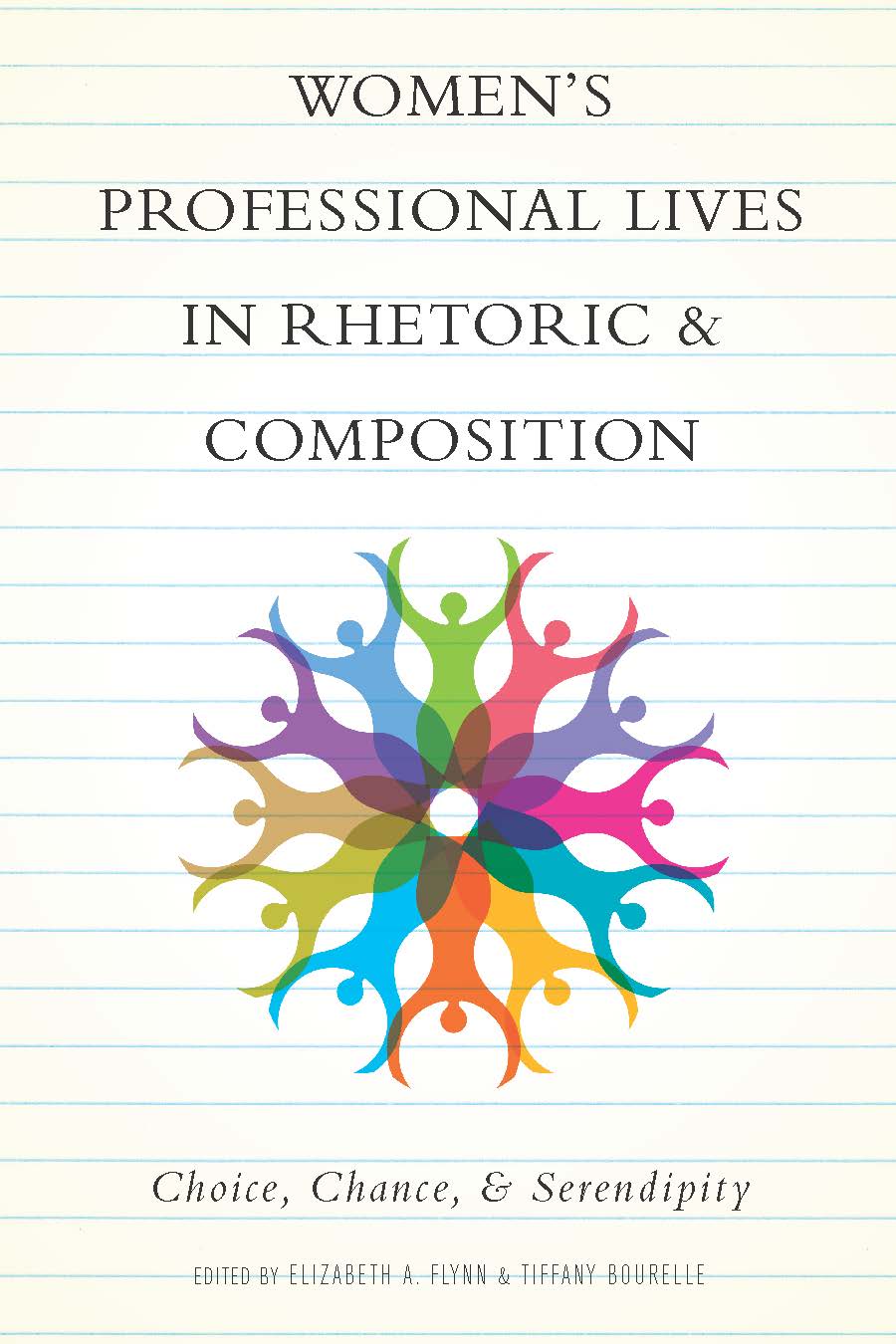
Book cover of Flynn and Bourelle's edited collection. The title text is written on college-ruled notebook paper, and there is a colorful floral-like design made from the outlines of women's bodies in the center of the cover.
Image from The Ohio State University Press website.

When we decided to review Women’s Professional Lives in Rhetoric & Composition, it was not without a certain bitter taste leftover from our previous realization that certain voices are amplified (and others are not, like those who are multiply marginalized) within the working lives of women in rhetoric and composition. We learned this when we wrote “Sisyphus Rolls On: Reframing Women’s Ways of ‘Making It’ in Rhetoric and Composition” (Bivens, et al.). However, in Women’s Professional Lives in Rhetoric & Composition, there is a shift from a focus on an ideal tenure track career to the realities that pervade most of our working lives. The chapters in this collection do not focus on or establish a “normal” career path. Instead, the contributors emphasize how they navigated a career path or multiple career paths that include twists, turns, challenges, and, as editors Elizabeth A. Flynn and Tiffany Bourelle write in the introduction, “serendipity.” Although we have no criticism to offer the impressive selection of women and what they share about their remarkable lives in the volume, we were reminded that a print book limits inclusivity for projects like these. As we discuss later, if rhetoric and composition scholars want to represent career paths in the field and what the profession resembles then and now, we suggest that they turn to other venues that do not include word count limits, chapter limits, and design limits in quite the same ways that print texts do. The ability to inclusively showcase what women’s professional lives might look like at multiple levels, in multiple venues, and in ways that consider the current political, economic, and arguably anti-intellectual, anti-woman, anti-LGBTQ climate is of tantamount importance for those individuals up and coming in academic culture.

Before offering our review of the chapters, first a note on the editing. A skilled scholar with experience editing volumes can do wonders for readers in terms of maintaining an argument thread throughout a collection. Flynn and Bourelle do this skilled editorial work in framing Women’s Professional Lives in Rhetoric & Composition by focusing the collection on serendipity. In fact, Flynn and Bourelle point out, “Our collection differs…in that it places emphasis on the convergences of choice, chance, and serendipity in the professional lives of women with diverse backgrounds and situated in diverse locations within the field of rhetoric and composition” (3). Given that this thread, as well as references to each other’s narratives, is apparent throughout the collection, it is clear that the editors encouraged authors to explore serendipitous moments in their professional lives and to engage with each others’ experiences as appropriate. From start to finish, each narrative coherently and effortlessly exists within the frame Flynn and Bourelle introduce and maintain throughout the collection, resulting in an expertly edited volume that contributes to the discourses (and details) of women’s working lives.

Details allow readers to personalize these stories of serendipity and, as many of these women point out, the resiliency Flynn, Patricia Sotirin, and Ann Brady collected and theorized in Feminist Rhetorical Resilience. If we accept Kenneth Burke’s idea that identification precedes persuasion, then to be persuaded or moved, readers need these narratives’ details so readers can identify with these exemplary women. And the details, in almost all cases, are ample and persuasive. For instance, the details shared by Lisa Ede about her collaborations with Andrea Lunsford resonated with us because we, too, have collaborated on multiple texts. Flynn’s narrative helped us to trace and understand her feminism, its lineage, and its legacy at Michigan Technological University. Anne Ruggles Gere’s chapter highlights the necessary legacy of interdisciplinarity that grounds our field and the ways in which navigating various forms of writing, literacy, and rhetoric can open kairotic space along a career path that does not seem, at first, traditional. Her chapter also reflects the necessary though largely ignored role that care work and personal relationships have in our working lives. The vast majority of us will care for a young person or an ailing parent at some point in our lives, and Gere (as well as other contributors) seamlessly blends the discussion of her life with her career. It is a necessary example of the ways in which our personal lives powerfully factor into our professions and should be acknowledged as such.

Lynn Z. Bloom’s narrative reminds us to be flexible with our knowledge and consider deploying it to help others in telling their stories. Libby Falk Jones’s chapter is simply melodic in its organization and representation of her story through various lenses, while her discussion of mêtis and the ways closings and openings complement that melody and the pacing of her story’s presentation. Suellyn Duffy also draws upon the mêtis thread to frame her chapter. In it, she voices what many do not or cannot—that if she followed the scripts and the advice about how to make it as an academic she would judge herself as less than, or she would have to maintain an oppositional stance, neither of which are useful as we strive forward in our careers. Instead, she invites readers into an embodied feminist resilience that powerfully reminds us that there are times in which less than ideal circumstances allow for freedom—of movement, of choice, of direction. Malea Powell’s chapter is a story, and like Duffy, she reflects on her career through art. She gives us a narrative framed by beadwork. Her writing is tactical, physical, personal, instructional. Powell uses the weaving of beadwork to reflect on the network of relationships, the accumulations (385), that led to her professional choices. Powell’s work is a reflection on a career that necessarily indicates the continuing focus on settler colonialism on authenticity—a demand of our indigenous colleagues for a “real” identity that is unnecessary and, frankly, racist. Powell reminds us that as scholars in a diverse field we must do our part to consciously make the academy livable for those it was built to exclude and marginalize.

Linda Adler-Kassner’s chapter on scrappiness is the perfect corollary to the chapters that draw on mêtis, that write through art and expression. She uses the threshold concept of troublesome knowledge to frame herself as a “scrapper”—someone who looks for opportunity or “cracks” and moves to enter (350). As she deconstructs her reflection on her career path, she recognizes the ways in which the troublesome, the disappointing, and the seemingly insurmountable became serendipitous and led to a knowledge of self and scrappiness that propelled her forward in her career. This combination of determination and resilience is something that Holly Hassel and Kirsti Cole highlight in their 2017 collection, Surviving Sexism in Academia. Many of the contributors in that volume also found agency in spaces that ignored or dismissed them, and they leveraged those spaces to forge connections with people around them who were interested in building something new, in moving past outmoded and outdated notions of who belongs in our academic spaces. Resilience, then, is as deeply practical as it is creative. Resilience is how these women get things done.

Jacqueline Rhodes begins her narrative reflecting on depression and queer time through resilience. She writes, “Our strength comes through these fractured moments of influence and narrative, fleeting intensities, years of immediacy. And strength too comes from a balancing of choice and chance, of wave and field” (451). Class, identity, and intimacy intersect in Rhodes’s chapter as she writes about the vulnerabilities of coming from a working-class family, living the academic life with depression, and finding her identity as a queer scholar. Beth L. Hewett, who, like Bivens, taught for the City Colleges of Chicago for a period of time, shares her experiences with grief, loss, and challenges that ultimately led her research to focus on collaboration. Though she writes about serendipity, hers is certainly a career that exemplifies resilience, ultimately revealing that “…when a person has more than one deep interest and a compelling sense of obligation and motivation in different areas, one may never feel complete on any one path” (170). One of those areas includes bereavement training and grief coaching, or acting as a mentor for those experiencing loss. Rhodes and Hewett both draw attention to the intersections of affect and personal-professional lives, while challenging our notions of what it means to live an academic life.

The chapters in this collection are interconnected, and Bourelle illustrates the predominant ways in which they are interconnected. Her chapter acknowledges her influences and notes how her mentors “had guided [her] to find [her] own voice and to make [her] own decisions,” (179) which is a welcome nod toward personal agency—a rhetorical concept that serendipity seemingly excludes, especially for the inexperienced and uninitiated. Iklim Goksel relies on kismet (or destiny) for the choice, chance, and serendipity her story reveals; it is a breath of fresh air in the collection with its references to non-western traditions (e.g., Rumi, Yunus Emre) and a beautifully-written chapter whose narrative roams the globe from Sweden to Turkey to the United States. Bourelle’s serendipity and Goksel’s kismet use the frame Flynn and Bourelle craft in the introduction skillfully.

It is important to acknowledge, however, the ways in which serendipity could potentially limit agency. Sharon Crowley noted this in her profile in Women’s Ways of Making It in Rhetoric and Composition (Ballif, Davis, and Mountford). She says, “We did what we were told, and it did seem like serendipity if things happened for us. Or we were taught to rationalize it as serendipity. If we made it happen, we told ourselves it was luck” (218). However, Flynn and Bourelle note that their use of serendipity as a frame is not just “luck but the willingness to act on hunches or trust one’s own intuition—to learn from one’s experience” (Flynn and Bourelle 5). When trade presses focus on issues such as imposter syndrome and an unstable job market, trusting one’s intuition may seem, well, Sisyphean. But the collected chapters in this text demonstrate clearly that even seemingly impossible tasks are doable, and that voices that are not often heard can find a venue if individuals are willing to prepare themselves in their field, take on challenges, and navigate opportunities that seem, at first, like luck or chance. Or, as Bloom writes, “Making good choices positions you to take advantage of serendipity” (103). The process of making choices demonstrated throughout this collection is one motivated by the personal—something the contributors reference in each chapter. These are works of powerful vulnerability and making the most of it.

This kind of professional vulnerability is demonstrated in Irene Papoulis’s chapter. Those off the tenure track or not teaching at their ideal institutions—or those with feelings of “status anxiety” (202)—will find a similar, newfangled representation, like Goksel’s chapter, of the working lives of those who rely on contingent teaching assignments, while also living life as a single mother dealing with “considerable psychological stress” (13). Papoulis organizes her chapter around the elements of her life that have contributed to her “shame-inducing anxieties” (210), including being a lecturer, composition studies itself, and her scholarly dedication to expressivism. As readers and writing teachers, we found much to identify with in her chapter, especially in the chapter’s final paragraph, when Papoulis writes, “The antidotes to academic shame begin with acknowledging what the feeling is and how our institutions foster it” (216).

The remaining chapters in the collection, written by Natasha Jones and Shirley Rose, tackle the ways that institutional forces shape us and how we must work to shape them. As a single mother, Jones experienced a transformative commitment to social justice when her daughter was born. Jones cites inspiration from a keynote by Dr. Angela Davis at the Conference on College Communication and Composition in 2014—an inspiration that Jones responds to through her social justice scholarship in technical and professional communication. She writes, “simply that [her] personal and academic career goals are one in the same—to embrace change and to empower others and [herself] to be resilient and strong” (232). In the final chapter of the collection, Rose directs readers to our professional focus: teaching students to write. Rose starts with the acknowledgment that she is in the “last verse of her professional work” (244). She reminds readers of the vulnerability of learning and what we ask our students to do in unfamiliar educational territory. Rose frames her narrative with her experiences being a member of the Scottsdale Chorus. She reminds us of effective teaching practices, like being patient with students’ questions that we think we’ve answered already (239) and even “singing out” or taking the chance of making a mistake or doing something wrong (241). The latter reminds readers of agency and the power we find in making choices regarding our professional lives.

In this collection, Flynn and Bourelle include voices that remind us that our professional lives, at whatever stage, are necessarily grounded in our personal experiences, past histories, pains, and joys. One of the more powerful aspects of this volume is that the contributors tell their personal stories as they discuss their careers. Another unique aspect is that there are women in this volume that are no longer in academia, as well as women who served, at some point, in non-tenure track jobs at many Carnegie classification types of schools. For us, this collection serves as an important reminder to think strategically about the role of composition in the university and the role of those who teach it. Compositionists know the business of the university, perhaps better than people in any other discipline. However, knowing the business of the university requires a certain kind of permanence and stability. Without it, without the agency provided by tenure and tenure-track jobs, transience and insecurity interfere with our ability to focus on the spaces in which we work because we are forced to simply focus on whether or not we will work. The strength of a text such as this is that it opens space within precarious employment circumstances for individuals to leverage longitudinal knowledge and understand the systems in which we labor. In this way, resilience through mêtis is a key theme of Women’s Professional Lives. This book reflects a reality that many find themselves in—and asks readers to identify and take up the various pathways showcased as possibilities for moving through an academic career well. The problem is that the landscape that maps academic, career, and good navigation thereof are all shifting at an accelerated rate.

Regarding editorial savvy and the structure of the collection, we found great (and quite frankly, surprising) joy reading the endnotes of several chapters. For example, Ede, Flynn, Bloom, Duffey, Adler-Kassner, and Powell provide details that add depth to their professional lives’ narratives in these endnotes. In fact, Powell’s 29 endnotes read like a worthy history lesson for the uninitiated. Relatedly, Bloom adds depth and details to her work as a biographer with historical tidbits like “the international dateline determines whether December 7 or 8 is the date ‘which will live in infamy’” (72). It is because of these footnotes, as well as the limitations endemic to print books, that we recommend that works like these be moved to digital spaces. In our estimation, the metadiscourse found in these footnotes would benefit from a series of hyperlinked pages.1 By moving to digital spaces, not only can more narratives be included, but more details about those narratives can be included, too. Ultimately, although we find the book format limiting for works that describe women’s working lives in rhetoric and composition, the showcase of scholars, teachers, and workers here is extensive and inclusive. This collection is an exemplar in a small but significant group of texts that place under the microscope the demonstrably different and shockingly similar ways people come to and live in academia. However, if projects like this are to be more inclusive and welcoming for the diversity of those who teach rhetoric and composition, we suggest that these works transition to open access and be housed in digital spaces. The project of storytelling and reflecting on the serendipitous choices and chances of an academic career is, perhaps, more important than ever as the seemingly traditional career paths are disappearing, but in order to engage in this project and provide a blueprint or a way forward for up-and-coming people in the field, we must carefully consider how we access the stories that might provide insight and guidance along our own circuitous, contingent, caregiving, serendipitous professional paths.

Endnote

  1. In fact, our work on the (now defunct) CCC Committee on the Status of Women in the Profession (CSWP) tried to do similar work, Story Corps-style, nearly ten years ago by working with Cindy Selfe’s Digital Archive of Literacy Narratives (DALN). In this project, a handful of women were interviewed for the Women’s Lives in the Profession Project under Eileen Schell’s chairing of the CSWP. Two interviews remain online: a video interview with Gwendolyn Pugh and a text self-interview of Bivens.

Works Cited

Ballif, Michelle, Diane Davis, and Roxanne Mountford, editors. Women’s Ways of Making It in Rhetoric and Composition. Routledge Press, 2008.

Bivens, Kristin, et al. “Sisyphus Rolls on: Reframing Women’s Ways of ‘Making It’ in Rhetoric and Composition.” Harlot: A Revealing Look at the Arts of Persuasion, vol. 1, no. 10, 2013.

Burke, Kenneth. A Rhetoric of Motives. University of California Press, 1969.

Flynn, Elizabeth A., Patricia Sotirin, and Ann Brady, editors. Feminist Rhetorical Resilience. University Press of Colorado, 2012.

Hassel, Holly and Kirsti Cole, editors. Surviving Sexism in Academia. Routledge Press, 2017.

return to top

Response to “Rhetorical Pasts, Rhetorical Futures: Reflecting on the Legacy of Our Bodies, Ourselves and the Future of Feminist Health Literacy”

The essays in this special issue of Peitho were prompted by a range of impulses: to recognize the Boston Women’s Health Book Collective as they ended the project of revising Our Bodies, Ourselves in favor of a broader project of health advocacy; to investigate the contributions of that book and describe their limits; to draw connections between the work of the collective and current projects in women’s health. All these essays take into account the dramatic changes in health care from 1970 to 2019: the displacement of the family doctor as primary health care provider; the growth of big pharma and big data; the development of evidence-based medicine, managed care, and a host of other changes in both medical treatment and the conditions of its administration. It is not easy to capture the rhetorical salience of these developments; all the essays in this issue help us to see them with more historical depth and contribute to our understanding of the work of the collective and its influence on medical practice and medical writing. In my response, I will discuss each group of essays, ending with suggestions for further research.


The first group of texts, in which I include Lynn Bloom’s moving essay “Hard Labor,” deals with the legacy of Our Bodies, Ourselves and the future of its innovations. Bloom’s memoir concurs with the BWHBC’s own account of their accomplishments. In 2002, the Our Bodies, Ourselves website listed changes in “the public discourse on women’s health” that they had sponsored, especially the claim that “normal life events,” such as birthing, should not be pathologized. Early editions of Our Bodies, Ourselves offered not only a vigorous critique of physician-centered birth protocols, but a range of alternatives, many of which were adopted by the women’s health movement and entered mainstream medicine. Bloom’s essay makes clear how deeply these changes have benefitted birthing women. Similar shifts in women’s self-understanding are taken up in Heather Adams’ discussion of shame, a subtle and engaging analysis of how shame works, how it feels, and how it can be transformed or realigned. Adams traces discussions of shame in Our Bodies, Ourselves; she shows how the text adroitly acknowledges the power of shame while offering the reader a solvent for its “stickiness.” (The spectacular cover image Meredith Spence drew for this issue offers us a visual solvent.) And Clancy Ratliff’s essay explores the collective’s practices of collaboration, focusing on the movement from a model of individual authorship to alternative means of acknowledging multiple contributors and of negotiating the relationship between the collective and publishers. She relates these  practices to current discussions of student writing and collaboration. Two details bear out the salience of Ratliff’s essay: whenever possible the BWHC paid those who contributed to the book, insisting that feminist research was labor that deserved compensation. And the collective insisted on retaining the copyright to Our Bodies, Ourselves, a provision that held through the final 2011 edition. (When I was working on permissions for my book, Our Bodies, Ourselves and the Work of Writing, I forgot that Simon and Schuster did not hold copyright, and requested from them the right to reprint images from the book. They were quite willing to charge for reprinting material in a book they did not own!)


Adams’ essay explicitly engages with one of the central issues in feminist scholarship on Our Bodies, Ourselves—the question of universality. This issue is also raised by Lillian Campbell and by Maria Novotny and Les Hutchinson. The BWHBC did not explicitly advocate a feminist universalism, but it was important to them that, as a member of the collective put it, “Women’s bodies don’t look the same, but they all work the same.” This served as a vernacular feminist universalism that was, for the BWHBC, the material basis for feminist solidarity, supporting their many international collaborations. (They also collaborated with the Combahee Women’s Collective, who originated the term identity politics.) And a recognition of universal female biology did not blind the writers to the limits of their experiences: “Nor could I, as one person, even think of all the information and feelings that would be relevant [to childbirth]” (Women and Their Bodies, 1970, 154). The BWHBC might not have recognized that the “relevant feelings” would include those of trans women (they barely had begun to recognize the specificity of lesbian experience). Contemporary feminists are unlikely to take up the universalism of Our Bodies, Ourselves, since recognition of the intersectionality of oppression is now our central issue. But universalism in various guises has been an important resource for insurgent rhetorics since abolitionism. Study of the BWHBC’s practice could bring us to a more nuanced evaluation of the potentialities of this resource, while acknowledging the collective’s difficulty in sustaining collaborations beyond their intensely literate, white, and initially heterosexual circles.


The second section of this special issue takes up the issue of the relationship of Our Bodies, Ourselves to clinical practices. Barry DeCoster and Wendy Parker discuss how the rhetoric of Our Bodies, Ourselves modelled a collaborative relationship between contemporary patients and caregivers. The writers offer a lively account of a passage in the BWHBC minutes that recorded a discussion of their future directions. They compare this with accounts of collaborative health care collected in their own interviews with caregivers and birthing mothers. Lillian Campbell’s discussion of the presentation of medical women in Our Bodies, Ourselves takes a distinct approach, arguing that the collective “demonized” female care providers from the beginning, and that this mistrust of women physicians, present in all eleven editions of the book, blocks meaningful collaboration between women and their caregivers. Although I admire the care of Campbell’s analysis, I cannot agree with her evaluation of the collective’s attitude toward women health care providers. As DeCoster and Parker remind us, the collective considers that their project began when they gave over an attempt to develop a list of “good doctors”; since every doctor praised by one respondent to their survey was damned by another, the nascent collective saw that problems in women’s medical care were systemic rather than personal failures, and decided to focus on how medical information was constructed and distributed. Indeed, it is difficult to see how collaborative relationships between women’s health advocates and female physicians could have been developed at mid-century, given the radical power imbalances of the doctor-patient relationship. Physicians in Boston could withhold birth control pills from unmarried women; questions were discouraged; and consent was often notional. Nor was the collective’s distrust extended to health care providers in general; they focused on personal physicians. Other women health care providers were trusted, even celebrated; members of the collective were active in public health circles, and midwives were the heroines of childbirth chapters in early editions of Our Bodies, Ourselves. Finally, the collective’s treatment of health care providers needs to be put in the context of the collective’s overall political outlook. They criticizeda childbirth education program for not offering a critique of the nuclear family; they wanted to educate their readers to be “properly critical of hospital procedures and the medical profession” (BWHBC, Women and Their Bodies, 127-30).


Ironically, both Campbell and DeCoster and Parker could be correct: Our Bodies, Ourselves did present a negative picture of physicians, especially in its earlier editions, and warned that including more women in the profession would not bring about the fundamental changes they sought. It is also possible that this adversarial stance laid the basis for a more collaborative future relationship. By urging women to go to medical appointments “together in small groups to doctors to support each other,” to learn about their own anatomy, and most of all to ask questions persistently, the BWHBC seeded a culture of medical dialogue with the potential to evolve into the teamwork that DeCoster and Parker describe.


The final section of this special issue traces the lineage of Our Bodies, Ourselves in contemporary rhetorical innovations, from applications that gather medical data to “period proof panties.” The range and inventiveness of the essays in this section bear out the special issue editors’ identification of Our Bodies, Ourselves as the link between feminist rhetorical theory and the rhetorics of health and medicine. Two of these essays, those by Novotny and Hutchinson and by Sarah Singer, rely on first-person experiences, violating a central taboo of traditional academic writing in medicine, but drawing on the BWHBC’s custom of using their experience as a basis for research. The final essay by Stone is a deft examination of the rhetorical work done by an object—in this case, panties designed to absorb menstrual flow.


The Boston Women’s Health Book Collective called their history “a good story,” and for many of the writers in this special issue, and surely in my response, the story of their continuing influence is also good: patients and doctors establish cooperative relationships, women are empowered to question institutions and to claim their authority. Other writers evaluate the collective’s legacy differently. For Novotny and Hutchinson, OBOS’ style has been co-opted in the service of corporate medicine; for Campbell, the collective’s trust in their own experience has empowered anti-vaccination rhetoric. Such a range of opinion is to be expected: in their 50 years of work, the collective made their share of mistakes, and their innovations have not always been put to good use.


Future researchers may want to explore some of the questions raised by the essays in this special issue. For me, the most important of these is the question of influence, and particularly its implication for ethics: how do we think about the effects of a rhetor’s performance on future discourses? What responsibility does the rhetor have for those effects?


The writers in this collection present a rich variety in their discussions of the influence of Our Bodies, Ourselves on health discourses. Here are the passages where they make claims of influence:

  • OBOS created a critical space for both questioning normate affects and bringing this questioning to bear on wider conversations and efforts of personal discovery (Adams).
  • We can clearly see [OBOS’] important place in the story of feminism and authorship, not only as a complex and enduring model of collaboration, but also as a model for feminist authorial agency (Ratliff).
  • In a similar way, second-wave feminist critiques of medical institutions have provided a rhetorical foundation for radical anti-science movements such as the anti-vaxers (Campbell).
  • Lastly reflecting on the work of the BWHBC and the founders of OBOS, we see lasting consequences today in the clinical relationship and how patients and providers engage and forge a relationship, in particular when they negotiate trust or when they determine it cannot work (DeCoster and Parker).
  • We find that without the publishing of Our Bodies, Ourselves (OBOS), the FemTech industry would not be the dominant industry it is becoming today. OBOS laid the foundation for valuing new methods that enhanced women’s health literacies by fusing both embodied and medical expertise into one text with the goal to increase female agency and sense of empowerment in making health decisions (Novotny and Hutchinson).
  • These apps, websites, and health data sharing platforms deploy a rhetoric of user-centeredness that is eerily similar to that of Women and Their Bodies, emphasizing qualities such as power, simplicity, and individuality, but they have a different goal: to earn money (Singer). 
  • This article explores Thinx underwear as a feminist embodied rhetorical object that indirectly inherits the spirit of Our Bodies, Ourselves (OBOS) (Stone).

Whatever their views on the BWHBC’s influence, writers in this issue use a range of terms to describe how that influence was exercised. The terministic screen of inheritance (“legacy,” “heirs”) emerges in more than one essay, suggesting an orderly succession of feminist rhetors, transmitting a stable body of rhetorical resources. A looser relationship is suggested in the image of a model, a pattern that can be taken up or modified. Other writers use spatial images: the collective created a foundation or a platform or an opening. The discourse field is imagined as a space—a building site, or perhaps a battlefield—where objects can be sited or expeditions launched. Or, writers simply assert that Our Bodies, Ourselves changed discourse: the terms of health care collaborations, the development of digital data collection apps. Perhaps the most accurate of these terministic frames is Singer’s assertion that the influence of Our Bodies, Ourselves is “eerie”: we do not yet have very good ways of describing how persuasive discourse, broadly understood, is mysteriously dispersed, distributed, and sustained.


Theories of literary and scientific influence are helpful, but not well-adapted to the exigencies of rhetorical analysis. Literary influence is traditionally traced through verbal and generic references, yielding statements like “In the seventeenth century, women poets transformed the tropes of Paradise Lost.” But rhetorical influence is far more widely distributed, far less dependent on textual transmission. Scientific influence is traditionally traced through shifting paradigms, ensembles of concepts, methods and problems that are productive of new research; rhetorical influence is far less propositional, and the norms of evidence are far more flexible. To construct a theory of rhetorical influence we need, not Harold Bloom and T.S. Kuhn, but Jacqueline Rose and Lorraine Daston or Karen Barad.


The theory we need is being constructed in contemporary rhetoric, drawing on such sources as Heidegger’s lectures on Aristotle’s Rhetoric, Bruno Latour’s actor-network theory, and Nancy Struever’s rigorous readings of early modern knowledge practices. The themes of such rhetorics include circulation, memory, and embodiment. Often, these themes are deployed in painstaking work with deep, complex archives, as in Dave Tell’s account of memorials of the Emmett Till murder, or Christa Olson’s analysis of exchange and circulation in representations of the indigeneity in Ecuador. Or they may emerge in sustained rhetorical reflection, such as Thomas Rickert’s appreciation of the complexities of attending to the material in Ambient Rhetoric: the Attunements of Rhetorical Being. In all of these accounts, the issue of influence is implicit; all of them discuss how rhetorical resources emerge, circulate, and become consequential. And in all of these accounts, especially Tell’s, the issue of rhetorical ethics is salient.


Given that genres, tropes, forms of argument and narrative, and affective resources circulate with and without the individual agency of rhetors, how can we understand issues of rhetorical responsibility? The Boston Women’s Health Book Collective certainly advocated trust in one’s own experience, but they did not invent this idea, nor were they alone in circulating it. A quick browse in back issues of High Times, or any of the hundreds of local underground papers, or a playlist of popular music from the 60s, would generate many assertions of the need to trust oneself rather than established authorities. The BWHBC’s contribution was to apply this maxim to medical issues, particularly as they affected women.


In this context, the question to ask is not “Was the BWHBC responsible for the good things that happened to medical care for women after 1970?” or “Was the BWHBC responsible for the bad things that happened to medical care for women after 1970?” This binary, taken generally, is meaningless; focused on particular rhetorical interventions, it flattens the texture of multiple rhetorical transmissions and intersections. Instead, we might ask what connections the collective forged, what movements of language they sponsored, and what rhetorical resources they put in circulation, making them available to new speakers and writers. Here, the record is clearer: the BWHBC taught endless classes and workshops on women’s health; for years, they sent out regular packets of materials relevant to women’s health to women’s clinics and self-help groups; they made their book available to women who otherwise would not have had access to it. The collective also established a protocol for responsibly and respectfully aligning individual experiences and scientific knowledge, a vocabulary for expressing women’s agency in ensuring their own health, and a set of tropes for understanding the shortcomings of US institutions of healthcare as systemic failures, rather than individual lapses. There were, of course, connections that the collective might have made, or made earlier: most especially, they were unable to establish a sustained, inclusive, intersectional practice. The Boston Women’s Health Book Collective, therefore, offers us a way to think about the ethics of public discourse as a situated practice, operating on many levels (in their case, from the small consciousness-raising group to the Senate hearing room), and subject to larger economic and political changes. The years ahead are likely to require us to become skilled in such practices; the essays in this special issue will help us to think about how to negotiate them ethically and effectively. 

Works Cited

Boston Women’s Health Book Collective. Our Bodies, Ourselves. ourbodiesourselves.org/bwhbc.htm. Website. Accessed 1 June 2002.

—. Women and Their Bodies. Boston: New England Free Press, 1970.

Heidegger, Martin. Basic Concepts of Aristotelean Philosophy, translated by Robert D. Metcalf and Mark B. Tanzer. Bloomington: Indiana University Press, 2002.

Latour, Bruno. Reassembling the Social: An Introduction to Actor-Network Theory. Oxford: Oxford University Press, 2005.

Olson, Christa. Constitutive Visions: Indigeneity and Commonplaces of National Identity in Republican Ecuador. State College: Penn State University Press, 2014.

Rickert, Thomas. Ambient Rhetoric: The Attunements of Rhetorical Being. Pittsburgh: University of Pittsburgh Press, 2013.

Struever, Nancy S. Theory as Practice: Ethical Inquiry in the Renaissance. Chicago: University of  Chicago Press, 1992.

Tell, Dave. Remembering Emmet Till. Chicago: University of Chicago Press, 2019.

Wells, Susan. Out of the Dead House: Nineteenth Century Women Physicians and the Writing of Medicine. Wisconsin: University of Wisconsin Press, 2001.

return to top

“Like Regular Underwear, But So Much Better”: How Thinx Can Create Feminist Embodied Subjects through the Enduring Legacy of OBOS

Underwear for People Who Menstruate

Across time and cultures, women have used and continue to use a variety of products for catching menstrual flow. The choice often comes down to comfort, availability, convenience, and price. You might find the perfect match right away, or you might try different options, looking for more comfort or a better fit.

(Our Bodies, Ourselves, 2011)

From its conception in 1969 at a Women’s Liberation Conference in Boston, Massachusetts, Our Bodies, Ourselves (OBOS) has been committed to informing its audience about topics of health and the body through feminist perspectives. While OBOS began as a text targeted toward straight middle class white women, each update has been more inclusive of different bodies and identities. Although the production and printing of OBOS has been discontinued, OBOS creates a tangible legacy for future feminist health literacies and technologies. In this way, OBOS provides a means to compare and measure other feminist health texts and objects. In this article, I use that legacy to explore the implications of Thinx panties, which are underwear that can be worn during the menstrual cycle sans other menstrual products, or as a backup to other menstrual products. While Thinx panties were not invented before the last printing of OBOS in 2011, their products represent the kinds of technologies OBOS contributors would showcase in their feminist health text, which is evidenced in the current OBOS blog. In 2015, OBOS contributor Miriam Zoila Pérez published a blog post detailing Thinx as a menstrual product that is both innovative and more sustainable than other menstrual products.


Thinx was founded by Antonia Saint Dunbar and sisters Miki and Radha Agrawal in 2011, and they began selling their menstrual products in 2014. This company provides people who menstruate with underwear that can be worn during the menstruation cycle sans other menstruation products, or as a backup to other menstruation products. In product advertisements, Thinx boasts that their “period panties” have a patented four-layer technology that is supposed to allow the wearer to move through their day without the interruptions that other menstruation products can cause. Wearing these undergarments may limit the interactivity a menstruator might normally have with other menstrual products (i.e. tampons, pads, menstruation cups, etc.), as wearers might have less need to check the fullness of the undergarment and actual menstrual byproducts are potentially more fully concealed through this technology. Because OBOS and Thinx are part of an evolving ecology of lived practical experiences centered around feminist reproductive health and feminine coded bodies, I consider the following questions in this article:

  1. how might a feminist health literacy text like OBOS inform how we think about products like Thinx?
  2. what do both OBOS and Thinx underwear suggest in terms of assumptions made about the size, shape, and movement of menstruating bodies?
  3. how does the case study of Thinx underwear as a feminist wearable technology become important for the future of feminist health literacies?

To answer these questions, this article makes a case for Thinx underwear as a wearable technology by expanding upon feminist rhetorical research that considers technological objects from an embodied perspective. Positioning OBOS as an agentive prior text, this article shows how OBOS has, through its many editions, strived to be inclusive not only of different bodies and identities but also of multiple approaches to reproductive healthcare technologies and activism. Drawing on this foundation, I conduct a materialist rhetorical analysis of Thinx underwear in connection to OBOS using Jordynn Jack’s feminist wearable technology framework. This article explores how Thinx panties can become a structure of feminist meaning-making that is transmitted through bodies, analyzes the assumptions that this technology makes about menstruating bodies, and argues in the spirit of OBOS that powerful agencies are invented in the collaboration among Thinx underwear and menstruating bodies. The concluding discussion focuses on how continued feminist rhetorics of embodiment and wearable technologies are important for the future of feminist health literacies, for complicating Thinx underwear, and for the enduring legacy of OBOS.

Feminist Rhetorics of Embodiment and Wearable Technologies

Feminist Rhetorics of Embodiment

OBOS and Thinx both have the potential to empower bodies through feminist rhetorical action; as a result, turning to feminist rhetorics of embodiment can help us better understand their interrelation. Through our embodied choices, we have the agency to create rhetorical action that can empower or disempower our bodies. For example, Maria Novotny and Katie Manthey position the journey of coming to understand and embrace their bodies as a feminist rhetorical act. More directly, Manthey explains, “How I manage my body and specifically, how I present it to other people through dress practices including clothing that hides or reveals my flesh, is a feminist rhetorical move” (11). A number of feminist scholars have correspondingly illustrated that the intersection between bodies and the everyday is a deeply rhetorical space (Johnson et al.; Molloy et al.). Feminist rhetorics of embodiment can also focus on the agency bodies can have with and through technological objects. In this regard, Lisa Melonçon states, “The instrumental nature of technology means that human bodies exist as tool-beings that use a variety of equipment, or technology, to move through each day” (71). In further drawing from this point, Jack asserts, “…the ways that we live in and through our bodies are inextricable from the technologies we use” (209). Because we are inextricably linked to technologies through our bodies and lived practical experiences an expanded understanding of what counts as a technology is necessary if we want to fully consider the embodied potential of technologies.

Feminist Rhetorics of Technology

Thinx underwear is a wearable technology: a product or material that provides a means to assist the wearer in everyday life. They are, however, an unusual wearable technology in that they challenge the predominant notion of how wearable technologies are currently understood. To better understand Thinx underwear as a wearable technology, we need a broader conception of technology use, particularly within a feminist rhetorical framework. Specifically, we need to consider Thinx and other menstruation technologies from a feminist rhetorical framework that, as Jack contends, considers these objects as “everyday rhetorics” (208). Arguing for a feminist rhetoric of technology, Amy Koerber expands the definition of technology based on feminist observations that address how previous definitions of technology, “…have evolved in a way that excludes the historical contributions of women” (60). Her expanded definitions by contrast “enrich[es] the rhetoric of technology…by revealing the blind spots inherent in narrow definitions” (60). Jessica Enoch similarly explains that we should open more paths in feminist rhetorical research through “scholarly interventions” that invite more scholars to “push the boundaries of feminist research” (438). However, pathways that push the boundaries of feminist perspectives of technologies must not only consider broader definitions of technologies but also reconsider the rhetorical implications that are disseminated through technological artifacts. For example, Sarah Hallenbeck articulates the idea that “everyday practices gain strength and traction as rhetorical actions through their articulations within the networks that support or subvert them” (22). Feminist rhetorical studies of technological objects, then, should consider and reinvent how technologies enact or subvert imbalanced power relations, binary understandings of gender, and divisions in social categories.


Jenny Edbauer’s work offers an important method for analyzing the relationships between technologies and rhetorical effects and affects. In her proposed reconfiguration of the rhetorical situation, Edbauer suggests a strategy for theorizing rhetorics as “a circulating ecology of effects, enactments, and events by shifting the lines of focus from rhetorical situation to rhetorical ecologies” (9). A rhetorical ecology recognizes how texts and objects circulate and transform those who interact with them. An analysis of Thinx’s “period panties” as a technological artifact should position these objects in a developing ecology of lived practical experiences centered around reproductive health and menstruating bodies.

Feminist Wearable Technologies

While popular definitions of wearable technologies tend to be understood through ubiquitous computing and the ability to collect and track quantifiable data, in this article I take the position that wearable technologies can include a wide range of objects and artifacts that people can wear. Clothing and shoes, for example, provide a layer of protection from natural and synthetic elements. I further argue that it is a feminist rhetorical practice to redefine understandings of technologies to be more inclusive of marginalized experiences that are lived through these technologies. Continually, it seems, broad understandings of technologies often only consider innovative technologies in their definitions. For instance, dominant understandings of wearable technologies commonly connect closely to cutting-edge digital technologies. When the term “wearable technology” is used, many might call to mind images of Apple iWatches, FitBits, GoPros, smart glasses, etc. Isabel Pedersen refers to this type of technology as “wearable computers,” and explains them as “…computers that you strap to the body and ‘wear’” (183). However, a wearable technology does not necessarily have to be understood as a digital gadget.


Thinx underwear can provide the function of protection from the messes that menstrual periods have the potential to cause, and they can also allow the wearer to move more freely throughout the day. Before the invention of commercialized menstrual products, menstruators used objects like cloth rags, cotton, sheep’s wool, handed knitted pads, or even animal furs and plants like grass to stifle blood flow. With the evolution of menstrual products, a menstruator’s ability to exist in the world during a menstrual cycle has become easier to manage. Like most menstrual technologies, Thinx stifles a menstruator’s blood flow so they are able to move more easily through their day. While these undergarments do not rely on ubiquitous computing technology and do not collect or track data in the usual sense, they do, I argue, have the potential to assist the wearer in their everyday lives. Following Jack’s emphasis for further research of wearable technologies that takes up a feminist perspectives of rhetorical embodiment more directly, in my analysis I further explore how wearing Thinx underwear can become a rhetorical act that encourages a feminist embodied subject who can participate in knowledge creation. In order to move forward in this analysis, I now turn to OBOS as a forerunner in providing increased agency to menstruators and their bodies.

OBOS and Practices of Inclusion

My understanding of Thinx panties as related to the legacy of OBOS is primarily positioned in the ninth edition published in 2011, and I want to start by considering how this feminist health literacy text is situated in a feminist history of inclusion. Different iterations of OBOS show how contributors have strived to be more inclusive of different bodies, identities, technologies, and activist movements. As Heather Stephenson, Zobeida Bonilla, Elizabeth Sarah Linsey, and Marianne McPhearson trace in a 2005 special issue for the journal for the National Women’s Studies Association Journal themed around the update and revision of the eighth edition of OBOS, inclusivity, attention to current reproductive health issues, and the desire to stay relevant through technological advances have long been at the core of the driving beliefs behind OBOS. Stephenson, who led the revisions project for the eighth edition update published in 2005, describes how her revisions speak to new and different generations of women. Stephenson explains, “Our aim has been to reach the next generation while retaining the essential strengths that make the book beloved by longtime fans” (173). This commitment to generational inclusion that Stephenson describes is part of what makes OBOS a legacy text against which to compare and measure other feminist health texts and technologies.

Inclusion of Language and Identity

The inclusion of marginalized voices and experiences extends to language use within OBOS. Bonilla, for example, focuses on the struggle for OBOS to continue to be inclusive through the use of the “royal we,” how inclusive pronouns are used, and the constructions of the Other in the text. Bonilla explains, “The use of the word ‘we’ in OBOS has been a fundamental feature of the book, which has given OBOS an accessible and caring tone and a more inviting and embracing voice” (176). She further explains how in the early iterations of OBOS the “royal we” did not necessarily include everyone. This point is evidenced in Linsey’s article in the same special issue. Linsey discusses her experience with updating the gender and sexuality chapter for the eighth edition of OBOS. In doing so she describes how as an “anti-authoritarian African American high femme dyke from a working poor family,” she did not feel she fit into the intended audience for OBOS, which she describes as white middle class women. However, she states, “When Heather [Stephenson] asked me to write this chapter, I tearfully accepted because I realized that OBOS was committed to expanding the breadth and depth of its audience by becoming more inclusive of young women, women of color, and trans and queer people” (184). Through Linsey’s example, we can see how OBOS has recently attempted to expand its conception of who counts as “we.”

Inclusion of Technologies

In various updates through the years, OBOS has also worked to include new and emerging technologies and the discussions around them as a means to keep their readers informed about feminist healthcare practices. McPhearson discusses the importance of updating OBOS through revising the “textbook feel,” updating the anatomy chapter to be more supportive of vulvovaginal self-examinations, and the challenges of including hot topic reproductive issues in such a way for them to remain relevant in print. In particular, McPhearson concentrates on the eighth edition update of OBOS by giving attention to menstrual suppression through the technological advancements of the birth control pill. In explaining her rhetorical decisions on how best to address menstrual suppression, McPhearson states, “Many other public spheres give attention to menstrual suppression drugs. I thought that OBOS could be a space for a broader debate about suppression in a feminist voice, both in terms of safety and desirability” (194). This shows the attention paid not only to including new technologies within OBOS updates, but also to the importance of including the debates, opinions, and information that surrounds these technologies.

Inclusion of Activist Movements

The inclusivity that OBOS has strived for is also apparent in the relationship variations of the text have had with feminist activist movements like that of menstrual activism. Through tracing the history of menstrual activism via key events, Chris Bobel argues that menstrual activism in the 1970s began with gratitude, seeing menstrual products as conveniences; however, due to the rise of Toxic Shock Syndrome (TSS) in 1971 to 1992, that gratitude transformed into skepticism. Through the discussion of key events in the history of menstrual activism, Bobel explains how the Boston Women’s Health Collective marked transformations and updates to each edition of their health literacy text and how menstrual activism has shaped the progression of OBOS as a text. Today, Thinx is arguably at the forefront of the modern menstrual activist movement because of the company’s commitment to inclusivity and dedication to challenging pervasive menstrual stigma.

The Embodied Feminist Subject

Texts like OBOS have the potential to create what Kathy Davis describes as feminist embodied subjects. More specifically, she states that OBOS creates an “embodied, situated subject who can actively participate in the feminist knowledge project that it represents” (142). Through Dorothy Smith’s “sociologically informed methodology” (143) for text analysis, Davis explains that there is “…the active and constitutive relationship between texts and readers, as well as the role texts play in organizing and regulating power relations” (143). This type of analysis, Davis states, provides a way to understand OBOS in terms of how it “activates readers” to become embodied subjects who are situated in such a way as to participate in “feminist politics aimed at empowering women in matters concerning their bodies and health” (143). For example, Davis illustrates this argument through her focus on how the first chapter of the ninth edition of OBOS, “Understanding Our Bodies: Sexual Anatomy, Reproduction, and the Menstrual Cycle,” hails the reader. This chapter calls a reader to action in exploring their anatomical parts via a mirror, rather than just explaining female sexual anatomy to the reader through medical information and depictions about and of bodies.


OBOS includes detailed diagrams to provide readers with visuals as a point of reference. These particular visuals are interesting in comparison to visuals one might see in other health resources because they depart from a sterilized depiction of female sexual anatomy. Instead, the renderings are based in realism and provide details of female sexual anatomy that often go unnoticed. With one depiction in particular, the reader has access to a labeled diagram of human vaginal anatomy, but the visualization also demonstrates using a mirror in a way that will allow a person to explore and examine their own reproductive parts. Again, the text invites the reader to be an active participant in understanding the body, rather than a passive recipient of information about it. Additionally, OBOS includes anecdotal accounts of women describing their experiences with exploring their own bodies. These accounts include multiple experiences, including those that might be positioned as non-normative. For instance, among the anecdotes included in OBOS one states:

I don’t menstruate, and have actually always felt kind of alienated by the way in which female experiences are sometimes centered around menstruation—the idea that menstruation makes someone a “real” woman for example, or that menstruation is such a quintessential experience that if you haven’t menstruated, you don’t know what it’s like to be a woman.

(18)

Narrative accounts like this one further invite readers to actively participate in exploring their own bodies alongside reading trusted medical information. The text encourages a reader not just to absorb the text, but to experience their body through it.


In addition to inviting readers to learn and explore female sexual anatomy, the first chapter in OBOS describes the menstrual cycle in great detail, covering everything from menarche to details about ovulation, ovaries, and the cervix. This chapter also briefly covers certain menstrual products that can be used to catch blood flow. One section in particular, however, specifically covers the stigma around periods. In this subsection entitled “It’s Your Period–How Do You Own It?” the editors state, “We may hear jokes about it on television, or we may see advertisements for menstrual products, but rarely is menstruation talked about in honest terms.” Further they ask, “When’s the last time you heard menstrual blood even mentioned?” and they state, “Being ‘fresh’ or ‘clean’ is emphasized, and the fact that we menstruate is hidden” (22). Through deep descriptions, direct statements, and bold questions, OBOS challenges menstrual stigma to encourage an agency amongst its readers.


Like OBOS, Thinx engenders this agency through challenging menstrual stigma. We can see this in Thinx ad campaigns, and in their ability to collaborate with users and other like-minded organizations both nationally and abroad to assemble and mobilize their aims and goals. In their ad campaigns, Thinx does not avoid using images of real blood, and they take on direct discussions of menstruation via their website. This agency can also be constructed through the wearing of Thinx’s menstrual products, which I argue in accordance with Davis creates embodied feminist subjects. In the next section of this article I want to further expand upon how wearing Thinx underwear can aid in the creation of an embodied feminist subject.

Understanding Thinx as a Feminist Embodied Rhetoric

In this section I use Jack’s framework to analyze Thinx underwear as a wearable technology. I expand on these three factors to setup a framework for considering Thinx panties as a wearable technology. In drawing from Pedersen’s framework for analyzing wearable technologies Jack explains that the following three qualities to consider are movement, interactivity, and beingness.

Movement

Jack states that movement requires that a wearable run constantly in the background but not interfere with our day-to-day activity. With the “signature leak-fighting tech” that Thinx boasts, these undergarments have the potential to augment a wearer’s experience by stifling blood flow and odor, and through limiting trips to the bathroom for the purpose of checking or changing filled menstrual products. As advertised on their website, Thinx claims that every pair of underwear is made with their “…signature 4-layer technology for ultimate period protection” (Thinx). Fig. 1 shows how this technology works together by way of a moisture-wicking layer, an anti-microbial lining layer, a super-absorbent fabric layer, and finally a leak-resistant barrier layer. Each layer of the underwear takes on a specific aspect of combating the elements of menstruation that have moored menstruators historically and still do presently. In this sense, Thinx underwear as a wearable technology can allow for free movement and unwanted interruptions during a menstrual cycle just like any other menstrual product promises.

Fig. 1. Thinx’s patented four-layered technology. (Image courtesy Thinx, Inc.).

Interactivity

Interactivity in terms of wearable technologies, Jack explains, requires that technologies become present when we call upon them, otherwise they should exist in the background without much notice. With menstruating bodies there is a probability that these undergarments can become present much more frequently than a wearer might like. Often, menstrual cycles cause the stress and worry of leakage and with this stress comes the thought of protection against it. Because of this stress, there is a likelihood that this technology is called upon more times than the wearer might want, especially if a wearer is experiencing this technology for the first time, or has a flow that cannot be accommodated by Thinx’s patented technology alone. In this sense, the interactivity of Thinx underwear as a wearable technology becomes complicated. Interactivity differs in the context of wearable technologies and menstruating bodies because menstrual fluid can function as a catalyst that frequently calls attention to the technology. The involuntary experience of menstruating can be physically felt throughout the day as the menstrual fluid exits the body. This sensation is a consistent reminder that forces a menstruator to consider the level of fullness a menstrual wearable might have.

Beingness

Jack explains the quality of beingness through how wearable technologies allow us to exist in the world. Along with this comes the question of whether these technologies are helpful or harmful. For this final criterion Jack specifically states, “…one might consider how a wearable technology becomes  akin to an additional bodily organ that functions automatically” (209). For this, she draws on Pedersen’s example of “breathing, swallowing, or perspiring” (194). In this article I add bleeding to the list just as Jack added breast milk. The question here, then, becomes about how wearable technologies are attuned to bodies, or how bodies attune to the act of wearing the object. With Thinx underwear in particular we should consider how the act of menstruating is often described in terms of being uncomfortable, an annoyance, or painful. Discomfort and annoyance from menstruation, in part, comes from levels of menstrual flow, constantly tracking the fullness of menstrual products, and the fear of leakages. Because of these negative experiences the state of beingness a menstruator could achieve when wearing Thinx technology has different potentials depending on how a person’s menstrual flow allows them to move or interact in and with the underwear.

Micro-performances of Gender, Status, and Identity

In addition to the qualities of movement, interactivity, and beingness, Jack further argues that wearable technologies can enable micro-performances of gender, status, and identity (209). Although it is a natural bodily function that can be a signifier for healthy bodies, menstruation has historically been an involuntary act that has held back those who menstruate. How menstruation has held people back varies between negative social constructions of feminine coded bodies and actual physical disadvantages that can come with menstruation. In terms of physical disadvantages, menstruators have always had to deal with the pain and overall negative bodily feeling that can accompany a person’s menstrual cycle, but menstruators have also always had to deal with how they might move through their everyday lives without bleeding through their clothing and onto furniture and other objects.


Understanding this often-fraught experience of menstruation is one that requires us not only to analyze its texts, but also its technologies and their ecologies. Hallenbeck claims that a feminist rhetorical project “…ought to undertake the work of identifying the impacts of material arrangements and seemingly nondeliberate arhetorical embodied activities on gender norms” (12). While we have typically studied written and spoken communication, Jack contends, “It is not only ideas and beliefs that must change, but also material arrangement of bodies, spaces, and time” (300). To this end, I argue that both objects and textual artifacts must be studied more closely in order to understand the arrangement of bodies, spaces, and time that affect the experience of menstruation in everyday life. Because products like Thinx underwear and texts like OBOS allow menstruators to actualize their bodies and bodily functions in more positive ways, an understanding of these artifacts in terms of micro performances of gender is paramount. This type of understanding is particularly important for menstrual technologies because of the long and persisting stigma that surrounds the involuntary bodily practice.


Menstrual stigma is often used to other menstruating bodies. For example, Janice Delaney, et al. in their 1979 book The Curse: A Cultural History of Menstruation, point out that menstruation has been stigmatized, undervalued, and all together erased from cultural histories. They state, “In our own culture…women continue to suffer the taboos of centuries. Law, medicine, religion, and psychology have isolated and devalued the menstruating woman” (2). Delaney, et al. additionally discuss the deeply embedded cultural stereotypes that exist around the figure of the menstruating woman. They contend that, “Women who experience the debilitating mental or physical pain of menstruation are made prototype for all; and in the face of statistics to the contrary, women are still considered unreliable workers and unstable human beings at that time of the month” (2). In these descriptions Delaney, et al. show how ingrained cultural understandings of micro-performances of gender, status, and identity can come to be. Hallenbeck, in relation to this argument, explains that we ought to begin our, “…investigations with an everyday practice because the mundane nature of many everyday practices means they are likely to become naturalized activities that escape human scrutiny in their role of re-inscribing or challenging gender norms” (22). By examining Thinx and other technological objects through their use in practice, we can highlight how technologies are responsible for enacting or subverting power relations, binary gender distinctions, and problematic social categories.

How Thinx Extends the Legacy of OBOS

As with the commitment OBOS had to accounting for change with each update, it is apparent that Thinx is similarly committed to accounting for the consistent changes and updates that relate to feminist healthcare needs. Taking on a responsibility like this requires that the creators and designers regularly reconsider what types of bodies their technologies must accommodate. Thinx’s commitment to striving for accessibility for bodies of all types is evidenced in the varied styles of underwear that range in levels of absorbability and through the sizes they offer for each style of underwear, which range from XS to 3XL. The dedication Thinx has to inclusion is evidenced in their Thinx BTWN line, developed especially for new and young menstruators (see Fig. 2). This example in particular also highlights the commitment Thinx has to encouraging positive body literacy from a young age.

Fig. 2. Thinx underwear styles. (Image courtesy Thinx, Inc.).
Fig. 3. Thinx advertisement featuring transgender model Sawyer Devuyst. (Image courtesy Thinx, Inc.).

Moreover, attentiveness to body literacy and inclusion can be recognized in the introduction of their boy shorts style, which was released in honor of Transgender Awareness Week and advertised by Sawyer Devuyst, a transgender model who menstruates (see Fig. 3). With the assortment of styles and sizes that Thinx offers for their underwear and their attention to bodies, it can be argued that Thinx’s products are both well designed technologically and in terms of recognizing the potentiality for the multitude of shapes and sizes among menstruators. With this potentiality there is the chance to refigure assumptions about who menstruators are and what their needs might be. Further, the inclusivity commitment of Thinx is not just related to exploring the body but also to interacting with bodies through extensions that value how wearable technologies work with bodies.

Complicating Thinx as an Extension of OBOS

Even after its discontinuation, OBOS survives as a text that encourages its readers to have agency over their bodies both personally and politically. However, while the Boston Women’s Health Collective, who helped in the authorship and printing of OBOS, has always been a nonprofit organization, Thinx has been since its inception a for profit company. Thinx may offer a reusable and sustainable product, which is unlike disposable tampons and pads, but their garments are costly nonetheless. With expensive wearable technologies like Thinx underwear, it is not uncommon for potential users to be priced out of the possibilities for experiencing more positive ways of movement, interactivity, and beingness. The expense of these products can also hinder menstruators’ abilities to learn about their bodies and about different experiences surrounding reproductive health because of how these educational practices are so deeply embedded in the market practices of companies like Thinx, as a for profit company that has an interest in education and issues of social change. Additionally, while Thinx has from the beginning been controversial due to their products, advertisements, and overtly feminist commitment to supporting menstrual equality around the world, the company has also been met with controversy brought on by potentially problematic practices of their former “SHE-eo” Miki Agrawal. Amid allegations of sexual harassment, workplace nudity, and claims of creating a hostile work environment, Agrawal stepped down as the CEO of the company in 2016. These allegations brought against Agrawal highlight how dissonance between the feminist values associated with a brand and potentially problematic leaders in companies can arise.


While it might seem like people have so much more at their fingertips than they did in the past in terms of body literacy, Thinx shows that issues of feminist health literacy access are not necessarily diminishing, but rather are changing form. Thinking about menstrual wearable technologies in relation to these ideas is crucial to better understand the consideration of the lived experiences of menstruation. While OBOS has influenced bodily literacy practices for the past forty-five years, moving forward, we need more research that not only helps individuals to better understand the experience of using wearable menstrual technologies, but also research that helps menstruators to understand how the presence and use of wearable technologies can shape how people come to understand their own bodies. Feminist rhetorical perspectives can help inform a more critical approach in this area by making room for tracing the complicated connections between (dis)empowerment that might be created through the use of wearable menstrual technologies.


When reading texts like OBOS or in wearing products like Thinx, there is the potential to construct an embodied, situated feminist subject who can actively participate in the knowledge production of their own bodies; however, health texts or health technologies also have the potential to create obverse affects. Further research in this area might draw upon critical, rhetorically informed qualitative approaches to studying menstruation technologies in use. This kind of research should contribute to the idea that for genuine inclusivity to occur in the context of feminist rhetorical research practices we need a broader conception of the kinds of technological artifacts that can be studied from an embodied perspective. We also need an expanded conception of what a wearable technology is and how these technologies can both encourage and complicate knowledge production about feminine coded bodies. What this allows for is work that considers rhetorical artifacts old and new from a mediated technological perspective that takes up matters of movement, interactivity, and beingness.


In doing this work, we can trace what has and has not counted as technology through a feminist perspective as a way to point out how menstruation technologies have not gained the same recognition, respect, and attention that other technologies have. Katherine T. Durack makes a similar point when she states that because scientific inquiry and technological innovation have primarily been the work of men the “contributions of women have consequently been subsumed, lost, or overlooked” (250). In each of its iterations, OBOS has been committed to recognizing menstruation technologies as a way to inform readers about feminist healthcare practices. But in the discontinuation of OBOS, we must constantly reconsider both what we deem as an important and innovative technology and what impact and power these technologies can have on our bodies and in our everyday lives.

Works Cited

Bobel, C. “From Convenience to Hazard: A Short History of the Emergence of the Menstrual Activism Movement, 1971–1992.” Health Care for Women International, 29, 2008, 738-754. Print.

Bonilla, J. “Including Every Woman: The All-Embracing ‘We’ of Our Bodies, Ourselves.” National Women’s Studies Association Journal, 17.1, 2005, 175-183. 

Boston Women’s Health Collective. Our Bodies, Ourselves. Simon & Schuster, 2011. Print.

Davis, Kathy. The Making of Our Bodies, Ourselves. “Creating Feminist Subjects: The Reader and the Text.” Duke University Press: Durham, 2007. Print.

Delaney, Janice, Lupton, Mary Jane & Toth, Emily. The Curse: A Cultural History of Menstruation. New York: E.P. Dutton & Co., INC, 1979. Print.

Durack, Katherine T. “Gender, Technology, and the History of Technical Communication.” Central Works in Technical Communication 6.3, 249-260, 1997.

Edbauer, Jenny. “Unframing models of public distribution: From rhetorical situation to rhetorical ecologies.” Rhetoric Society Quarterly, 35:4, 2005, 5-24. Print.

Enoch, Jessica. “There’s No Place Like the Childcare Center: A Feminist Analysis of <Home> in the World War II Era.” Rhetoric Review, 31.4, 2012, 422-442. Print.

Hallenbeck, Sarah. “Toward a Posthuman Perspective: Feminist Rhetorical Methodologies and Everyday Practices.” Advances in the History of Rhetoric, 15, 2012, 9-27. Print.

Jack, Jordynn. “Acts of Institution: Embodying Feminist Rhetorical Methodologies in Space and Time.” Rhetoric Review, 28.3, 2009, 285-303. Print.

—. “The Leviathan and the Breast Pump: Toward an Embodied Rhetoric of Wearable Technology.” Rhetoric Society Quarterly, 46.3, 2016, 207-221. Print.

Johnson, Maureen, Levy, Daisy, Manthey, Katie & Novotny, Maria. “Embodiment: Embodying Feminist Rhetorics.” Peitho, 18.1, 2016, 39-44. Print.

Koerber, Amy. “Toward a Feminist Rhetoric of Technology.” Journal of Business and Technical Communication, 14.1, 2000, 58-73. Print.

Manthey, Katie, & Novotny, Maria. “Telling Our Stories: Women’s Studies and Embodied Rhetorical Subjectivities.” Feminist Spaces, 1.1, 2014, 8-13. Print.

McPhearson, M. “Breasts, Blood, and the Royal V: Challenges of Revising Anatomy and Periods for the 2005 Edition of Our Bodies, Ourselves.” National Women’s Studies Association Journal, 17.1, 2005, 190-196. Print.

Melonçon, Lisa. “Toward a Theory of Technological Embodiment.” Rhetorical Accessibility: At the Intersection of Technical Communication and Disability Studies. Ed. Lisa Meloncon. Amityville: Baywood, 2013. 67–82. Print.

Molloy, Cathryn, et al. “A Dialogue on Possibilities for Embodied Methodologies in the Rhetoric of Health & Medicine.” Rhetoric of Health & Medicine, 1.3 & 4, 2018, 349-371. Print.

Pedersen, Isabel. “A Semiotics of Human Actions for Wearable Augmented Reality Interfaces.” Semiotica, 155, 1.4, 2005, 183-200. Print.

Pérez, Miriam Z. (2015). “These Underwear are Trying to Make Managing Your Period More Sustainable.” Our Bodies, Our Blog. https://www.ourbodiesourselves.org/2015/12/these-underwear-are-trying-to-make-managing-your-period-more-sustainable/. Web.

Stephenson, Heather. “Our Bodies, Ourselves for a New Generation: Revising a Feminist Classic.” National Women’s Studies Association Journal, 17.1, 2005, 173-174. Print.

Thinx. THINX Inc, 2019. www.SheThinx.com. Web.

return to top

Health Information Sharing as Feminist Rhetorical Work: Rethinking Power, Individuality, and Simplicity in Women and Their Bodies1

“In the previous sections to this course, we have discussed the problems women face in their encounter with our medical system. We have been given inadequate and often incorrect information on how our bodies function. We can’t get birth control, so thousands of us die each year from illegal abortions. Childbirth is often a tarrying and inhumane experience. These problems are not mistakes, they are results of a system which is designed to make profits, maintain a professional elite, and treat certain sick people, rather than deal with the problems of human beings and their illnesses.”
Women and Their Bodies (179, emphasis added)

The authors of Women and Their Bodies (WATB), the earliest version of Our Bodies, Ourselves (OBOS), cautioned readers about the growing power of the “healthcare economy” long before such a term was in circulation. Although the authors encourage users to further their health education, they warn them to be wary of particular organizations, insurance companies, and, ironically, doctors. The authors characterize Ortho and Tampax as “capitalist organizationsp” [sic] that “[push] their own products for profit” (5), and they contend that Planned Parenthood “pushes population control and birth control pills” (5). The authors alert users to insurance companies’ goals and practices, noting that healthcare “will be the nation’s largest industry” by 1975 (182). They explain that doctors earn additional profits from Medicare’s “usual and customary” billing system (186), and they examine evidence from a range of sources to reveal how the privatization of hospitals prevents low- and middle-income patients from seeking care (186).

But the authors could not have anticipated that health information is the primary capital of the twenty-first century healthcare economy. Today, in an age of chronic, ambiguous, and contested health problems, sharing health data—which includes culling anecdotes, doctor’s names, medical tests, and validated and experimental treatments—is a necessary strategy for gathering information. Patients with these challenging conditions rely on data sharing for multiple reasons. Primarily, traditional doctors and data from clinical studies have not cured their health problems. After years of living with ambiguous symptoms and paying for expensive, ineffective treatments, these patients remain ill. They do not want to pursue additional treatments without clear justification. They worry that consulting with too many medical providers may be seen as suspect and thus wish to pursue healthcare selectively. Accordingly, these patients seek out others’ health data via social media, patient advocacy groups, nonprofit organizations, “fringe” healthcare providers, and data sharing apps and repositories, all of which offer more capacious discussions of chronic, ambiguous, and contested health conditions and user-generated data (Singer).2

However, processing user-generated patient data can be confusing, especially for patients who face dire health circumstances. Women, in particular, are vulnerable yet empowered in their search for adequate healthcare and health information. In Tasha Dubriwny’s words, they are forced to “grapple with and make active decisions” based on a range sources with ambiguous credentials, including websites, magazines, and advertisements (6). These sources are made more confusing by “[n]eoliberal marketing strategies,” which “have effectively blurred the line between medical research and marking of pharmaceutical drugs and illnesses” (147). As part of this dynamic, when patients review other patients’ data, they often feel compelled to share their own. Lori Beth De Hertogh notes that new “interactive features” in online health spaces, such as discussion boards, prompt users to “collectively produce and share health-related content” (“Feminist Digital” 486). Clearly, patients stand to benefit from reviewing other patients’ health data, but what do they gain from sharing their own health data? And, perhaps most importantly, how are patients persuaded to share their health data—and at what personal cost?

As patients shift away from a manual-centered health information sharing system, in which texts such as OBOS were central, they will be forced to seek out other validated sources and make choices about sharing their own health data. Because OBOS and other trusted print sources are no longer being updated, patients must learn to navigate a confusing digital terrain replete with persuasive appeals. As they decide which apps, websites, and platforms are worthy of their attention (and data), Robert Johnson’s framework for classifying user-centered versus user-friendly technology remains a helpful guide. Building on Johnson’s framework and Jordynn Jack’s embodied feminist rhetorical approach to examining mobile technologies, I argue that a feminist rhetorical approach to user-centered technologies involves three key principles: power, simplicity, and individuality. To demonstrate, I first show how the principles work by rhetorically analyzing WATB, which I assert is a truly user-centered text. Next, I show how a current health information sharing platform, MyLymeData (MLD), employs similar rhetorics of user-centeredness but does not yet achieve the same goals for transformative access as WATB. Even when MLD and other technologies appear to be system-disrupting and claim to “help a user to manipulate parts of the system, negotiate the system, or change the system even in a small, local way,” they still require users to agree to their restrictive terms and conditions and submit their data in exchange for access (Seigel 74). I examine WATB and MLD as a user-rhetorician, drawing on my experiences as a patient and a scholar to reveal the complexities of health information sharing. I conclude by imagining what truly user-centered versions of health information sharing platforms might look like and considering directions for future research.

From Manual to Digital: User-Centered Technology and Women and Their Bodies

As Marika Seigel (2013) and Sarah Hallenbeck (2015) have shown, there have long been manuals about women and their bodies, most of which circumscribed their agency and opportunities for engagement. Although it is celebrated for many innovations, Susan Wells argues that WATB (published in 1970) was the first manual that prompted women to “investigate their own bodies directly” (185). Wells and Seigel clarify that WATB was unusual for this reason and others. Seigel argues that manuals often “assume uncritical acceptance of the technologies and processes about which they instruct the reader” and take for granted “an expert-notice relationship between the rhetor and reader” (32). However, like many contemporary social media platforms, blogs, and digital health information repositories, WATB framed users as experts—or at least equals—and engaged them by invoking their knowledge and experiences. Similarly, the authors created the manual by combining scientific and medical research with their own experiences with healthcare. They “decided on the topics collectively” and “were doing research and writing that were about us and for us” (3). The authors’ horizontal workflow, which included undertaking a “dynamic” process of writing, “g[iving] support and helpful criticisms to each other,” and rewriting, meant that the users were integral and the knowledge was crowdsourced (3).

In turn, WATB and newer digital health sharing platforms have three key things in common: the centrality of the user, the focus on user expertise, and the collection of crowdsourced information. In Robert Johnson’s book, User-Centered Technology: A Rhetorical Theory for Computers and Other Mundane Artifacts, he theorizes the role of the user and considers how users “unwittingly surrender knowledge and power due to our lack of reflection on our mundane interactions with technology” (10). Johnson defines users quite simply: as “the audiences of technology” (xv). User-centered technologies, he argues, offer users an opportunity to be “active participants” in the “negotiated process of technology design, development, and use” (32, emphasis original). Seigel contends that WATB, the first version of OBOS, is truly user-centered and, accordingly, provides a model of a system-disrupting technology. These technologies allow users transformative access, or the ability to change the technology in ways that benefit them personally as well as others in the system. In other words, the authors of WATB  hoped that users would not simply learn to identify their body parts, but also to have orgasms, discover their sexual proclivities, advocate for themselves in clinical environments, create additional content, teach the content to other women, and reform the healthcare system to make it less sexist, racist, and classist. Seigel focuses on the chapter on pregnancy, which aims to “[disrupt] the user’s functional engagement with the components (or subsystems) of the healthcare system” (74) and, as such, “overwhelmingly focuses on questions of definition and evaluation” (76). In the remainder of this section, I extend Seigel’s work by reading across the text to consider how the authors invoke power, simplicity, and individuality, aiming to empower users to help themselves and radically reform the healthcare system. From there, I compare WATB with MLD, a contemporary health information sharing website, to pose questions about the challenges of creating transformative user access in the current age of health information sharing.

From its instantiation, the structure, organization, and content of WATB aimed to enable transformative user access. WATB is merely 193 pages long and divided into twelve sections. The authors envision the manual to be a “course” in women’s health. Using this frame, the authors encourage users to draw on their own expertise and offer “more deliberative than prescriptive” instructions for examining women’s bodies (Seigel 81). In an effort to provide transformative user access, many sections of WATB focus on patients’ power (and lack thereof in most cases).3 In the introduction, the authors discuss how the users were “an integral, participatory force in the process of writing” (Johnson 31). There is a long section about the iterative writing, drafting, and revision process, which involved groups of women from across the Boston area. The authors note that the text is “not final” (3) and “not static” (3), recognizing that it “should grow and include other topics” based on users’ needs (4).

To further empower users, the authors urge them to use the manual “as a tool” for prompting “discussion and action, which allows for new ideas and change” in an effort to ensure that users’ needs are met (4). Similarly, the content of the manual centers users’ ambitious needs and goals: to “act together on our collective knowledge to change the health care system for women and for all people” (4). Whether the authors are discussing the “capitalist medical care system,” which they emphasize is “no more dedicated to improving the people’s health than can General Motors become dedicated to improving people’s public transportation,” or the doctor-patient relationship, they aim to empower users to understand their personal power in relation to the institutions that govern U.S. healthcare (8).

Moreover, the authors offer simple, straightforward information using a simple, straightforward approach. They streamline complex medical terminology and information so that it is easy to understand, but they do not undermine users in the process. The authors critique the “pseudoscientific jargon” that allows doctors to “set themselves off from other people” (8) by offering relevant medical terminology alongside relatable analogies. In the “Women, Medicine, and Capitalism” section, for instance, the authors discuss female sex organs and suggest methods and reasons for self-investigating them. Specifically, they offer a short, friendly description of how a reader can palpate her cervix:

“You can touch your own cervix; it feels like a large nipple with a small dimple in its center, extending from the top part of the vagina way towards the back. The uterus changes position during the menstrual cycle, so where you feel the cervix one day may be slightly different from where it will be next! The entrance into the uterus through the cervix is very small, about the diameter of a very thin straw. This is the little dimple that you feel in the middle of the ‘nipple.'” (12)

The description is conversational rather than technical, clearly oriented towards the user population: women who were self-aware but unfamiliar with their reproductive anatomy. Readers are addressed in second person. They “can” touch their vaginas—they are able to and empowered to if they wish. The description of the cervix as a “large nipple with a small dimple in the center” and the entrance to the uterus as “a very thin straw” are colloquial and would have been easily understood by users at the time. The addition of an exclamation point signals the surprising joy that can be found in learning about one’s body, which is an affordance of self-investigation that benefits users personally. Later in that section, the authors note, “We emphasize that you take a mirror and examine yourself. Touch yourself, smell yourself, even taste your own secretions. After all, you are your body and you are not obscene” (14). Here, the language is more directive, but the authors know that most users have internalized overwhelming shame about their bodies, particularly their vaginas, and they must prompt users to work through this shame to become more educated and, thus, be more empowered as they make decisions about their healthcare (Adams). By offering accessible yet explicit instructions for investigating their sex organs, the authors show how a plain language approach to healthcare instruction can be simple without being reductive.

Despite their effort to simplify information and provide general knowledge, the authors still manage to emphasize users’ individuality. Throughout the “course,” the authors highlight the importance of individuality by providing a range of personal stories from contributors and encouraging users to figure out what works for them specifically. The authors explain that the paper on sexuality, in particular, includes many personal stories “because we felt that our own voices, our own histories rang the clearest and truest and helped us reclaim the mysterious topic of sexuality as familiar and ours” (16). These personal stories, or vignettes, are a few sentences long and present a wide variety of experiences, including instances of sexual pleasure, confusion, and violence. Even fraught topics such as masturbation (23) and sexual fantasies (30) are covered comprehensively. Moreover, with each vignette, the authors honor the individual’s story and reemphasize their focus on the individuality of the user. After the vignettes about masturbation, to take one example, the authors note, “If you have never masturbated, don’t feel like you are confined to these techniques. Finding what you like to do is what it’s all about” (23, emphasis original). This multifaceted understanding of individuality remains a central focus throughout the “course.” As the authors emphasize, “By talking to each other, taking support from each other, we can set our own standards which will bear the mark of sanity and individuality” (18). Such notes make it clear that the authors do not simply want users to replicate other users’ techniques or experiences, but instead to pay attention to their own individual needs to improve their wellbeing.

Later on, the authors emphasize repeatedly that the manual is not merely a how-to guide for pleasing women; instead, it is a course designed for personal and collective empowerment. They address “any men who happen to read” the course directly, noting that it is not a “marriage manual” (37). Instead of experimenting with the advice offered by the course, the authors implore men to “change [their] behavior” and “start doing half the housework” (37). This is yet another instance in which the authors reinforce the importance of individuality and using the manual to discover themselves and their needs, not to please others nor find a universal approach to doing so.

In all, WATB functions as both a manifesto and a manual, offering critiques of the capitalist, “pay-as-you-die” (7) healthcare system alongside accessible instructions for how users might explore their own bodies and personally benefit from reading the text. Unlike WATB, which aimed to convince users to self-investigate as a way to counter the “corporate capitalist entities” (7) that make up our healthcare system, contemporary data-sharing technologies are created and sustained by the “new medical-industrial complex” (Relman 963). These apps, websites, and health data sharing platforms often deploy a rhetoric of user-centeredness that is eerily similar to that of WATB, emphasizing qualities such as power, simplicity, and individuality. However, while these platforms claim to help patients, they may also profit in various ways from collecting their health data. Whether or not they are selling the data to interested companies, health data collection platforms may seek to gain political power or influence, advocate for certain treatments over others, and more. Additionally, as Marissa J. Doshi and other scholars show, data sharing may have unanticipated consequences (197). In a study of over 100 of the most popular Google Play apps, researchers found that more than 70% shared users’ data with outside sources, such as Amazon and Google (Grundy et al.). The study found that data sharing in health apps is “routine,” and that some forms of unauthorized data collection are considered “legitimate business practice[s]” despite issues with consent, privacy, and ethics (n.p.).

In what follows, I offer a case study of MLD, a nonprofit health data collection platform for Lyme disease patients. By charting the struggles of Chronic Lyme disease patients and others who struggle with chronic, contested, and ambiguous illnesses, I consider why these patients are motivated to share their health data and the questions and concerns they may have as they make data-sharing decisions.

Lyme Disease and MyLymeData

Lyme disease is just one example of the many chronic, ambiguous, and contested conditions from which Americans increasingly suffer. Lyme disease is a common condition that comes bacterium transmitted to humans when they are bitten by infected deer ticks. Theoretically, Lyme disease is simple to diagnose and treat, and recovery should begin as soon as it is treated. According to the most recent clinical guidelines, patients who are diagnosed quickly after their initial infection and treated with antibiotics for fourteen to twenty-one days are expected to recover completely (Wormser et al.). However, there is no consensus in the medical community about how to diagnose or treat persistent, ambiguous Lyme disease symptoms, which impact 10-20% of patients (Rebman et al.). Many people refer to these persistent symptoms as Chronic Lyme Disease, but term is hotly contested in the medical community. Thus, patients may suffer for years from so-called “subjective symptoms,” such as joint pain, fatigue, and brain fog, waiting in vain for a diagnosis, which, as medical anthropologist Mara Buchbinder notes, may be “the fundamental explanatory act in medicine” (9). Since Chronic Lyme patients face challenges with receiving a correct diagnosis (Hirsch et al.) and may “undergo multiple diagnostic tests while being seen by many health care professionals from numerous subspecialties, thus extending the time to diagnosis” (Drew and Hewitt 23), they seek out information in the interim.

With delays in diagnosis and few long-term solutions, Chronic Lyme disease patients are forced to consult shared health data on blogs, “Lyme literate” doctor’s websites, patient advocacy websites, nonprofit organizations, and social media platforms in an effort to get well (Singer 161). Patients and their allies face a difficult crossroads. Since there are no simple cures for Lyme disease, patients are left with one option: they can take comfort in sharing their pain, their stories, and their data to prevent others from experiencing the same suffering. For many patients, these sharing platforms are critical. For instance, users may compile their health data in apps to help them track symptoms, identify trends, chart a history of treatments. Most importantly, patients’ participation in data sharing does not (ostensibly) adversely affect their ability to obtain healthcare, render them “noncompliant,” nor interfere with their current treatment plans. In turn, ill individuals may see sharing their health information as less risky than not sharing their information. So, with few other choices, they share their data and examine other patients’ shared data.

When I first came across MLD, the primary health information sharing platform for Lyme disease, I felt energized for the first time in months. It seemed like website authors knew me and my Lyme disease story and were speaking directly to me. I was immediately drawn to the text in the center of the homepage, which reads, “IMAGINE A WORLD where people with Lyme disease are diagnosed and treated correctly and go back to living their lives” (“Home”; see Fig. 1; emphasis original). I have imagined this world for eleven years, since I was diagnosed with Lyme disease in November 2009. I am one of the 300,000 or more people who are diagnosed with Lyme disease each year (“Data and Surveillance”), and I am one of the 10-20% of patients who are affected by long-term “subjective symptoms” (Rebman et al.).  

Image shows a screenshot from the MyLymeData homepage. There is a woman standing to the left of text that reads "Imagine a world" in bold typeface.

Fig. 1. MLD homepage, 19 February 2019, https://mylymedata.org/. Screenshot by author.

Reading on, MLD tells me, “YOU CAN BE PART OF MAKING THIS HAPPEN” (emphasis original) and implores me to “Add your Lyme data to MyLymeData to help find a cure for Lyme disease” (“Home”). Throughout the years, I have suffered significantly. I would do almost anything to prevent others from the same pain: negotiating with well-intentioned but disbelieving doctors, taking drugs that cause intolerable side effects, spending thousands of dollars on medical tests, and sleeping away their youth. I have worried about my treatments, which sometimes caused more harm than good. I have taken conventional medications, such as antibiotics, anti-inflammatories, and biologics, and paired them with elimination diets, exercise, and other complementary therapies. I have dreamed about “living” my life and recovering from Lyme disease. I have felt so powerless over my own body—which doctors tell me is my responsibility to control—and it is exhilarating to think that I can use my experience to help others. And, perhaps more importantly, to help myself. The next paragraphs explain the goals of the website, but I have already clicked the bright orange “Count Me In!” button to sign up. This is the moment I have been waiting for: I can be “counted on” to share my experiences of suffering, which, more importantly, will finally “count” for something, towards something better.

MLD’s immediate goal is quickly producing research that improves Lyme disease diagnosis and treatment processes. In a recent letter to Peitho, the Principal Investigator elaborated on MLD’s history and mission:

MyLymeData is one of the very few patient-driven research projects in the nation. The registry is a project of LymeDisease.org, which was founded in 1989 as a grass-roots organization. Over 80% of the members of the board of directors of LymeDisease.org are patients or have family with Lyme disease and the Principal Investigator is a patient who suffered from chronic Lyme disease. Hence, MyLymeData is run by patients, and holds patient interests at the center. The funding for MyLymeData is exclusively from individual donors or individual foundations. We do not sell data to pharma, commercial industry interests, or any other entity. We are a trusted community based data steward for vetting researchers, data use and re-use, and ensuring that data is used to benefit Lyme disease patients.” (Johnson, “Letter”; emphasis original)

To achieve this goal, MLD implores users to share their health data, which the MLD leadership team studies and shares with others at their discretion. “User [s]ubmitted [c]ontent,” as noted in the Terms & Conditions, “may be available for viewing by other registered users or toLDo-approved4 affiliates, service providers or other business partners of LymeDisease.org as de-identifiable data only, for research, statistical, study, and evaluation purposes” (Terms & Conditions). Because MLD is a project of LymeDisease.org, a nonprofit that has been advocating for Lyme disease patients since 1989, users likely believe that the organization’s key “principles”—patient empowerment, participation, and self-determination”—inform its selection process for data sharing (“Who We Are”). However, as a user-rhetorician, it seems as though users are an “integral, participatory force” in MLD’s data collection process (Johnson 30) but also “inevitably ancillary” when it comes to circulating and publishing the data (27). MLD cannot conduct research without users’ health data, but users do not appear to be leaders in the research development nor publication processes.

In the next section, I consider how MLD employs similar rhetorics of power, simplicity, and individuality as WATB. While the platform aims to support Lyme disease patients, my interpretation of the website’s content suggests that it does not yet offer transformative user access. As I will suggest, a truly patient-powered data sharing tool would ensure users transformative access to information as well as tangible benefits from sharing their data.

Power

MLD’s use of the term “patient-powered” is its most significant rhetoric of user-centeredness. The term appears on nearly every page of the website. On a page titled “Patient Powered,” the term is defined more specifically: “MyLymeData expects to gather more data about Lyme disease than any research study has done before and build a patient-centered research community. That’s what patient-powered research is about!” Further down the page, the authors note that “New technology allows patients to take the lead” and “MyLymeData lets patients lead the way to help find a cure” (“Patient Powered”). As a user-rhetorician, the idea of “patient-powered” research is very exciting to me because it seems like a bottom-up, rather than a top-down, approach to gathering data. To me, “patient-power” suggests that patients are leaders in the data collection, use, and sharing processes. Traditional clinical trials are “patient-powered” in the sense that researchers gather and process patients’ data, from which they discern results and make recommendations for future research, treatments, and protocols. Patients like me do not have power beyond choosing to participate. However, the idea that MLD is “patient-powered” makes me think that typical users like me are at the helm of making important research and publication decisions.

After reading more closely, though, it becomes clear that MLD users cannot share any of the data they find on MLD without explicit permission. The Terms & Conditions page outlines the “[a]llowable [a]ctivities” for users: “users shall not disclose, post, publish, display, or transmit any of the Website content, without the written consent of LymeDisease.org.” In order to do anything publicly with the “user-submitted content,” including “downloading,” “modifying,” or “distributing” the data, users must “secure all necessary rights and permissions” (Terms & Conditions). As a user-rhetorician, it might be helpful for me to look at other users’ data to see, for instance, which medications they are using to treat their Chronic Lyme disease. However, telling my illness story has always been central to my healing process. Whether I am sharing it in private groups on social media sites, blogging about it, or writing about it as part of my academic work, my personal and scholarly mission is bringing attention to the plethora of information available to health seekers and how they make decisions about that information. I draw on my personal experiences with illness to help students, academics, and community members understand why some people rely on “bad” sources, try dangerous treatments, and thwart traditional medical research. Even though the official purpose of MLD is to “allow individuals, families and medical and research providers to register certain information on the Website’s registry database” (Terms & Conditions), the rhetoric of “patient-power” that permeates the website makes me feel like the platform wants to help me directly.

Most of the MLD webpages are directive and friendly, promoting the benefits of “patient-power” in Lyme disease research. Regardless of what any other page says, though, I am bound by MLD’s terms and conditions. While the majority of the website is replete with invitational, bold colors and graphics, the Terms & Conditions page seems typically system-centered. It includes large blocks of text and does not match the same infographic style as the rest of the website. In my work as a patient and as a rhetorician, comparing, analyzing, and amplifying recent research about Lyme disease is crucial. While many health information sharing platforms do not allow even partial access to disaggregated, deidentified data, MLD does not offer me transformative access if I cannot share the information without a review and approval process.

Moreover, as a user-rhetorician, I trust the leaders at MLD to make careful choices about who is allowed to access my data. However, I was not permitted to gain researcher-level access to the MLD data, which made me wonder about the selection process. When I contacted MLD in 2017 about their work and asked for a copy of their survey questions, the Primary Investigator offered to talk with me but wrote that it was “unlikely that [she] would provide [me] with a copy of [the MLD] survey as it is confidential and proprietary” (Johnson, “Dissertation”). Ultimately, we were unable to connect. I was surprised that MLD seemed opposed to allowing a graduate student, especially one who is deeply invested in seeking equitable treatment for Lyme disease patients, to review their survey. While there may be valid reasons why MLD chose not to provide me with researcher-level access to their data, the process made me—a user-rhetorician—question how their policies were different from for-profit health information sharing platforms. To whom do they give access and why? Again, I was reminded that even though I contributed my data, I cannot share it without permission, even in service of conducting additional research to further the cause.

As I continue to review MLD as a user-rhetorician, I am struck by some of the paradoxes of the “patient-powered” research process. It seems like patients power the website by sharing their data, but patients have little power in what happens to their data once they share it. It seems like the idea of health information sharing is powerful enough to harm patients, but MLD employs powerful rhetorics to persuade users to share their data with minimal acknowledgement of the potential consequences. Even though MLD does not sell patients’ data, other organizations and companies do. I am surprised that there is not greater acknowledgement of the problems with data misuse and breaches, especially since MLD is a nonprofit and does not benefit financially from patient’s data. There are also other, more subtle places where I am reminded that I am a regular user—that my “patient-power” is serving MLD rather than me specifically. On the “About MyLymeData” page, the MLD authors note, “After the first one, we will send you additional surveys (about quarterly) asking additional questions and tracking your progress. We will let you know what we discover.” The we-you-we pattern here illuminates a persuasive hierarchy: MLD is the organizing and authoritative power that propels me into action, but they cannot have power without me. Although users can view the data, only high-level authorities make decisions about developing, analyzing, and circulating it for broader audiences. While the LymeDisease.org advisory board members are primarily Lyme disease patients and healthcare experts, they are also business leaders, authors, and members of other advisory boards (“Board of Directors”). At press time, they hail solely from California and Utah. It is hard to imagine that they fully understand my experiences as Lyme disease patient from the east coast and that I would agree with their choices about collecting and publishing MLD’s data. This hierarchy is very different from WATB, in which users are encouraged to adapt the course to meet their personal and specific community’s needs. Again, I was struck by the differences between MLD’s discussion of “patient-power” the discussion of power in WATB. Instead of empowering users to become part of the health information sharing process to help themselves and help reform the healthcare system, MLD’s rhetoric struck me as a classic example of neoliberalism at work, in which patients are conscripted into sharing their data and are not compensated for their efforts.

Individuality

In addition to the focus on “patient-power,” the MLD authors deploy ostensibly user-centered rhetoric that acknowledges users’ individuality. MLD’s focus on individuals and individuality is primarily constructed through two key phrases, which appear on multiple pages of the website: “Count me in!” and “Can one make a difference?” (see Fig. 1). These phrases appear to be user-centered, but they ultimately work to persuade patients to contribute their data to MLD, which may not necessary help them directly. This is vastly different from the authors’ inclusion of personal stories and perspectives in WATB. The phrases, “Count me in!” and “Can one make a difference?,” emphasize that individual voices are not merely important but integral to finding a cure for Lyme disease.

Image is a screenshot of the MyLymeData website showing a page where users can sign up to be part of the study by clicking on an orange button that says "Count Me In!"

Fig. 2. “Count Me In!” button on the “About MyLymeData” page, 19 February 2019, https://www.lymedisease.org/mylymedata/national-study-chronic-lyme-disease/. Screenshot by author.

The phrase “count me in!” has multiple meanings, particularly for Lyme disease patients like me (see Fig. 2). Although researchers in fields such as entomology, public health, rheumatology, and infectious diseases are studying Lyme disease, there have been only a few clinical trials for patients with Chronic Lyme (Turk et al.). Clinical trials for Lyme disease often have strict inclusion criteria, requiring multiple positive tests and the presence of a bull’s eye rash. I, personally, have not qualified to participate in any clinical trials despite all of the documentation verifying that I tested positive for Lyme disease. Since interested patients like me are unable to participate in these clinical trials, we are excited about other opportunities to advance research. More than that, I want to be counted. After years of doctors questioning my pain and evading answers about my prognosis, I want to move forward knowing that others will not have to suffer in the same ways that I did. The language of “counting” honors individuals’ identities, stories, and experiences, especially Lyme disease patients who do not “count” in other settings. This user-centered rhetoric invites users to contribute their data and authorizes them to share diverse experiences. It’s important to note, however, that once I am “counted,” I am still not authorized to share any information I learned from MLD without permission.

Image is a screenshot from the MyLymeData website showing a still image to a video with "Can 1 Have Power?" written in orange text. Underneath in a bright blue banner is the text "Add your Lyme data to MyLymeData to help find a cure".

Fig. 3. “Can 1 Have Power?” video slide, 19 February 2019, https://www.lymedisease.org/mylymedata/videos/. Screenshot by author.

The second phrase—“one can make a difference”—suggests that that I, personally, can help create new scientific knowledge about Lyme disease. This phrase is primarily presented in the 1:28 minute video, “Can 1 Have Power?,” which is featured at the top of the MLD “Home” page as well as on the “Videos” page (see Fig. 3).This video begins by asking “Can one person have power?” and tells me, “If you have Lyme Disease, YOU’RE NOT ALONE” (“MyLymeData Videos,” emphasis original). This statement resonates with me. For the first five years especially, I felt isolated because of my illness. Each time a friend complained that I cancelled plans due to illness, asked why my fatigue could not be cured with a nap, or wondered how I could be so young and so sick, it reaffirmed that chronic illness was destroying my social life. The video goes on to introduce “big data,” which is framed as a “new kind of research” that combines individual experiences to learn more about Lyme disease. As a user-rhetorician, I’m surprised by the simplistic definition that is offered: big data “is a big deal” and “allows you to fight Lyme disease with your own health information.” Starting in 2013, so-called “big data” has been critiqued in highly respected publications such as The New York Times, Scientific American, Time Magazine, Newsweek, and The Atlantic. The video goes on to explain, “When researchers study lots and lots of health data from you and thousands of others living with Lyme disease, they can see patterns. And those patterns could lead to better understanding, treatments, or even a cure for Lyme disease.” I can appreciate this idea, but it also makes me wonder: What will be missed by looking at Lyme disease experiences through a big data lens? I am worried about what “big data” means at MLD and how they take care to preserve the texture and individuality of people’s stories. It seems like users do not need to understand anything about science or “big data” to feel agented (or perhaps more significantly, obligated) to contribute to Lyme disease research. The video concludes, “It’s within your power to change the future, starting right now. Add your Lyme data to my Lyme data, and help find a cure for Lyme Disease.” At this point, it almost seems unethical for me not to contribute my data and increase the seemingly exponential power of MLD’s big data project.

After watching the video, I can understand how big data might be a useful tool for researchers, but I am not yet sure how it will help me individually. To me, it makes sense that gathering and analyzing large quantities of data and searching for patterns can provide new insight about Lyme disease. Perhaps when this research is published it will make a difference for me, but in the interim, I am not sure what this research method offers. It seems like another example of how the MLD appears to center users but has designed the platform to serve their own interests. On the “About MyLymeData” page, MLD suggests that “big data” is what makes their study so simple and easy. They cite three easily comprehensible benefits of big data research: it “provide[s] lots of information,” “uses very broad entry criteria,” and “examines treatments used in the real world.” And yet there is no acknowledgement that big data requires patient labor and creates an exclusive sharing economy, which economist Chris J. Martin defines as the exchange of knowledge, tools, skills, or other information that is primarily “driven by digital technologies” (152). As it plays out on MLD, users must become members and share their data in order to gain access to the platform’s data repository. Although sharing economies may lead to “a more sustainable form of consumption,” they may also be rhetorically “reframed by regime actors as purely an economic opportunity” (Martin 149). In other words, sharing economies may reinforce system-centered practices and technologies. Estee Beck notes that sharing can allow for “reciprocity, trust, and…altruism,” but her work suggests that it can also have a “dark side” that involves “capitalistic exploits of unpaid labor of its users” (38). I am left wondering about how the sharing economy shapes MLD’s big data project. It is difficult to compare it to WATB, which does not require users to share their data to gain access to the information and has clear benefits for individual users.

Simplicity

As I think more about MLD and how its rhetoric agents me—as an individual—to share my story and my data, I cannot help but think about how easy the website makes it to do so. MLD employs a rhetoric of simplicity and goes to great lengths to make it possible for users to contribute, but it prompts me to ask: How could contributing my personal health data be so simple? What am I missing? The language of simplicity, ease, and speed contradicts the rhetoric of complexity that typically undergirds scientific work.

These concepts appear on most pages of the MLD website, beginning on the “Home” page. The authors contend, “Our patient surveys draw over 9,000 responses! We’ll use the information provided by patients to help figure out how to prevent and treat all stages of Lyme disease. It’s that simple” (emphasis added). Similarly, the “About the Study” page urges users to “Sign up to become part of the study. It’s easy” (emphasis added). It is strange to think about the MLD surveys as “simple,” since there are multiple surveys that ask hundreds of questions about users’ experiences with Lyme disease. For me, answering all of the questions might require me to look back at my medical records, speak with my range of medical specialists, and “fact check” key symptoms and dates with my partner. Furthermore, “simply” taking the survey may require a relatively high level of medical literacy that goes beyond the scope of some users’ comprehension. In turn, the repetition of this language seems to detract from the complicated issues at stake, such as data security. 

Image is a screenshot from the MyLymeData FAQ webpage. It shows two questions "How do I sign up for the study" and "What's the purpose of MyLymeData" on the lefthand side of the page, and the questions' corresponding answers on the righthand side.

Fig. 4. MLD FAQ page, 19 February 2019, https://www.lymedisease.org/mylymedata/faqs/. Screenshot by author.

With these issues in mind, I turn to the FAQ page in search of answers. As a user-rhetorician, I see FAQ pages as essential to my understanding of how a platform works and what I can expect if I choose to engage with it. By nature, FAQ pages appear to be user-centered because they seem to anticipate users’ questions and concerns. In this case, however, the MLD FAQ page appears to prioritize its organizational needs over me, the user. Users are immediately confronted with this concept of simplicity, starting with the first question: “How do I sign up for the study?” (see Fig. 4). Rhetorically, the content managers have chosen to put this information first because they want users to pay the most attention to it. The answer to this question, accordingly, is “Signing up is easy. Just fill in the required information. Then, simply take your first survey” (“FAQ,” emphasis added). Two FAQ questions in particular focus on the language of simplicity. In the answer to Question 7, the content creators report that “If you are of legal age (18 years old in most states), simply sign up” (emphasis original). Similarly, in question 9, which is about privacy, the answer notes that if I get uncomfortable, “[w]ith few exceptions, [I] can simply skip questions [I] prefer not to answer” and that if I decide to withdraw from the registry, I can “[s]imply contact the registry and all of [my] data will be removed from the database” (“FAQ,” emphasis added). The repetition of the word “simply” here is notable because without signing up and taking a survey, it is unclear, exactly, how easy it is for participants to skip questions and revoke their data.

Some of the questions that I need answered, such as “How will my data be used?” and “What about privacy?” are buried in the middle of the FAQ list, which does not have numbers or bullet points. For me to read the list, I am forced to either control+F search for this information or skim through large blocks of small text. The second-to-last questions—“Is there IRB approval for the study?” and “Who can I contact if I have questions about the study?”—may be the most important of all, but again, they are buried in the FAQ list and are not organized in a user-centered way. The questions themselves are easy to read, but they generally focus on how I can contribute to MLD rather than how MLD will protect me, my story, and my data. For example, Question 5 reads, “What is expected of me?” and Question 7 reads, “How can I participate?” These questions prioritize me, the user, by employing first-person language, but the answers repeat information that is available throughout the website rather than sharing additional details.

After I review the FAQs, I find that I still have other questions, so I look for the MLD contact information. The MLD website “Contact” page (which is accessible only via a small link at the bottom of the home page that says “CONTACT,” emphasis original) has two buttons: one for “MyLymeData Support” and one for “Researchers.” If users click on the “MyLymeData Support” option, they must select one of five ambiguous subcategories, none of which directly address potential issues with data breaches or other negative consequences of data sharing. Overall, I am left concerned about a number of issues: Is revoking my data a truly simple process? If the “Contact” page does not offer an option that matches my concerns, where will I go to find additional information?

Conclusion

Unfortunately, nearly fifty years later, many of the problems articulated by the WATB authors remain unsolved. Many patients still do not receive necessary preventative care (183). Black women are three- to four-times more likely than white women to die in childbirth—unchanged from 1970 (183).5 As the authors lamented, children still lack sufficient vaccines and major cities are experiencing outbreaks of previously eradicated diseases (179). We have been unable to ameliorate the root causes of so many health problems: “bad housing, poor nutrition, poor sanitation, pollution, and dangerous working conditions” (179). It is still true that many of these issues are “suffered mainly by poor people who have no control over them” (179). And, perhaps worst of all, the U.S. still spends more money per person on healthcare than any other country (182).

Accordingly, feminist rhetoricians and healthcare activists are tasked with identifying “new forms of feminist knowledge that meet the challenges of corporatized, neoliberal health care” (Dubriwny 154). One of these challenges is figuring out who, specifically, health information sharing platforms aim to support. It is easy to imagine how health information sharing platforms would be different if average patient users had transformative user access to their research, data collection, and publication processes. In Kristin Arola’s book chapter, “Indigenous Interfaces,” she considers how Facebook would be different if it had been created “by and for” American Indian users (209). Drawing on interviews with twelve American Indian people, mostly from the Keweenaw Bay Indian Community Lake Superior Band of Chippewa Indians, Arola argues that a Facebook for American Indians would look different, perhaps using Native colors and “iconic image[s] like a feather or medicine wheel” (212). She also suggests that it would be used differently, in a way that “allows and encourages certain actions important to a group of people” (215).

What are the actions that are important to people with chronic, contested, and ambiguous illnesses? Building on Arola’s findings, health information sharing platforms could allow for transformative user access by taking the following steps:

  1. Allowing patients to publicly use and discuss their data.
  2. Discussing the benefits and limitations of using “big data” as a research method and explaining how the platform is truly doing “big data” differently than other companies and organizations, which may sell or misuse data.
  3. Making the FAQ and terms of service pages more user-centered. Ultimately, terms of service documents are legal documents that govern data use and misuse. Adding bolding, highlighting, and other forms of emphasis; eliminating legalese whenever possible; and providing context about why users have certain rights and not others would invite transformative access.

Most importantly, it is integral that average patient users can be intimately involved with managing the site, making changes based on evolutions in patients’ needs, and analyzing and publishing the results of data collection projects. Instead of emphasizing the simplicity of big data and avoiding discussions of the potential for data misuse, which are typically only addressed in terms of service documents to which users must agree before signing up, health information sharing platforms should be community-oriented. They should provide tools to help users mine through other users’ data and anecdotes. They should include supporting information that contextualizes conventional and radical treatments, thus integrating scientific and medical research alongside patients’ stories. They should provide talking points for discussing the data with different types of healthcare providers (such as primary care providers versus specialists) and have charts outlining potential responses, noting how a patient might proceed if their efforts to share data are rebuffed.

In a world without dependable texts like OBOS to ground patients’ research, feminist rhetoricians must continue investigating Dubriwny’s core questions, especially: How can we “recognize” the important work of apps, website, and health data sharing platforms in a way that presents a “critical stance” yet does not “unquestioningly embrace” them entirely (161)? There is much work to be done, and by considering issues of power, individuality, and simplicity in language and information design, feminist rhetoricians are equipped to lead the way.

Endnotes

  1. This article was updated in March 2020 in response to letters from LymeDisease.org/MyLymeData and Invitae. The author wishes to thank representatives of these organizations for their interest in her article. The author has updated this article in an effort to correct any potential misunderstandings about the work of LymeDisease.org/MyLymeData and Invitae Corporation. To most effectively define the goals and work of these organizations, the author has chosen to quote directly (rather than paraphrase) from their websites and recent correspondence, sometimes at greater length than is typical in peer-reviewed journal articles in rhetorical studies. [return to text]
  2. As I’ve written elsewhere, patients are forced to find, contextualize, and evaluate what I call “wildcard sources” in their quest for good health information. Wildcard sources typically include a range of scholarly and non-scholarly features, such as “personal testimonies, interpretations of scholarly research, plain language descriptions of complex diseases, reference lists, frequently asked questions sections, and descriptions of provider qualifications” (164). [return to text]
  3. WATB and OBOS have been critiqued for its focus on white, middle and upper-middle class women’s experiences. While they may not have transformed the healthcare system for women of color nor people with other multiply marginalized identifies, the manuals clearly “[call] attention to” gender, race, and class power dynamics (De Hertogh, Lane, and Ouellette 12). [return to text]
  4. The author is unsure if this is a spelling error or an acronym. [return to text]
  5. This statistic has been reported by multiple publication venues. For more information, see the CDC’s Pregnancy Mortality Surveillance System webpage. [return to text]

Works Cited

About MyLymeData.” MyLymeData. Accessed 19 Feb. 2019.

Adams, Heather Brook. “The Feminist Work of Unsticking Shame: Affective Realignment in the 1973 Edition of Our Bodies, Ourselves.” Peitho 21.3 (2019): 580-598.

Arola, Kristin L. “Indigenous Interfaces.” Social Writing/Social Media: Publics, Presentations, and Pedagogies, edited by Douglas M. Walls and Stephanie Vie, The WAC Clearinghouse and University Press of Colorado, 2017, pp. 211-226.

Beck, Estee. “Sustaining Critical Literacies in the Digital Information Age: The Rhetoric of Sharing, Prosumerism, and Digital Algorithmic Surveillance.” Social Writing/Social Media: Publics, Presentations, and Pedagogies, edited by Douglas M. Walls and Stephanie Vie, The WAC Clearinghouse and University Press of Colorado, 2017, pp. 37-52.

Board of Directors.” Lymedisease.org. Accessed 20 Feb. 2020.

Boston Women’s Health Collective. Women and Their Bodies. 1970.

Buchbinder, Mara. All in Your Head: Making Sense of Pediatric Pain. U of California Press, 2015.

Data and Surveillance.” Centers for Disease Control and Prevention. Accessed 2 March 2020.

De Hertogh, Lori Beth. “Feminist Digital Research Methodology for Rhetoricians of Health and Medicine.” Journal of Business and Technical Communication 32.4 (2018): 480-503.

De Hertogh, Lori Beth, Liz Lane, and Jessica Ouellette. “‘Feminist Leanings:’ Tracing Technofeminist and Intersectional Practices and Values in Three Decades of Computers and Composition.” Computers and Composition 51 (2019): 4-13.

Doshi, Marissa J. “Barbies, Goddesses, and Entrepreneurs: Discourses of Gendered Digital Embodiment in Women’s Health Apps.” Women’s Studies in Communication 41.2 (2018): 183-203.

Drew, Debra, and Hilary Hewitt. “A Qualitative Approach to Understanding Patients’ Diagnosis of Lyme Disease.” Public Health Nursing 23.1 (2006): 20-26.

Grundy, Quinn, et al. “Data Sharing Practices of Medicines Related Apps and the Mobile Ecosystem: Traffic, Content, and Network Analysis.” BMJ 364 (2019): 1920. doi 10.1136/bmj.l920.

Hallenbeck, Sarah. Claiming the Bicycle: Women, Rhetoric, and Technology in Nineteenth-Century America. SIU Press, 2015.

Home.” MyLymeData. Accessed 19 Feb. 2019.

Jack, Jordynn. “Leviathan and the Breast Pump: Toward an Embodied Rhetoric of Wearable Technology.” Rhetoric Society Quarterly 46.3 (2016): 207-221.

Johnson, Lorraine. Letter to Jen Wingard and Wendy Sharer. 23 January 2020.

—. “Re: Dissertation.” Received by Sarah Singer, 11 April 2017.

Johnson, Robert R. User-Centered Technology: A Rhetorical Theory for Computers and Other Mundane Artifacts. SUNY Press, 1998.

Hirsch, Annemarie G., et al. “Obstacles to Diagnosis and Treatment of Lyme Disease in the USA: A Qualitative Study.” BMJ Open 8.6 (2018): e021367. doi:10.1136/ bmjopen-2017-021367.

Martin, Chris J. “The Sharing Economy: A Pathway to Sustainability or a Nightmarish Form of Neoliberal Capitalism?.” Ecological Economics 121 (2016): 149-159.

Patient Powered.” MyLymeData. Accessed 20 March 2020.

Rebman, Alison W., Soloski, Mark J., and John N. Aucott. “Sex and Gender Impact Lyme Disease Immunopathology, Diagnosis and Treatment.” Sex and Gender Differences in Infection and Treatments for Infectious Diseases, edited by Sabra L. Klein and Craig W. Roberts, Springer, 2015, pp. 337-360.

Relman, Arnold S. “The New Medical-Industrial Complex.” New England Journal of  Medicine 303.17 (1980): 963-970.

Seigel, Marika. The Rhetoric of Pregnancy. University of Chicago Press, 2013.

Singer, Sarah Ann. “Embracing Wildcard Sources: Information Literacy in the Age of Internet Health.” College English 82.2 (2019): 152-172.

Turk, Siu P., et al. “Post-treatment Lyme Disease Symptoms Score: Developing a New Tool for Research.” PloS One 14.11 (2019): e0225012. doi:10.1371/journal.pone.0225012.

Wells, Susan. Our Bodies, Ourselves and the Work of Writing. Stanford University Press, 2010.

“Who We Are.” LymeDisease.org, https://www.lymedisease.org/about-lymedisease-org/. Accessed 20 March 2020.

Wormser, Gary P., et al. “The Clinical Assessment, Treatment, and Prevention of Lyme Disease, Human Granulocytic Anaplasmosis, and Babesiosis: Clinical Practice Guidelines by the Infectious Diseases Society of America.” Clinical Infectious Diseases, vol. 43, no. 9, 2006, pp. 1089-1134.

return to top

Tracing the Future Lineage for OBOS: Reproductive Health Applications as a Text for Feminist Rhetorical Inquiry

As women, knowledge of our reproductive organs is vital to overcome objectification…The purpose of this paper is then to help us learn more about our own anatomy and physiology, to begin to conquer the ignorance that crippled us in the past when we have felt we don’t know what’s happening to us. The information is a weapon without which we cannot begin the collective struggle for control over our own bodies and lives.

(Boston Women’s Health Course Collective, p. 9-10)

Introduction

This abbreviated essay discusses the future of feminist health rhetorics research given the announcement that the Boston Women’s Health Collective will no longer publish updated versions of Our Bodies, Ourselves. Specifically, we situate the Collective’s decision to end production of this important text by considering the rise of (and simultaneous reliance on) female reproductive health technologies, commonly referred under the scope of the “FemTech” industry.1 This industry is largely technology-driven, promising women’s empowerment in health-related decisions through the collection of personal health data. Examples of such products and services include mobile reproductive health applications such as Clue (a period and health tracker), Glow (an ovulation and period tracker used often for predicting fertility), and Maven (a digital clinic for women). Recent projections predict FemTech to become a $50 billion industry by 2025 (“FemTech Digital”). Frost and Sullivan’s reporting indicates that this boom in female-centered health technology can be traced to new statistics citing women as primary users of digital health tools. In fact, these statistics reveal that women are 75 percent more likely to use digital tools for healthcare than men (Magistretti). Additionally, 66 percent of female internet users look online for healthcare information (“FemTech—Time”). Frost and Sullivan’s findings underscore women’s turn towards technology as a platform to increase empowerment in the making of health decisions and marks a palpable shift in the types of texts women consult and trust when seeking new methods for assessing health information. Nonetheless, we find that without the publishing of Our Bodies, Ourselves (OBOS), the FemTech industry would not be the dominant industry it is becoming today. OBOS laid the foundation for valuing new methods that enhanced women’s health literacies by fusing both embodied and medical expertise into one text with the goal to increase female agency and sense of empowerment in making health decisions.


In what follows, we trace the parallels between OBOS and reproductive health technologies with a focus on period and fertility tracking applications; both can be seen as resources that seek to empower female users with an increased self-knowledge about their reproductive health. Establishing commonality between the two resources, we turn our attention to their differences and how reproductive health applications and FemTech at-large. A critical look at these reproductive health applications unearths how data collection that occurs within the apps precariously positions female users and impacts their assertion of agency over their health. We examine the feminist ethics of collecting personal health data in exchange for providing female users with an increased self-knowledge about their reproductive health and suggest how OBOS’ history can inform more ethical, feminist approaches to the collection of personal data in these applications. Pivoting outwards, we reflect on what FemTech technologies, like reproductive applications, can learn from OBOS’ past by pointing to a series of questions to guide future feminist health rhetorics research. These questions may be viewed as an invitation for further scholarship that evokes critical care, an idea that posits rhetorical scholarship can influence how care is extended to scenes of health and its stakeholders. We end by articulating that perhaps the most important contribution OBOS made to women’s health, including the rise of the FemTech industry, was the ability to collectively use one’s voice to advocate for better care.

From the Textual to the Digital: A Commitment to Empowering Women

For over 40 years, OBOS operated as a “living document” representing a collective of female voices, which “provided the tools for women readers to challenge medical decision making and to seek alternative structures of care based on the notion of experiential knowledge” (Kline 11). Strategically, the text was always in a state of revision so as to be “viewed as a tool which stimulates discussion and action, which allows for new ideas and for change” (OBOS 5). Additionally, the Collective’s decision to write the text as a fusion between medical terminology and embodied experience allowed for crowd-sourcing of expertise, thereby providing women access to medical discourse so as to advocate for their own personal experiences.


Because of OBOS, expertise was no longer in the hands of medical professionals, but women had access to the complex medical language that discussed their bodies as well. Susan Wells explains, “this language destabilized the relationship between expert knowledge and experience to suggest a different way of knowing the body” (707). Further, the coupling of medical discourse with embodied experience provided new moments for increased patient agency, inviting female patients to share with each other and, later, with their doctors how they felt (emotionally and physically) during a procedure and/or illness. For example, Wells explains how this fusion enhanced female agency in the clinic, writing: “women who shared their stories of menstruation or childbirth empowered one another to effect or demanded change” (72). Through the collective, women shared stories that enabled them to look at their bodies as a source of inherent knowledge. These stories challenged the top-down expertise on the female body from physician-to-patient, and, instead, empowered women to have access to medical and embodied discourses resulting in more of an equal stake in their care. The Collective’s decision to incorporate personal experience into the narrative notably allowed for a “process of transforming medical knowledge into something subjective, political, and empowering” (Kline 15). As a book, OBOS structurally changed the language of how women talk about their bodies and the ability to challenge notions of medical expertise.


By changing women’s access to medical language/terminology and, thereby, increasing their health literacies, OBOS created strategic linguistic moves to emphasize “embodiment as central to emancipation” (Wells 715). For example, in the 1973 edition of OBOS, the Collective underscored their embodied approach to the book claiming, “For us, body education is core education. Our bodies are the physical bases from which we move out into the world; ignorance, uncertainty—even, at worst, shame—about our physical selves creates in us an alienation from ourselves that keeps us from being the whole people that we could be” (1973, xix). OBOS served to create a counter approach to prior female experiences in the clinic. It radically changed where expertise lived—no longer only from the position of physician but as negotiated expertise between female patient and medical expert. In many ways, OBOS made space for boundary spanning, which works to establish authority “by demonstrating their ability to use the techniques and vocabulary of the dominant profession or community” (Lay 78). By making medical terminology more readily available and accessible to women, OBOS served as a text that allowed individuals to become an authoritative subject over their health. Yet, how OBOS represented women’s embodied experiences was often criticized for a lack of “a commitment to honor difference, particularly racial difference” (Wells 710). As the project developed, a real need emerged “to negotiate two commitments: to the body as universal, as the ‘real’ upon which feminist solidarity could be based, and to the differences in women’s modes of embodiment as they are shaped by class, race, sexual orientation, and age” (Wells 714). Readers of the text identified a need to acknowledge that while bodies may be female, their lived experiences in the world and experiences with health are directly impacted by their varied lived experiences and positionalities. This critique that OBOS sought to speak for all women continued as the book was reprinted. Wendy Kline explains that “readers expected to find themselves described within the book’s pages, and expressed confusion, disappointment, frustration, or anger if they did not” (31-32). As Wells and Kline point out, while OBOS as a text sought to be inclusive and empowering, issues of representation remained.


Reproductive health applications, and the rise of the FemTech industry, mirror OBOS’ commitment to women’s empowerment, offering personalized health information that also asserts that women’s health varies between bodies. As digital texts, reproductive health applications operate as technologies that empower users by

  1. their wide accessibility and affordability, and
  2. their capacity to collect and interpret personal health data to enhance agency in health-related decisions (Novotny and Hutchinson).

These two points, we argue, make FemTech more appealing than less-digital texts such as OBOS. And while, OBOS will no longer update its text, new reproductive health applications are being developed and downloaded for use at a consistent rate. For example, a 2015 IMS Institute for Healthcare Informatics report found that of the 90,088 health apps in the U.S. Apple iTunes store, 7 percent of them are marketed solely as products assisting with women’s health and pregnancy. Another study reported that women who are under the age of 35, trying to become pregnant, and have regular cycles are more likely to use apps to track their periods than other women (Lanham and Christensen). Additional studies cite that use of these applications support more interactive and engaged conversations between women and their physicians concerning their reproductive health (Haelle). The embrace of these apps, the impact they have had on patient-physician interaction, and the ease of accessing these applications for relatively no-to-little-cost suggests how they mirror much of the self-empowerment intentions of OBOS.


Therefore, the intuitive design of these technologies enhances the use and appeal of FemTech compared to a physical text like OBOS, as these apps are generally affordable, easily accessible on a mobile device, and generate personalized health information that recognizes the embodied differences of individual users. The default requirements of their programming ask users to input name, weight, race, gender, age, height, and detailed information about their reproductive cycles. The collection of this information, when collated through the complex algorithms within the application, seek out to provide users with an individualized, tailored user-experience directed personally for them. These apps mirror prior commitments made by OBOS and the women’s health movement which argued that bodily knowledge can support women’s agency over their bodies. In these ways, reproductive health applications embrace the commitments of OBOS and simultaneously respond to the need to recognize difference in women’s embodied experiences.


Though specific facets of both OBOS and FemTech support women’s ability to assert more agency over their bodies through acquisition and access to medical discourse about their body’s functions, certain limitations still present issues. Marissa J. Doshi built off of feminist communication research that showed how reproductive health applications operate based on traditional, heteronormative ideologies of gender to study how these applications also reinforce beliefs on what constitutes a “healthy female subject” (185). Looking at applications within the iTunes app store that specifically targeted women’s health, Doshi found that these applications overwhelming depict white women who fit the Barbie stereotype, are “bikini ready,” and exists in a resting state of fertility (187). Doshi’s research points to how the marketing and design of FemTech further normalizes limited—and even oppressive—views of what constitutes a healthy woman. FemTech offers the potential to increase women’s agency over their reproductive health, but also encapsulate limitations of representation that OBOS has as well.

Troubling the Empowerment of “DIY” Health Technologies: FemTech for Profit

We find reproductive health FemTech operates as “do-it-yourself” (DIY) technologies. Such applications offer a variable of services to monitor user’s bodies that provide them with substantial information about how their reproductive cycles function. Many track women’s menstruation cycles to predict ovulation dates in order to help users either plan for or avoid pregnancy. Applying user generated data, some, such as Glow, provide financial support to guarantee pregnancy; others collect and compile user data to provide substantial reproductive health information such as STI/D prevention (Clue) or promise to work as digital contraception (Natural Cycles). The popularity of these apps shows just how needed they are and how necessary users find having access to both information and the means to monitor their body’s reproductive health on their individual terms.


Technology companies have capitalized on these reasons and promoted their apps accordingly. However, as the Electronic Frontier Foundation (EFF) reports, “Women’s health is big business” (Quintin 3). Not only has news surfaced that these apps tend to fail in their marketing promises, but they also have significant security issues. In 2017, EFF published The Pregnancy Panopticon, a twelve-page research report that analyzed security and privacy issues within the most popular apps claiming to empower women over their reproductive health. EFF found that, while many of these apps like Glow and Clue use certificate pinning (a security measure that protects data from being intercepted in transit between the user to the company’s servers that, apparently, most bank applications do not even use), they tend to allow third parties to track users throughout their use of the app (Quintin). The big business of women’s health through FemTech inevitably means that the data provided within these apps—content users provide through app use—is what drives profit. Michelle Murphy’s work points to how necessary–and feminist-it can be for women to look at their own bodies (117), whereas reproductive applications can mediate how users visibly interface with their bodies in similar ways.2 If the empowering promises of FemTech texts are replacing the use of OBOS, we would like to call on feminist health rhetorics scholars to investigate how the collection of data empowers and creates moments of agency through for users of these reproductive health applications interactive participation.

The Feminist Ethics of Collecting Personal Health Data

Our scholarship has focused on FemTech because we have experienced the value of reproductive health apps first-hand (see “Teaching a Critical Digital Literacy of Wearables: A Feminist Surveillance as Care Pedagogy” and “Data Our Bodies Tell”). For example, Maria has relied on fertility and ovulation prediction applications as an alternative option to expensive out-of-pocket clinical services. Les looked to several pregnancy platforms during her complicated pregnancy to gain insight for navigating health complications. Like other users of these applications and technologies, we, too, value the appeal of these apps to have support while making health decisions across a variety of industries that are often costly, inaccessible, and even invasive or depersonalized.


Incidentally, we also know, as feminist researchers who think critically about how our bodies are implicated through our technologies, that the data collected from our bodies by these applications raise concerns both for their security issues, but also their backend design to profit off of user bodily data. We have previously discussed the implications of third-party tracking, explaining that both collecting and providing access to data to third parties through these apps envelops users in a non-consensual relationship with unknown entities (Hutchinson and Novotny). Because, while many of these apps have extensive security backend design to prevent public leaking of sensitive health data, they still give access to private (and often silent) corporations at the benefit of the technology companies.


Acknowledging these design contractions, we find that FemTech apps are not as empowering as they make themselves out to be, and offer a definition of empowerment situated in rhetoric. Natasha Jones explains that “while rhetorical agency creates a (negotiated) rhetorical space for resistance and potential change, empowerment represents the actual enactment of rhetorical agency in a transformative way” (342). Her emphasis on empowerment needing the capacity to act with rhetorical agency shows how users of FemTech would need the ability to enact agency over their health data. To be more empowered as users of reproductive health apps, women should have a say in what data is collected from their bodies, how it is collected and stored in the company’s servers, and who has access to their personal, private health information. We consider here the ethical problems surrounding data collection when users have no means for input or negotiation when that data is content derived from the body. In her chapter “Terror and the Female Grotesque,” Rachel Hall felt prompted to move conversations around surveillance “away from matters of privacy, security, and efficiency to a consideration of the ethical problem of combating new forms of discrimination that are practiced in relation to categories of privilege, access, and risk” (148). Hall’s prompt returns us to OBOS’ purpose: women feeling empowered over their reproductive health with language and knowledge through the collective uplift of their voices. Though FemTech may do all of these things, the self-knowledge gained does not solely rest with the individual user. At the end of the day, all the bodily data collected is for sale. We wonder, for those of us doing feminist health rhetorics, how can we intervene to support further feminist empowerment via FemTech?

Future Questions to Guide Feminist Health Rhetorical Research

We see the capacity for OBOS to inform ethical approaches in reproductive health application design. For instance, Kline reminds feminist researchers of OBOS’ commitment to honoring the lived experiences of users of the text. She explains, “By its very formation, then Our Bodies, Ourselves encouraged readers to respond” (Kline 90). However, Kline and other scholars have noted the limited capacity to integrate a diversity of representations in the text and also found issue with OBOS’ lack of providing women with the means to address gender discrimination from their physicians (98). This same fundamental commitment to inviting readers critique and response is a feminist ethic we also see missing in the FemTech industry. Technology companies can better design their reproductive health apps to adapt critique and response through user experience surveys regarding data collection and consent, consultation with privacy and surveillance scholars, and by redesigning Terms of Service/Use with options for users to decide what and how their personal, private health data is collected, stored, and used by the technology companies and their third parties.


We also propose that reproductive health technology companies and designers take note of The Design Justice Network’s series of principles that can guide ethical, just design. These Network Principles3 set a standard of practices that promote decolonial, feminist, community-based practices that challenge us all to consider how we can evaluate and intervene with these technologies. By redesigning apps that already work to promote user empowerment in many ways, but still require change to limit commodification and exploitation of users through data collection, these applications can fully fulfill their marketing promises to their users by respecting them as knowledgeable contributors to the application’s community.


We offer the following questions as consideration to guide technology designers, researchers, educators, and users in evaluation and intervention of FemTech and reproductive health applications:


Designers

We call upon designers, as well as instructors of design, to consider not only the use of health applications but the ethics of these applications. The questions below, we hope, will guide more just design and ultimately empower users of FemTech applications.

  • What does a more socially just design of a reproductive health application look like?
  • What aspects of data collection could this design adopt to support user empowerment?
  • What is beneficial and supportive about the apps already available to users that helps them feel empowered over their health data, and how can designers continue designing for what works well while making more supportive accommodations?
  • In what ways can designers create applications that invite responsive critique from users during real-time app use?


Researchers

As feminist health rhetoricians, we seek to not only critique the limitations of FemTech but hope our scholarship may respond and inform user empowerment. We see then these questions as guiding future feminist health rhetoric inquiry:

  • What feminist theories and methodologies would inform the design of reproductive health applications to promote user agency?
  • What sub-fields or related areas of inquiry might feminist scholars draw upon to respond to the collection of personal data in reproductive health applications? How may these fields inform or re-envision an empowering user experience?
  • How may feminist commitments of inclusivity and social justice assist in how researchers gauge and study user experience of reproductive health applications?
  • How might Indigenous research methodologies inform data collection and storage so as to limit the effects of cultural appropriation, racism, and the technology industry’s ecological imprint on the land?


Educators

Many feminist health rhetoricians apply their scholarship to writing, rhetoric, and/or technical communication classroom. In these positions, we may instruct and train future designers and users of FemTech. We see the following questions as informing our instruction and curriculum design:

  • What courses would be most beneficial for students to inquire about socially just application design?
  • What readings and assignments would work well pedagogically in support of these courses’ curriculum?
  • How can a service-learning course be designed to critique the collection of personal data and serve local and global communities invested in inclusive responses to reproductive health?
  • How can writing studies educators bridge relationships between community stakeholders and FemTech industry partners to support collaborative design of empowering reproductive health applications?


Users

As feminist health rhetoricians, we and our students are also potential users of FemTech. Given this position, we reflect on the following questions:

  • How can users call for a redesign of an application based on negative experiences such as surveillance, non-consensual data collection, or troubling interactions with other users and/or representatives working on behalf of the tech company (content moderators, designers, etc.)? 
  • Can users act on their own behalf as individuals or is collective user response needed to make these changes? 
  • Where does user agency exist when reproductive health applications have secret relationships with unknown third parties? 
  • What does user-centered, feminist resistance look like in these applications when FemTech fails to listen? Do users quit using the app? Do they protest online in other digital spaces? What forms of resistance are available to users?

These questions offer an entrance for feminist designers, researchers, educators, and users to intervene and reimagine the empowering potential of reproductive health apps and the FemTech industry. As a physical text, OBOS can inform and inspire a critical look at how reproductive health applications handle data collection. As feminist health researchers, we believe in the value and potential of FemTech applications for how they enable users’ access to better understanding their reproductive cycles. OBOS has shown how empowering access and information can be for women. By critically examining and calling attention to moments where female agency could be negatively affected, we believe reproductive health applications and FemTech have opportunities to reimagine how their technologies (physical and digital) may empower, and ultimately provide better care, for users.


Our hope is that this piece can serve as a call for women to continue using their voices by demanding reproductive health apps demonstrate more critical care for their users and be more responsible with private health information. OBOS created a legacy by giving women the language in which to exert agency over their bodies, and reproductive health apps can do the same. With our collective voices, we can challenge FemTech to hear us as our needs evolve and continue to represent our many different—yet all valid and important—lived experiences. The future of OBOS is with us.

Endnotes

  1. FemTech can be defined as “software, diagnostics, products, and services that use technology often to focus on women’s health” (“FemTech—Time”).
  2. We engage in a critical rhetorical analysis of fertility applications in a 2019 issue of Technical Communication Quarterly entitled “Data Our Bodies Tell: Towards Critical Feminist Action in Fertility and Period Tracking Applications.” This article presents a more thorough interrogation of this argument in order to discuss how users interact with the design of fertility application interfaces. Due to the limit of space and time in this article, we do not go into that analysis here.
  3. To view these principles, please consult: http://designjusticenetwork.org/network-principles/.

Works Cited

Boston Women’s Health Course Collective. Women and Their Bodies: A Course. New England Free Press, 1970. Print. 

Design Justice Network. “Design Justice Network Principles”. http://designjusticenetwork.org/network-principles/

“FemTech Digital Revolution in Women’s Health: Global Transformation Health Team at Frost & Sullivan”. Frost & Sullivan. 2018, https://ww2.frost.com/files/1015/2043/3691/Frost__Sullivan_Femtech.pdf.

“FemTech—Time for a Digital Revolution in the Women’s Health Market”. Frost & Sullivan. 31 Jan 2018, https://ww2.frost.com/frost-perspectives/femtechtime-digital-revolution-womens-health-market/

Haelle, Tara. “Pregnancy Apps: Your Patients Use Them — Are Your Up to Speed?” Medscape Ob/Gyn. 28 Feb 2018, https://www.medscape.com/viewarticle/892945 

Hall, Rachel. “Terror and the Female Grotesque: Introducing Full-Body Scanners to U.S. Airports.” Feminist Surveillance Studies edited by Rachel E. Dubrofsky and Shoshana Amielle Magnet. Durham, NC: Duke University Press. 2015. 127-149.

Horwitz, Jeremy. “Qualcomm and Intel have 5G Devices at CES 2019, but Huawei’s are MIA.” VentureBeat, https://venturebeat.com/2019/01/09/qualcomm-and-intel-have-5g-devices-at-ces-2019-but-huaweis-are-mia/

Hutchinson, Les, and Maria Novotny. “Teaching a Critical Digital Literacy of Wearables: A Feminist Surveillance as Care Pedagogy.” Computers and Composition 50 (2018): 105-120.

IMS Institute for Healthcare Informatics. “Patient Adoption of mHealth”.  http://www.imshealth.com, 2015.

Jones, Natasha N. “Rhetorical Narratives of Black Entrepreneurs: The Business of Race, Agency, and Cultural Empowerment.” Journal of Business and Technical Communication 31.3 (2017): 319-349.

Kline, Wendy. “Please Include This in Your Book”: Readers Respond to” Our Bodies, Ourselves.” Bulletin of the History of Medicine (2005): 81-110.

—. “Transforming Knowledge: The Making of Our Bodies, Ourselves.” Bodies of Knowledge: Sexuality, Reproduction, and Women’s Health in the Second Wave, University of Chicago Press, 2010. 9-40

Lanham, Michael, and M. A. Christensen. “Fertility-related smartphone application use among patients seeking treatment for infertility.” Fertility and Sterility 104.3 (2015): e354.

Lay, Mary M. The Rhetoric of Midwifery: Gender, Knowledge, and Power. Rutgers University Press, 2000.

Magistretti, Berenice. “Frost & Sullivan: Femtech could become a $50 billion market by 2025.” Venture Beat. https://venturebeat.com/2018/03/08/frost-sullivan-femtech-could-become-a-50-billion-market-by-2025/ 08 March 2018. 

Murphy, Michelle. “Immodest Witnessing: The Epistemology of Vaginal Self-Examination in the U.S. Feminist Self -Help Movement.” Feminist Studies 30.1 (2004): 115-147.

Novotny, Maria and Les Hutchinson. “Data Our Bodies Tell: Towards Critical Feminist Action in Fertility and Period Tracking Applications.” Technical Communication Quarterly 28.4 (2019): 332-360.

Our Bodies, Ourselves: A Book by and for Women. New York: Simon and Schuster, 1973. Print.

Quintin, Cooper. “The Pregnancy Panopticon.” Electronic Frontier Foundation, https://www.eff.org/wp/pregnancy-panopticon. 27 July 2017: 1-14.

Wells, Susan. “Our bodies, ourselves: Reading the written body.” Signs: Journal of Women in Culture and Society 33.3 (2008): 697-723.

return to top

Introduction to “Rhetorical Pasts, Rhetorical Futures: Reflecting on the Legacy of Our Bodies, Ourselves and the Future of Feminist Health Literacy”

This special issue is born out of a specific moment—the April 2, 2018, announcement by the Boston Women’s Health Book Collective that it would no longer publish updated print or digital versions of its foundational text, Our Bodies, Ourselves (OBOS) due to financial pressures and the changing nature of online health information (Shephard). As feminist rhetoricians of health and medicine, the editors of this special issue felt that this announcement was a moment deeply worthy of reflection. After all, OBOS is a landmark text in the history of women’s health activism, a text through which generations of women have learned to understand not just their bodies, but the power of bodily knowledge. First published in 1970, the nine print editions of OBOS have provided a roadmap of changing priorities and relationships within the world of feminist health activism; the texts represent important changes throughout the history of not only women’s health in America, but also broader discourse about health, knowledge, and empowerment.


Reflecting on the history and legacy of OBOS seems doubly important in this political moment, as we publish this issue at a time when the healthcare of many marginalized groups is under attack in the United States. We find ourselves a nation with exceedingly high maternal mortality rates, particularly for women of color. We see state after state passing heartbeat bills and other anti-abortion legislation with little concern for the health and well-being of people with uteruses and watch ongoing attacks on the federal and state levels against protections for the medical care of transpeople. In this moment, looking back at the almost fifty-year history of OBOS reminds us of how much has happened in that timespan: Roe v. Wade, the AIDS crisis, home pregnancy tests, IVF, digital health information—the list goes on. But the deep resonances of our contemporary moment and that earlier history, as the current attacks on healthcare illustrate, show us that we are perhaps closer to that history than we’d prefer to think. As we consider the history and legacy of OBOS in this issue, we must also remember and acknowledge that that legacy is far from linear, that the battle for control over bodies and knowledge and health justice continues to this day.


OBOS radically suggested that the healthcare system could be changed, that patients could come to know their bodies and that through that knowledge the system might change. This radical vision allowed the text to function as what Marika Seigel calls a “system-disrupting” manual (73). As a set of instructions for women, the original edition functioned to encourage women to see themselves as a “potential expert” and to attempt to change the system of medical care for women (81). This “system-disrupting” nature sets the book apart from other health manuals even today, which still often suggest that women should see themselves as inexpert patients. As Wendy Kline explains, the message of early OBOS was that “every woman’s body contained the seeds of knowledge crucial to defining her own well-being” (166-167). The move to combine the personal experiences of women into a medical guidebook “began the process of transforming medical knowledge into something subjective, political, and empowering” (223-224). Though as Donna Haraway argues, the text’s focus on individual bodily discovery may not provide for a more systemic feminist knowledge politics that can approach political and global inequalities, OBOS’s focus on embodied knowledge allowed generations of readers to better understand their bodies and the power that could come from coming to know it.


We can read this act of turning knowledge into power as one that is, in many ways, fundamentally rhetorical. Through the process of writing and reading the text, and exploring their bodies in concert with this process, both the authors and the readers of Our Bodies, Ourselves engaged in what Maureen Johnson et al. describe as a goal of embodied rhetorics—“mak[ing] all bodies and the power dynamics invested in their (in)visibility visible” (39). As feminist rhetoricians such as Susan Wells, the respondent to this issue, and Marika Siegel have explored elsewhere, the project of Our Bodies, Ourselves provides a case study for thinking about knowledge and writing itself. And thus, this issue dedicates itself to thinking about the history and legacy of Our Bodies, Ourselves, especially as that history resonates with feminist health rhetorics. In this introduction, we present a brief history of the organization and the varying editions before thinking about what the 50-year legacy of Our Bodies, Ourselves means for feminist rhetorical studies.

A Brief History of OBOS

In 1969, a group of women who would become the Boston Women’s Health Book Collective (BWHBC) “got together to work on a laywoman’s course on health, women and [their] bodies” (Women and Their Bodies 3). The women translated the course into Women and Their Bodies, a nearly 200-page pamphlet published in 1970 by the New England Free Press, a radical publisher based in Boston. This pamphlet was sold to women in the feminist movement for seventy-five cents; as Jane Pincus recalls, the text’s success was quick and somewhat unexpected:

OBOS sold so quickly that the Free Press printed five more editions over the following two years. Although eventually we had to hire someone to send the books out because of the high demand, we had no idea that they were reaching thousands of readers. Women began sending letters about their own lives and experiences…We included their suggestions in successive books; many became the basis for additional chapters.

(Pincus 125)

After its initial popularity within the women’s movement, the text was later rewritten and reprinted in 1973 as the familiar Simon & Schuster version of Our Bodies, Ourselves. The final New England Free Press editions of Our Bodies, Our Selves1 feature a letter from the collective explaining their choice to move to Simon & Schuster, as well as a letter from the independent press that explains why the press disagreed with the decision to switch publishers. Feminists met the decision with mixed feelings, as they appreciated the desire to get cheaper copies in the hands of health clinics, but worried that a transition to mainstream publishing would come at the expense of some of the foundational philosophy of the text (Hobbs).


Part of that foundational philosophy came through the use of a collective model of writing, or what Susan Wells calls “distributed authorship” (10). In this model, “the work of writing was shared among dispersed networks of experts, lay readers, and editors that gathered information, organized activity, and carried on the political work of the group” (10). Though individuals were often in charge of individual chapters, each section’s authors were responsible for accounting to the larger Collective as well as outside readers. According to Wells, the original members of the collective still resist being called writers because of this collective writing process; the text belonged to no one and everyone (2).


Each edition’s revisions were chosen not simply because of publisher demands or because of changing times; rather, the authors revised each edition in order to incorporate their own changing political beliefs as well as reader feedback and criticism. Though previous editions had seen revision as the authors endeavored to make the text work for Simon & Schuster, it was not until a 1976 introductory note that the following first discussion of a revision process driven by the authors themselves appears:

When we started to revise Our Bodies, Ourselves, we thought it would be a simple two-month job of updating some facts […] The revised edition turned out to be 100 pages longer and more than two-thirds revised, because:

1. We ourselves have grown and changed with two more years of living, as we have worked, loved, played, read, heard from others and shared among ourselves.

2. Readers of the first edition have energetically urged us both by letter and in person, to include more of certain kinds of needed information—for instance, on menopause, breast cancer, self-help.

3. Much has changed in the health field, including improvements (like the increased availability of first trimester abortion and the emergence of various woman-generated health-care alternatives), and set-backs (such as increasing medical intervention in normal childbirth).

(1976, 13-14)

The sense of surprise indicated by this note would soon disappear as the act of revision became an institutionalized part of the book’s life. Indeed, over the years the members of the Boston Women’s Health Book Collective have publicly discussed their revision processes through a variety of means, such as including introductory notes in each edition, reprinting previous introductions of the books in later editions, and publishing papers and interviews about the process of writing the books. For example, in 1984, the authors describe their sense of how the book has changed in the edition’s introduction:

This rewrite reflects our Collective’s long-time commitment to keeping the book up to date. Health and medical information changes quickly…Equally important, our own political awareness keeps changing: the more we learn, the less we believe that the medical system as it is structured today can or will alter to meet our needs. So in this book, less medically oriented than previous editions, we emphasize what we as women can do for ourselves and for one another, and we often discuss nonmedical perspectives as well as medical ones.

(1984, xi)

Similar introductions, which clearly state the overall philosophy of revision that accompanied the book, appear in each edition. These introductions give us valuable insight into the authors’ intentions; the changes the 1984 authors talk about can be directly seen in that texts’ engagement with women’s ways of taking care of themselves. So, too, does this introduction provide a sense of what this edition is not—it is “less medically oriented than previous editions” as it turns to a direct focus on modes of community care.


By the late 70s, the book had become institutionally secure; though the revisions of the 1970s did change the book, those editions remained fairly stable in their focus and technique. However, 1984 would see the release of The New Our Bodies, Ourselves, which even in its title sought to separate itself from what had come before. In order to do so, the Collective put out many calls like the following, found in a 1981 issue of the feminist journal off our backs: “We have just begun a major revision of Our Bodies, Ourselves. We need your help to make it speak to and for as many women as possible” (Members of the Collective 28). This habit of making public calls for personal experiences and critiques continued on listservs, websites, and journals through the 2011 edition’s publication. In order to disrupt the system of the health manual, OBOS did not just rely upon the knowledge and experiences of the Collective’s authors. Rather, the text incorporated the personal stories of a variety of readers, a practice that continued through its final edition.


These calls were doubly important due to the limitations of the text’s worldviews. As Jennifer Yanco argues, OBOS’s original creators represented a “group of highly educated urban women” who created the manual on “the assumption that their book would speak to all women, including rural peasant women and marginalized urban women” (515). Early editions of the text left out issues of import to women of color, lower-income women, LGBTQIA+ people, older women, and many others. As Kathy Davis notes, “Many readers have been critical of the lack of attention paid to perspectives of women of color and low-income women in early editions of OBOS, resulting in significant changes in later editions of the book” (153). The Collective worked hard to craft a more inclusive text in later editions, drafting many more authors from underrepresented groups and taking considerable feedback from readers, as well as documenting that process. Elizabeth Sarah Lindsey, for example, writes movingly of her experience reaching out to queer and trans people about their experiences as she revised the gender and sexuality section for the 2005 edition (Lindsey). The incorporation of this feedback led to material changes in the book that made it much more inclusive, though the sheer scope of its goal to speak to and for so many people remained a challenge throughout the text’s production history.


The “new” 1984 version of OBOS, as Susan Wells has argued, represents the largest shift in rhetorical practices surrounding the book, emphasizing “choices […] made by individuals, each reflexively for herself, but […] secured by collective action” (169). As a result, the 1984 edition brought with it the assumption that women are responsible for their own care and treatment. Though the 1970s editions implied this responsibility, they did so through collective knowledge—learning about your body would help the feminist cause. By 1984, Our Bodies, Ourselves compelled women to worry less about developing that understanding and more about choice and action. This slow change from embodied knowledge to choice and action would continue in later editions of the book.


As the text moved on through its later editions, it grew in size and rhetorical scope, and as a result its editorial processes continued to develop. While the 1970 text was widely inconsistent in voice and tone, the much larger later texts were kept more consistent by changes like the addition of a tone and voice editor in 1998 (Bonilla 175). Despite these attempts at consistency—or, perhaps, because of them—Marianne McPherson, the editor of the 2005 sexual anatomy chapter, argued that the 1998 text had too much of a “textbook feel” (191). This comment is worth pausing over, as it marks the distance between the later editions of Our Bodies, Ourselves and their origins. No one would accuse 1973’s text, with chapters such as “In Amerika They Call Us Dykes” and “Women, Medicine, and Capitalism,” of having a textbook feel; rather, the original book stood out in part because of its ability to present medical information, political activism, and personal experience side by side. The original editions of Our Bodies, Ourselves introduced subjectivity into medicine; however, after personal experience was accepted as a valid topic of medical discussion within larger culture, the text turned primarily to thinking about informed choice, as scholars such as Wendy Kline, Lisa Diedrich, and Kathy Davis have noted. A popular review of the 2005 revised edition in the New York Times argued that the “advocatory vigor, not to mention a sense of team spirit, is lacking” in revised edition (Jacobs). Eryn Loeb, another critic of the 2005 edition, asked

Has Our Bodies, Ourselves really changed so much in the last thirty-five years? Yes. No. Both not as much as it needs to, and too much. I guess that’s the way it goes, for a book whose continued relevance depends so much on its ability to be everything to every woman. And maybe that’s the problem.

(Loeb)

As these critiques of the later editions illustrate, while OBOS was widely successful in bringing important issues in women’s health into popular discourse and in empowering readers to understand their bodies, the very ambition of its project—to provide inclusive healthcare knowledge for a global audience—also led to its struggles. The text’s use of a feminist “we,” for instance, represents a central point of concern; even among the authors of later editions, there remained debate over whether this “we” is useful or harmful to the spirit of inclusiveness (Bonilla; Lindsey; McPherson; Stephenson). The editions thus raise the question of how and whether it is possible for a single health text to do so much for so many without erasure, its successes and failures illustrating both the benefits and limitations of this ambition.


By 2011, the text had stretched to 944 pages and hundreds of writers and editors working hard to develop an inclusive view of the body that could inform a contemporary audience in a complex healthcare context. The BWHBC developed a strong web-presence, where parts of the text were updated to include new and shifting pieces of health information through October of 2018. But in our contemporary moment—the world of WebMD, social media, and health 2.0—the collective struggled to maintain financial solvency, shifting their mission to healthcare advocacy and social justice work in October of 2018. The almost fifty years of work left behind had radically shifted the discourse about how to navigate the healthcare system and one’s own body, after empowering generations of women to recognize the political potential of learning about and from their bodies. The articles in this issue, as we discuss in our next section, consider both the impact of OBOS over the years and how we as feminist rhetoricians might move forward—how do we view, write, learn about, and consider the body and women’s health advocacy in the era after OBOS?

OBOS and Feminist Health Rhetorics

Since OBOS’ publication as Women and Their Bodies almost fifty years ago, much of the writing and thinking around women, gender, and feminist studies has evolved. The field of feminist rhetorics—pioneered by such scholars as Karlyn Kohrs Campbell, Patricia Bizzell, Shirley Logan, Andrea Lunsford, Jacqueline Jones Royster, Cheryl Glenn, and others—emerged as an interventional field of study that sought to recover the voices and narratives of women, people of color, and marginalized groups that had been “pretty much excluded” from the rhetorical tradition (Bizzell 50). Much like the early efforts of OBOS to recover women’s ability to speak about (and for) their bodies, feminist rhetoricians sought to reclaim and recover the voices, stories, and histories of women in order to account for the rhetorical work women had long been undertaking.


The field of feminist rhetorics has stayed true to its mission to preserve and recover women’s writing, while also moving into new areas of rhetorical study, including cyberfeminist rhetorics, transnational and global rhetorics, queer theory, indigenous rhetorics, and interstitiality (just to name a few). Similarly, the trajectory of OBOS has shifted over the last fifty years to respond to the evolving health exigencies of girls, women, LGBTQIA+ groups, indigenous peoples, women of color, and differently-abled individuals. 


One place where we see the trajectories of OBOS and feminist rhetorics converge is in the emerging field of feminist health rhetorics. In their introduction to a special issue on rhetorics of health and medicine (RHM) as an emergent field, Erin Frost and Lisa Melonçon highlight the ways RHM has gained significant traction over the last decade, particularly as concerns over critical health literacy, online health communication, and patient-doctor relationships have grown. Scholars of feminist health rhetorics are harnessing the often overlapping concerns of rhetorics of health and medicine and feminist rhetorics in distinctive and compelling ways, as demonstrated by an array of publications in areas such as rhetorics of reproductive justice (Johnson, et al.; Novotny and De Hertogh; Yam), embodied rhetorics (Johnson, et al.; Molloy et al.), pregnancy and motherhood rhetorics (Buchanan; Seigel; Owens; Johnson and Quinlan; Vinson), rhetorical theories and histories (Jensen; Segal; Koerber), and female sterilization (Davis and Dubisar).


We posit that the seed for disciplinary convergences between RHM and feminist rhetorics can be traced to the legacy of OBOS which—perhaps to a greater extent than any preceding text—ignited conversations about the need to acknowledge the fundamental feminist idea that knowledge over one’s own body and one’s self is essential for reproductive justice. As Wells puts it, early OBOS authors believed that “women who learned basic health information from other women would understand themselves, their relation to other women, and their capacities in new ways” and that such understanding would lead to “transformative practice[s]” around healthcare (70). Scholars of feminist health rhetorics share this aspirational goal—like early OBOS authors, we too strive to achieve transformative practices around the social, rhetorical, and cultural contexts that mediate the health and well-being of marginalized bodies.

Reflecting on the Legacy of Our Bodies, Ourselves and the Future of Feminist Health Literacy

The articles and artistic pieces in this special issue represent unique convergences between OBOS and feminist health rhetorics; these pieces also reflect intradisciplinary knowledge-making that can unveil new truths and perspectives on women’s health literacy. In doing so, contributors position the field to reflect on the rhetorical legacy of the past forty-eight years of OBOS, while also considering future directions for women’s health literacy and activism. Just as importantly, articles in this issue offer a starting place for more fully recognizing feminist health rhetorics as a powerful emergent field that interrogates, disrupts, and intervenes in health policies and practices in order to underscore the value of lived, bodily experiences and collective knowledge-making about one’s health.


We have organized contributions to respond to the overlapping rhetorical conversations we see happening around OBOS and feminist health rhetorics. As we read manuscripts, we identified four frameworks that represent distinct rhetorical approaches to feminist health activism and collective authorship around OBOS. These frameworks include:

  • creative responses to OBOS
  • the legacy and future of OBOS
  • OBOS in clinical contexts 
  • OBOS and women’s health literacy in digital environments

We begin this issue with creative responses to OBOS, one of which is the special issue’s cover art, created by Meredith Spence, and a personal narrative, written by Lynn Bloom. In her cover art, Spence draws from her talents as a digital illustrator to present a piece that echoes the style, color, and tone ofearly OBOS print editions. In her childbirth narrative “Hard Labor,” Bloom uses storytelling to remind us that OBOS was not written as an academic text, but as an accessible resource that any person could use to take “full ownership of their bodies” (OBOS “Our Story”). As Bloom’s story aptly illustrates, OBOS represented an ambitious ideal—a vision that each person could, despite the modern medicalization of childbirth, be empowered within “the obstetrical world” (Bloom) and fearlessly claim the kind of childbirth experience they hoped and longed for.


We next look to articles by Heather Adams and Clancy Ratliff, each of whom examines the rhetorical legacy and future of Our Bodies, Ourselves and the implications of that legacy for feminist health endeavors. Building on this historiographical work is Lillian Campbell’s investigation of female healthcare workers across editions of Our Bodies, Ourselves, followed by Barry DeCoster and Wendy Parker’s archival work in the Boston Women’s Health Book Collective, investigations that inform their analysis of modern clinical practices around pregnancy and labor. Finally, we turn to intersections between the legacy of OBOS and what the future of collective health authorship might look like in technological contexts. In this section, authors Maria Novotny and Les Hutchinson, Sarah Singer, and Melissa Stone consider feminist rhetorical implications associated with convergences between women’s health information and digital technologies and spaces. We conclude with a response by Susan Wells, who considers the implications of the issue and the ways it speaks to the past and future legacy of OBOS and feminist health literacy.


Regardless of the particular focus, each of the pieces in this special issue do important rhetorical work: they acknowledge the enormous debt feminist health rhetoricians owe to the legacy of Our Bodies, Ourselves. These pieces also illustrate the rarity of scholarly work that bridges feminist historiographic concerns with feminist health activism. Thus, we see this special issue as a response to an exigence for more of this kind of work—work that leads to new rhetorical discoveries that deepen how we understand our bodies, ourselves, and our futures.

Endnotes

  1. The text was renamed from Women and Their Bodies in 1971 “to emphasize women taking full ownership of our bodies,” and then again slightly renamed in the shift to Simon & Schuster.

Works Cited

Bell, Susan. “Translating Science to the People: Updating The New Our Bodies, Ourselves.” Women’s Studies International Forum, vol. 17 no. 1, January-February 1994, pp. 9–18.

Bizzel, Patricia. “Opportunities for Feminist Research in the History of Rhetoric.” Rhetoric Review, vol. 11, no. 1, Autumn 1992, pp. 50-58.

Bonilla, Zobeida. “Including Every Woman: The All-Embracing ‘We’ of Our Bodies, Ourselves.”  NWSA Journal, vol. 17, no. 1, Spring 2005, pp. 175-183. 

Boston Women’s Health Book Collective. The New Our Bodies, Ourselves. Simon and Schuster, 1984.

—. The New Our Bodies, Ourselves: A Book by and for Women. Simon and Schuster, 1992.

—. Our Bodies, Ourselves. Simon and Schuster, 1973.

—. Our Bodies, Ourselves. Simon and Schuster, 2011.

—. Our Bodies, Ourselves: A Book by and for Women. Simon and Schuster, 1976.

—. Our Bodies, Ourselves: A Book by and for Women. Simon and Schuster, 1979.

—. Our Bodies, Ourselves for the New Century: A Book by and for Women. Simon and Schuster, 1998. 

—. Our Bodies, Ourselves: A New Edition for a New Era. Simon and Schuster, 2005. 

—. Our Bodies, Ourselves: Website. “Our Story,” www.ourbodiesourselves.org

—. Women and Their Bodies. New England Free Press, 1970

Buchanan, Lindal. Rhetorics of Motherhood. Southern Illinois University Press, 2013.

Davis, Kathy. The Making of Our Bodies, Ourselves: How Feminism Travels Across Borders. Duke University Press, 2007. 

Davis, Sara and Abby M. Dubisar. “Communicating Elective Sterilization: A Feminist Perspective.” Rhetoric of Health and Medicine, vol. 2, no. 1, 2019, pp. 88-113. 

Diedrich, Lisa. Indirect Action Schizophrenia, Epilepsy, AIDS, and the Course of Health Activism. University of Minnesota Press, 2016.

Frost, Erin and Lisa Melonçon. “Charting an Emerging Field: The Rhetorics of Health and Medicine and Its Importance in Communication Design.” Communication Design Quarterly, vol. 3, no. 4, 2015, pp. 7-14.

Haraway, Donna. “The Virtual Speculum in the New World Order.” Feminist Review, no. 55, Spring 1997, pp. 22-72.

Hobbs, Chris. “Our Bodies, Ourselves.” off our backs, vol. 3, no. 8, 1973, pp. 29. 

Jacobs, Alexandra. “A Feminist Classic Gets a Makeover.” The New York Times, 17 July 2005. 

Jensen, Robin. Infertility: Tracing the History of a Transformative Term. Pennsylvania State University Press, 2016.

Johnson, Jenell. Graphic Reproduction: A Comics Anthology. Penn State University Press, 2018.

Johnson, Bethany and Margaret Quinlan. “Insiders and Outsiders and Insider(s) Again in the (in)fertility World.” Health Communication, vol. 32, no. 3, pp. 381-385.

Johnson, Maureen et al. “Key Concept Statement: Embodiment: Embodying Feminist Rhetorics.” Looking Forward: The Next 25 Years of Feminist Scholarship in Rhetoric and Composition, special issue of Peitho: Journal of the Coalition of Feminist Scholars in the History of Rhetoric & Composition, vol. 18, no. 1, Fall/Winter 2015, pp. 39-44.

Kline, Wendy. Bodies of Knowledge: Sexuality, Reproduction, and Women’s Health in the Second Wave. The University of Chicago Press, 2010. 

Koerber, Amy. From Hysteria to Hormones: A Rhetorical History. Penn State University Press, 2018.

Lindsey, Elizabeth. “Reexamining Gender and Sexual Orientation: Revisioning the Representation of Queer and Trans People in the 2005 Edition of Our Bodies, Ourselves.” NWSA Journal, vol. 17, no. 1, Spring 2005, pp.184–189. Web. 11 Dec. 2012.

Loeb, Erin. “Our Bodies, Ourselves.” Bookslut. May 2005. 

McPherson, Marianne. “Breasts, Blood, and the Royal V: Challenges of Revising Anatomy and Periods for the 2005 Edition of Our Bodies, Ourselves.NWSA Journal, vol. 17, no. 1, Spring 2005, pp. 190–196. 

Members of the Collective, Letter. “Our Bodies, Ourselves 2.” off our backs, vol. 11, no. 8, August/September 1981, pp. 29.

Molloy, Cathryn et al. “A Dialogue on Possibilities for Embodied Methodologies in the Rhetoric of Health & Medicine.” Rhetoric of Health and Medicine, vol. 1, no. 3, 2018, pp. 349–371. 

Novotny, Maria and Lori Beth De Hertogh. “Rhetorics of Self-disclosure: A Feminist Framework for Understanding Infertility Activism.” Women’s Health Advocacy: Rhetorical Ingenuity for the 21st Century, edited by Jamie White-Farnham, Bryna Siegel Finer, and Cathryn Molloy, 2019.

Owens, Kimberly. Writing Childbirth: Women’s Rhetorical Agency in Labor and Online. Southern Illinois University Press, 2015. 

Pincus, Jane. “The Travels of Our Bodies, Ourselves.” New England Journal of Public Policy, vol. 20, no. 2, 2005, pp. 123-136. 

Ritchie, Joy and Kate Ronald, eds. Available Means: An Anthology of Women’s Rhetoric(s). University of Pittsburgh Press, 2001.

Segal, Judy. “Sex, Drugs, and Rhetoric: The Case of Flibanserin for ‘Female Sexual Dysfunction.’” Social Studies of Science, vol. 48, no. 4, 2018, pp. 459-482.

—. “The Rhetoric of Female Sexual Dysfunction: Faux Feminism and the FDA. Canadian Medical Association Journal, vol. 187, no. 12, 2015, pp. 915-916.

Seigel, Marika. The Rhetoric of Pregnancy. Chicago: University of Chicago Press, 2013.

Shephard, Bonnie. “A Message About the Future of Our Bodies Ourselves.” Our Bodies, Ourselves. www.ourbodiesourselves.org/2018/04/a-message-about-the-future-of-our-bodies-ourselves/ Accessed 27 May 2019.

Stephenson, Heather. “‘Our Bodies, Ourselves’ for a New Generation: Revising a Feminist Classic.” NWSA Journal, vol. 17, no. 1, 2005, pp. 190-196.

Vinson, Jenna. Embodying the Problem: The Persuasive Power of the Teen Mother. Rutgers University Press, 2018. 

Wells, Susan. Our Bodies, Ourselves and the Work of Writing. Stanford University Press, 2010.    

Yam, Shui-yin S. “Birth Images on Instagram: The Disruptive Visuality of Birthing Bodies.” Women’s Studies in Communication, 13 May 2019. Online.

Yanco, Jennifer. “‘Our Bodies, Ourselves’ in Beijing: Breaking the Silences.” Feminist Studies, vol. 22, no. 3, 1996, pp. 511-517.

return to top

Rhetorically Framing the “Inside Woman”: Female Healthcare Workers across Editions of Our Bodies, Ourselves

Doctors are doctor chauvinists as well as male chauvinists. Most women doctors are no exception to this, having taken a role of “honorary men.”

(Our Bodies, Ourselves, 1970, p. 187)

I chose one of the two women doctors because I believed a woman would be less likely to push drugs and surgery…In the first visit, she suggested not only thyroid medication but also a routine X-ray; she talked crisply, rapidly, coolly, with many complicated medical terms. I felt as if I were sitting across from a medical school curriculum.

(Our Bodies, Ourselves, 2011, p. 673)

These two quotations show the consistency in messaging about female providers across four decades of the feminist health book, Our Bodies, Ourselves (OBOS): that they approach healthcare just like men. This is a surprising stance for a book that advocated female empowerment through acquisition of bodily knowledge, rhetorically enacting this commitment by juxtaposing women’s testimonies alongside excerpts from medical textbooks (Wells). While critics have recognized OBOS’s limitations, calling attention to the exclusion of women of color, lesbians, and women with disabilities from early editions, few have considered the exclusion of women in healthcare from the text’s collective “we.” Early editions framed the female healthcare worker as opponent rather than collaborator. They constructed the medical field as a “men’s club” and women within it as alienated from their feminine identities. And while the most recent 2011 edition revises pronouns for doctors to present day gender-neutral standards, it still reveals vestiges of an insider/outsider divide that distances readers from women working in healthcare. This divide becomes all the more problematic in an age where women’s decisions about controversial care like vaccines often rely on accounts of bodily experience while villainizing medical professionals.


In this article, I examine framing of female healthcare workers—the “inside women”—in the 1971 edition of OBOS, the 1973 edition that marked its transition to mainstream publisher Simon and Schuster, and the most recent 2011 edition. While previous authors have pointed to the 1984 edition as a key turning point for the collective’s critique of medicine, I show how the 1973 edition’s framework created a basis for that critique (Davis; Wells). In addition, rather than tracking changes from one edition to the next, my project is interested in showing what lingers and unpacking the remarkable consistency that emerges in how the editions treat female healthcare workers; hence, my focus is primarily on the first two publications and the 2011 edition. I draw on frame analysis to help understand this consistency, a methodology based on Erving Goffman’s theory about how events are presented and placed within a field of meaning. Rhetorical frame analysis attends to how discourse impacts the presentations of events, people, or things over time. Specifically, Snow and Benford’s concept of “ideational anchoring” provides a lens for this project and unpacking how “[social] movements that emerge later in the cycle will typically find their framing efforts constrained by the previously elaborated master frame” (212).


Overall, I argue that the most recent edition of OBOS is rhetorically torn between maintaining faithfulness to its original strategies—demonizing doctors and mobilizing a radical feminist movement—and updating its perspective to reflect a medical industry in which women serve as both laborers and patients. The result is a guide that simultaneously discourages cooperation between female healthcare workers and medical consumers, even while it espouses messages of access and collaboration. While critical, my aim is not to discredit OBOS or other women’s health initiatives. By demonstrating how the consistent insider frame of OBOS leads to a mistrust of medical authorities and an overreliance on the experiences of the individual, I can also offer pragmatic implications for those involved in women’s health advocacy and for feminist rhetoricians who study health and medicine. In the discussion, I address connections between OBOS’s framing of female healthcare workers and rhetorics of anti-science to consider both the pitfalls of this framing and potentials for reimagining the position of the “inside woman” within feminist health initiatives (Dubriwny; Scott; Whidden).

The Women’s Health Movement and Feminist Activism 1970-Today

Before delving into an analysis of rhetorical framing across editions of OBOS, it is important to contextualize the book within the shifting landscape of the women’s health movement more broadly from the 1970s to today. The contemporary women’s health movement began as a radical, grassroots initiative that spread techniques for attaining personal embodied knowledge, but with the aim of large-scale institutional and social change. Today, women’s health is a billion-dollar industry that “depict[s] health as both the responsibility and the obligation of individuals and consistently reif[ies] traditional gender roles for women” (Dubriwny 3). Alongside these shifts, the feminist movement has undergone its own ideological transformations, grappling with how to maintain emphasis on foundational concepts like embodiment while accounting for intersectionality and individual choice (Hayden; Fahs).


While women’s health advocacy undoubtedly has a long and varied history, Barbara Seaman’s 1969 book, The Doctors’ Case Against the Pill, is often referenced as a starting point for the second-wave feminist health movement in the United States. Seaman drew on testimony from women about their dangerous health experiences with legal birth control, as well as interviews with physicians and medical researchers to show the limitations of scientific knowledge about the pill (Dubriwny 17). This book, as well as early editions of OBOS, exemplified three modes of storytelling that Sobnosky (2013) describes as key to the rhetoric of the second-wave women’s health movement. Sobnosky argues that women used three modes to (1) link current medical care to biased and unscientific practices of the past, (2) demonstrate how these practices negatively impacted their care through “doctor stories,” and finally, (3) position themselves as the real experts “test[ing] theoretical knowledge against their empirical experience” (219). These narratives relied on tactics of feminist consciousness-raising, which worked to bridge the personal and the political by demonstrating that “what were thought to be personal deficiencies and individual problems are common and shared, a result of their position as women” (K. Campbell 79). They also relied on the unique practices of embodied self-help characteristic of the second-wave feminist women’s health movement, like the vaginal self-exam. In her analysis of this exam, Michelle Murphy describes how a learned process of “producing the evidence of experience” taught women to value and claim their embodied knowledge and to leverage it as evidence for institutional and social change (119).


Indeed, many of the women’s health initiatives emerging in the early 1970s were deeply radical—aiming to overhaul and replace a patriarchal medical system with grassroots women’s health clinics and self-help practices. A project launched by the Boston Women’s Health Collective during the early 70s to provide training to Harvard medical students on performing women-centered pelvic exams exemplifies this trend. After several revisions to the collaboration that gave Collective members exceptional input and leadership in designing and implementing the pelvic exam training, the group proposed a program for only women students based on “reciprocal sharing” (Kline 58). This request was untenable and led to the dissolution of the program, despite its initial widespread support from the university, professors, and students.


However, Roe v. Wade’s passing in 1973 also provided an impetus for cooperation with medical practitioners. Feminist abortion clinics came under federal jurisdiction and were legally required to hire licensed physicians, “typically a white male” (Morgen 127). By 1976, there were approximately fifty women-controlled clinics in the United States (Kline 41). Relationships with physicians in these clinics were tenuous—they faced ridicule and harassment from their colleagues in hospitals and resistance from feminist at the clinics themselves (Morgen 127). Still, the institutionalization of previously feminist women’s health spaces began a trend that would carry steadily through into the 1980s when women’s health centers were “coopted by hospitals and health care systems,” lacking any of the “radical, alternative approach to care for women” that had characterized feminist health centers of the 70s (Bernhard 76). Meanwhile, changing legislation in the 70s provided increasing opportunities for women to access medical education. During this decade, the proportion of women medical students nearly tripled, from 10 percent to nearly 28 percent (Kline 46).


Characterized by “ten uninterrupted years of antifeminist, antiliberal, self-identified conservative presidential administrations,” Katzenstein argues that the 1980s necessitated that feminist movements develop new tactics, specifically “unobtrusive mobilization” (30). Working within institutions like higher education, social services, and medicine, feminists managed a marked growth in gender consciousness during a period of political resistance (Katzenstein 30). Still, there was a growing divide between radical feminist initiatives and liberal women’s health movements that by the 1990s meant the two were facing very different fates. While unified feminist movements declined, the women’s health movement flourished spurred by both a specific focus on issue-based initiatives as well as cooperation with institutional insiders (Baird 15). In fact, the leaders of women’s health organizations were often working professionally in medicine or law and were capable of expressing their demands in “culturally acceptable terms” that appealed to the institutions they sought to change (Baird 18).


Of course, institutional collaboration also came with significant risks of co-optation and loss of political vision. In these contexts, “The conditions for success or even continued existence often undermine[d] feminist goals and processes” (Katzenstein 31). Thus, what looks like a flourishing women’s health movement today—in the form of nationwide campaigns to support breast cancer awareness, research on women’s heart disease, or attention to postpartum depression—has lost many of its connections to feminist aims. Instead, these movements promote a vision of what Dubriwny calls “the vulnerable empowered woman,” who “through her various practices of risk management and consumption, functions to support a variety of neoliberal power structures, ranging from reifying traditional gender roles to supporting certain research agendas over others” (9).


Admittedly, our vision of what feminism and feminist rhetoric entail has changed dramatically in the intervening decades as well. The second-wave feminist focus on individual embodied knowledge as a source of radical political change has come under fire for its naïvity, while women’s studies programs have shifted towards more theoretical and abstract notions of the body (Fahs; Kline). Meanwhile, the idea that all women across cultural, racial, and socio-economic boundaries share essential and universal experiences has also been critiqued, with more recent movements emphasizing the necessity of intersectional approaches and a diversity of perspectives. Some recent rhetorical research has worked to recoup the tactics of second-wave feminist health movements to demonstrate their complexity and contributions to contemporary feminist conversations about individual experience, choice, and institutional change (Fahs; Hayden; Sobnosky). Still, new technology for tracking women’s health demonstrates how radical political acts like the vaginal self-exam can be co-opted into ideologies of self-regulation, as women are asked to enter their cervical position into their fertility apps—one data point among many. With the advent of online health communities and the rise of the e-patient, we face a proliferation of health misinformation that frequently blurs lines between corporate interests and scientific work, between expert knowledge and individual experience. It is in this context, I will argue, that collaboration between feminist health activists and healthcare insiders becomes all the more important. Understanding how and why OBOS maintained its mistrustful stance towards insiders across multiple decades can provide one means for reimagining that relationship in future feminist work.

Rhetorical Frame Analysis of the 1971, 1973, and 2011 editions

While the shifting landscape of the women’s health movement in the 1970s certainly impacted OBOS’ messaging, their move from the radical publisher New England Free Press to mainstream publisher Simon and Schuster in 1973 also played a role. This move was one of the most controversial decisions for the collective, but was born of a desire to reach wider audiences outside feminist organizations and even the women’s health movement (Kline 17). Meanwhile, Musser argues that the book’s move to a larger, mainstream publishing house in 1973 also marked a shift away from collective health goals towards a more essentialist, individual vision: “In the 1973 edition of OBOS, the pull toward a collective identity had been displaced by a desire to foster the growth of the individual” (102). But why did this shift to a more individualist perspective on healthcare also reinforce the alienation of the female healthcare worker? To make sense of this perpetuation of the “insider frame” between the 1971 and 1973 editions, and its continuation in the latest 2011 edition, I turn to rhetorical frame analysis.


Based on Erving Goffman’s 1974 book of the same title, frame analysis was initially developed as a method in Sociology to analyze mobilization of participants in social movements. Sociologists understand framing as “meaning work” and frames are described as “‘schemata of interpretations’ that enable individuals ‘to locate, perceive, identify, and label’ occurrences within their life space and the world at large” (Benford et al., 464). Rhetoricians have since adapted frame analysis to attend to how discursive choices shape the framing of events, people, or things over time. Kuypers (2010) describes a rhetorical methodology that begins by identifying themes that appear in narratives over time and then examines “key words, metaphors, concepts, symbols, visual images, and names given to persons, ideas, and actions” to understand how that theme is being framed (301). His approach resonates with other methodologies, such as Condit’s (1999) tracking of the “rhetorical formations” in discourse on the gene (14). However, frame analysis is particularly apt for this project both because it aligns with a critical feminist orientation and because it offers an analytic vocabulary specifically tied to social movements.


First, Hardin and Whiteside argue that frame analysis is ideally aligned with feminist goals; it enables them to “advocate pragmatic ways that social movement organizations can advance more progressive framing” (315-316). Similarly, my project aims to unpack the processes that caused the ideational anchoring of OBOS’s insider frame with the goal of revealing how part of an organization’s message might remain inconsistent with the greater goals of a movement. In addition, frame analysis provides a language for describing frames that emerge as a social movement seeks to align participant’s perspectives with its own. One method for linking individual perspectives to organizational frameworks is frame amplification, which clarifies and invigorates a previously established frame (Snow et al. 469). Rather than radically altering their mistrustful attitude towards female doctors between the 1971 and 1973 editions, I argue that the authors amplified their perspective of the woman insider.


To make sense of the amplification of this “insider frame,” it is necessary to contextualize it alongside the changing diagnostic, procedural, and motivational frames occurring between the 1971 and 1973 editions. According to Snow and Benford, the diagnostic frame “identif[ies] a problem and [attributes] blame or causality” (200). Meanwhile, prognostic frames “not only suggest solutions to the problem but also identify strategies, tactics, and targets” (201). Finally, the motivational frame is “the elaboration of a call to arms or rationale for action that goes beyond the diagnosis and prognosis” (203). These three components help bring to light the relationship between the amplification of the “insider frame” and OBOS’s vision. Finally, I turn to the 2011 edition, which reveals vestiges of an insider/outsider divide that distances readers from female healthcare workers. Snow and Benford argue that early on in a movement a “master frame” is developed which often remains intact: “provid[ing] ideational or interpretive anchoring for subsequent movements within the cycle” (212). If each edition of OBOS is read as a “movement within a cycle,” then the remains of a mistrustful framing of female healthcare workers in the 2011 edition can be understood as part of an “interpretive anchoring.” Overall, this analysis draws on and adapts frame analysis to better understand the mechanisms of ideational anchoring and the interactions between an anchored frame and other central frames in a text.

Diagnostic Framing in 1971 and 1973: Blaming the Doctors

Both editions of OBOS begin with a similar diagnostic account of the “problem” that prompted the book: bad doctors. Ultimately, doctors are described as personifying the more comprehensive institutional problems in healthcare. The doctor is a natural scapegoat—often white, male, and upper-class he embodies the institutional forces at work in maintaining the status quo and is often the face that accompanies the collective’s medical experiences. Thus, the diagnostic task of OBOS in both 1971 and 1973 involves identifying patriarchy and capitalism as causes for the inadequate health system in America and subsequently “blaming” the doctor for those problems. In order to link the doctor to an overarching patriarchal system, the authors eliminate female healthcare workers from their narrative through the use of male pronouns, parallelism between male problems and doctor problems, and causal links between patriarchal doctors and sexist medical institutions.


First, the authors consistently use the male pronoun “he” when discussing doctors, associating the profession with masculinity. Some may argue that attending to male pronoun use for books published in the 1970s is problematic, since the use of “he” as gender-neutral was so widespread at the time. Still, linguistic studies have shown that readers’ interpretations of a text are directly affected by gendered pronouns. Miller (1994) reports that “women tend to avoid responding to job advertisements containing generic he, because they feel that they do not meet the qualifications outlined in the ads” (269). In addition, in 1970 7.6 percent of physicians were female, so the male pronoun did represent the vast majority of doctors (Kline 14). Thus, female readers were already unlikely to associate themselves with the doctor’s role. The use of the masculine pronoun then served to augment this disassociation and to position them in opposition to the “masculinized” women who did take on roles as health practitioners.


In addition, the problems with doctors are often conflated with problems of masculinity, in both editions, so that the masculine pronoun is necessary for the logic of the collective’s arguments. For example, the 1971 edition accuses “doctors” of a lack of knowledge about female sexuality: “Doctors in general are as ignorant about sexuality as the rest of the men in society” (135). Here, “doctors” are equated with men, and to read “doctors” as meaning both male and female would make the sentence  illogical. Similarly, the 1973 edition describes defensive men using psychological diagnosis as a weapon against female patients: “In a strange way, a doctor often feels personally attacked or threatened when he cannot find any physical cause for the symptoms you report, and this can cause him to become hostile and use a label of ‘neurotic’ or ‘psychosomatic’ as a weapon” (246). Again, while one could read the “he” here as gender-neutral, one would miss the larger argument being made about the patriarchal construction of the hysterical woman as indicative of male ignorance. A number of metaphors in the two editions also emphasize the parallels between doctors’ and men’s weaknesses. For example, connections are drawn between medical training and a fraternity rush (1971, 6) or the priesthood (1971, 129). Meanwhile, the 1973 edition discusses women’s instinct to equate the doctor role with a father role and cautions against it (250). In these ways, doctors’ weaknesses are tied specifically to men’s limitations solidifying their masculine positioning.


Finally, both editions articulate a causal link between the patriarchal doctor and the oppressive healthcare system. The 1971 edition uses an excerpt from Fortune magazine to put the faults of the medical system on the doctor’s shoulders: “Fortune magazine says: ‘The doctors created the system. They run it. And they are the most formidable obstacle to its improvement” (182). Here, doctors are both “obstacles” and decision-makers, controlling the fate of consumers in numerous areas of medical access. The 1973 edition features a nearly identical attribution of blame, although Fortune magazine is removed as a source, with the authors taking ownership of the sentiment: “The American doctor has claimed for himself unusually broad powers. It is he who decides which patients are treated and where, the cost of treatment, who goes to the hospital, which treatment is given and for how long” (240). Interestingly, the 1973 edition removes the language of a “system,” instead speaking of “unusually broad powers,” which the American doctor actively claims. This portrays each American doctor as taking part in claiming power, rather than participating in an oppressive system that was created before them.


Overall, then, the diagnostic frame remains consistent across the two early editions of OBOS: the doctor is the scapegoat, a face for the institutional problems of the medical industry. Meanwhile, his masculinity is fundamental to occupying that position. However, the 1973 edition diverges from the 1971 edition by providing far more elaboration on why the “inside woman” could not be an active participant in the women’s health movement. This is directly related to the larger frame shift from a collectivist project in 1971 to an essentialized understanding of all Women as already unified in 1973.

Prognostic and Motivational Framing in 1971 and 1973: From Collective to Individual

In general, the 1971 and 1973 editions share a prognostic frame as well. To counter patriarchal doctors and an oppressive healthcare system the authors encourage women to gain self-understanding of both their minds and bodies. Learning about one’s body is the fundamental strategy and tool that undergirds both editions. However, because of a shifting understanding of their audience, there are also distinctions in how the two editions view that process of self-understanding contributing to the creation of a feminist collective (their motivational frames). The 1971 edition argues that all women are coming from a position of alienation to their bodies and thus, need education about those bodies in order to become a collective and overhaul the system. Meanwhile, the 1973 edition still speaks to women’s lack of bodily understanding, but also assumes an already existing bond between all Women. Its motivational frame, then, is focused on informing individual consumers rather than motivating a revolutionary collective. While Davis attributes the shift away from collective transformation to individual action to the 1984 edition, this analysis shows the origins of this shift appear much earlier in revisions between the 1971 and 1973 editions.


Setting out its prognostic frame, the 1971 edition outlined a number of steps that must be taken for women to become part of a successful feminist collective: “First, subjectivity had to be composed of both the body and the mind. Second, the particularly female body had to be redeemed from its debased status. These things taken together allowed for the third, the formation of female bond and ultimately feminist collectives political female social bodies” (Musser 96). Along these lines, then, the authors in 1971 edition describe their initial alienation from their bodies and reaction to the bodies of other women as an experience that is mediated through the male gaze: “Every part of our body is an area of real or potential disgust to us…And the objectified disgust we have for ourselves we feel towards other women” (9). All women, then, are in need of an education that will allow them to remove the male gaze from themselves and others. Thus, when the authors go on to casually mention female doctors as “having taken a role of ‘honorary men’” (186), this does not prove particularly surprising. After all, patriarchal society has caused all women to objectify one another and be disgusted with their own bodies; female doctors naturally share in these prejudices.


Meanwhile, the motivational frame of the 1971 edition was visible even through its layout: it is book-ended by two chapters that address the patriarchal and capitalist forces at work in medicine, contextualizing all of the informative chapters within a movement to revolutionize healthcare. In both chapters, justice in healthcare is depicted as only possible outside of the current system: “We will gain nothing by pumping more money into our present system. Healthcare for everyone is possible only outside of the profit system” (191). Thus, learning more about one’s own body is part of a larger process in becoming a member of a feminist collective and enacting revolution. To stop at self-help is to understand the strategies (prognostic frame) being articulated in the 1971 edition, but to miss the call to arms (motivational frame).


The 1973 edition, in contrast, proposed similar methods for developing bodily understanding, but assumed an already unified female readership: “Since one was already taken to be a member of the community of women, one did not become a woman/subject in the same way as in the 1971 edition, but rather one was informed” (Musser 102). This was part of their broader shift to a motivational frame that focused on being informed rather than systemic overhaul. The 1973 edition allocates all of the information about systemic injustice to a final chapter entitled “The Women’s Health Movement.” Even this is a deceiving title, since the chapter focuses primarily on practical advice for receiving the best possible treatment in the current medical system. The authors optimistically suggest the potential of systemic change but also assert that these changes are already in progress:

Lots of changes are coming…but for most of us for a long time doctors and hospitals as they are now will be part of our lives. Just being enraged with the system shouldn’t keep us from trying to the very best medical care that money can buy right now, for the very least we can pay, whenever we need it.

(269)

This articulation is sharply juxtaposed to the call not to “pump more money into our present system” in the 1971 edition and followed by concrete advise on mediating interactions with doctors and medical staff and gaining access to insurance benefits and treatment. Ultimately, rather than overthrow the system, the revised OBOS helps readers “to negotiate the system instead of allowing the system to negotiate you” (269).


However, for the 1973 edition, the idea of an existing bond between women proves problematic in the case of female healthcare workers alongside the consistent diagnostic frame that identifies all doctors as patriarchal: could someone be a doctor and thus responsible for the capitalist and patriarchal medical system as well as a Woman? In response, the authors amplify the insider frame, highlighting the masculinity and self-alienation of the female healthcare worker to address this discrepancy.

Amplifying the Insider Frame from 1971 to 1973

With these shifting prognostic and motivational frames also comes a shifting relationship to female healthcare workers. In the 1971 edition, the potential for the reader to develop a new relationship to her body also leaves open the potential for the female doctor to do the same, to come to understand herself and other women through participation in a feminist collective. The authors discuss their previous cooperation with insiders in the medical field in the introduction to the text and also envision future cooperation as part of the process of overturning the current healthcare system. Meanwhile, the 1973 edition takes the initial accusation that female doctors are “honorary men” and amplifies it, emphasizing the masculinity of the workers and arguing that medical training has inducted them into the patriarchy.


The 1973 edition amplifies the masculinity of female healthcare workers through both descriptions of their training and by separating them from the book’s collective “we.” The authors discuss how female doctors overcame prejudice in medical school: “They had to ‘outman the men,’ so to speak—to be more conservative, more rigid, ‘better’ in every way than their male colleagues, or even renounce the mother-wife role altogether, just to survive” (350). Hyper-masculinity is viewed as necessary over-compensation for the inside woman. In addition, the Collective makes rhetorical moves to separate female doctors from themselves and their readers. Female doctors are not seen as mothers or wives, and, therefore, just like a male doctor, they cannot understand “women’s issues” of pregnancy, birth control, or sexuality. To further this separation, the 1973 edition also suggests that the female doctor might be sexually repressed: “It has also been suggested that as women they had problems with their sexuality, and perhaps…they did, having absorbed so much contempt for their sex from doctors and from society and yet still wanting to be doctors” (350). In the 1973 edition, alienation from her body is not a shared trait of the unenlightened woman like it was in the 1971 version, but a further mark of estrangement for the female healthcare worker. The “and yet still wanting to be doctors” comment suggests that a continued desire to stay in medicine is evidence of one’s acceptance of a patriarchal perspective.


That said, the 1973 edition does discuss the potential for new women doctors who are coming out of the feminist movement to be more resistant towards the patriarchal medical institution but these female doctors are still not a part of the collective “we” of OBOS. The book suggests that some of these doctors have similar goals to the women’s health movement generally: “Many of these women are deeply interested in community medicine and family practice…Some hope to be able to improve medical care for women and families, and will be looking for communities in which to do this work” (241). However, the use of “these women” and “some” separates female doctors from the movement rhetorically, highlighting again the notion that female doctors are not part of a shared feminine subjectivity. Later on, the authors become altogether dismissive of any course offered by a medical professional: “Courses taught by people who are part of the ‘health’ system have rarely given really honest consumer information…Only when health education is based in the community and run by the community will women be able to get truthful information” (270). Even “these women” who want to work in community medicine are not to be trusted, coming from within the system. The authors invalidate both their ability to participate in sharing female experience and the legitimacy of their information. In examining the 1973 edition’s positioning of female healthcare workers, then, one can see how the amplified insider frame expanded on their masculinity to align them with a patriarchal system and repeatedly distanced them from the readers of OBOS and its feminist health project.

The 2011 Edition: Ideational Anchoring of the “Insider Frame”

Given the changing landscape of healthcare in the nearly forty years that separate the 1973 edition of OBOS and the 2011 edition, one might expect the newest edition to offer a transformed “insider frame” that reimagines female healthcare workers as part of the book’s collective “we.” Indeed, the authors acknowledge the large population of female insiders in healthcare: “Women are now more often healthcare professionals (accounting for 49 percent of medical school graduates in 2007, compared with 9 percent in 1970)” (759). In fact, beginning with the 2005 edition, healthcare practitioners contributed to the text, included among a group of 400 external contributors that also involved journalists and administrators” (Davis 40). In addition, beginning with the 1998 edition, OBOS authors hired voice and tone editors to ensure that the book best spoke to its diverse readership. Among the considerations for these authors were racial differences, disability issues, sexual orientation, and religious background (Bonilla). While healthcare practitioners were not explicitly identified as a diverse group, grammatical changes reveal that the book is responding to the changing role of women in medicine. Doctors are primarily referred to as “healthcare providers/professionals” and the authors now employ multiple pronouns to demonstrate gender flexibility in the profession. Bonilla specifically describes how part of her work as voice and tone editor of the 2005 edition was to “acknowledge the many individual women, advocates, and families who have learned to fight the medical-zation of women’s bodies from inside the medical establishment” (181).


Still, the tentative relationship to female healthcare workers that began back in the early editions remains anchored in the newest edition. As they reassign blame to the more abstract agent of the “United States” and articulate models for self-education that might involve collaboration with healthcare insiders, the authors of the newest edition face what Benford and Snow describe as “dilemmic contradictions.” These contradictions emerge as a result of an anchored frame that no longer aligns with the larger views of an organization. The authors resolve these contradictions, in part, through a turn to technological innovations at the end of the edition, presenting a vision for feminist health movements that positions the Internet as a radical space where non-experts can share information and mobilize. In this way, they still look towards a future where change can happen without collaboration with female insiders.


In constructing their diagnostic framework, the authors of the 2011 edition have shifted the blame from doctors and healthcare workers to politicians and the United States’ government. Wells traces this shift to the 1984 edition when she argues the focus on the doctor as scapegoat no longer held political resonance: “They had begun by investigating the individual doctor-patient relationship and criticizing its power relationships; in 1984, they confronted medicine as a corporate practice that posed questions of access to care” (13). In the 2011 edition, Chapter 26 is entitled “The Politics of Women’s Health” and begins with a discussion of how the widening economic gap that was a result of the Reagan and Bush administrations has negatively impacted access to healthcare across the country. The primary agent of blame in this section is the “United States.” The “United States” is useful as an agent since it descriptively encompasses a range of injustices and systemic forces, allowing the authors to make sweeping statements such as: “The United States does not ensure access to healthcare and related services” (651). At the same time, opposing this agent and all of the various forces involved in its agency is nearly impossible to imagine. Instead, this diagnostic frame offers the potential for only individualized, small-scale interventions, often focused on acquisition of knowledge.


Meanwhile, the prognostic frame of the 2011 edition does envision a degree of cooperation with healthcare providers in the process of gaining more knowledge about personal health. The authors address groups and classes that are run by “physicians, medical centers, and hospitals” and “emphasize self-care and activities that we can do to manage our care in conjunction with our providers” (659). Still, they urge readers that when it comes to “self-help groups,” it is only without the presence of institutional insiders that real interrogation of the system can occur: “When these groups are independent of healthcare institutions and professionals, we can freely question, challenge, and evaluate accepted medical treatments and explore nonmedical therapies and providers” (659). As Snow and Benford argue, the perpetuation of the “master frame” can often lead to “dilemmic contradictions” in a text and here we see those contradictions at work. The authors want to acknowledge the productive potential of expert-lead groups, but still feel that the most productive knowledge building can only occur outside of institutional contexts because of their book’s ties to feminist consciousness-raising.


Similar contradictions appear in explicit discussions of female healthcare workers in the 2011 edition, where the ambivalence of the authors towards female insiders is made clear. The book references research that finds female healthcare workers tend to be more in-line with feminist health practices: “Studies have found that female physicians spend more of the visit on preventive care…and patients of female physicians report higher satisfaction with their care” (673). Yet, at the same time the authors urge readers not to choose practitioners based on gender, since all doctors emerge from the same training programs: “Unfortunately, female physicians emerge from the same stressful and dehumanizing medical training process that affects all doctors” (673). Here, the author’s have switched from a view of medical training as “de-feminizing,” removing the potential for female healthcare workers to be in touch with their female sexuality, to “dehumanizing.” This is in line with the abstracting work of the diagnostic frame, which removes human agents by giving action to a system.


The mistrustful positioning towards the female healthcare worker as a result of this dehumanizing education remains the same, however. For example, the 2011 edition shares an anecdote from a patient who chose a woman doctor and was appalled when: “In the first visit, she suggested not only thyroid medication but also a routine X-ray; she talked crisply, rapidly, coolly, with many complicated medical terms. I felt as if I were sitting across from a medical school curriculum” (673). While female healthcare workers are no longer described as paternalistic or hyper-masculine, the authors of the 2011 edition still highlight their participation in a medical school system that alienates them from personal, woman-centered care. Even in the case of alternative female practitioners, the 2011 edition emphasizes emergence from a “system” that is not aligned with feminist ideals for health practice. The authors acknowledge that when it comes to nurse practitioners and midwives, institutional training may lead to better care but add the caveat that “they often learn in a hierarchical learning model similar to that for physicians and face some of the same constraints as physicians” (673). Thus, even as they describe a range of healthcare providers, they align alternative practitioners with more mainstream caregivers through discussions of their training and thus, take a mistrustful stance towards them.


The 2011 edition does break from the 1973 edition, in that it uses technology and access to information on the Internet as the means for a new motivational frame that emphasizes the potential for anyone to intervene in spreading health knowledge. Chapter 27, the last in the 2011 edition, is entitled “Activism in the 21st Century” and optimistically imagines a world in which readers can share information and become part of international health movements using the Internet. In keeping with the larger vision of the book, this chapter emphasizes the non-expert status of members in these online communities: “In this new era, traditional gatekeepers have been replaced by a decentralized assembly of digitally empowered citizen journalists” (810). These “citizen journalists” have the potential to counter mainstream medical information and challenge the doctors and pharmaceutical companies that spread misinformation. In addition, it is easier than ever to form groups without the guidance of experts in the field: “Organizing does not take experts or a lot of money. What it does take is a committed group of individuals willing to invest time and energy to work together towards a common goal” (810). Thus, the Internet has reinvigorated OBOS’s motivational frame, providing a new platform for collective action. At the same time, their mistrustful stance towards female insiders remains in tact. Ultimately, this view of the productive potential of non-expert online spaces has been significantly called into question by recent developments in online health discourse, like the anti-vaccination movement, as I consider in the next section.


Overall, while the frames OBOS authors used to describe female subjectivity, blame individuals or institutions, and suggest potential venues for action have all responded contextually to historical changes over the past three decades, the treatment of the “insider woman” has remained ideationally anchored. Its anchoring, despite the shifting relationship between female insiders and outsiders in the women’s health movement generally, leads the authors to a motivational frame in 2011 that encourages grassroots action but does not imagine successful cooperation with women inside the medical institution.

Looking Forward: Directions for Activist-Expert Collaboration

Reflecting on how the critical lens of science studies has been taken up by anti-science organizations to argue against climate change, pre-eminent science studies scholar Bruno Latour notes: “a certain form of critical spirit has sent us down the wrong path, encouraging us to fight the wrong enemies and, worst of all, to be considered as friends by the wrong sort of allies” (231). In a similar way, second-wave feminist critiques of medical institutions have provided a rhetorical foundation for radical anti-science movements such as the anti-vaxers. Here, I consider anti-science movements’ appropriation of arguments about bodily expertise and antagonistic stance towards expert insiders. Then, I discuss existing models for activist-expert collaboration as future directions for feminist health movements and feminist rhetoricians.


Like the authors of OBOS, much anti-vaccination rhetoric that circulates in online forums relies on the evidence of women’s bodily expertise—particularly their motherly intuition—to counter scientific claims about health. Whidden (2012) describes the MMR-autism controversy: “a number of celebrities join other mothers to advance the idea that a mother’s personal experience with her child is stronger evidence than research validated by the standards of the technical sphere” (251). Similarly, Scott (2016) notes how Jenny McCarthy’s account describes her son as “her science” in her book about autism: “exemplifying the way that the observations and experiences of parents are constructed as scientific evidence” (67). Of course, this is not merely a replication of feminist health rhetorics. OBOS was radical in part because of its willingness to engage directly with scientific sources like medical textbooks and put these sources in conversation with women’s embodied experiences (Wells). Rather than simply repeating or validating a single experience or perspective, the juxtaposition of accounts in OBOS created a cacophony of different perspectives. As Hayden (2018) explains, “[the authors] acknowledge that their perspectives are partial and they seek out the opinions of others, including those whose experiences differ from their own and with whom they disagree. The result is a text replete with contradictions” (241). And yet, my analysis has also shown that even if there was variation in how women’s experiences were described in OBOS, there was also consistency across many decades in OBOS’s orientation towards female insiders. We can see the spirit of this skepticism of and resistance towards health “experts” replicated in the rhetorics of anti-science movements in ways that suggest a need for reimagining the relationship between feminist health movements and mainstream practitioners.


Just as the current edition of OBOS envisions online spaces as radical places to continue the work of feminist health movements, these spaces can also create opportunities for more interaction between experts and lay-people. Bakke (2018) offers one model for this kind of collaboration in her examination of a Parkinson’s discussion forum that includes a physician moderator. She notes how the moderator facilitated trust with the forum participants “as he interacted and empathized with members” (3). Meanwhile, Dubriwny provides a vision for feminist health activism to act as a “watchdog of biomedicine” on a larger scale with the example of the grassroots organization Breast Cancer Awareness (BCA), which takes on “an activist orientation that exists both alongside and in opposition to biomedicine” (157). Through activities like testifying at FDA hearings and gathering their large-scale evidence through online surveys of women, BCA participants frequently read scientific research and engage directly in expert conversations rather than rejecting scientific work. These modes of engagement create opportunities to align themselves with like-minded health practitioners rather than taking an antagonistic stance towards anyone involved in healthcare practice.


Meanwhile, the call for more cooperation with healthcare insiders extends to feminist rhetoricians of health and medicine as well. As Reed (2018) and Campbell (2018) have noted, research in the rhetoric of health and medicine has frequently taken a critical stance towards health practitioners and researchers, aligning themselves with the patient’s embodied experiences that so often go unheard. However, there are many risks inherent in calling for more collaboration between activists and healthcare insiders, from abdicating responsibility for medical monitoring and responsibility to patients (Kopelson 357) to corporate appropriation of personal discourses of embodiment (Whidden 246). Thus, feminist rhetoricians have much to contribute in reimagining productive modes of engagement between disparate groups with varying levels of expertise while also looking out for slippages that disadvantage the patient. However if, like the authors of OBOS, we consistently prioritize the embodied experiences of patients and alienate the experts, we run the risk of replicating the kinds of logic that have fueled anti-science movements rather than contributing to a future vision for productive collaboration with science experts. Thus, looking forward, it is imperative for both feminist health movements and feminist rhetoricians of health and medicine to consider how expert-activist cooperation might be accommodated in our rhetorical frames in innovative and revolutionary ways.

Works Cited

Baird, Karen L. “Introduction—Beyond Reproduction: The Women’s Health Movement of the 1990s.” Beyond Reproduction: Women’s Health, Activism, and Public Policy, edited by Karen Baird, Dana-Ain Davis, and Kimberly Christensen, Fairleigh Dickinson University Press, 2009, pp. 9-34.

Bakke, Abigail. “Trust-Building in a Patient Forum: The Interplay of Professional and Personal Expertise.” Journal of Technical Writing and Communication, Online First, 2018.

Bernhard, Linda A. “Women’s Health Nurse Practitioners, Feminism, and Women’s Studies.” Women’s Studies Quarterly, vol. 31, no. 1/2, 2003, pp. 76-89.

Bonilla, Zobeida E. “Including Every Woman: The All-Embracing ‘We’ of ‘Our Bodies, Ourselves’”. NWSA Journal, 2005, pp. 175-183.

Campbell, Karlyn Kohrs. “The Rhetoric of Women’s Liberation: An Oxymoron.” Quarterly Journal of Speech, vol. 59, no. 1, 1973, pp. 74-86.

Campbell, Lillian. “The Rhetoric of Health and Medicine as a ‘Teaching Subject’: Lessons from the Medical Humanities and Simulation Pedagogy.” Technical Communication Quarterly, vol. 27, no. 1, 2018, pp. 7-20.

Condit, Celeste Michelle. The Meanings of the Gene: Public Debates about Human Heredity. University of Wisconsin Press, 1999.

Davis, Kathy. The Making of Our Bodies, Ourselves: How Feminism Travels Across Borders. Duke University Press, 2007.

Dubriwny, Tasha N. The Vulnerable Empowered Woman: Feminism, Postfeminism, and Women’s Health. Rutgers University Press, 2012.

Fahs, Breanne. “The Body in Revolt: The Impact and Legacy of Second Wave Corporeal Embodiment.” Journal of Social Issues, vol. 71, no. 2, 2015, pp. 386-401.

Hardin, Marie and Erin Whiteside. “Framing through a Feminist Lens: A Tool in Support of an Activist Research Agenda.” Doing News Framing Analysis: Empirical and Theoretical Perspectives, edited by Paul D’Angelo. Taylor & Francis, 2010, pp. 312-330.

Hayden, Sara. “Toward a Collective Rhetoric Rooted in Choice: Consciousness raising in the Boston Women Health Book Collective’s Ourselves and Our Children.” Quarterly Journal of Speech, vol. 104, no. 3, 2018, pp. 235-256.

Katzenstein, Mary Fainsod. “Feminism within American Institutions: Unobtrusive Mobilization in the 1980s.” Signs, vol. 16, no. 1, 1990, pp. 27-54. 

Kline, Wendy. Bodies of Knowledge: Sexuality, Reproduction, and Women’s Health in the Second Wave. University of Chicago Press, 2010.

Kopelson, Karen. “Writing Patients’ Wrongs: The Rhetoric and Reality of Information Age Medicine.” JAC, vol. 29, no. 1/2, 2009, pp. 353-404.

Kuypers, Jim. “Framing Analysis from a Rhetorical Perspective.” Doing News Framing Analysis: Empirical and Theoretical Perspectives, edited by Paul D’Angelo and Jim Kuypers. Taylor & Francis, 2010, pp. 286-311.

Latour, Bruno. “Why Has Critique Run Out of Steam? From Matters of Fact to Matters of Concern.” Critical inquiry, vol. 30, no. 2, 2004, pp. 225-248.

Miller, Cristanne. “Who Says What to Whom?: Empirical Studies of Language and Gender.” The Women and Language Debate: A Sourcebook, edited by Camille Roman, Suzanne Juhasz, and Cristanne Miller. Rutgers University Press, 1994, pp. 265-279.

Morgen, Sandra. “The Changer and the Changed.” Into Our Hands: The Women’s Health Movement in the United States, 1969-1990. Rutgers University Press, 2002, pp. 120-153.

Murphy, Michelle. “Immodest Witnessing: The Epistemology of Vaginal Self-examination in the US Feminist Self-help Movement.” Feminist Studies, vol. 30, no. 1, 2004, pp. 115-147.

Musser, Amber Jamilla. “From Our Body to Yourselves: The Boston Women’s Health Book Collective and Changing Notions of Subjectivity, 1969-1973.” Women’s Studies Quarterly, vol. 35, no. 1/2, 2007, pp. 93-109.

Our Bodies, Ourselves: A Course by and for Women. New England Free Press, 1971.

Our Bodies, Ourselves: A Book by and for Women. Simon and Schuster, 1973.

Our Bodies, Ourselves. Simon and Schuster, 2011.

Reed, Amy R. “Building on Bibliography: Toward Useful Categorization of Research in Rhetorics of Health and Medicine.” Journal of Technical Writing and Communication, vol. 48, no. 2, 2018, pp. 175-198.

Scott, Jennifer B. “Boundary Work and the Construction of Scientific Authority in the Vaccines-Autism Controversy.” Journal of Technical Writing and Communication, vol. 46, no. 1, 2016, pp. 59-82.

Snow, David A., et al. “Frame Alignment Processes, Micromobilization, and Movement Participation.” American Sociological Review, vol. 51, no. 4, 1986, pp. 464-81.

Snow, David A. and Robert D. Benford. “Ideology, Frame Resonance, and Participant Mobilization.” International Social Movement Research, vol. 1, no. 1, 1988, pp. 197-218.

Sobnosky, Matthew J. “Experience, Testimony, and the Women’s Health Movement.” Women’s Studies in Communication, vol. 36, no. 3, 2013, pp. 217-242.

Steinberg, Mark. “Tilting the Frame: Considerations on Collective Action Framing from Discursive Turn.” Theory and Society, vol. 27, no. 6, 1998, pp. 845-872. 

Wells, Susan. Our Bodies, Ourselves and the Work of Writing. Stanford University Press, 2010.

Whidden, Rachel A. “Maternal Expertise, Vaccination Recommendations, and the Complexity of Argument Spheres.” Argumentation and Advocacy, vol. 48, no. 4, 2012, pp. 243-257.

return to top

Feminist Authorial Agency: Copyright and Collaboration in the Boston Women’s Health Book Collective

We were just glad when the book could get out at all, and we did what we could to help. (Sally Whelan, qtd. in Davis 62)
Thus, as the millennium approaches, our original goals for this book remain as important to us as ever: to fit as much information about women’s health between the covers of this book as we can, providing women with tools to enable all of us to take charge of our health and lives; to support women and men who work for progressive change; and to work to create a just society in which good health is not a luxury or a privilege but a human right. (1998 edition of Our Bodies, Ourselves 22)

Introduction

The political economy of authorship and intellectual property in academia and the publishing industry is set up to reward single authors in the form of name recognition and sole ownership of copyright and its attendant royalties. Where is the glory in being one among 500 coauthors and directing royalties into a nonprofit organization? Although single-authored scholarship is still privileged at some universities, we know the value of collaboration now; perhaps it is familiar to hear deans and provosts call for more collaboration among multiple disciplines of study, even going so far as to put collaboration into universities’ strategic plans for accreditation reviews. We (okay, I) love a new collab between a beauty influencer and makeup brand, or Isaac Mizrahi x Target, or a group of musical artists. We also have relatively new options for configuring the copyright ownership of our work in the form of the General Public License (for software) and Creative Commons for other formats, if we want to encourage other people to share and adapt our work: to translate it into other languages or make audio recordings of it, for example.

However, in the early days of the Boston Women’s Health Book Collective, collaborative writing did not have the aura it currently enjoys, and those particular alternative models of copyright were not available. Still, the BWHBC embodied an ethos of collaboration and sharing that was remarkable for its time. Their collaborative model is best described as distributive authorship, a term that Susan Wells traces back to its use in avant-garde art in the early 1980s. In 2003, Sarah Robbins defined distributed authorship as “a view of shared textual ownership adaptable to today’s writing and publication circumstances” (157). Wells notes that it refers to writing that “is done by multiple authors, often removed from one another in space and time” (64). I would like to highlight copyright and authorship as a key aspect of Our Bodies, Ourselves’ legacy and bring the BWHBC’s work to bear on rhetoric and composition studies’ ideas about authorship and copyright in the context of feminism. OBOS has been, and continues to be, an exemplar of collaborative knowledge production. I will situate OBOS in rhetoric scholarship on authorship, access, and copyright and analyze it as a platform of feminist authorial agency.

As I stated previously, in the last fifteen years, we have seen the proliferation of open access publication and alternative models of copyright, like Creative Commons, which automatically and preemptively grant specific permissions, including copying and distributing, as well as derivative works, like translations or audio recordings. Although OBOS predates Creative Commons, the BWHBC did have a progressive approach to copyright. According to the timeline on the OBOS website, when the BWHBC negotiated their deal with Simon & Schuster to publish OBOS for commercial distribution in 1972, they secured an agreement for health clinics and nonprofit organizations to get a 70% discount on copies of the book (which has remained in place for every new edition) plus some funding toward a Spanish translation. They have also donated many copies. While the print form of OBOS is not as inexpensively distributed as an online text would be, the BWHBC has taken access seriously and has worked to get the book in the hands of low-income readers all over the world. Moreover, the BWHBC has leveraged the proceeds from sales of OBOS, along with donations to the organization, to maximize the agency of the book and the work of the authors. They have helped to fund the translations of OBOS into 30 languages, as well as advocacy efforts with legislators, and they have provided grants and launched projects like the website Surrogacy 360 and a documentary film about egg donors. They held a symposium in 2011 on health and human rights that is still available to stream online. Working within traditional strictures of copyright law and publishers, the BWHBC has managed to share rights to OBOS with translators and copies of the book with those unable to afford it.

Copyright, Authorship, and Feminist Rhetorics

Authorship and feminism have an interesting intellectual history together. The simple sketch is that the “solitary, originary, and proprietary” Romantic view of authorship as termed by Martha Woodmansee—the man alone in his garret, the singular genius—is hierarchized over a (feminized) collective, mixological, and open-access model. As Lunsford writes, “solitary, original authorship = powerful, privileged, and good; collaborative, shared authorship = ‘uncreative,’ transgressive, and bad, very nearly a ‘crime’ of writing” (530). Women’s writing historically took place in circumscribed contexts; as Royster and Kirsch describe, “in the social-aid societies, in church communities, in literary societies and garden clubs, in public libraries and historical societies and many other kinds of organizations,” engaging in, for example, “the sharing of recipes, keeping of minutes for social and church clubs, recording of local histories, presentations for other club members,” and other similar genres (60). The Romantic author prevailed until around the mid-twentieth century, when critics called him into question and creators embraced collaborative authorship.

There is some truth in the simple sketch, but of course we know it’s more complex than that; we see evidence of collaboration in the distant past and strict Romantic notions of authorship right now, and it is important to see the narrative of authorship as complicated, contradictory, and iterative to best see how the Boston Women’s Health Book Collective fits into this history. Indeed, as Ede and Lunsford maintain, there are multiple ways to do collaborative writing (236). Sarah Robbins argues that “connections between authorship and textual ownership need to be viewed in particular material contexts rather than framed in a simple then/now narrative” (164-5). Robbins illustrates her claim by analyzing embedded notions of authorship in Anna Barbauld’s Lessons for Children, a primer originally published in 1778 but which circulated into the nineteenth century, particularly in the United States. Displaying a quite Creative Commons-like disposition toward her work, Barbauld wrote, “This little publication was made for a particular child, but the public is welcome to the use of it” (qtd. in Robbins 164). When American women edited Lessons for Children for an American reading audience, they were “community-oriented Barbauldian editors,” downplaying their role, choosing not to have their names listed as coauthors, and foregrounded the purpose of their edits—the benefit of American children’s education—rather than their own work (164). Robbins points us to this one ordinary example of an early notion of authorship that does not adhere to the Romantic idea of the author. Its everydayness suggests multiple ideas of authorship existing simultaneously. Robbins’ position on authorship emphasizes reflection on the emergence of a text. She explains that “an extreme application of ‘free use’ can actually elide aspects of the social writing processes behind a particular text” and claims that “we should try to teach practices that create a record of the meaningful, materially situated links between our writing and its sources, not because others we ‘credit’ with conventions like footnotes are the sole owners of their texts, but rather to show how they have shared their work with us” (168, emphasis in original).

We see this clearly in the BWHBC, across the various editions of OBOS. The edition that I know best is my personal copy, which I have owned since 2002, the 1998 Our Bodies, Ourselves for the New Century. The Acknowledgements section is a three-page list of hundreds of names. The two-page spread in between the Preface and the Introduction is a grid-style collage of around 80 photographs of contributors. Each chapter also has its own careful list of author credits, all of a style resembling chapter two, “Food,” which says at the top: “By Maria Bettencourt and Christina Economos, based on earlier work by Esther Rome,” and then on the next line, “With special thanks to Trisha Brown, Patricia Cooper, Marilyn Figueroa, Bonnie Gage, Deb Levine, Bonnie Liebman, Ruth Palumbo, Caterina Rocha, Judith Stein, Margo N. Woods,” and then an asterisk that leads to the footnote, “Over the years since 1969, the following women have contributed to many versions of this chapter: Judy Norsigian, Marsha Butman, Tricia Copeland, Demetria Iazzetto, Bonnie Liebman, Vivian Mayer, Ruth Palombo, and Christine Rugen” (BHWBC 44). The reader gets a clear sense of past, present, and ongoing contributions, all of which are acknowledged. Some changes came in response to letters from readers. Wendy Kline has shown how OBOS readers have contributed to subsequent editions through their responses. They wrote to the BWHBC to share their stories about diagnoses including vaginitis, pelvic inflammatory disease, small vaginal opening requiring a hymenectomy, amenorrhea, explaining the trial and error of finding solutions that finally worked, and urged the BWHBC to include these solutions in subsequent editions, which they did.

The 1990s saw, in rhetoric and composition studies, the beginning of a productive strand of scholarship about copyright and intellectual property. Lunsford and West vigorously critique the ideology of authorship as it plays out in scholarly publication and in teaching. They ask, “How do most contemporary writing classrooms continue to perpetuate traditional concepts of authorship, authority, and ownership of intellectual property,” and point to “a deep and abiding investment in knowledge as a product to be traded in the academic marketplace” (397). Lunsford and West push deeper into this line of inquiry: “should teachers operate under a tacit assumption that we somehow own the knowledge on which we build CVs and which we ‘give’ to students or ‘rent’ to others, who must cite us as the autonomous authors who have created and thus necessarily control what we claim to know?” (397). They call out the politics of citation norms, “the academy’s nearly compulsive scholarly and teacherly attention to hypercitation and endless listing of sources,” which

are driven, for the most part, by the need to own intellectual property and to turn it into commodities that can be traded like tangible property, a process of alienation that is at the heart of copyright doctrine based on the abstract concept of “work.” This process is self-perpetuating, of course, when we cite others with the expectation that our own “intellectual property” will be acknowledged similarly elsewhere. (397)

One might say the copious listing of names in OBOS is also hypercitation, but the difference is that the BHWBC does not feel compelled to tag particular terms, phrases, or sentences with individual authors’ names in a territorial way, but honors all individuals in the group as equally important members of the group.

Lunsford and West go on to argue for new direction in authorship. During the late 1990s, rhetoric and composition scholars were just beginning to understand the massive changes that the internet would bring to global cultures, and their work with authorship and copyright contends with the rise of the internet directly. They call for the audience to “join us in beginning this process of renegotiation and in owning up to our responsibilities as intellectual laborers-as creators, consumers, teachers. These responsibilities include, in the first place, making our voices heard in the public policy arena through political action regarding intellectual property law and, in a larger sense, understanding as fully as possible what it means to write and read in a new information economy” (403). I am reminded of my department chair, Dr. Dayana Stetco, a playwright, who once observed that for many writers, when the writing is done, the project is finished. For her, though, finishing the writing is only the beginning; she must then work to secure a venue, design sets, cast actors, organize rehearsals, and much more. What if we thought of our work that way—that finishing the writing is only a brief stopping point in the project? It is daunting, but I see the BWHBC doing this as well: writing the book, but then working for the nonprofit organization, managing the partnerships for translations, securing grant funding for women’s health care, and then some. In her 1999 article “Rhetoric, Feminism, and the Politics of Textual Ownership,” Lunsford writes (535):

I hope that, working together, feminist rhetoricians can create, enact, and promote alternative forms of agency and ways of knowing that would shift the focus from owning to owning up; from rights and entitlements to responsibilities (the ability to respond) and answerability; from a sense of the self as radically individual to the self as always in relation; and from a view of agency as invested in and gained through the exchange of tidy knowledge packages to a view of agency as residing in what Susan West defines as “the unfolding action of a discourse; in the knowing and telling of the attentive rhetor/responder rather than in static original ideas.” (190)

Like the author and editors of Lessons for Children Sarah Robbins studied, the BWHBC was doing this collaborative work all along, since the late 1960s. Bringing their work into dialogue with Lunsford’s critique makes a place for OBOS as the embodiment of what Lunsford’s vision looks like, certainly the model of ownership and intellectual processes over products, but particularly the notion of answerability regarding race, class, sexuality, ability, gender, culture, and religion. Leigh Patel’s work on answerability applies here, as well as the related concept used by the BWHBC, cultural humility.

I recently wrote to Joan Norsigian, the leader of the OBOS Board, and asked for context about their choices related to copyright. She generously sent me an internal policy document that guides their global partnership work. In it, toward the beginning, they define the term: “Cultural humility suggests a willingness to suspend what you know or think you know about a person, based on generalizations about their culture and, instead, develop an understanding based on their personal expression of their heritage” (4). They continue, observing that “Program partners know their culture best, and an egalitarian partnership is best served when we ask rather than assume and (educate) them on what they know best. This is why program partners have full editorial control over their adaptations and make/own all decisions about their projects” (4). With OBOS, the end of the (collaborative) writing is the beginning of the work, and only the middle of the relationships formed and maintained throughout the process. Nearly every project eventually ends, though, as some of the BWHCBC’s work has, which is why sustainability is especially important, particularly with regard to making archives accessible. The Schlesinger Library at Radcliffe College houses all the BWHBC’s print and audio archives related to OBOS; while most of those archives have not been digitized, I hope that the OBOS Foundation has a long-term plan to keep their web content online in sustainable digital file formats that are not vendor-based.

OBOS and Progressive Approach to Copyright

The story of OBOS‘s distribution has been told in many books and articles, but to provide a gloss of it that focuses on copyright: the Collective had a publication arrangement with a small independent publisher, the New England Free Press, but the demand for copies of OBOS outpaced their production capacity, so the Collective decided, against the wishes of the New England Free Press, to enter into a contract with a commercial publisher (Wells 4). According to Wells, they had offers from both Simon & Schuster and Random House, and at this point we can note the care with which the Collective attended to matters of copyright. They declined the offer from Random House via a letter from BWHBC member Norma Swenson, who mentioned that Random House was owned by RCA, which she described as “a war contractor” (qtd. in Wells 4-5). Scholars echoed these concerns around 35 years later from 2005 to 2007 upon discovering that Reed Elsevier’s parent company was involved in both the legal and illegal arms trade, including illegal land mines, many of us who were born around the time Swenson was writing her letter believing this was a shocking new development (“Reed Elsevier” 987-990).

Not only was the Collective progressive in its choice of publisher, they also set specific terms of the copyright contract that ensured the sharing of and access to OBOS, another exercise of feminist authorial agency. They insisted on “a 70 percent discount for health clinics, a clause that is included in every subsequent contract, as well as funding for a Spanish language translation of the book” (“OBOS Timeline”). They make it easy for global partner organizations to re-use graphics that OBOS got permission to use, effectively building in a type of “Share Alike” clause that would be popularized by Creative Commons later: According to their “Program Manual for Global Partners,”

To facilitate the use of OBOS graphics, OBOS’s contract with photographers, illustrators and graphic designers contributing to our publications explicitly asks permission on whether or not their images can be used in materials based on or using the “Our Bodies Ourselves” title, including our own publications and those developed by program partners overseas. This basically means that program partners do not have to waste time and money seeking permissions and have ready access to many OBOS images in three easy steps. (27

The Collective’s progressive approach to copyright operates on the same principle as Creative Commons: to use the existing copyright law structure and its concordant rights of ownership in order to grant rights of use to others; in other words, when I own something, I have the right to give it away. What that means for OBOS is most clearly seen in the use of royalties from the sales of the book and the encouragement of derivative works, specifically translations.

Royalties

Among those who have followed the history of OBOS, it is common knowledge that the Collective did not profit from the sales of the book; they opted to put the royalties into their US nonprofit organization. According to Norsigian, Diskin, Doress-Worters, Pincus, Sanford, and Swenson, “We took no profits from sales of the books, using the royalties to support women’s health projects and eventually to start our own WHIC [Women’s Health Information Center] and advocacy work” (n.p.).  Using this funding as well as donations, they have contributed money to women’s community health centers over the years. Again using the Share Alike principle and feminist authorial agency, Jennifer Yanco writes that “By 1977, the Boston Women’s Health Book Collective had adopted a policy of working only through country-based women’s groups when signing tracts with foreign publishers, thereby facilitating feminist editorial control and the return of foreign-earned royalties women’s health projects in those countries” (513). The Collective strategically used their agency as authors and copyright holders when they originally entered into the contract with Simon & Schuster, but also in these subsequent agreements with overseas publishers, ensuring that some of the royalties from the sale of the translations went to local women’s community health organizations.

Translations/Derivative Works

A derivative work is distinct from a copy, legally speaking. Some forms of copying and derivative works are protected under Fair Use and the first amendment, such as parody, but generally, permission from the copyright holder is required to distribute derivative works, which include translations, film adaptations, and audio recordings. Subgroups of the BWHBC themselves have written spinoff books based on OBOS that would be considered derivative works: Our Bodies Ourselves: Pregnancy and Birth; Our Bodies Ourselves: Menopause; Changing Bodies, Changing Lives: A Book for Teens on Sex and Relationships; Ourselves and Our Children; and The New Ourselves, Growing Older. Because derivative works can be considered market competition for the original works they’re based on, authors and publishers can be reluctant to grant permissions for them. The Collective, however, has strongly encouraged translations of OBOS, contributing funding themselves from their foundation and helping to find other sources of funding, such as Soros Open Society. Their Program Manual for Global Partners remarks, “Program partners were actively encouraged to ‘tear the book apart’ and change as much content as possible—guidance that OBOGI [Our Bodies Ourselves Global Initiative] has continued to offer and recommends going forward as, without adaptation, the resulting resources cannot be relevant or useful to the communities for which they are created” (6). Davis writes,

In addition to situating women’s health as a global issue, part of an international feminist health politics, each new edition of the U.S. OBOS was produced so that it could be literally “passed on.” This involved a series of interventions, including making every aspect of the book available electronically; negotiating global rights for photographs and printed material; providing guidelines on how to produce, distribute, or update the book; and sustaining an interactive Web site and a discussion list for “global conversations”. (80)

Because the original OBOS emerged from the context of the U.S. health care system, there are practical reasons that translations cannot be direct; the translators must make departures from the source text. The Collective sought to encourage adaptations beyond that, though, practicing the principle of cultural humility.

Translators in other countries have had wide discretion to adapt OBOS, from word-level changes to changes at the level of the whole discourse, or “cultural transformation of content,” as the Our Bodies Ourselves Global Initiative (OBOGI) has called it (Chatterjee 6). In the most recent translation for Ugandan women in 2017, Diana Namumbejja Abwoye “incorporated slang commonly used by Ugandan women, along with their experiences. For example, in reference to HIV, Ugandans refer to condoms as ‘bugalimpitawa’ or ‘where would it pass to get to me.’ She intentionally used this cultural term—over other generic language—to help women negotiate safer sex with resistant partners who believe condoms have no business in marital relationships” (Chatterjee “Luganda”). This is a small instance of cultural humility. The Serbian translators, for their 2001 translation, made more sweeping changes to the form of the book. Chatterjee describes it:

This edition is situated in ethnic and gender-based violence and focuses on the use of women’s bodies as weapons of war. It is designed like a journal, with blank space on each page, so women can record their experiences and share copies—and stories—with one another. The OBOGI program partner also omitted content related to healthy eating, to be sensitive to the number of Serbian people living in starvation during and after conflict. (6)

In a place and a situation so catastrophic, dire, and tragic, we feel like bystanders unable to do anything to ease the suffering of so many women on such a scale. But the BWHBC made a small gesture—again, a small act of feminist authorial agency—and encouraged the Serbian translators to make this adaptation a participatory book that could help women heal.

The work with translators sometimes took the form of advocacy. The early translations to Taiwanese, Dutch, and Italian had used images that were stereotypical and offensive. The Dutch translation, “Je Lichaam Je Leven featured a ‘lurid cartoon’ (One of the members of the BWHBC recalled ‘We made them tear it off, cover by cover, and replace it with a plain red cover with black lettering.’)” (Davis 59). The Collective was also concerned about censorship, with good reason, given restrictive laws in many countries about abortion and sexuality. They were “concerned that the ‘problem’ chapters on controversial subjects such as abortion, lesbian relationships, or masturbation” would not make the final versions of the translations, so they “began to establish guidelines, which stated that no foreign adaptation could use the OBOS title if it did not include at least some part of every chapter of the original book” (Davis 59). Although the Collective’s main concern was that a foreign government would censor OBOS content for anti-feminist reasons, it could be said that the compulsory use of part of every chapter functions as a form of censorship or colonialist power. Still, censorship of the governmental variety remains a problem for translators, albeit in fewer countries now than when the first translations were being written, and in more subtle forms. With the Serbian translation in mind, Anna Bogic explains that:

The role of translators and publishers’ translation ideologies also needs to be examined in addition to profit-making motivations that characterize new, post-socialist, capitalist book markets. While the specific institutional agents involved before and after 1989 are different, it remains the case that they all imposed constraints on the selection of texts for translation. Although more overt mechanisms of censorship that were prevalent to varying degrees in some communist countries have disappeared—specifically censorship implemented by state officials—funding provided by foreign and domestic foundations and profit motivations continue to steer text selections in specific, constrained directions. (220)

The BWHBC has tried to help negotiate and navigate these diplomatic situations as well. Financial donations have at times come with strings attached. Bogic explains that one American woman donated $7,500 for the Serbian translation, which “came with a number of conditions, including the stipulation that 200 copies of the translation had to be distributed to three different NGOs in Bosnia and Croatia” (218), and “this condition encouraged feminist activists involved in the translation to remove any markers that would make ATTA/explicitly Serbian, in content or in presentation” (219). Even though there will no longer be new editions of OBOS and the organization has downsized into a volunteer operation, translation projects have not come to an end. They have, however, changed, and in ways that further enable access and circulation of the work.

As of June 2018, the OBOS Foundation only gives the rights to publish a translation of twenty pages of OBOS at a time. This change makes it manageable for the foundation to provide the same level of support (which includes fundraising) to translators that they did for larger-scale projects when they had more financial resources. The foundation has made translating and adapting 20 pages of OBOS very easy. Translators just fill out one agreement form and then do the adapting and translating. It is then possible to scale up from there, twenty pages at a time (Chatterjee “Manual”).

Certainly, the Collective has failed to take some opportunities to provide access to OBOS. Nadia Farah, who worked on the translation for Egyptian and Arab women, relayed an occasion when she was meeting with Palestinian women. She writes that “one young woman confronted me. She expressed her agony at being illiterate and therefore being deprived of reading such a book. She then asked if the collective could put the information on cassette tapes, so it would be accessible to illiterate women” (25). Farah added that the Egyptian collective was moving forward with that idea, but to date, there is no audio version of OBOS in English, which would also be more accessible for readers with particular disabilities. But an audio recording is still possible; the BWHBC’s work is not done yet.

Conclusion

Feminist scholars in rhetoric and composition studies have engaged in critique and analysis of authorship and intellectual property issues for over twenty years. Perhaps we didn’t immediately consider the BWHBC’s work in the 1990s and 2000s when much of the scholarship about copyright, collaborative writing, and authorship was being written and published, but now, looking back on the legacy of OBOS, we can clearly see its important place in the story of feminism and authorship, not only as a complex and enduring model of collaboration, but also as a model for feminist authorial agency, of flexin’ and power moves, of strategically using copyright law to be strict with those seeking to censor content about the body and sexuality or to put insulting, sexist, stereotypical visual representations of women into translations, while also using copyright law to be generous toward women’s health nonprofits. The Bulgarian translators, in their preface, state:

The authors consign the copyright to their foreign colleagues for a symbolic price and understand the term “copyright” quite freely. They insist on adapting the book in a way that it will make it maximally useful in the specific context even if some radical changes are to be made. At the same time they provide consultation based on the experience of other collectives that have translated the book. (Chatterjee 33)

The most recent OBOS translation project, which was a 2017 booklet for Ugandan women, is freely available online. Also, linked from the “Our Story” section of the OBOS website, is a PDF to the full 193-page text of the 1970 first edition, the course booklet “Women and Their Bodies.” I believe the OBOGI will continue to encourage a small-scale, open-access model in the future. In her vision of new forms of feminist authorial agency and new approaches to ownership, Lunsford calls for maneuvers that “work toward a balance between protecting individual dignities and rights-especially those not protected by earlier regimes of intellectual property-and protecting the public good” (537). Working from an orientation of cultural humility, the Collective has sought to achieve this balance. When the writing is done, the work is only beginning.

Works Cited

Boston Women’s Health Book Collective. Our Bodies, Ourselves for the New Century. Simon & Schuster, 1998.

Chatterjee, Ayesha (ed.) “Our Bodies, Ourselves Transformed Worldwide: A Collection of Prefaces from Culturally Adapted Translations of Our Bodies, Ourselves.” Our Bodies, Ourselves, www.ourbodiesourselves.org/cms/assets/uploads/2015/07/prefacebooklet.pdf, 2015. Accessed 13 January 2019.

Chatterjee, Ayesha. “‘Our Bodies, Ourselves’ in Luganda: Changing the Course of Ugandan Women’s Health and Rights.” Our Bodies, Ourselves,     www.ourbodiesourselves.org/2017/11/our-bodies-ourselves-in-luganda-changing-the-course-of-ugandan-womens-health-and-rights/, November 2017. Accessed 15 January 2019.

Chatterjee, Ayesha, and Sally Whelan. Our Bodies Ourselves Global Initiative Partnerships for Knowledge, Action, and Change: A Manual on Program Procedures and Policies. June 2018. Collection of Judy Norsigian, Boston, MA.

Davis, Kathy. The Making of Our Bodies, Ourselves: How Feminism Travels Across Borders. Duke University Press, 2007.

Ede, Lisa, and Andrea Lunsford. “Rhetoric in a New Key: Women and Collaboration.” Rhetoric Review, vol. 8, no. 2, 1990, pp. 234-241.

—. Singular Texts/Plural Authors: Perspectives on Collaborative Writing. Southern Illinois University Press, 1990.

Farah, Nadia. “Our Bodies Ourselves: The Egyptian Women’s Health Book Collective.” Middle East Report, no. 173, 1991, pp. 16-17, 25.

Kennedy, Krista, and Rebecca Moore Howard. “Collaborative Writing.” Guide to Composition Pedagogies, ed. Gary Tate, Amy Rupiper Taggart, Kurt Schick, and H. Brooke Hessler. Oxford University Press, 2013, pp. 37-54.

Kline, Wendy. “‘Please Include This in Your Book’: Readers Respond to Our Bodies, Ourselves.” Bulletin of the History of Medicine, vol 79, no. 1, 2005, pp. 81-110.

Lunsford, Andrea Abernethy. “Rhetoric, Feminism, and the Politics of Textual Ownership.” College English, vol. 61, no. 5, 1999, pp. 529-544.

Lunsford, Andrea A., and Susan West. “Intellectual Property and Composition Studies.” College Composition and Communication, vol. 47, no. 3, 1996, pp. 383-411.

Norsigian, Judy, Vilunya Diskin, Paula Doress-Worters, Jane Pincus, Wendy Sanford, and Norma Swenson. “BWHBC and Our Bodies, Ourselves: A Brief History and Reflection.” Our Bodies, Ourselves, www.ourbodiesourselves.org/issues-impact/articles-books-media- about-our-bodies-ourselves/bwhbc-and-our-bodies-ourselves-a-brief-history-and- reflection/. Accessed 13 January 2019.

“OBOS Timeline: 1969-Present.” Our Bodies, Ourselves, www.ourbodiesourselves.org/our-story/history/obos-timeline-1969-present/. Accessed 13 January 2019.

Patel, Leigh. Decolonizing Educational Research: From Ownership to Answerability. Routledge, 2015.

“Reed Elsevier and the Arms Trade Revisited.” The Lancet, vol. 369, 2007, pp. 987-990.

Robbins, Sarah. “Distributed Authorship: A Feminist Case-Study Framework for Studying Intellectual Property.” College English, vol. 66, no. 2, 2003, pp. 155-171.

Wells, Susan. Our Bodies, Ourselves and the Work of Writing. Stanford University Press 2010.

Yanco, Jennifer. “Our Bodies, Ourselves in Beijing: Breaking the Silences.” Feminist Studies, vol. 22, no. 3, 1996, pp. 511-517.

The Feminist Work of Unsticking Shame: Affective Realignment in the 1973 Edition of Our Bodies, Ourselves

Picture a woman trying to do work and to enter into equal and satisfying relationships with other people—when she feels physically weak because she has never tried to be strong; when she drains her energy trying to change her face, her figure, her hair, her smells, to match some ideal norm set by magazines, movies, and TV; when she feels confused and ashamed of the menstrual blood that every month appears from some dark place in her body; when her internal body processes are a mystery to her and surface only to cause her trouble (an unplanned pregnancy, or cervical cancer); when she does not understand nor enjoy sex and concentrates her sexual drives into aimless romantic fantasies, perverting and misusing a potential energy because she has been brought up to deny it.

(Preface to Our Bodies, Ourselves 1973; emphasis added)

The 1973 mainstream publication of Our Bodies, Ourselves (OBOS), certainly a landmark manual of women’s health literacy, is also a text that helps women think about the feelings of being a woman. The publication invites readers to trust in their ability to know and listen to their bodies. At the same time, it also grants them permission to acknowledge the emotional constraints that likely shaped their relationship to that body—the affective experiences that they carry and that might have carried them to this book. The Boston Women’s Health Book Collective (BWHBC) calls attention to the emotional side of health literacy toward the end of its preface, excerpted above. The image that the preface authors conjure sets the stage for the project that follows; it encourages readers to grasp the range of ways that women do not realize the potential of their bodies and its desires or understand its natural processes and characteristics. Amid this picture, however, readers also are also encouraged to appreciate how feelings of shame meld with the confusion of being unaware of one’s own body. I consider this invocation of a woman “confused and ashamed” to be a significant aspect of this first commercial edition of the publication—part of the “rhetorical experiment” of OBOS that sought to “construct a new space that opened to public discourse issues that had been consigned to individual privacy” (Wells 3). This essay questions how and why feelings of shame figure into OBOS and considers to what effect shame plays a role in discussions of women’s sexuality as well as their physical, emotional, and social health more generally.


By focusing in on the role of emotion, I explore how the first mainstream edition of OBOS functions as an affectively attuned example of gendered health literacy. More specifically, I examine the text for references to and invocations of shame related to the female body (as gendered), the sexed body (as feminized), women’s sexuality, and women’s experiences and associations with the act of sex. Using this examination, I make a case for understanding OBOS as a site of “unschooling” that involves an affective realignment away from experiencing the body as a site of shame and toward cultivating associations of positivity and bodily self-acceptance. Throughout this essay, I use the term affective realignment to indicate invited or encouraged shifts in feeling that can be traced through the language and presentation of ideas in OBOS. These shifts pivot away from negative and oppressive perceptions of how women (and others) “should” feel about women’s bodies in order to turn toward different associations and more positive feelings of bodily acceptance and love. Not a nominally apparent aspect of health literacy even for members of the collective, affective change is encouraged and warranted, given that shame’s traces are present in this early publication. OBOS takes up this work by persuading readers of the value of emotional reorientation as part of the larger project of being “better friends and better lovers, better people, more self-confident, more autonomous, stronger, and more whole” (3). Women’s greater health literacy, after all, needed to be premised on this more fundamental sense of acceptance and dignity of women’s bodies.


I contend that, given the pervasiveness of these feelings of shame, the OBOS authors practice “insubordination” through their careful, slow, and intentional focus on the shame as part of a larger landscape of “gendered subordination” (Fischer 371). This attention to affect is informed by and extends the work of Nancy Tuana, who taxonomizes epistemological ignorance as practices by which not knowing occurs. Through this essay, I make a case for reading OBOS 1973 as a text that trains readers in affective dimensions of health literacy and for understanding this rhetorical work as challenging given deeply embedded cultural scripts of gendered, feminized sexual shame. My close reading of the first commercial publication of the book illustrates that the BWHBC’s use of narration is an especially effective tactic; it opens a space for positive affective realignment to expose a paradox whereby women’s knowledge of their bodies can be understood simultaneously as a site of confusion and shame. I further trace textual references to shame—what I refer to as interstitial affective expressions—as a method for identifying shame’s figuration in OBOS. I then use these expressions to speculate as to the varied effects of and opportunities missed by this attention to emotion. One affordance of the expressions is the BWHBC’s ability to call attention to binary cultural scripts during an era of sexual liberation that rendered many women anxious about their sexual identities. My analysis concludes by suggesting that the book prepares readers for the necessarily slow uptake of affective realignment meant to subvert long-held practices of rhetorical shaming.


By remaining attuned to the affective economy that OBOS illuminates and disturbs, this project considers the publication illustrative of a “rhetorical process of gendering,” or what Jessica Enoch describes as “the rhetorical work that goes into creating and disturbing the gendered distinctions, social categories, and asymmetrical power relationships that women and men encounter in their daily lives” (115). The discursive and non-discursive rhetorical processes of associating women’s bodies with shame, I will show, have long roots in political culture even though they might become manifest in women’s everyday experiences, as OBOS suggests. Affective realignment, then, represents a significant rhetorical goal—one that is not the central focus of the text or our celebrations of it, but one that nonetheless laid crucial groundwork for the book’s trajectory and continued development through subsequent editions. Creating affectively attuned health literacy, I contend, encouraged women to recognize and confront the notion that they had been taught to feel ashamed of their bodies, sexual knowledge, and sexual desire. Before turning to my analysis, I discuss the reasons for focusing solely on the 1973 version of the text and then provide an overview of salient aspects of shame theory as an increasingly significant site of feminist scholarship. After my three-part analysis, I conclude by meditating on the legacy of OBOS’s initial mainstream publication, particularly as it might relate to shame’s lingering connection to gender, power, and knowledge-formation.

Why Consider Shame in OBOS 1973?

Through OBOS 1973, we can recover a sense of the pervasiveness and intensity of shame as a gendered experience of subordination even in the early 1970s. My own attention to rhetorical shame has emerged from my examination of women’s experiences with sex and pregnancy in the decades before OBOS’s first publication. In my study of unwed motherhood during the 1950s and 1960s, I found that such women heard explicit messages of shame and felt unarticulated feelings of shame among family and kin, peers, school officials, and religious authorities. The pervasiveness of the alleged shame of the unwed and pregnant, often white, female body was sufficient enough to warrant elaborate methods to hide an “illicit” pregnancy (often in a maternity home) and relinquish an “illegitimate” child for adoption (often through an adoption service operating at or in close coordination with the maternity home). The 1960s marked the apex of these practices of hiding and surrender, although historians must estimate the number of unmarried women in such a situation because of the secrecy shrouding the practice. Nevertheless, a more general perception of the 1960s is that it represented a decade in which sexual shame largely dissipated (Adams). Although the initial Simon and Schuster publication of OBOS in 1973 does not focus on unwed motherhood as a topic, its invocation of shame helps to identify an affective trace at a time when notions of womanhood and women’s relationship to their bodies and health were undergoing a major shift. This affective trace—the evidence of a feeling made explicit through language or, here, writing—functions as a vestige of emotions held and felt but potentially distilled by other aspects of women’s health literacy and more widely circulating figurations of women’s liberation. The first commercial publication of OBOS provides a unique opportunity for capturing this affective trace as the collective is

  1. widening their audience through “wider distribution” beyond the capacity of a regional press (Boston Women’s Health Book Collective 1), and
  2. revising their early and “not final” (Boston Women’s Health Course Collective 4) papers to function as a more cohesive text (for instance, with a preface that more fully calls to readers’ minds the goal of the text, as quoted above).

By 1973 the birth control pill had been on the market (at least for married women who had access to it) for eight years and a “new candor in American culture” was allegedly taking hold (Allyn 5). The so-called sexual revolution was well underway. The U.S. Supreme Court renounced literary censorship, sexology was a growing field, nudity was introduced to theatre and film, and new expressions of sexuality were emerging among some: these are just some of the manifestations of the revolutionary spirit of the 1960s and 1970s (Allyn 4-5). To the extent that such profound change was happening in the U.S. and Europe in relation to sex, it would seem that people’s feelings—women’s feelings—about sex would also change. While this surely was the case for many women and in innumerable ways, large and small, OBOS helps us reconnect to a moment within this “revolutionary” trajectory and explore how, affectively, many women did not experience a sense of the embodied truth of liberation and sexual freedom. For instance, OBOS 1973 critiques the sexual revolution by asserting that it is premised on “alienating, inhuman expectations” that are “no less destructive or degrading than the Victorian puritanism we all so proudly rejected” (23). The authors also amplify Robin Morgan’s dissatisfaction with this milieu of change, quoting her as they continue, “‘Goodbye to Hip Culture and the so-called Sexual Revolution which has functioned toward woman’s freedom as did the Reconstruction toward former slaves—reinstituted oppression by another name’” (23-4). Later in the book, in the chapter on abortion, the authors situate the repeal of abortion laws as insufficient in ensuring that “abortions are voluntary as well as free and safe,” noting the raced and classed violences such as sterilization that were not erased with decriminalization (139). Additionally, the chapter on birth control notes that “[i]n 1973, there are some good birth-control methods to use” but that they “are not perfectly effective, they are not always available, and they tend to put the burden of choice, acquisition, use, maintenance, and risk on the woman instead of on the man and the woman together” (106). As these examples illustrate, OBOS can be read as a reflection of the lived experiences of many women rather than an omniscient and timeless text. As an early 1970s artifact, it helps today’s readers more fully understand how and why love was still far from being “free” for women and how a woman’s relationship to her body frequently remained a site of affective confusion and doubt.


Sociologist Kathy Davis argues that OBOS, as a text responsive in various editions to the changing context of historical and political moments, took up as a central concern the medicalization of women’s bodies. Davis defines this project as one interrogating “the social construction of women’s bodies as deviant, ill, unruly, and requiring constant medical surveillance” (45-6). Attending to OBOS as a response to medicalization emphasizes women’s relationships with their physicians, who were nearly always male at the time of the book’s first publication. Davis notes that while the initial distrust of medicalization was never entirely removed from the book, the text “became less adversarial as more women entered medical schools and became physicians themselves” (46). OBOS is, however, just as much a book about women’s feelings about their sexual knowledge (or lack thereof), various gendered affective expectations about sex and sexuality, and the processes whereby shame and anxiety became normalized and “correct” ways for women to experience their own bodies and sense of self.


In addition to critiquing medical orientations, the authors of OBOS are presenting body knowledge and sexual desire as a “new regim[e] of normalcy” and displacing shame as a perceived gendered norm (Wells and Stormer 30). By so carefully attending to body shame, the publication illuminates the prevalence of these affective alignments and thus sheds light on common gendered affects related to sex and sexual bodies at the time. By studying OBOS 1973 for its care in helping readers navigate feelings of shame, we can thus appreciate the text’s axiological value (Wells and Stormer 29). Through its rhetorical efforts at affective realignment, the text vestigially enables a reconstruction of sexual pedagogies as affective economies upheld, interrupted, and subordinated.

Beyond Blushing: Gender, Sex, and Shame

It is a fitting moment for turning to OBOS and asking questions of how the text attends to and handles shame. Shame has been of recent and developing interest among feminist scholars and contributes to what Clara Fischer refers to as a “‘new school’ of feminism made up of affect theorists and new materialists” (372). This larger turn toward affect and materiality invokes concerns of “the body, affect, and emotion, and generally present[s] feeling-states as embodied phenomena” (Fischer 372). As feminist rhetoricians also turn to affect, materiality, and the related questions of posthumanism (e.g., Barrett-Fox; Gunn and Cloud; Hallenbeck), new questions about agency, and agency’s relationship to gender and power, arise. This essay values affect as a non-discursive, embodied, and everyday emotional engagement that plays a significant role in rhetorical processes of gendering and the rhetorical artifacts—such as OBOS—that emerge when these processes are called into question.


Several aspects of shame—a notoriously complex and thus vexing emotion to study—will provide a basis from which to build my analysis. Although early psychological work has focused largely on the distinction between guilt (a result of bad action) and shame (a result of personal failing) (Scheff), ongoing and cross-disciplinary theory provides additional insight on this emotion that is helpful in thinking about its presence in OBOS. The culturally attuned work of scholars—especially queer theorists—have helped to expand the study of shame beyond the discipline of psychology and, particularly, individual psychology. Increasingly, scholars from various disciplines see shame as contributing to group identity formation— how it accretes to form a “collective politics of shame” (Ahmed 102) and how the emotion performs “cultural labor” that, in part, “attempts to mark and contain fluid boundaries” such as those of national and group identities (Mendible 9).


One commonly discussed aspect of shame relates to how we experience it on and how it becomes perceptible through physical bodies. Eve Kosofsky Sedgwick notes that the “blazons of shame, the ‘fallen face’ with eye down and head averted” as well as blushing, are indicators of feeling ashamed (“Shame” 50). The physical response to feelings of shame, then, manifest in ways that are both call on the attention of others and that communicate an awareness of being ashamed. As Melissa V. Harris-Perry explains, the tendency to “fold into ourselves” is a response to one’s “psychological and physical urge to withdraw, submit, or appease others” and a response to feeling particularly exposed (104). Feminist scholars must intellectually access the idea of shame always in relation to its  embodiment, even as we consider how shame functions socially. The promise of explorations of shame’s relationship to the body—and in light of a body-oriented project of OBOS—is our ability to rethink sites of agency afforded and/or circumscribed through our gendered relationships with our own bodies, especially as those relationships are constituted by expectations of propriety and normalcy. In other words, as we think about, from, through, and beyond bodies, we are reminded of Jay Dolmage’s claim that “studying any culture’s attitudes and arguments about the body always connects us intimately with attitudes and arguments about rhetorical possibility” (114).


Sedgwick also argues that shame “living, as it does, on and in the muscles and capillaries of the face” is a “uniquely contagious” affect all the same (“Shame” 61).1 This paradox—shame being experienced both in an especially individual manner but being socially shared—has been of great interest to scholars theorizing what shame does. Harris-Perry articulates shame’s sociality as one of its most significant features because we cannot feel it in isolation but experience it, rather, “when we transgress a social boundary or break a community expectation” (Harris-Perry 104). The intimacy of shame relates to its visibility and its performance on bodies that are looked upon; experiencing shame makes us seen but also confirms that we know we are seen as wrong or less than, which contributes to its threat of spreading to others. “All the blushing/flushing that marks the skin as a primary organ for both the generation and the contagion of affect seems linked to a fantasy of the skin’s being entered” writes Sedgwick (Touching 59).


The sociality of shame—its requirement of the idea of an intersubjective encounter, of disappointment, of failure in the eyes of another even if one is by themselves—is one aspect of shame’s “stickiness,” a quality articulated by feminist theorist Sara Ahmed. In her larger project of mapping economies of affect, Ahmed explores how emotions stick and move as feelings exist and “circulate between bodies” (4). Working with the idea that those things that are horrifying and disgusting seem to “stick” most, Ahmed theorizes that emotions are not sticky, per se, but the bodies on which they are manifest threaten to be sticky. This potential is made apparent when bodies “surface,” make contact, and run the risk of passing on shame through absorption (90). Although Ahmed’s project traces the historical contact of bodies and other carriers of emotion, my thinking about shame in the context of OBOS as a pedagogical intervention into women’s sense of bodily normalcy and possibility encourages me to look for affective traces that illuminate how shame has stuck to women through time—how it has been a lingering experience of femaleness that the health book collective seeks to undo.


And, finally, shame’s sociality relates specifically to its rhetoricity; it is an affect that is always contingent and ever intersubjective. Shame, much like rhetoric, simply cannot exist for its own sake, even as we understand it to operate beyond rationality or the boundaries of discreet human animals. Or, as feminist political philosopher Jill Locke asserts, shame has “no clear ontology” (19). Feminist scholars have argued that women are more prone to experiencing shame than men (Manion; Johnson and Moran) and that because of the persuasive logics that contribute to gendered shame culture, that women can be understood as being “schooled by the strictures of shame” (Stenberg 122).


Shame as a learned type of gendered experience has most recently been considered by Locke, who examines the historical legacy of pudeur, or feminine modesty. Locke argues that pudeur, a French term that in Latin translates to pudenda and in German Scham, is an historical cultural and political philosophy that suggests female appropriateness through sufficient covering (of the body) before others (24). The relationship among these words is revealing. According to poet and literary critic John Hollander,

Germanic languages reached out desperately to cover the nakedness of their bodily terminology with the cloak of Latinity, even to the extent of calling sexual organs pudenda, paralleled by the use of shame as a noun to designate sexual parts. The Latin pudenda, “that of which one ought to be or to feel ashamed or, indeed, ashamed to mention,” was primarily medical usage, and almost always referred to the female genitals.

(1064)

Pudeur as an orientation refers to this concept casting a long shadow. It is “as if the sexual parts of the body, like the sexual impulses of human life itself, shame the rest of the body and the life” or as if some aspects of shame extended that shamefulness onto a community or the body politic (Hollander 1064). Locke refers to pudeur as a “virtuous restraint” (116), and she contends that by the nineteenth century, the concept was “very much a call to action” for women who were not only expected to show restraint and demureness themselves, but also to teach this modesty to others, thus bolstering the attitude through its defense and reproduction (117).


Shame’s rhetoric-like qualities and its long, if under-studied relationship to women’s public life make it an important site of feminist investigation; additionally, there are several ways why attention to shame lends itself to intersectional thinking. Poverty as a class-status is commonly linked to feelings of shame and assumptions of shamefulness. Less apparent are other connections such as race and age. Harris-Perry’s work especially focuses on how “racial shame” is a “political emotion” (103), one that is a central feature of our understanding black women as contemporary citizens. Shame’s relationship to age—also a factor contributing to intersectional experiences—has been theorized by Neil Postman whose careful reading of ancient texts suggests that shame historically distinguished the young from the mature (9). These various perspectives all point to shame locating difference and inequity and serving as a marker of the perception and potential acceptance of one’s lower status in relation to the other. It is not coincidental that shame is addressed in OBOS because of the long affective imprint of pudeur as well as the book marking a shift in women’s liminality. In other words, insofar as the manual helped women mature into their bodies by way of greater self-knowledge, increased assuredness, and an ability to embrace feelings of worth and desire (sexual and otherwise), readers were necessarily crossing an epistemological bridge of sorts that required acknowledgement of shame’s role in this separation.


We might think of this project of unlearning shame as one type of ignorance as theorized by feminist philosopher Nancy Tuana. From her examination of the women’s health movement, Tuana has made the case for dialectically pairing the “complex practices of knowledge production and the variety of factors that account for why something is known” with a simultaneous examination of “the practices that account for not knowing” or the processes by which knowledge is unlearned (2). In what follows I track instances of shame’s presence in OBOS 1973 in order to suggest the affective epistemological  work of the book as not only that of “resistance” (Tuana 7) but of “realignment” of a sticky affect.

Unlearning Shame: Affective Realignment in OBOS

A close textual reading of the introduction and the “Sexuality” sections of OBOS 1973 enables an examination of the BWHBC’s effort in identifying shame, practicing a pedagogy of insubordination in which this shame is questioned, guiding readers toward a compassionate and slow reorientation away from the emotion, and suggesting the benefits of performing such affective realignment. An affective alignment approach is notable because it is neither sentimental, in a romantic sense, nor willing to dismiss or overlook feelings of discomfort that arise from such topics. Additionally, the text is written from a woman’s point of view, a characteristic that encourages the authors to fully consider the entire affective ecology that their audiences might experience when reading the book. My analysis suggests that the authors of the text are taking a clear-eyed but not overly technical approach to guiding readers toward knowledge of the female body and its typical processes and functions. I identify three qualities of this realignment that reflect the text’s rhetorical possibility and strategy in terms of addressing and managing negative emotion. OBOS 1973 narrates an entry point for affective realignment that cultivates capacities for reconsidering ontological assumptions of womanhood, troubles binaries of sexual purity and freedom as evidenced by emotional traces, or interstitial affective expressions of varying effects, and models the effort, time, and patience required for affective realignment.

Narrating a Way into Affective Realignment

Even from the introductory page of the book, the authors of OBOS narrate for readers their unfolding awareness of the value of identifying and naming the feelings that emerged through the process of consciousness raising. In describing the process of developing “a course for women on women and their bodies,” the authors of OBOS write that through creating the material, “we realized more and more that we were really capable of collecting, understanding, and evaluating medical information” (1). This point aligns with Davis’s assertion, noted above, that a fundamental aspect of the book is its critique of medicalization as an often patronizing and low-information experience that happened to women at the hand of medical professionals and instead of with them. But while discussions of medicine took place, another type of awareness emerged from this group. In practicing the rhetorical arts of discussion, asking questions, and arguing with one other, the BWHBC members share that they “were equally struck by how important it was for us to be able to open up with one another and share our feelings about our bodies. The process was as crucial as the facts themselves” (1). The collective opens the book by giving equal attention to various types of truths that women experienced in relation to their bodies, creating a space for attending to affective knowledges in addition to other logic-based practices such as labeling women’s anatomy and explaining how to use methods of birth control.  The authors go on to credit these facts and feelings as coming together in such a cohesive way—“in ways that touched us very deeply” (1)—so as to inspire the book being named Our Bodies, Ourselves. Thus, the affective aspect of the book is folded into its very title, which suggests a holistic turn inward and the goal of setting new epistemological boundaries and establishing new epistemological processes.


Having established this affective attunement, the BWHBC members attest, quite clearly, to the powerful presence of shame that emerged from this journey of self-knowledge. In the “Sexuality” chapter the authors offer a bold set of statements to this effect. “There is something shameful about our bodies. Our sexuality seems to shock and anger our parents; it scares us, and adds to the growing sense of alienation and mystery we have about our bodies” (27). We can understand this assertion as a realization of the accumulative power of shame and the amassed effects of pudeur. What is notable in this passage is the authors’ ability to express so concisely the communicable quality of feminine sexualized shame as an affect that threatens to stick and whose stickiness is radial, reaching out and reverberating within relationships of fear and “shock.” Shame is profoundly felt and experienced but is not readily apparent to these women, who have appreciated its presence through their collective conversation and consciousness raising efforts. Its prevalence and paradoxical elusiveness as a normalized orientation to the female body results in women’s “alienation and mystery” in relation to their own anatomy and feelings.


The introduction to the book also helps readers link affective concerns with shifting ontological awareness, assisting women in recalibrating their understanding of themselves as women. Here the effort of creating a space to value feelings as a site of truth supports what Tuana refers to as “liberatory knowledges” or those which might support an effort to “transform our knowledge of women’s bodies so as to remove oppression, to augment women’s lives, and to transform society” (2). BWHBC members share their burgeoning awareness in narrative form, demarcating early layers of awareness from later, deeper liberatory knowledge and potential. They write:

Once we had learned what the “experts” had to tell us, we found that we still had a lot to teach and learn from one another. For instance, many of us had “learned” about the menstrual cycle in science or biology classes—we had perhaps even memorized the names of the menstrual hormones and what they did. But most of us did not remember much of what we had learned.

Here the authors portray themselves as eager and competent students, obediently “learn[ing]” discreet pieces of information presented to them. The authors’ choice to qualify the term “learned” by placing quotation marks around it quietly suggests the paradox of knowledge for their younger selves. We might consider the “learning” being recalled here as an instance of epistemological ignorance related to “topics that we do not even know that we do not know” (Tuana 6). Tuana attributes this form of trained ignorance to the difficulty of gaining awareness beyond “our current interests, beliefs, and theories” (6). Rhetorically, these places devoid of real understanding can be understood as effects of what Thorstein Veblen originally names and Kenneth Burke later recalls as our “trained incapacities,” or an ironic ability-based inability (Burke 7). Both Tuana’s and Veblen’s (via Burke) conceptions aid in understanding this moment of gaining knowledge (by learning hormone names, for instance) as one of cultivating ignorance or incapacity. The authors’ admission that most of this knowledge had been forgotten testifies to its insufficiency. They go on to further narrate this emerging awareness:

This time when we read in a text that the onset of menstruation is a normal and universal occurrence in young girls from ages ten to eighteen, we started to talk about our first menstrual periods. We found that, for many of us, beginning to menstruate had not felt normal at all, but scary, embarrassing, mysterious.

(2)

Through the process of sharing personal stories, contributors displaced forgettable knowledge (e.g., scientific names) with awareness of the ubiquity of bodily function (menstruation). Such displacement encouraged reflection on the experience of transitioning from pre-menstruation to having a first menstruation and thus revealed an unreconciled dissonance: the normalcy of menstruation did not align with feelings (“scary,” “embarrassing”) and thus contributed to the “myster[y]” of menstruation. This story reveals that learning about terminology and processes in a scientific and disembodied way diminished young girls’ capacity to really know or understand their own bodies.


From the perspective of understanding how shame contributes to rhetorical processes of gendering, one can recognize this cultivated ignorance as an expression of pudeur, or the need for women to shield this aspect of female physicality from public discussion and, in the process, to normalize its supposed inherent shamefulness. The knowledge/ignorance paradox, its connection to feelings of shame, and its ontological implications are most apparent as the narration continues:

We realized that what we had been told about menstruation and what we had not been told, even the tone of voice it had been told in—all had had an effect on our feelings about being female. Similarly, the information from enlightened texts describing masturbation as a normal, common sexual activity did not really become our own until we began to pull up from inside ourselves and share what we had never before expressed—the confusion and shame we had been made to feel, and often still felt, about touching our bodies in a sexual way.

(2; emphasis added)

This passage not only makes explicit that shame is infused in these memories, this act of experience-sharing, and these moments of realization but also indicates the materially inflected micropractices, such as tone of voice, that impart an expectation of shame. Further, this passage asks readers to consider how affective responses map onto ontological awareness. The rhetorical power of this excerpt is its ability, through an accessible and inviting story of how the authors came to write the book, to walk readers through the process of questioning, homing in on the rhetorical—if non-propositional—ways shame is imbued, and linking these affective remembrances with ongoing notions of identity and one’s self-worth or self-doubt. The power of this opening for affective realignment through the text becomes most apparent as the authors assert, with confidence, a claim that frames the remainder of the book: “Our bodies are the physical bases from which we move out into the world; ignorance, uncertainty—even, at worst, shame—about our physical selves create in us an alienation from ourselves that keeps us from being the whole people that we could be” (3). One can imagine this first commercial version of the book echoing the generic scope and approach of the earlier non-commercial “course” material that was meant to be used in a group setting in order to spark discussion and additional awareness-raising (Davis 23). Ranking shame as the “worst” relationship with one’s own body is both a firm assertion and, in the context of OBOS as a course-turned-commercial publication, an invitation for readers to grapple with their own feelings and memories to identify dissonance and, potentially, to affectively realign away from pudeur.


By sharing these experiences of phenomenological salience and surprise, the authors of OBOS name shame as a thing that is experienced, that can be shared through stories, and that does relate to women’s sense of their bodies and their sense of themselves. This naming through narration can be understood as an act of subordination, for it not only fashioned arguments about feelings that women shared anecdotally but through this sharing and unsilencing it gave female readers permission to recognize and admit similar feelings and perspectives. An authoritative, permission-granting tone is detectable when contrasting the 1973 publication’s origin story with that of the 1971 New England Free Press version. In the earlier text, the authors describe the development of a “laywoman’s course on health, women and our bodies,” and narrate how group sharing led to “collective knowledge” the group was ready to share with “other sisters” (Boston Women’s Health Course Collective 1). Nevertheless, the authors write that they were “[e]xcited and nervous (we were just women, what authority did we have in matters of medicine and health?)” (Boston Women’s Health Course Collective 1; emphasis in original). Just two years later, the same process is described without the expression of self-doubt. Instead, the authors state their awareness of a need to learn about their bodies and their decision to collaboratively research and compose their findings. “As we developed the course,” the authors share, “we realized more and more that we were really capable of collecting, understanding, and evaluating medical information” (1). No longer compromised by a sense of duty and inherent intellectual inferiority, the 1973 authors are able to impart their own credibility and thus more fully prime readers to make similar intellectual and dispositional shifts.


Additionally, the emotional register and urgency of the book’s message—whether in relation to shame or the various other topics discussed—suggest that OBOS 1973 is not a mere exposition but is an act of insubordination through its insistence that women could trust their perceptions in the slow act of unlearning shame logics related to sex. Consider the New York Times review of this edition by Christopher Lehmann-Haupt, an ostensibly open-minded audience who refers to himself as “the male [reader] in the ointment.” Lehmann-Haupt’s generally positive review includes several “quibbles,” including an assessment that the collaboratively written book is not “refreshing” because of its ubiquitous use of the word “crucial.” This mark of intensity, a word of urgency among writers working toward various realignments, is, in Lehmann-Haupt’s estimation, a bothersome aspect of the composition, one that has led him to nearly “wear the last of the enamel off [his] molars.” Rather than just being a commentary on redundancy in writing, this note of annoyance suggests that Lehmann-Haupt does not truly know what all the fuss is about. Indeed, he continues, “I am still trying to dovetail all the talk about ‘living less in our heads’ and responding ‘to our feelings’ with the book’s overriding message that women must know and think about their bodies in order to get control of their lives.” Affective realignment, this comment suggests, is perplexing work—what the reviewer likens to “climbing an epistemological wall.” It undisciplines logics of feminine modesty to model new approaches to doing things with feelings that result in unfamiliar ways of thinking. In this first commercial version of OBOS, a text now reaching a far larger readership, more women would have had the opportunity to adopt such an insubordinate attitude themselves, whether in conversation with other readers or simply by reading and engaging with the book itself. Lehmann-Haupt’s review helps us imagine that even among generous-minded others, this affective realignment through narrative might be met with exasperation, misunderstanding, or confusion.

Troubling the Dualism of Cultural Scripts through Interstitial Affective Expression

As noted above, the era in which OBOS emerged as a major publication is one that is largely remembered as being a time of women’s sexual and social liberation. While troubling this history is not my primary goal in this essay, I contend that there is value in pausing to trace how affective reorientation relates to the pressures and anxieties within this moment of significant change in gender relations and in understandings of sex and gender more generally. Examining OBOS 1973 for these traces of affect enables identifying some of the “other moves” and “other possibilities” of gendered rhetorical action that is generated through efforts that are not “discrete and organized” (Hallenbeck 16-17). Here I rely on Sarah Hallenbeck’s work to challenge the methodological boundaries of feminist recovery efforts. Hallenbeck encourages scholars to look beyond “collectives or organizations” as the site of rhetorical activity, and certainly the BWHBC represents a “normative” (Hallenbeck 11) set of rhetors insofar as they published as a collective. At the same time, identifying what we might call interstitial affective expressions—the brief but powerful references to emotional orientations that aid in cultivating cohesiveness within OBOS—can be a useful and non-normative analytical move because it looks at both explicit claims in the text as well as beyond and between these propositions. For instance, in the “Sexuality” section of OBOS, the authors reflect several times on the confusion and pressure of understanding women’s sexuality at this time. In one observation, the authors write from personal experience:

We are simultaneously bombarded with two conflicting messages: one from our parents, churches and schools—that sex is dirty and therefore we must keep ourselves pure for the one love of our lives; and the other from Playboy, Newsweek, etc., almost all women’s magazines, and especially television commercials—that we should be free, groovy chicks.

(24)

At this time of cultural change and women’s liberatory emergence, the collective chose to clarify stultifying binary options that they, as white, middle-class women felt: be pure or be free. Obviously dissatisfied with polarizing “options” that feel deterministic and disempowering, the authors name the categories of expectation by which they are “bombarded.” In protest of liberatory scripts that do not account for their lived experiences, the authors assert that “sexual revolution—liberated orgastic women, groupies, communal love making, homosexuality—has made us feel that we must be able to have sex with impunity, without anxiety, under any condition and with anyone, or we’re uptight freaks” (23). As an argument, the statement asserts a position that the BWHBC holds firmly—one that they later make clearer by admitting that they are “learning to resist this double message and realize that neither set of images fits us” (24). But as an example of interstitial affective expression, we can better account for these messages as teaching readers about the emotional heaviness of the perceived expectations that some women felt in the midst of a seemingly all-or-nothing sexual revolution.


Additionally, this passage—what with its reference to the binary of being completely sexually undiscerning or being labeled “uptight freaks”—suggests the crucial role affect plays in recognizing and working through an exigency that is still becoming—one that might not yet be articulated or that might not be understood in rational terms. A less pathos-oriented explanation of the limitations of revolutionary change might not be so compelling or persuasive, might not help readers identify or empathize. In other words, we might read these expressions not only as evidence of an argument but according to their “relevance” (Hallenbeck 18) to women’s efforts in grappling with this moment of affectively laden cultural change. Instead of “relegat[ing]” this content “to the back of a study as ‘context,’” or the historical backdrop against which women lived, a more intentional approach to surveying OBOS for its affective inflections reveals that such emotions are likely “vital elements in a network of material-semiotic relations within which gender is negotiated” (Hallenbeck 18). In simpler terms, the sexual purity/sexual freedom binary became manifest in daily living and fomented internal tensions, experienced by some women as an anxiety that was embodied and emotional.


Attention to interstitial affective expression can also help us identify missed opportunities for coalition building and drawing useful connections across various women’s experiences. For instance, the chapter “In America They Call Us Dykes,” written independently by the “gay collective” (56), is rife with queer narratives (though not named as such) of women coming to terms with their own and others’ non-heteronormative identities. The perspectives included in this chapter impart emotions such as “the horror and fear with which others view us” (56) and “anger” (61) experienced by writers who share provocative “experiential accounts” (Davis 40). These are personal stories of women being “scared” (57, 59), being perpetually subjected to “insult and embarrassment” (61), and experiencing lives “controlled by the fear that others will find out” about their lesbianism (61). The chapter, as “the beginning of our efforts to define for ourselves what it means to be a lesbian in this society” (56), highlights a range of affects extending beyond shame that animate the experience of gayness for the authors of this portion of the book. But, as contributor Jesse shares, some of the ongoing anxiety of the experience comes from the expectations and demands of “middle-class movement women” (70) who upheld heteronormativity as a standard. While this tension between heterosexual and non-heterosexual women is a broadly recognized, if lamentable, part of the larger story of the women’s liberation movement in its various iterations, it is striking that, given the emphasis on self-awareness and feelings of shame that are such a cohesive part of the larger OBOS project, lesbian experiences with bad feelings are not more explicitly taken up in the introduction or Sexuality chapter. The general siloing of lesbians within the text is made more obvious by the BWHBC’s inability to recognize—or its choice to ignore—the shared stickiness of emotion expressed by various women in the book.


Another way that the book assumes a universalizing and thus highly problematic approach to grappling with shame despite its reliance on various anecdotes is its unwillingness to consider racial orientations to the emotion. Harris-Perry reminds that a cultural script of black women’s reproduction being shameful was reified by the 1965 publication of The Negro Family: The Case for National Action, otherwise called the Moynihan Report (114). This document, written by then-U.S. Assistant Secretary of Labor Patrick Moynihan, offers a sweeping overview of the history of African-American experiences and ultimately points to black women, and tendencies toward matriarchal culture within black communities, as the reason for African-Americans’ ongoing strife. What greater awareness could OBOS have cultivated if its emphasis on sexual exploration and the strictures of gendered expectations could have taken into account the highly politicized assumptions about black female sexuality circulating just several years earlier? What if shame and other feelings were explored by white women and non-white women together, in the same attempt to root out affective truth as a supplement to extant knowings and epistemologies? Rather than simply lament the whitewashed shortcomings of a nevertheless significant text, I find it more productive to ask such questions in an effort to imagine possibilities, historical and contemporary.

Modeling Affective Realignment’s Slow Uptake

Finally, OBOS provides readers with the encouragement to recognize that affective realignment will not likely be a smooth, fast, or comfortable process. The decision to include extended personal narratives enables the authors to illustrate this point, signaling the magnitude of the sorts of attitudinal changes that the book encourages its readers to adopt. The authors preface one anecdote by commenting on the lingering effects of sexual shame, which transfer into the realm of parenting. As they explain,

shame and anxiety also make it hard for us to raise our own children. We want to be more open about our sexuality than our parents were, but it is very hard. When our kids ask about where they came from, we use different words from those our parents used, but feelings of discomfort remain.

(27)

A willingness toward affective realignment does not make such realignment easy, the authors assert. To model this challenge of slow uptake, the next passage is an experiential account of a mother who shares the experience of “taking a bath with [her] almost-three-year-old-daughter” (27). During the bath, the daughter observes, “‘Mommy, you don’t have a penis’” (27).  In explaining male and female anatomy to the child, the daughter asks the mother to take a step beyond just naming a body part—the clitoris—but to also show her where the clitoris is located on the mother’s body. The simple story performs the same sort of literacy that is advocated throughout OBOS: understanding the body as it is seen and felt, not only as it has been named by experts. Nevertheless, the point of the story rests with the mother’s own affective response to the unexpected observations and questions. The mother reflects on her own anxiety at the daughter’s request, noting her need to muster “courage or something” in order to respond, and her realization that the experience “didn’t feel so bad” (27) in light of these fears.


The rhetorical work of this story in relation to shame is two-fold. First, it normalizes what could be an uncomfortable site of body literacy and demonstrates how to disrupt rather than extend, a pedagogy of sexual shame. In other words, by simply responding to her daughter’s questions, the mother resists her initial anxiety (“Okay, now what was I going to do?”) and her affective associations of shame (I “tried not to blush”) in order to make the question-and-answer session seem perfectly normal. In so doing, she chooses not to teach her daughter that female anatomy is shameful or that seeing, touching, and actually knowing the body is somehow shame-worthy. In short, the mother teaches her daughter and, indirectly, readers how to occupy, touch, and name an unshamed female body.


In addition to modeling this affective normalization, the woman also encourages readers to be wary of their expectations for the time and effort needed for their own affective realignment. She continues, “At least, I feel that I can have some greater ease and openness about sexuality with my daughter than my mother had with me. It took us time to develop bad feelings about our sexuality, and we must allow ourselves more time to undo those feelings and develop new and healthier ones” (27). The stickiness of shame is not easily undone, as the BWHBC realizes. Early 1970s readers might have found themselves, like members of the collective, “left with shame and anxiety” for not having a body that conforms to the “commercial norm of beauty” (27), feeling ashamed by the shock and dismay of parents silenced by the taboo of sexuality, or having lingering feelings of shame and confusion based on epistemological ignorance of sexed bodies. In any of these cases or others like them, women were encouraged to recognize this shame as a constructed and learned attitude that could only be realigned with awareness, effort, time, courage, and patience. Or in the words of the BWHBC, “[i]t will take time to become more aware, to use our bodies better” (13).

Conclusion

I opened this essay with one of the initial images brought to OBOS readers’ minds: that of a woman, confused and ashamed, struggling to exist in a world of gender and sex-based discrimination. The authors hold up a different image—one of hope—in those same introductory pages:

Learning to understand, accept, and be responsible for our physical selves, we are freed of some of these preoccupations and can start to use our untapped energies. Our image of ourselves is on a firmer base, we can be better friends and better lovers, better people, more self-confident, more autonomous, stronger, and more whole.

(3)

This essay has suggested that this reimaging and the change it was meant to cultivate can best be understood by considering OBOS as a health literacy text attuned to both bodies and the emotional economies into which women of this era were conscripted.


By way of conclusion, one might consider how OBOS 1973, what with its attention to affect and shame, contributes to the ongoing legacy and influence of feminist health literacy efforts. I contend that the slow and deliberate work of affective realignment is ongoing (as I will describe below, noting a more recent reappearance of discourse about sexual shame), but that OBOS created a critical space for both questioning normate affects and bringing this questioning to bear on wider conversations and efforts of personal discovery.


It is hard to imagine a time when sexed bodies have been or might be completely devoid of the awkwardness of a burgeoning awareness or exploration. We only need to think about the euphemism of “the birds and the bees” to be reminded of the level of discomfort many parents experience when discussing sexuality and sexual maturation with their children. Attesting to the ongoing challenges of  these discussions and sites of self-knowledge is the 2013 publication of a feminist zine, Not Your Mother’s Meatloaf: A Sex Education Comic Book (NYMM), edited by Saiya Miller and Liza Bley. The collection gathers comics from a range of persons who address issues about sexual exploration, confusion, and knowledge-making from non-heteronormative perspectives. Susan M. Squier has examined NYMM, noting that it uses “personal experiences to offer an intentionally non-expert perspective on sexuality” that is meant to be shared (234). Squier also usefully situates the multiple issues of NYMM within a tradition of “sex ed comics” (234) providing sex education that, like OBOS, performs this pedagogy collaboratively and by creating opportunities for conversation (226).


Notably, NYMM’s education includes a need for emotional support that frames the book, as the editors provide readers with a sense of the exigence for the collection. Miller shares her disorientation, which echoes the naming/feeling disparity shared by OBOS contributors in 1973:

There were many discrepancies between what I had been told about sex and what I had experienced at that point. I had been thoroughly instructed about the functions of the reproductive system, but I had very little idea of what to expect when it came to my heart and my mind. There was no chart, no map. My only reference was other people, whom I looked to for answers.

(15)

While Miller’s experience of being “thoroughly instructed about the functions of the reproductive system” suggests a more robust education that the story of memorizing menstrual hormones referenced earlier in this essay, she nevertheless laments not having had a holistic introduction to sex that addressed biological functions, physical experiences, and the emotional complexity of sex as an act. We might infer that what Miller “had experienced” sexually as a young woman was different than the experiences of young women beginning to explore sexual desires and knowledges in the 1970s; nevertheless, Miller’s attention to what all she did not know in her “heart” and “mind” shows an ongoing conflation of ignorance and affective disorientation.


Bley’s introductory remarks reckon with emotion—and shame in particular—in an even more explicit way. Bley shares a story of pretending to have sex with a boy as an innocent act of make believe at a very young age. When she is playfully teased by her mother for not realizing that she did not actually have sex, Bley feels ashamed. The sting of this emotion stays with her, and she references it to explain the reason she has sought out a range of people’s experiences with sex in order to further her emotional and epistemological journey:

Just like the little girl who was mortified about not knowing exactly what sex was, I am still embarrassed when I don’t know all the answers to my own body’s questions. After years of repressing my genuine emotions, it was a habit to be insincere. Compiling Not Your Mother’s Meatloaf over the past five years has helped me remember the importance of confronting this shame. Reading other peoples’ stories has a powerful influence on interpreting my own sexual experiences.

(15)

Bley’s rationale for creating the zine—a project that she and Miller began as undergraduates—and the perspectives of the many contributors suggest that the effects of pudeur and the gendered discomfort related to sexuality lingers, even among those who reject gender binaries and are otherwise open to talking, writing about, and even drawing their experiences.


Although we cannot say that Miller and Bley were inspired to create a collaborative zine project because of OBOS, it is promising to think that the BWHBC succeeded in creating an aperture for and model of health literacy writing created by non-experts that addressed their concerns and questions and that took seriously their own fraught emotions about their bodies and their very being. At the same time, Jenna Vinson’s recent scholarship on teenage pregnancy reminds us that “young pregnant and mothering women” are often spoken for, figured as social problems, and subsequently seen as “emblems of shame” despite their willingness to self-advocate and write counter-narratives to these framings (3). These resonances of shame prompt me to consider additional questions: Where else might we find examples of affectively attuned feminist health writing and advocacy that echo the earliest commercial publication of the BWHBC? And why might feminists have a need to realign themselves away from shame through new writings and new forms of sharing, even if the qualities of these realignments differ somewhat over time? In short, why does this shame remain so very sticky?


Later versions of OBOS strike a different tone than the 1973 publication. By 1984, the topic of sexuality was embedded deeper in the text and contributed less to the framing of the book (Davis 29). As the book continued to expand in size and scope, the attention given to recognizing and normalizing shame lessens; more focus is directed to body image and other concerns such as age, nutrition, and alternative health options. These changes evidence that the authors, editors, and contributors show increasing attention to diversity of representation in the book, a needed and encouraging effort. But Miller’s and Bley’s testimonies above are just two indications of how sexual shame tends to persist, an unwelcome aspect of social constructions of gender difference and practices of injustice based on sex. More broadly, rape culture, the #metoo movement and backlash to it, and practices of sexual shaming on social media are indications that in our present moment, sexual shame continues to contribute to economies of power, violence, and resistance. Part of the legacy of this profoundly important feminist work, then, might be consider what realignments are still necessary or perhaps emerging so many years after this early publication. After all, “it will take time to become more aware, to use our bodies better.”

Endnotes

  1. Blushing as a physical sign of shame is implicated in long-held notions of racial difference and racism based on white women’s “ability” to blush and, therefore according to this racist logic, experience shame. See Deidre Cooper Owens’s discussion of Jeffersonian writings on race and gender (22-3) in Medical Bondage: Race, Gender, and the Origins of American Gynecology.

Works Cited

Adams, Heather Brook. “Rhetorics of Unwed Motherhood and Shame.” Women’s Studies in Communication, vol. 40, no. 1, 2017, pp. 91-110.

Ahmed, Sara. The Cultural Politics of Emotion. Routledge, 2004.

Allyn, David. Make Love, Not War: The Sexual Revolution: An Unfettered History. Routledge, 2001.

Barrett-Fox, Jason. “Posthuman Feminism and the Rhetoric of Silent Cinema: Distributed Agency, Ontic Media, and the Possibility of Networked Historiography.” Quarterly Journal of Speech, vol. 102, no. 3, 2016, pp. 245-63.

Boston Women’s Health Book Collective. Our Bodies, Ourselves: A Book by and for Women. Simon and Schuster, 1973.

—. Our Bodies, Ourselves: A Course by and for Women. New England Free Press, 1971. 

Burke, Kenneth. Permanence and Change: An Anatomy of Purpose. 3rd ed. U of California P, 1954.

Davis, Kathy. The Making of Our Bodies, Ourselves: How Feminism Travels across Borders. Duke, 2007.

Dolmage, Jay. “The Circulation of Discourse through the Body.” Rhetoric Review, vol. 30, no. 2, 2011, pp. 113-15.

Enoch, Jessica. “Finding New Spaces for Feminist Research.” Rhetoric Review, vol. 30, no. 2, 2011, pp. 115-116.

Fischer, Clara. “Gender and the Politics of Shame: A Twenty-First-Century Feminist Shame Theory.” Hypatia, vol. 33, no. 3, 2018, pp. 371-83.

Gunn, Joshua and Dana L. Cloud. “Agentic Orientation as Magical Voluntarism.” Communication Theory, vol. 20, no. 1, 2010, pp. 50-78.

Hallenbeck, Sarah. “Toward a Posthuman Perspective: Feminist Rhetorical Methodologies and Everyday Practices.” Advances in the History of Rhetoric, vol. 15, no. 1, 2012, pp. 9-27.

Harris-Perry, Melissa V. Sister Citizen: Shame, Stereotypes, and Black Women in America. Yale UP, 2011.

Hollander, John. “Honor Dishonorable: Shameful Shame.” Social Research, vol. 70, no. 4, 2003, pp. 1061-1074.

Johnson, Erica L. and Patricia Moran, editors. The Female Face of Shame. Indiana UP, 2013. 

Lehmann-Haupt, Christopher. “Thinking about the Thinkable.” The New York Times, 13 March 1973. 

Locke, Jill. Democracy and the Death of Shame: Political Equality and Social Disturbance. Cambridge, 2016.

Manion, Jennifer C. “Girls Blush, Sometimes: Gender, Moral Agency, and the Problem of Shame.” Hypatia vol. 18, no. 3, 2003, pp. 21-41.

Mendible, Myra. Introduction. American Shame: Stigma and the Body Politic. Indiana, 2016, pp. 1-23.

Miller, Saiya and Liza Bley, editors. Not Your Mother’s Meatloaf: A Sex Education Comic Book. Soft Skull, 2013.

Owens, Deidre Cooper. Medical Bondage: Race, Gender, and the Origins of American Gynecology. U of Georgia P, 2017.

Postman, Neil. The Disappearance of Childhood. Vintage ed., Vintage, 1994.

Scheff, Thomas J. “Shame and the Social Bond: A Sociological Theory.” Sociological Theory, vol. 18, no. 1, 2000, 84-99.

Sedgwick, Eve Kosofsky. “Shame, Theatricality, and Queer Performativity: Henry James’s The Art of the Novel.” Gay Shame, edited by David M. Halperin and Valerie Traub, Chicago, 2009, pp. 49-62.

—. Touching Feeling: Affect, Pedagogy, Performativity. Duke UP, 2003.

Squier, Susan M. “Comics in the Health Humanities: A New Approach to Sex and Gender Education.” Health Humanities Reader, edited by Therese Jones, Delese Ware, and Lester D. Friedman, Rutgers, 2014, pp. 226-41.

Stenberg, Shari J. “‘Tweet Me Your First Assaults’: Writing Shame and the Rhetorical Work of #NotOkay.” Rhetoric Society Quarterly vol. 48, no. 2, 2018, pp. 119-38.

Tuana, Nancy. “The Speculum of Ignorance: The Women’s Health Movement and Epistemologies of Ignorance.” Hypatia vol. 21, no. 3, 2006, pp.1-19.

Vinson, Jenna. Embodying the Problem: The Persuasive Power of the Teen Mother. Rutgers UP, 2018. 

Wells, Susan. Our Bodies, Ourselves and the Work of Writing. Stanford, 2010.

Wells, Susan, and Nathan Stormer. “Historical Work in the Discourses of Health and Medicine.” Methodologies for the Rhetoric of Health and Medicine, edited by Lisa Meloncon and J. Blake Scott, Routledge, 2018, pp. 24-40.

return to top

Autobiography of an Archivist