Remembering Nan Johnson: A Visionary, Mentor, and Friend

On August 31, at about 2:30 in the afternoon eastern time, Nan Johnson, Professor of English at Ohio State University, shuffled off this mortal coil, leaving so very many of us bereft and grieving. Nancy (as I never learned not to call her!) was a great teacher. A magnificent teacher.

As I flew to Ohio that day in a futile attempt to be with her, I kept thinking of that part of her identity. Like all of us, she was many things: daughter, sister, mother, partner, writer, reader, researcher, friend, gardener, artist. And more. She was all those things, along with being a magnificent teacher, as legions of her students will testify. I first met Nancy at a conference in 1980, I think, and then I had the great good fortune to be on the hiring committee that offered her a position at the University of British Columbia in 1981, where she taught until 1990. I remember her impish grin, her quick wit, the funny spin she put on almost everything. I remember her kindness, her way of being absolutely present in the moment. And I remember her passion for pedagogy and for students. Her intense attentiveness to students was a gift that kept on giving: I have seen her, patiently and quietly, draw out of students insights they wouldn’t have imagined they could have, ideas for articles and talks and dissertations that they had never dreamed of.

And she was a great friend too: in the darkest days of my life (so far!), she came to sit with me in the hospital and hold my hand, bringing me the surprise gift of a small teddy bear she had gotten when she was 11 years old and named Thomas Aquinas. Thomas Aquinas! I was bringing Thomas back to her on that flight, and he is now with Nan and Abigail’s daughter Isabel. Always unobtrusive, always quiet and calm, Nancy was also always there, and especially when I needed a friend the most. As Toni Morrison’s Sixo says of Thirty Mile Woman, “She is a friend of my mind. She gather me, man. The pieces I am, she gather them and give them back to me in all the right order.”

Somehow, in this time of near despair at a world spun out of control, hovering on the brink of disaster and presided over by a person without a shred of integrity, thinking of good teachers—of those who in Marge Piercy’s words do “the work of the world” and keep on doing it in spite of everything—lifts my spirits and touches my heart. So here’s to all those teachers and to one magnificent teacher and friend in particular: Nancy Johnson.


Understanding Women: Nan Johnson’s Scholarship on Nineteenth Century North American Women’s and Men’s Rhetorics and Writing Practices

Kathleen Ethel Welch

The achievement of Nan Johnson’s exemplary scholarship marks one of the high points in the field of rhetoric and composition studies as it has existed since 1949. Her very influential contributions from the 1980s until 2019 can be categorized in two primary ways.

Constructing New Knowledge with Feminist Principles

The first contribution treated here is her deep scholarship on nineteenth century women and men rhetors and writers in North America, particularly in her two single-authored scholarly books, Nineteenth-Century Rhetoric in North America, published in 1991, and Gender and Rhetorical Space in American Life, 1866-1910, published in 2002, and the promulgation of that scholarship to her graduate and undergraduate teaching she did at the University of British Columbia and then at Ohio State University in the professorial ranks. (In addition, she taught as a graduate student at the University of Southern California, where she received her Ph.D. in rhetoric and composition in English). She directed numerous dissertations; and she served on many graduate student committees. Crucially, she also helped to build one of the strongest and lasting rhetoric and writing Ph.D., M.A., and B.S. programs in the United States. Many excellent programs have been established and then have gone away, but the Ohio State program has overcome many obstacles. The program-building work, led by Edward P.J. Corbett and then Andrea Lunsford and others, is a central location of her feminist influence. This work from the 1960s until about the 2000s, at Ohio State University and elsewhere through the United States, cost all the rhetoric and composition professors an enormous amount of energy and time; it cost the women who were active, like Johnson, much more as they battled entrenched sexism in the academy. The obstacles seemed to be never ending, as they now continue to be never ending but in different ways.

Putting Research into Action through the Coalition of Women Scholars in the History of Rhetoric and Composition

The second contribution examined here has to do with Johnson’s professional service. This service Johnson participated in included complex work on the Coalition of Feminist Scholars in the History of Rhetoric and Composition (founded as the Coalition of Women Scholars in the History of Rhetoric and Composition), in which she served in the intense and difficult milieu of deep sexism that seemed to exist everywhere in the academy, some of it unconscious, as it existed all over the world. To the extent that a great deal of it has been eradicated in the field, a lot of credit goes to Johnson. The Coalition was founded in August 1989, without its eventual name, in Boulder, Colorado, at 1536 Chambers Drive, in response to violence against women in a particular English department and narratives of violence in many other English departments. Its founding occurred immediately after an English department in the southwest had gone through evaluation and training by an external evaluator from the University of South Carolina Medical School. (Note the medical model.) The evaluator’s report indicated that violence against women was taking place and that the unit was the worst one she had evaluated. In a three-hour conversation with me after the “training for men” she emphasized that the greatest protection for women professors was to go not to the disciplinary level but to the subdisciplinary level. I immediately set to work forming what would become the Coalition. The women I chose for the second stage were Johnson, Winifred Bryan Horner, C. Jan Swearingen, and Marjorie Curry Woods. In this context, Johnson took forceful, difficult, brilliant actions to help women professors stand up for our rights by becoming vocal advocates for universities to get new procedures in response to sexual harassment, including violence (for example, documented assault and stalking in some English departments) and the existence in many universities of parallel criteria for women in tenure and promotion decisions, and other things. Given these circumstances, it is extraordinary that a few women in the Coalition have historicized its beginnings as a kind of picnic, a way to get together before the large convention. I continue to hold out hope that these history-as-pabulum interpretations can be left behind. The Coalition was founded largely because of violence against women and the inability of many women to achieve tenure and promotion while unfair and actionable conditions prevailed in their university departments. Johnson, like the other four women, lept into the very hard work the second part of the Coalition delved into. This five-woman group, led by me, was meant to found a feminist scholarly organization that was embedded in 1970s activism (all of us had participated in those exhilarating as well as sometimes scary activities while we were in undergraduate programs and graduate programs). All five of us had been transformed by second-wave feminism. Our feminist action was meant to go on the offensive and not merely be on the defensive, although the latter always seemed necessary. The criteria I used were two:

  1. Who are some of the very top scholars in the field; and
  2. Who answered phone calls and print letters, two of the dominant communication technologies in 1989.

During the 1980s, many, many women were fired in rhetoric and composition studies because of the field (sometimes said to signal the end of western civilization; unfortunately, this is not hyperbole or a joke) and/or because of one’s gender as a woman (in the binary gender world that dominated the time and accounted for some of the difficulties). Misogyny was rampant, and I watched Johnson over and over call it out, demand retractions from those espousing sexism (and misogyny), and give 20- and 30-minute lectures to men in our field who made unconsciously sexist statements. One of these occurred in Paris after a meeting of the International Society for the History of Rhetoric. At a large dinner with ten rhetoric and composition assistant professors, one of the men stated that he was powerless to do anything if a female student flirted with him or asked him out during office hours. Johnson delivered a detailed explanation of who exactly had all the power in the situation, and that it was the man speaking. The student “could take off her clothes and sit on his lap, and he still held all the power.” She understood and conveyed persuasively and forcefully all the legal, rhetorical, ethical, and other issues in this assistant professor’s rhetorical stance about his powerlessness in that situation. It was a tour de force.

Johnson was extraordinarily generous in helping the many women who came to her about how to deal with violence in departments, being put up for tenure in ways that conflicted with the established university criteria, and so on. Most importantly, she believed the women who went to her for help; she also clearly understood the role that numerous women took in supporting sexist men (in fact, many of these men, who frequently work in cabals, rely on nonfeminist women to cover for them, to advance their agendas, and to provide protection of many kinds). Johnson realized that feminism in rhetoric and composition had a very hard time in dealing with this aspect. I think Johnson did not have time to read the indispensable 2019 book She Said: Breaking the Sexual Harassment Story That Helped Ignite a Movement by Jodi Kantor and Megan Twohey, but she would have liked it a lot. The Coalition will in the future come to grips with this aspect of women who strongly support predators largely because they, too, get power from that.

Johnson was tireless between August 1989 until the Conference on College Composition and Communication rollout in March 1990 where the third phase of the organization took place. There were a many meeting in person and phone meetings, too. The Group of Five had selected and then invited 20 high-powered women scholars to form a board for the organization. On the Wednesday before 4Cs (I selected that time because it was the only temporal real estate I could rely on), I went to Janice Lauer’s suite she had offered to me so that we would have adequate space to meet in. As I set up the chairs in the empty room, I still wondered if this group would work. Two of the invitees had declined to join, citing its inherent unfairness to men. But Johnson was there quickly, as were Horner, Swearingen, and Woods, to help get us through this third phase, and it worked. The suite was soon packed with amazing women scholars, and we hammered out the next steps. It was exhilarating, important, and momentous, and at the end Johnson was beaming. And then there was even more work for us to do. The five women from the second phase became the first set of five officers of the Coalition, and we met again at the end of that 4Cs meeting in my hotel room. Two or three of us met at every meeting of the Rhetoric Society of America, the ISHR, the Modern Language Association, and the Speech Communication Association, as the National Communication Association was then called.

The Coalition always fit Johnson’s research principles. Her publications will endure. For many decades, graduate students have been studying Johnson’s books in their courses, for their comprehensive examinations, and for their dissertations. These uses of her work will grow as the field continues to progress. In addition to the books, it is important to delve into Johnson’s book reviews, journal and edited volume articles, and conference papers which may be preserved through recordings. This is so because Johnson took every piece of her writing very seriously. Her capacious mind, great intellectual curiosity, and tendency to perfectionism led her to make each writing occasion an important endeavor. Open one of her books and read any page. You will find that it is deeply persuasive and amazingly articulate. She lets you see her writing activity, and that action takes the reader into her mind and reasoning for the text.

The reviews, in places such as Rhetorica, Rhetoric Review, and Rhetoric Society Quarterly, are pearls of scholarly accomplishment. Her work on ethos, for example, remains very important and appears in some of her essays and reviews as well as one of her books. Her deep understanding of ethos and its centrality to our field is rooted in her intensive training in classical rhetoric at USC and her continuing development of that field of expertise at the University of British Columbia and, crucially, at Ohio State University, where Edward P.J. Corbett and Andrea A. Lunsford continued to develop a high-powered rhetoric and composition program. Corbett and Lunsford found tenure-track lines wherever they could at Ohio State, and they adroitly expanded that way and kept advancing the strong curriculum. People flocked to that rhetoric and composition program. Corbett, Lunsford, and Johnson were all credentialed and accomplished classical rhetoricians, and it formed a basis for much of Johnson’s nineteenth century work, including untangling the brazen misogyny that drives so much of classical rhetoric and many of its receptions.

Johnson was able to redirect the dynamism of classical rhetoric into feminist rhetorical actions. She did this in the milieu of 1970s feminism she was a central part of. The movement was fuel for her, and it never left her.  This contribution is a very great one, and it has led to much subsequent research. Johnson always protested some feminist stances against formal written argument, its teaching, and its need for constant correction. Why give away all that power formal argument can give women? Nan Johnson lives on in her work and in her family. She lives on in the work of her wonderful Ph.D. students and anyone who was lucky enough to take a course from her. Her publications will continue to shine and guide women and men to higher levels of rhetorical and compositional achievement. She lives on.

Works Cited

Enos, Theresa. Gender Roles and Faculty Lives in Rhetoric and Composition. Carbondale, IL: Southern Illinois Univ. Press, 1996. Print.

Johnson, Nan. Nineteenth-Century Rhetoric in North America. Carbondale, IL:  Southern Illinois Univ. Press, 1991. Print.

—. Gender and Rhetorical Space in American Life, 1866-1910. Carbondale, IL:  Southern Illinois Univ. Press, 2002. Print.

Kantor, Jodi, and Megan Twohey. She Said: Breaking the Sexual Harassment Story That Helped Ignite a Movement. New York: Penguin Press 2019. Print.

Welch, Kathleen Ethel. A Documentary History of the Founding of the Coalition of Feminist Scholars in the History of Rhetoric and Composition. In progress.


Remembering Nan

Jane Donawerth

I knew Nan from her scholarship first, which helped me design my history of rhetoric graduate course. But I met her in the 1990s at a Penn State Rhetoric Conference where we gave papers that took opposed tacks—Nan arguing, from her meticulous archival research, for the confining constraints on women’s speech in the nineteenth century, I arguing we must look at the women who were theorizing speech in new ways. Nan quickly saw our ideas were not in conflict, but were two parts of the whole. We met at conferences for dinner or a museum every year or two, and at the Coalition Meetings at CCCC and Feminism(s) and Rhetoric(s), which Nan had helped establish. We tested hypotheses about elocution, historical memory, women’s long history of gaining a public voice, and we shared stories about her daughter and my children. She was a brilliant speaker, often writing one paper, then talking on a different subject off the cuff. In Atlanta (CCCC? RSA?) we toured the Robert C. William Paper Museum, and here she explained her own interest in the craft. She was incredibly generous, reading manuscripts and talking about research and life in academia and out, introducing me to her students, coming to my students’ papers. She even advised me to add more contestation of her ideas in the introduction to my book, telling me that I was too easy on her! (I didn’t take all of her advice.) She was a true guru, a model.


On Meeting Nan

Elizabeth Flynn

The last time I saw Nan was at the memorial for Carol Berkenkotter, Theresa Enos, and Jan Swearingen at the ‘17 Fems Rhets. Most spoke about only one, but Nan spoke in her energetic, humorous, and insightful way about all three. She was able to encapsulate their careers in a few phrases. How very sad, then, that at this the ’19 Fems Rhets she herself is memorialized.

Our paths crossed many times, and we exchanged Christmas cards for a few years after she adopted Isabel. She always said meeting my daughter Kate at Young Rhetoricians when Kate was around 2 (she is now 31) inspired the adoption. The story she told many times—every time we met—was that Kate pointed to Nan’s briefcase and said she was going to have one when she grew up. Kate now has a large purse which accommodates her laptop—so very close.

Nan and my late husband John hit it off. They had met at Young Rhetoricians and at a few other conferences that John attended, and we sometimes all had dinner together. John was a part-time faculty member, and although he started out teaching writing, he mainly taught philosophy courses despite having a Ph.D. in history. It was this philosophy background that interested Nan, and they had some good discussions.

Nan was so warm, funny, and smart. How can we get on without her?


Learning from Nan Johnson: “discovery of the unexpected”

Lynée Lewis Gaillet

Image shows Nan Johnson sitting in a chair wearing a blue sweater. She is holding up her index finger in a gesture that suggests she is delivering an important point.
A screen capture from an interview with Nan for a Coalition documentary. Photo Credit: Michelle Eble and Wendy Sharer, used with permission.

Nan Johnson was one of my earliest academic influences. I came to doctoral studies in the late 1980s, after having taught composition for several years at state and community colleges. I loved the classroom teaching experience and my students, but like so many scholars of my generation, I had no idea that the work I was doing had such a rich history until I took classes in classical rhetoric and modern composition theory. My dissertation was grounded in this new knowledge, connecting my interests in 18th-century studies to 21st-century composition theory, but just as I graduated, this new little yellow book emerged: Nan’s 1991 Nineteenth-Century Rhetoric in North America…and it rocked my academic world. For the first time, I thought about the significance of this period, how odd that American scholars weren’t studying the composition history in our own backyards. Perhaps most importantly, I realized that I needed to reexamine my own assumptions about historical rhetoric and to do some digging in local archives.

I began to seek Nan out at conferences (as did so many others), to pick her brain about the possibilities within 19th-century rhetorical history, to discover ways to cast this period not as a vacuous wasteland (a result of only looking to classroom pedagogy for rhetorical history), but instead to find connections between North American cultural history (civil war, abolition, suffrage, temperance) and rhetorical scholarship. She indulged me—at 4Cs, at FemRhet, at ISHR—and eventually I wasn’t so intimidated by her (although always in awe!); we became not only teacher/student but friends. We bonded over having children the same age, the difficulties of RC folks getting tenure in traditional English departments, women’s rhetoric, and, always, archival investigation. Nan taught me the importance of ephemera, serendipity, and non-traditional rhetorical venues—“Elocution! Letter Writing! Encyclopedias! Conduct Manuals! Parlor Rhetoric!” (“Autobiography” 295). She taught me how to design and teach courses grounded in archival research methods—“all points on the wheel pointing to the center” (“Autobiography” 295-96). And perhaps most importantly, she taught me that “[c]ollecting was thinking: thinking was collecting” (“Autobiography” 295).

I am just one of so many beneficiaries of Nan’s largesse: she wrote support letters for us, mentored us officially and informally at Coalition mentoring tables, in hotel lobby bars, and between conference sessions. When we were graduate students, she treated us with kindness and lent us a listening ear along with sound advice. Then as we became the professors, she extended that graciousness to our students, fostering generations of academics in the process. Nan was quick to offer hugs and send short congratulatory emails (composed in all lowercase letters and with lots of exclamation points); to nudge others to apply for grants by thinking outside the box; to share her latest ephemera and artifact finds from the side of the road, in the middle of nowhere. For decades, she shared her wisdom on Coalition issues, challenging board members to think of creative ways to address issues.

I will miss her soft yet urgent voice, seeing her sitting in the back of a conference session waving a lovely fan, having her pass me a note during a Coalition board meeting, receiving emails that open with messages like “hi, i was JUST thinking about you…,” “too little time together at that conference which seems to have no ‘gaps’ for visiting,” and “wowsy!!!!!!!”.

Nan was the best of academic friends, always glad to see you and willing to volunteer for tasks that few others wanted to take on. She listened before delivering an opinion or offering advice, encouraged non-traditional approaches to problems while helping to reel back in ideas gone too far astray, and she invited new scholars both to join and shift ongoing conversations. I can’t imagine being at FemRhets and not seeing Nan’s knowing smile across the room or watching her point that finger as she makes a brilliant point. I will miss follow-up emails to Coalition group discussions, messages that quickly get to the point and focus conversations: “Dear Everyone: Growing pains can take unexpected turns.”

I am planning a pilgrimage to the Nan Johnson Collection on Elocution and Rhetoric at The Ohio State University Libraries to pay homage to Nan, to see again many of the items she discussed and shared with me at conferences—the materials collated along the spokes of her “wheel”—and mostly to feel her spirit in the very ideas and ephemera that brought us together in the first place. She helped shift the trajectory for historical archival research in Rhetoric and Composition through her groundbreaking works and her powerful influence upon so many followers, those of us who emulate and build upon her research. Nan was a kind and generous mentor, one who encouraged us all to be open to the unexpected.

Works Cited

Johnson, Nan. Nineteenth-Century Rhetoric in North America. Southern Illinois UP, 1991.

—. “Autobiography of an Archivist.” Working in the Archives: Practical Research Methods for Rhetoric and Composition. Eds. Alexis Ramsey, Wendy Sharer, Barb L’Eplattenier, and Lisa Mastrangelo. Southern Illinois UP, 2010: 290-300.


Encomium for Nan

Judy Segal

I met Nan in 1982, when she became my professor of Rhetoric; she was my mentor ever after. I was a beginning doctoral student then, but my first course with Nan was an undergraduate one: “English 306: History and Theory of Rhetoric”: Plato to Burke, pretty much. I was required to take the course as a rhetoric graduate student who knew, well, nothing about rhetorical history and theory. Rhetoric was a study I’d had a nameless hunger for as an instructor (with an M.A. in English Literature) of composition and technical writing. In that early course, Nan talked about the wonder—and the glory—of “finding” rhetoric. I found it.

– – – That was 37 years ago. This span of time is hard for me to comprehend—because, although Nan grew as a scholar and teacher and partner and mother and more, she also remained Nan, herself, continuously, until her last email to me, sent on July 29 of this year. On that day, she apologized for writing only a short (for her) message; she said she was looking at “a terrible fight,” that every day was “quiet and about endurance.” She said, from her struggle, “I wish I was more interesting.”

In the way that people remember where they were when they heard John F. Kennedy had been shot, I remember exactly where I was when Nan told me, in August 2008, that imaging had revealed “a spot” on her lung; this was the beginning of the metastasis that would haunt the next eleven years of her life.

In the years of her mentorship and our friendship, Nan and I both got new jobs (I got her old one); we both became mothers; we both taught and we both wrote scholarly things; we both were diagnosed with breast cancer; our parents died.

Despite some similarities of experience, one of us could do things the other one couldn’t. One of us could sing, garden, make beautiful art; that was, of course, Nan. In a 2009 email, Nan wrote to me that she found her own art “astonishing”—“like magic or something; what a surprise discovery, not what I ever expected in my life.”

In case no one else mentions it, I want to say something about Nan’s singing. 1984 was the year of the first Inkshed conference—in Fredericton, New Brunswick, hosted by Canadian rhet/comp geniuses Jim Reither and Russ Hunt. The history of Inkshed is well documented, but I want to say how lucky I was that Inkshed 1984 was my first academic conference and that I attended with Nan and with Andrea Lunsford, my other infinitely amazing academic mother. Inkshed was, and remained, a small and intimate meeting, involving writing itself: shedding ink. The Inkshed nights, though, were as memorable and as moving as the Inkshed days—and their highlight was the Talent Show. Other attendees may remember other performances in particular (the deft moves of Anthony Paré as a mime, for example, have some staying power)—but, for me, as her student, the pinnacle was Nan picking up her guitar and beginning to sing. Everything else dropped away at that moment. Is it strange that I can still see and hear her singing “Danny’s Song” in a better-than-Anne-Murray sort of way?

Even though we ain’t got money, 
I’m so in love with ya honey, 
Everything bring a chain of love
And in the morning when I rise
Bring a tear of joy to my eyes
And tell me every thing's gonna be all right.

– – – Like a good researcher, for the purpose of this writing, I have surrounded myself with the materials of my Nan archive. I have all the notes I took in all of her classes. I have most of her publications I have the dot-matrix print-outs of my dissertation chapters with her pencilled marginal notes in her almost-illegible handwriting. (I was, at the time of dissertation writing, teaching at the University of Waterloo; my chapters were flown to her in a brown envelope by Canada Post, and returned to me the same way.) Her final comments on drafts I had thought were pretty good almost invariably said, “Now that you’ve figured out what you want to say, start the chapter over.” This was withering to me every time and also profoundly helpful. It is advice that I have often given my own graduate students—because it’s so often exactly the right advice. I have the medal (seriously, an actual medal, engraved) that she gave me at dinner after my dissertation defense. In my archive too, I have a series of photos of our kids, Ibbi and Gabe, standing under a particular tree at the edge of Jericho Beach in Vancouver, photos taken annually, ritually (to watch them grow side by side), when Nan and Isabel would visit in the summers. How completely Nan adored Isabel; how Nan was almost hypnotized watching the kids frolic—I’d say, literally, “frolic”—at the shore. I also have a priceless box of ephemera, each item wrapped in its own plastic envelope—19th C patent-medicine ads and brochures that Nan collected for me in Columbus bookstores for years, and sent to me as surprise gifts while I composed a cumbersome essay on the rhetorical history of pharmaceutical advertising. And I have years of Nan’s emails on my computer.

The historical artifacts Nan sent me were not her only gifts over the years. There were books. In the first one (it was The Rhetorical Tradition and Modern Writing [James Murphy, ed.]) she inscribed this, from an 1886 sermon by Phillips Brooks:

Do not pray for easy lives
Do not pray for tasks equal to your powers
Pray for powers equal to your tasks
Right.

– – – Teaching seemed to come easily to Nan, because she loved it SO MUCH—never stopped being riveted by it. And she was a consummate performer, almost transported by the drama of her pedagogy. When Nan was my professor in that first undergraduate course, she would enter the room at precisely 9 a.m. on Monday, Wednesday, and Friday; on many days she sported a forest green light wool sweater, with a jaunty collar: asymmetrical, just a little off to the side of where you’d expect a collar to be. And she would take eight steps to the front desk, sit down (a little ceremoniously, really) open a large black 3-ring binder that, it seemed to me, contained all the secrets of the rhetorical universe, and begin to speak. I have to say she was mesmerizing, commanding. It occurs to me only now, as I date us both retrospectively, that she was, at the time, about 30 years old.

The first essay I read of Nan’s was “Ethos and the Aims of Rhetoric” (in Classical Rhetoric and Modern Discourse [Robert Connors, Lisa Ede, and Andrea Lunsford, eds]). I don’t think Nan ever knew that I titled my book, Health and the Rhetoric of Medicine, after that essay, plagiarizing a syntax that I found so rhetorically fine. In her essay, Nan wrote eloquently things that she taught me and that I have forever after known simply to be true: “The particular disposition of rhetorical theory during any one period in history reflects the intellectual and philosophical climate of that particular era; consequently, historical studies in rhetoric are also studies in the history of ideas” (98). Of course. Did I already know that? No, I did not. “When we trace the status of ethos in rhetorical theories of the classical period and our own contemporary discipline, we see that variations in definitions of ethos correspond to different views of the relationship between rhetorical practice, philosophy, and ethics” (98). The principle—of course, it applies not only to ethos—guides my research and my teaching. In 1990, Nan went to join Andrea at The Ohio State University, and, in 1991, I came to work at the University of British Columbia, where I still am—and where I teach a version of English 306 every fall. I’m teaching it right now. And when, as I prepared to write this piece, I found again my notes from the class I took in 1982, I was reminded that the voice I still hear when I teach, my voice, is hers. It always will be.


An Audience of One

Michael Harker

Those who attended the 2005 CCCC meeting in San Francisco will remember that the day-to-day operations of the conference were significantly impacted by a labor dispute that resulted in a strike. Like many others presenting on panels in concurrent sessions, my presentation was moved to the floor of the main convention center. While the curtain partitions of booths in the convention center blocked views of adjacent session, they provided little in the way of protection from noise. In some cases, presenters were literally yelling over one another as they read papers.

As a master’s student attending my first CCCC in 2005 in San Francisco, I had spent months preparing my presentation. When I arrived at my booth for my session, I remember seeing no one in the audience and three people standing at the front of the room. One person was the panel chair, another was a co-presenter identified on the program, the fourth was someone who was presenting on a related topic but was left off the program. Although I took the chaotic setting of the conference in stride, I was not prepared for the possibility that no one would show up to hear a presentation on which I had spent so much time developing.

As the start time for our session passed—and as we listened to presenters in the adjacent rooms begin their papers—we looked at each other nervously. Were we in the right place? Should we present our papers if no one shows up? If no one is present to hear a conference paper, did it really happen?

Just as we were about to throw in the towel and head back to our hotel rooms, the curtains of our booth parted. Clad in black from head to toe, a shadowy figure emerged from the rear of the room and approached us earnestly.

“I’m Nan Johnson,” she said. “I’m here to listen to your papers. Pull up a chair.”

And that’s precisely what we did. Without asking any questions, we came down from the front of the room and made a semicircle around Nan. We took turns reading our papers to her. After each participant finished, Nan did what Nan is known for: she posed thoughtful but pointed questions about our arguments, offering candid, instructive, and at times, unforgettable feedback.

It’s impossible to gauge the impact of Nan’s presence as the only audience member at that CCCC session so many years ago. But I think it’s undeniable that when it came to scholarly work, Nan understood the importance of helping others feel understood. Maybe this is because Nan’s disposition and style was so often mischaracterized or misunderstood in other contexts. It’s hard to say…

Years later I asked Nan if she remembered being an audience of one for some M.A. students at CCCC in San Francisco. I’ll never forget her response. She grinned and said, “We’ll always have that moment together at CCCC, won’t we?”


Memories of Nan

Melissa Goldthwaite

My first memory of Nan is from academic year 1994/95, my first year of graduate school at The Ohio State University. At a rhet/comp gathering, Nan half-crouch-trailed behind her tiny daughter, Isabel, who was learning to walk. Nan pumped her fist and declared, “This is better than a book!” She loved books, reading and writing and teaching them. I loved being in her classes, for which she assigned just enough reading and created an open atmosphere for her students to explore their own interests. She introduced me to the music of Chris Williamson, which I’ve started listening to again after two decades. Listen to “Waterfall” from Williamson’s 1975 The Changer and the Changed. Imagine Nan singing it. She had a gorgeous voice.


Dim the House Lights: Memories of Nan Johnson

Rebecca Dingo, Ben McCorkle, and Tara Pauliny

The three of us have known Nan in many different capacities but we all share a time in the late 1990s and early 2000s when Nan was our teacher, our advisor, our co-conspirator, our most pointed critic, and the most dynamic and remarkable professor-performer. We can all say that none of us would have the careers we have now if not for Nan.

For Rebecca, Nan coached her and supported her in her decision to stay at OSU for her Ph.D.; when there was a search to hire a new Associate Professor, Nan slyly told Rebecca that she was keeping Rebecca’s intellectual pursuits in mind as she worked on the search committee. Even today, Rebecca frequently finds herself repeating Nan’s witty advice to her own students even metaphorically gesturing to take off one hat and put on another, as Nan did when explaining different perspectives. Nan demonstrated a grounded feminist ethic of care to Rebecca through her wise calculated advice, patience, and open ear.

For Tara, Nan was an intellectual and pedagogical inspiration. She brought a power and a presence into the classroom that Tara is still trying to emulate; when Nan sang protest songs to her feminist rhetorics graduate class, she practiced what she preached. At that moment, and in so many other ways, Nan embodied a feminist pedagogy that Tara has carried with her and continues to try to emulate—even if she can only manage it with a fraction of the intensity and panache Nan had.

For Ben, Nan was often a source of support, talking him off the ledge as he dealt with the anxiety of taking his candidacy exams (“Trust me, the room will start to feel cozy and friendly really quickly!”). Later, when Ben would go on to join the faculty at OSU, Nan was a generous, welcoming colleague, offering advice about how to make the transition from graduate student to grown-up a bit more smoothly.

But what we all have in common are deep and heartfelt memories of Nan as a performer. Nan definitely saw her background as a singer intimately connected to her persona and her performance as a teacher. She enacted performative aspects of teaching—and we know this not only because she explicitly said so, and on more than a few occasions, but also because we experienced and deeply learned from sitting in her class or office as audience members observing Nan.

Even now, as we recall Nan in her element in front of the class, we can see so vividly those iconic moves she would so often make. Pulling out her paper fan and whipping it open to make a dramatic point. The poignant way she would say “Isn’t that interesting?” to direct us to a particular discussion topic. The sly advice she offered for navigating Ph.D. exams or difficult conference or job market questions: “You know, that makes me think of…” The mock conspiratorial whisper she would adopt whenever she let us in on some non-canonical information on the history of rhetoric. The direct eye contact she made when she was giving us permission to question what a scholar took as true. The way she delivered those excited exclamations of “You have arrived!” when you reached a breakthrough on your latest draft. The figurative hats she’d perform wearing as she gave us different people’s perspectives that she was trying to show she was balancing. The sly smile, quick sip of a drink, and wink before she began singing “My Girl” on one particular occasion in a Fem Rhet conference in a hotel karaoke bar in the middle of nowhere Indiana. Her hand on our shoulder briefly checking in with us at Cs even though we were all now successfully tenured faculty.

These moves were her own version of the Chuck Berry duck walk or the Mick Jagger strut or when James Brown threw off his cape and returned to the mic after catching a second wind. She was a mentor, a scholar, an unforgettable teacher but perhaps most notably she was a rock star and we will miss her. Rest well, Nan.


Nan’s Feminist Rhetoric Seminar

Paige V. Banaji

Two of my favorite memories of Nan are from when I was a student in her graduate seminar on feminist rhetoric. It was my first semester as a Ph.D. student at Ohio State. I was coming from a smaller program and feeling intimidated by my new school. I had read Nan’s books, and I was certainly excited to be taking a graduate seminar with a scholar whose work I admired. However, I was also scared, and I was determined to demonstrate that I knew my stuff. So, I was feeling this mixture of confidence and imposter syndrome when one of my peers had the guts to interrupt the class conversation and actually ask, What is rhetoric? I felt like the game was over. You can’t ask that! I thought, She’ll think we don’t know!

Nan, pausing only for a moment, responded, “Well…” and launched into a brilliant, extemporaneous narrative on the history of the Western rhetorical tradition from the Sophists through the 20th century. We were captivated.

That Nan was able to cover so much ground and so much detail without a single note or any advance preparation was impressive. One might think that such a “sage on the stage” demonstration would only further my feelings of intimidation. However, Nan delivered her lecture with a generosity of wisdom that is hard to articulate but important to my understanding of her as a teacher and mentor. Nan spent most of her life studying this subject of rhetoric, which she loved so deeply. She was eager to share her knowledge. Moreover, I think in that moment, she remembered what it felt like when she was the novice, asking what rhetoric is. (She was always willing to share her stories of her own process of learning. For example, in “Autobiography of an Archivist,” she describes with admirable, eloquent honesty her initial, “haphazard…lurching” to find a method for her research on nineteenth-century rhetoric [290].)

Nan’s impromptu lecture taught me a lot about the history of rhetoric, but the moment also taught me that it’s okay to ask questions and took the edge off of my imposter syndrome. We were all there to learn, and we had a generous teacher who was willing to tell us what she knew.

She was also willing to work alongside us to develop knowledge together. The lecture was a move that was out of character for the feminist scholar whose pedagogical practices were usually more student-centered. Indeed, it was the only time in that class that I remember her giving a lecture. The other moment that sticks out to me about that seminar on feminist rhetoric is one that demonstrates a very different pedagogy. At mid-term, after having read the significant packet of material she had prepared for us, Nan announced that we, the students, would be determining the rest of the readings for the term. We created a collaborative reading packet, each student contributing one reading that represented their particular interests in relation to feminist rhetoric. The result was a collection that demonstrated the class’s collaborative understanding of feminist rhetoric and became a foundation for my own understanding. The collection also fondly reminds me of Nan and of each member of that class. I still have those readings in a magenta three-ring binder in my office, and I plan to keep them forever.

These two memories—of the lecture and of the collaborative reading packet—reveal two seemingly opposing qualities that Nan held in balance as a teacher and mentor. On the one hand, she was such a brilliant, knowledgeable scholar. On the other hand, she promoted a feminist, collaborative spirit of inquiry.

Works Cited

Johnson, Nan. “Autobiography of an Archivist.” Working in the Archives: Practical Research Methods for Rhetoric and Composition. Eds. Alexis Ramsey, Wendy Sharer, Barb L’Eplattenier, and Lisa Mastrangelo. Southern Illinois UP, 2010: 290-300.


Nan Johnson Walked into a Bar…

Gavin P. Johnson

I first met Nan in 2015 at CCCC in Tampa at, of all places, a bar. I was being recruited for Ph.D. programs, and Scott DeWitt invited me to the annual Ohio State party. That evening I was star struck—meeting Cindy Selfe, Andrea Lunsford, Cheryl Glenn, and Jonathan Alexander. It was a bit overwhelming, and I needed a drink. As I waited at the bar for my drink, Nan approached me and introduced herself. THE Nan Johnson was shaking my hand and telling me how much she enjoyed my writing sample in a bar in Tampa…I could have died from excitement. As we talked, and as she cracked jokes, we discussed my concerns about joining the Ohio State program, particularly that there was no faculty with a vested interest in Queer Rhetorics. Nan looked at me and plainly said, “I’ll do that for you. We’ll do it together. Trust me.” And then she turned and walked away.

And trust her I did. After surviving my first semester of the Ph.D. program, I met with Nan in her office—an office that looked exactly as one would expect the office of a historian to look like: mounds of books, dusty pictures, stacks of 19th century rhetoric texts—and nervously brought up the possibility of an independent study. I asked, “Nan, do you remember when you told me we’d study Queer Rhetorics together?” She responded, “Yes. Are you ready now?” I nodded, “yes,” and, with a smile, she said, “Let’s go! It’ll be so much fun!” I spent the next semester meeting with Nan as we worked together to understand the ways Feminist and Queer Rhetorics intersect and diverge, especially when researching rhetorical histories. I emphasize that we worked together because it was a learning experience for the both of us: Nan had the Feminism covered and I brought the Queer Rhetorics to the party. We helped each other understand how issues of gender, sexuality, race, social justice, immigration, archives, and academic disciplinary politics become intermeshed to inform critical methodologies that can offer rhetoric and composition scholars distinct affordances and constraints. We had a grand ole time.

As I write these memories, I keep smiling and thinking about all the moments I could mention. I could talk about how Nan carefully reviewed my writing and asked pointed questions while wearing the sternest look I could imagine until I explained the issue to her satisfaction and a sly smile crossed her face; I could talk about how I often left her office in slight pain from laughing at her unique and dry sense of humor; but what I want to conclude with is a rather quiet moment. About mid-way through my program, I was very upset with the future of my research and felt like I might not be able to accomplish my goals since my research agenda didn’t really look like what my colleagues were working on. In essence, I wasn’t sure if I would have the support I needed. As I told Nan this she leaned forward, looked me in the eyes, and told me, “I will always support your research. That’s why I approached you back in Tampa. I wanted to be part of the work you are going to create. I wholly support you.” Years later, just a week before her passing, Nan echoed this earlier declaration through email. She signed off, “Always on your team, Nan.”

I will always be on Nan’s team.


“I can see your book right there next to all the others”: Nan as Scholarly Mentor

Marion Wolfe

As a first-year Ph.D. student at Ohio State, I met with my advisor, Nan Johnson, to discuss ideas for my dissertation. At the time, I only had three words: women, Christianity, rhetoric. I’d written several seminar papers on women preachers and women’s use of Biblical rhetoric, but I didn’t have a clear direction or focus for a dissertation-length project. Nan’s response was indicative of her approach as an advisor and a mentor: she took my abstract ideas and turned them into concrete, pragmatic action steps that showed a great deal of trust in my abilities as a scholar. She told me three things:

  1. focus on the early 20th century because the 19th century has been done (most notably by her in Gender and Rhetorical Space in American Life—I was relieved to not have to compete with that seminal text),
  2. do American, rather than British, so you have access to original primary sources without having to travel internationally on a graduate student budget, and
  3. pick a denomination and a social movement and find out what they were writing/publishing.

With that practical advice in hand, I went out to explore the archives to see what I could find.

In her “Autobiography of an Archivist,” Nan describes her “high regard for the discovery of the unexpected” (291, emphasis in original) and as my mentor, she pushed me to undertake my own journey of discovery. Through following my own curiosity within Nan’s helpful parameters, I first discovered the strangely titled Methodist periodical Heathen Woman’s Friend, which led me to the existence of an entire movement that had not yet been written about by scholars of feminist rhetoric: Protestant women’s foreign missionary societies. Although Nan had no knowledge of such groups beforehand, and her own scholarly expertise was not in the rhetoric of religion, I would not have discovered these sources without her guidance. And then, once I had figured out my topic, she searched her own personal archive and generously loaned me several 19th century texts that made mention of American women’s missionary work, texts that would later provide important evidence for my argument that these societies were well-known and well-respected in their time, in spite of being later forgotten.

My article that appears in this Peitho issue is based on a chapter from the dissertation project that Nan directed. In spite of her excellent mentorship, the process of writing it was not always smooth. When I brought Nan my first draft of my first chapter, which didn’t seem to be coming together in the way I had hoped, she said simply, “Often the first chapter doesn’t work.” As devastating as that comment was at the time, she was right—the chapter as I had originally planned it didn’t work at all. I ended up throwing out my initial draft and starting over, but taking that pause allowed me to rethink my entire dissertation project in a way that was productive and, ultimately, essential. The texts that I originally thought I’d address only in that one chapter (the United Study series of textbooks) eventually became the focus of the entire dissertation.

Nan’s pointed criticisms and brusque honesty could hurt (for some of her advisees, myself included, breaking down into tears in her office was a sort of rite-of-passage), but I quickly learned that she criticized because she truly cared. My scholarship, writing, and thinking vastly improved under her tutelage. She could also say just the right thing at the right moment to encourage a frustrated, overwhelmed graduate student. In our first conversation about my dissertation, before I even had a solid topic, Nan pointed at her bookshelf (where she had the entire series of “Studies in Rhetorics and Feminisms” along with other classics in the field) and said, “I can see your book right there next to all the others.” Knowing that she had such confidence in my abilities gave me the courage to explore, experiment, and struggle through when this project seemed impossible.

I was one of Nan’s final three advisees who defended in the semester before she retired, and she was determined to stick around until all of us had finished. The last email I sent to Nan was to tell her that my article would be published in an upcoming issue of Peitho, and I’m humbled that the work she was so influential in encouraging and supporting can now be published alongside remembrances of her. I’m heartbroken that my book will never sit on her office shelf, but I’m incredibly grateful for the time I did have with such a great scholar and mentor.


Nan Johnson: A Mentor

Jonathan Buehl

The following remarks were delivered by Jonathan Buehl on October 25, 2019, at the Faculty Club of the Ohio State University during a celebration of Nan Johnson’s life and career.1

In a 2009 essay titled “Autobiography of an Archivist,” Nan reflected on her career as a scholar and historian of rhetoric. After describing how a key artifact2 had shaped her thinking for her book Gender and Rhetorical Space in American Life, 1866-1910, Nan wrote “This has become my guiding question: What does this everyday artifact tell us about how rhetorical genres and values are put in place and upheld?”3

To highlight and honor Nan’s many contributions both to the Rhetoric, Composition, and Literacy Studies program at Ohio State and to the field at large, I’ll take up a similar question with a few everyday artifacts from my own archives: What might these artifacts reveal—and what do they not reveal—about Nan as a friend, colleague, mentor, and legendary scholar of Rhetoric and Composition?

Exhibit 1

Exhibit 1 is an email from 2007, which was sent to the faculty and graduate students at the University of Maryland—my graduate alma mater—inviting “all interested in Rhetoric and Composition and American Culture” to a pair of events scheduled back-to-back that were to be my first encounter with Nan—a lecture on “The Cultural Power of the Gettysburg Address” and a graduate student workshop titled “Tracking Covert Pedagogies: Rhetoric and Gender Roles.”4 This invitation to a Nan Johnson doubleheader tells us much that everyone here already knows. Only top scholars get invited to deliver workshops and talks at major research institutions, and in 2007 Nan had long been the kind of rock star scholar that could expect and did receive many such invitations. From her participation in the original Octalog to her ground-breaking books—Nineteenth-Century Rhetoric in North America and Gender and Rhetorical Space in American Life, 1866-1910—Nan was a leader in that generation of scholars that changed what it meant to do rhetorical history, both through her scholarship and through her collaboration and mentoring through the Coalition of Feminist Scholars in the History of Rhetoric and Composition.

But what this short invitation did not even begin to hint at was that three and half hours of Nan Johnson holding forth is really something to behold—her laser focus, her wry smile, her frank and well-supported arguments that left you utterly convinced and wiser for having heard them. In the workshop, Nan engaged with students in that moment but she also made more durable connections with their ideas and with them. Afterward, I never expected to hear from Nan, but she struck up an email exchange with this graduate student she barely knew, offering to mine her collection of 19th-century encyclopedias for sources that might help with my work. As I would later learn, such generosity was just characteristic Nan. She loved the work of this profession and truly enjoyed mentoring others as they joined it.

Exhibits 2 and 3

Exhibits 2 and 3: A spreadsheet and a diagram. This spreadsheet generated by Ohio State’s GradForms portal captures—in four pages of tiny rows of tiny font—the dozens of graduate students Nan worked with on dissertations, theses, and exams during her time at Ohio State, from the first exam committee she joined in 1990 to her last advisees of 2018.5 Although this artifact documents her popularity and dedication as a graduate mentor, it lists no dissertation or thesis titles and therefore does not capture the diverse interests of the students she mentored. Nan’s students wrote on topics across the history of rhetoric—from the Sophists to Buffy the Vampire Slayer and everything in between. And although most people (Nan included) would not think of her as a digital media scholar, she guided many of the graduate students who would go on to become award-winning leaders in that field as they brought rhetorical history and theory to bear on an emerging digital landscape.

Nor does this simple list capture the frenetic energy, candid demeanor, and deep caring that Nan brought to her role as a graduate advisor—which is why I’ll turn to Exhibit 3.6 This diagram—with all its arrows, rings, and multiple colors—probably only ever made sense to me, Nan, and one other person in this world. But I recall vividly when Nan burst into my office after meeting with one of our advisees. Conflicting teaching schedules kept us all from meeting at the same time to discuss a series of epiphanies the student had about her argument, which were going to mean a radical restructuring of her dissertation.

“She’s really had a breakthrough” Nan said with a grin, before going over her take—the diagram—of where the student’s project was now and where it might be headed. “This is it, she’s got it. Don’t you think.” And, indeed, I agreed. How could I not. It was all right there in the diagram.

Such enthusiasm and engagement in mentoring was just typical for Nan. In the days after Nan passed and the weeks since, many of her students have posted online or written to me in private about how much they valued those sometimes intense meetings with Nan—how they could tell by her eyes and her smile (or lack of smile) that you were either on the right path or wandering in the weeds.

And such mentoring was not limited to students and faculty here at Ohio State. In the introduction to their collection, Rhetoric, History, and Women’s Oratorical Education, David Gold and Catherine Hobbs describe the significance of a chance encounter with Nan:

At the 2010 Rhetoric Society of American Conference, we remarked to Nan Johnson that given this renewed interest in elocution, perhaps it was time to put together an edited collection, imagining that she would take on the task and, perhaps, invite us to contribute. Her response was immediate: “Great idea, I think you should do it.” Her imprimatur quite literally gave us the courage to move forward.7

Exhibit 4

Exhibit 4: Five years’ worth of RCL Faculty Scheduling Templates from 2013 through 2018—the year that Nan retired.8 These documents can tell us something about Nan’s teaching toward the end of her career. In that five-year span, she taught graduate and undergraduate surveys on rhetoric as well some of the first sections of the new methods course for the then-new major concentration in Writing, Rhetoric, and Literacy. But Nan also taught 10 sections of composition—a section of First-Year Writing and a section of Second-Year Writing every year for those five years.

What these tables don’t explain is that teaching writing was not a chore for Nan. She enjoyed it; it was a vocation she valued and embraced. I vividly recall a lunch conversation with Nan in this very room in which she talked about experiences, early in her career, teaching writing at night for a community college.9 She described how eager her developmental writing students were to learn, how they struggled, and how pleased they were when they could finally write a paragraph to be proud enough of to share with others. Nan knew how important writing could be, and that knowledge informed all of her teaching.

These tables also don’t communicate Nan’s genuine zeal for teaching. When I started at Ohio State, my office was just two doors down from Nan’s, we generally taught on similar schedules, and so we’d often chat about our classes as we crossed paths. Whether she was teaching first-year writing or a graduate seminar, her responses to the “How are your classes going?” question were always something like “It’s just a blast” or “Well, we’re doing Burke this week, but they’re going to love it,” or “Oh, we are having so – much – fun!”

And that sense of fun was not one-sided. Her students at all levels really responded to Nan’s genuine enthusiasm for teaching as well as her no-nonsense approach to leading discussion. As one undergraduate wrote in a course evaluation “She is an incredible instructor with a palpable enthusiasm for teaching, not only the course material but communicating the nuances of each rhetorical form and its functions. Our discussions were informative, well led, and she didn’t let anyone drone on once a key point was made.”

Now I could read off similar glowing praise from page after page after page of student comments.10 Instead, I’ll conclude by reading just one more. It is brief and direct, but I think it might capture how many people here are feeling today:

Dr. Johnson is one of those teachers you know you won’t forget. I’ve learned and grown so much from her teaching and will miss her.

Endnotes and Delivery Cues

  1. Jonathan Buehl became Nan’s colleague when he joined the Department of English at Ohio State in 2008. He is currently the Vice Chair of Rhetoric, Composition, and Literacy Studies—a position Nan held from 2000 to 2005.
  2. Johnson, Nan. “Autobiography of an Archivist.” Working in the Archives: Practical Research Methods for Rhetoric and Composition. Eds. Alexis Ramsey, Wendy Sharer, Barb L’Eplattenier, and Lisa Mastrangelo. Southern Illinois UP, 2010: 290-300.
  3. [Cue] Held aloft: “Dear Millie,” Shelby Dry Goods Herald, 1883 (Figure 19 of Working in the Archives). Nan described the significance of this artifact in “Autobiography of an Archivist”: “In Gender and Rhetorical Space, I used several illustrations to convey the embodied rhetorical limitations that nineteenth-century middle-class women were encouraged to see as virtues. Prominent among these illustrations was ‘Dear Millie,’ a drawing from the front cover of a nineteenth-century advertising circular that would become the featured visual in the chapter on letter writing. More important, ‘Dear Millie’ became the prototype for the kind of artifact of material culture that would become increasingly important to my research and to the configuration of the archive” (297).
  4. [Cue] Held aloft: A printed copy of an email from 2007 inviting faculty and students at the University of Maryland to a lecture and workshop by Professor Nan Johnson.
  5. [Cue] Held aloft and ruffled for emphasis: A four-page spreadsheet listing graduate students who Nan officially mentored in some way—as a dissertation director, dissertation committee member, candidacy exam chair, candidacy exam committee member, master’s exam chair or member, etc.
  6. [Cue] Held aloft: A sheet of white, blue-lined paper torn from a perforated writing pad. In pencil: Two sets of coffee-mug sized circles labeled with smudged descriptions (in Nan’s handwriting) of dissertation chapters written next to or inside the circles. Arrows (in pencil, with some over-written with green ink) demonstrate how concepts from a set of circles at the top half of the page map to a different arrangement of the same content in the bottom half of the page.
  7. Gold, David, and Catherine L. Hobbs, eds. Rhetoric, History, and Women’s Oratorical Education: American Women Learn to Speak. Routledge, 2013. xi.
  8. [Cue] Held aloft and paged through for emphasis: A stapled packet of scheduling templates of various designs for academic years 2013-2014 through 2017-2018. Each document lists the courses to be taught by Rhetoric, Composition, and Literacy Studies faculty for a given academic year.
  9. The celebration of Nan’s life and career took place in Colleagues, the lower-level casual dining space of Ohio State’s Faculty Club. Nan was a long-time member of the club and would often take graduate students and junior faculty to lunch at Colleagues.
  10. [Cue] Held aloft and paged through for emphasis: Student evaluations from one section of an undergraduate rhetoric course taught by Nan Johnson.

The Impact of Nan Johnson

Lisa Mastrangelo and Barb L’Eplattenier

It’s hard to describe Nan and the massive impact she had on our lives in a small space. We realized, after her death, that we’d spent far less time in her presence than you would think, given how much she impacted us. Nan’s mentorship resonated with us in so many ways, from advice on manuscripts to advice on careers and relationships. She had an amazing generosity of spirit, a fabulous sense of humor, an ability to say just the thing you needed to hear, and an ability to challenge you to do better when you needed it.

Nan, for her giant stature, was amazingly humble. When we created the first set of awards from the Coalition—the book award and the article award—Nan served on the committee. Nan left our pre-announcement meeting early, and in a flash of inspiration, in less than 30 minutes, we conceived and created the Nan Johnson Outstanding Graduate Student Travel Award. One of us ran to make flyers that night, and the rest of us giggled in excitement. The next day, Barb had the pleasure of announcing the new awards and the look on Nan’s face will remain with us forever. She had no idea and was overwhelmed. It was a great moment and one that we are proud to have had a small part in.

Part of knowing Nan was also knowing and loving her quirkiness. She survived menopause with the help of a lovely red fan that she often whipped out at meetings and presentations. She had the habit of returning emails to only one of us—which one varied without rhyme or reason.

Throughout her career, Nan remained committed both to the creation and support of history and historiography and the Coalition itself. Attendance at her mentoring group went up and down, but Nan was always there, supporting scholars in their work to bring women and women’s work to others’ awareness. It is through that group that we met—Lisa reminded Barb last year that we’d known each other 20 years thanks to Nan and her mentoring group—we met in one of her mentoring groups at the Coalition Wednesday night meeting. As the only people in the group who were researching the Progressive Era, we immediately clicked. The rest is, as they say, history. So, to celebrate our 20 years together, we sent her a lovely bouquet of flowers to thank her.

Above all, Nan reminded us that there are lots of ways to support people, lots of ways to move the discipline forward.

We turned to Nan when we needed mentoring or reassurance or just a good dose of loving and reality and a giant, heartfelt hug. It’s so hard to write this because it’s impossible to capture a person such as Nan Johnson. Her presence was a soft backdrop against our professional lives. It’s hard to imagine going forward without her.

return to top

Open publish panel Document Block Status & Visibility Visibility Public Publish January 1, 2020 10:00 am Stick to the top of the blog Author Move to Trash 17 Revisions Permalink Categories Tags Featured Image Excerpt Discussion Save

The Nan Johnson Collection and Archival Research Award

The Nan Johnson Collection on Elocution and Rhetoric

In anticipation of her retirement, Nan arranged to donate her extensive collection of rhetorical texts, Americana, and other ephemera to the Ohio State University Libraries’ Rare Books and Manuscripts Library. Once all of these materials have been fully processed, the Nan Johnson Collection on Elocution and Rhetoric will contain more than 450 rhetoric volumes and numerous pieces of ephemera related to rhetorical education, rhetorical culture, and American life. Its artifacts include elocution booklets, miniature books of popular literature, and magazines with stories used for recitations and elocution purposes. There are also a large number of postcards and ephemera related to Abraham Lincoln and George Washington, specifically focused on their speeches and rhetoric.

Materials in this collection are available for use, but they may only be used in Ohio State’s Thompson Library Special Collections reading room. Although a preliminary finding aid is available, the collection is still being processed; thus, the current version represents only a fraction of the collection. It will be updated once the collection is fully processed. If the link to the finding aid (above) ever ceases to work, the best way to find information about the collection will be to visit http://library.osu.edu and search for either “Nan Johnson Collection” or SPEC.RARE.0258.

The Nan Johnson Archival Research Fund and Award

On the occasion of Nan’s retirement, the Ohio State Rhetoric, Composition, and Literacy Studies program created the Nan Johnson Archival Research Fund to support access and use of the Nan Johnson Collection as well as other Ohio State archives and special collections related to the history of rhetoric and composition. In addition to Nan’s collection, Ohio State’s Rare Books Library hosts the Jerry Tarver Collection of Elocution, Rhetoric and Oratory Ephemera; the Ohio State University Archives stores numerous artifacts representing more than 150 years of higher education and rhetorical culture. To promote access to these and other resources in central Ohio, the Nan Johnson Archival Research Award will subsidize travel costs for researchers wishing to use them.

We will begin accepting applications once complete inventories of the collection are available and online. Applications from graduate students and junior faculty will be given highest priority. More information, including application instructions, will be available soon at http://english.osu.edu.

Donations to support the Nan Johnson Archival Research Fund can be made at https://www.giveto.osu.edu/makeagift/?fund=316220.

Please send any inquiries about the collection or the fund to Ohio State’s Vice Chair of Rhetoric, Composition, and Literacy Studies. At this time, that person is Jonathan Buehl (buehl.7@osu.edu).

A Letter from Nan’s Family

Nan JohnsonDear CFSHRC friends,

Nan loved the organization—indeed, before it was an organization, she organized her life and career around the concept and ideals that now embody it.
Her strength of character and integrity helped form our own family life. For those qualities, among many others, we are grateful to have been able to call her wife and mother.

Nan was proud of having been a part of the Coalition’s founding and reveled in its subsequent success. Her spirit watches over all of you. Thank you for honoring her legacy.

Abigail Jones and Isabel Johnson

Food Memoirs: Agency in Public and Private Rhetorical Domains

You know, eating is a form of listening, and I have something to tell you. (Abu-Jaber, The Language of Baklava, 192)

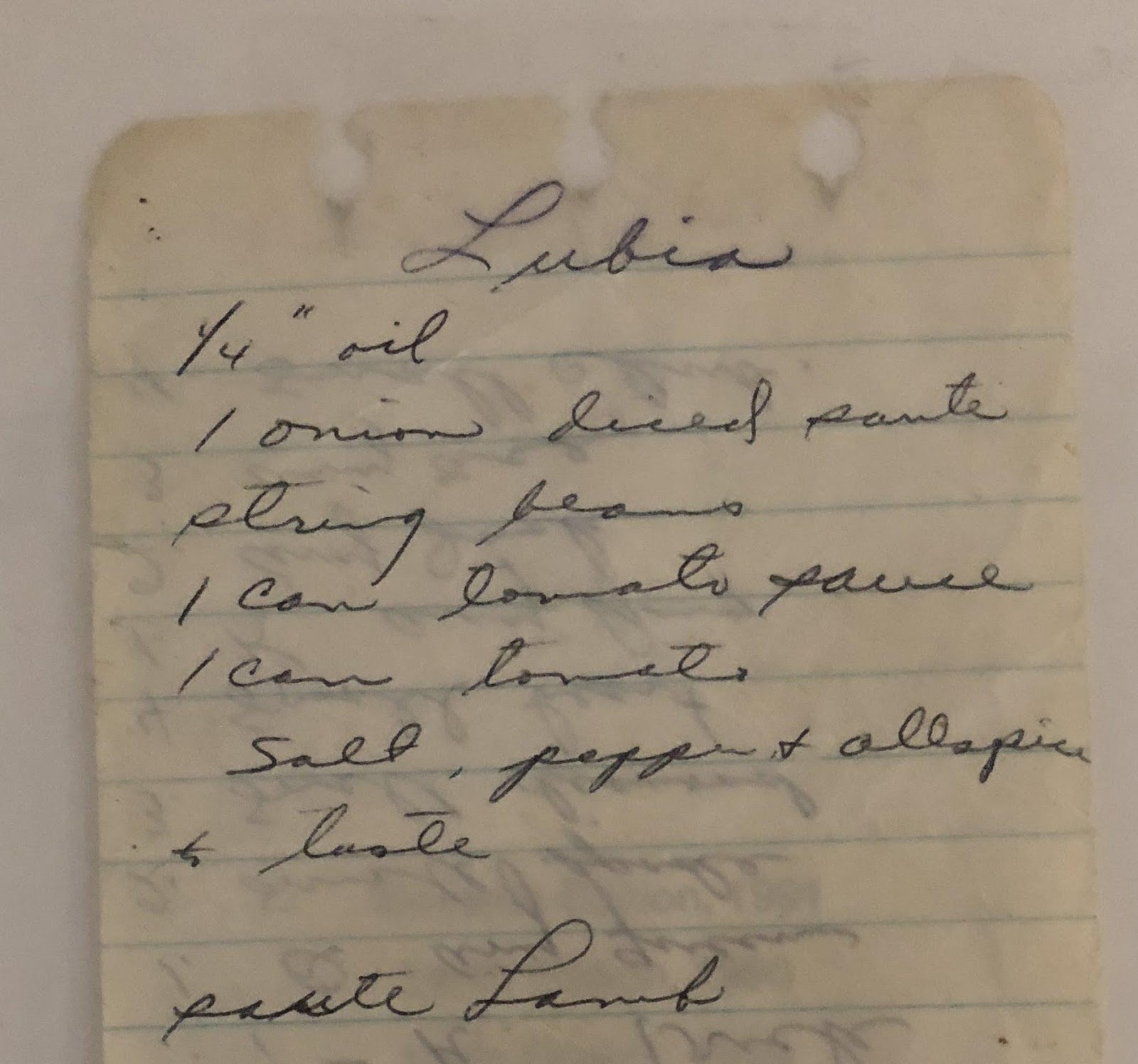
Last spring, I visited my family in New Mexico, and the first thing we did together, like always, was eat. My dad and my aunts are half Lebanese from my grandfather’s family, and our meals reflect that heritage. On the night of my arrival in Albuquerque we ate dolmades, kibbeh, tabbouleh, and lubia. When I asked my aunt for the lubia recipe, she opened up an old cookbook and showed me the recipe scrawled on a piece of scrap paper in my grandma’s handwriting taped inside the front cover. She then told me how my grandmother would make the dish weekly and serve it with rice and lamb. I didn’t remember my grandmother making this recipe but seeing the recipe written out in her handwriting and hearing my aunt tell stories about eating the food made me feel at home. These kinds of food stories and food texts are ones that create bridges. Like Jennifer Cognard-Black says in relation to her own grandmother’s recipe: “recipe writers elicit history, personal, communal, narrative, symbolic, and imagistic associations” (34). Each of these components of recipe writing, and I argue food writing more generally, has valuable implications to explore. But they must not be explored in isolation. It is through the crossing of rhetorical boundaries that we, as rhetorical scholars, can understand how food writing is a bridge.

Image is a photo of a recipe written on small, lined paper. The recipe is from the author's grandmother describing how to make lubia.
Fig. 1. The author’s grandmother’s handwritten lubia recipe.

In their 2012 book Feminist Rhetorical Practices, Jacqueline Jones Royster and Gesa Kirsch say that feminist scholars must pay attention to the stories women tell, as well as “rhetorical domains—not just public ones but those that might be considered private or social” (134) that women occupy. They say that “such [public/private] binaries have been powerful in limiting the frameworks within which women’s practices have been expected to occur historically and even more powerfully in creating the hierarchies of sociopolitical favor that have functioned to devalue women’s accomplishments, whether women were actually participating in public domains or private ones” (99). Both public and private domains must be recognized, as must women’s experiences within both. Scholars like Karen A. Foss and Sonja K. Foss have done much in working towards “dismantling the public-private divide” (Royster and Kirsch 99), but more must be done in order for the value of experiences and knowledge to be recognized and equally granted to men and women within both domains.

The edited collection Food, Feminisms, Rhetorics takes up this work of interrogating not only what food writing is, but how it needs to be taken up in rhetorical studies. The editor, Melissa Goldthwaite, says that “feminist food writing is neither monolithic nor beyond critique—and that definitions of what it means to be feminist change over time” (7). I agree with this claim, and I would add to it that as being feminist changes, so does what it means to be a feminist food writer. I believe that author Diana Abu-Jaber exemplifies this as she gives specific examples of domain crossing within both her first and second memoirs. Her second memoir does the kind of shifting work that mirrors Goldthwaite’s assessment, as it is a food memoir that does not include food recipes. Instead, what both of Abu-Jaber’s memoirs accomplish is to fulfill a desire to better understand women’s experiences in both public and private domains.

Women’s food memoirs draw attention to stories within both of these domains because of the very focus of the texts—food. Food is made, consumed, and discussed every day in both public and private settings. Women’s food memoirs offer insightful, revealing, and tangible examples of individual women’s interactions with foods, as well as their intersectional identities and the way that those identities are formed and communicated. These memoirs address rhetorical domains in ways that can impact the readers’ rhetorical decision making in regards to constructions and conversations of intersectional identity markers as the memoirs ask readers to consider experiences that are different than their own but still revolve around the familiar material object of food. Indeed, through the publication of women’s food memoirs, attention is drawn to both the public and private domains of the authors and reflect the social and cultural climates in which they lived. Through attention to these domains, this article explores the definitions, history, and potency of women’s food memoirs in order to show how these memoirs ask readers to interrogate both public and private rhetorical domains and the ways that these domains are created and shared with others.

Royster and Kirsch define four feminist rhetorical practices that value the interrogation of public and personal domains because they are practices that invite readers to engage with both the published texts and the authors of the texts. In the first section of their book, Royster and Kirsch write that their four feminist rhetorical practices of “critical imagination, strategic contemplation, social circulation, and globalization” (19 emphasis original) are “critical terms of engagement” because they “make the familiar strange and the strange familiar in order to call forward what we believe now constitutes a more clearly articulated vista of feminist rhetorical practices” (19). These terms of engagement offer a feminist rhetorical lens through which readers can understand the power and potency of both the lived narratives and recipes included in food memoirs. In this text, I apply these terms of engagement to Abu-Jaber’s 2005 food memoir The Language of Baklava. One reason that I am analyzing Abu-Jaber’s food memoir is because my father’s family comes from Lebanon and her family comes from Jordan, so I can relate to many of her cultural, food, and familial experiences. When reading memoirs, the most powerful ones are those that can speak to or align with the readers’ experiences. Her memoir follows her personal and familial experience living and loving in both Jordan and America. Abu-Jaber’s food memoir also speaks to lived experience in a way that prompts discussions of private and public domains by sharing experiences from both. Finally, I appreciate the way that Abu-Jaber weaves recipes throughout her memoir in a way that both invites engagement with the recipes and adds to the narratives within the text. She recreates her family’s story through fragments of both individual and communal experiences, specifically experiences with food.

I employ the tenets of critical imagination and social circulation in rhetorically analyzing this text. I focus on these two terms because critical imagination and social circulation respectively work to answer the questions “how do we render the work and lives [of female authors] meaningfully?” (Royster and Kirsch 20) and “how do we locate both writers and readers in relation to new textual forms?” (Royster and Kirsch 24). The exploration of women’s food memoirs offers feminist scholars a way to better account for women’s unheard voices and unaccounted for experiences, especially in relationship to food. Food is a material object that has been traditionally assigned to women without recognition of their agency or the opportunity to speak back to marginalizing norms.

As a genre, food memoirs offer scholars and everyday readers alike a glimpse into the life of an author as well as an embodied taste of their lived experience through the description and inclusion of food experiences and recipes. Understanding the genre of food memoirs means recognizing the various types of genres included in one published text, as well as the historical complexity of the term. The current genre of the food memoir has a foundation in the published work of women like M.F.K Fisher and Julia Child. In “Cooking Up Lives,” Arlene Avakian says, “contemporary food memoirs put food at the center of their narratives, but they are more systematically autobiographical, chronicling the author’s lives through cooking and eating rather than narratives about food that include personal anecdotes” (279). In addition to the focus on interpersonal narratives and anecdotes, the notion of authorial identity is a crucial part of why food memoirs are written and why they are so widely received.

I then add this definition of food texts from Massimo Montanari, that “through such pathways food takes shape as a decisive element of human identity and as one of the most effective means of expressing and communicating that identity” (xii). These two definitions of food memoir provide a nuanced definition of the term with Avakian’s focus on central narratives about the authors and food and Montanari’s definition of food texts as identity pathways. Together, both show why the focus on food is valuable to memoir work. Both also offer a framework through which to read Royster and Kirsch’s work as it applies to memoirs, as they call feminist scholars to attend to “genres that we have not considered carefully enough” and to “think again about what women’s patterns of action seem to suggest about rhetoric, writing, leadership, activism, and rhetorical expertise” (72). These understandings of food memoirs point to authorial agency, specifically in terms of the ways that women have taken up writing about individual and communal food experiences.

While the food memoir genre is growing, Diana Abu-Jaber’s now well-known food memoir The Language of Baklava represents unique food pathways as she discusses literal and figurative border crossing. She speaks from within marginalized identities and communities, and she weaves the three notions of “food, memory, and identity” expertly and smoothly together as she relates her food experiences to her readers (Avakian, “Cooking”, 283). Abu-Jaber’s food memoir shows how one woman dealt with marginalization both as an Arab woman in the United States and as an American woman in the Middle East. Abu-Jaber does this work through examinations and discussions of various aspects of her identity. She posits identity as individual, familial, and communal all at once, and she discusses specific food experiences that informed or challenge each of these understandings of marginalized identity.

This transcribing of identity can be understood through Chela Sandoval’s theory of differential consciousness. Sandoval discusses the way that Indigenous women and other women of color privilege specific components of their identities in response to varying situational and activist causes. In this way, we understand women as having the agency to choose whether or not to activate parts of their identities. What women must choose, then, is to either privilege these parts of their individual and communal identities, or to let those aspects of their identity lie dormant (127). Sandoval’s idea responds to a history of oppression, but the theory offers a hopeful agenda to the women, specifically the women of color, whose identities have been transcribed by others, such as Abu-Jaber’s. Avakian posits Abu-Jaber’s work as feminist because it has wide reaching implications for readers and other women authors, especially those in minority or misrepresented groups. Avakian writes, “The Language of Baklava is a stellar example of the literary use of food practices to interrogate the ethnic ‘we’ through the multilayered connections among food, memory, and identity” (“Cooking” 283). It is through the literary use of food practices that a connection to individuals and communities in both public and private domains is established. Food memoirs, then, become a revelatory text through which food, rhetorical domains, and individual and communal identity intertwine and can be explored.

Cooking, and writing about cooking has, traditionally, been considered women’s work. Elizabeth Fleitz says,

from its origins as an apprentice-based oral culture to the preponderance of food blogs and online recipe sharing forums, the authors of and audience for cookery texts is primarily female. Even with the inclusion of male hosts on Food Network cooking shows such as Bobby Flay and Emeril Lagasse, the majority of viewers—and consumers—are women. (2)

Fleitz argues that what has happened, then, is that women have formed a community in which they can act, speak, and affirm one another in this “private sphere, [which] has gone mostly unnoticed” (2). As this private sphere has become more public through media, like the cooking shows mentioned previously, typical patriarchal patterns of domination and silencing have started imposing on this sphere as well, as “the public/private division separates men and women unequally, as not only are men separate from women, but they are also dominant over women as well” (Fleitz 3). Food memoirs represent a space of authorial agency that speaks back to these patriarchal conventions and conversations by offering a space in which women can share their personal and communal experiences and show that “women’s traditional lives are worth thinking about, worth writing about, worth reading about” (Bower 9). Similar work can, and often does, happen on food blogs; however, for better or worse the permanency and accolades attached to published work does speak to the recognition and ability to share and reference these stories and experiences. Royster and Kirsch highlight the “shift in the commitment to engage dialectically and dialogically” with women authored texts, like food memoirs, “to actually use tension, conflicts, balances, and counterbalances” to better inquire and engage with not only the texts themselves but the “women whom we study” (72). This call asks readers and scholars to not just consider these texts a-contextually but to engage with both the narratives and recipes as representations of the author who wrote them. In this way, we recognize the way that food memoirs invite agency and demonstrate the value of sharing these texts and experiences as we explicitly affirm the value of the women who wrote them.

Crossing from a private to public domain, then, is about both engaging with published women’s texts but also about crossing borders of what we consider serious scholarship or narratives worth analyzing. Smith and Watson theorize the study of life writing, including genres like cookbooks and memoirs. The implications of Smith and Watson’s theory speak to the way that autobiographical texts, including memoirs, are currently conceived and the work that they can do within the university. Smith and Watson write of their three autobiographical theoretical tenets, performativity, positionality, and relationality, that they are “enabling concepts of recent theory [that] energize and redefine the terms of life narrative by calling formerly established critical norms into question” (217-8). Like Royster and Kirsch’s four feminist rhetorical practices, I see these three theoretical elements as asking rhetorical scholars to further engage with the material like Abu-Jaber’s text. Indeed, Smith and Watson say, “as we consider the complex ways in which new genres and new subjects may energize one another, these concepts enable more flexible reading practices and more inclusive approaches to the field of life writing” (218). This quote exemplifies my reason for choosing to use Abu-Jaber’s memoir as a site for analysis, as it shows not only Abu-Jaber’s crossing from a private (personally known) to a public (generally known) domain, but it asks the reader and researcher to do this same kind of crossing over, as many of the cited texts also ask researchers to do.

Smith and Watson assert that food memoirs “offer readers tasty pleasures and ‘food’ for self-revision” (148). Reading and writing about food is about so much more than simply sharing meals or recipes. It is about sharing culture, heritage, and individual experiences. Smith and Watson write that by including recipes in texts, “traditional foods become part of the cultural folklore that gastrophy revives and revalues in calling people to their cultures of origin and educating the dominant community about historical adventures occluded in urban life” (149). In this way, they discuss food memoirs as texts that reintroduce and revise narratives around food and food traditions. Memoirs interrupt traditional conceptions of food and food traditions and ask people to consider what it is they are cooking and eating. As Abu-Jaber demonstrates, crossing borders is about collectively becoming oneself—through historical, cultural, and communal experiences. Women authors like her

have conserved a whole world, past and present, in the idiom of food. In their personal manuscripts, in locally distributed community recipe compilations, and in commercially printed cookbooks, women have given history and memory a permanent loading. The knowledge contained in cookbooks transcends generations. (Theopano 49)

The crossing borders, specifically those of public and private domains, does this working of revaluing and preserving whole generations of history.

Middle Eastern Cooking

Abu-Jaber shares story after story about cooking Middle Eastern food both in America and in Jordan. These are stories that I recognize, as they are similar to my cooking and eating experiences with my Lebanese family members. Abu-Jaber’s memoir is divided into 24 different chapters. Although the chapters are arranged chronologically, each one focuses on one memory or specific period in her life. The first chapter, titled “Raising an Arab Father in America,” details her experiences as a six-year-old living in Syracuse, New York with her family, including her Jordanian father who she refers to throughout the text by his nickname, Bud. The reason for this nickname is that “he flags down men and women alike with the same greeting: ‘Hey, bud!’” even though, Abu-Jaber points out, “my father’s name is Ghassan Saleh Abu-Jaber” (4). This difference in naming is just one way that Abu-Jaber sees her family as “Arab at home and American in the streets” (5). Assimilation is not easy for her family, especially not her father.

The final chapter of the memoir is called “The First Meal,” and it describes Bud opening a restaurant—the realization of his lifelong dream. The restaurant does not feature Jordanian classics as he had once envisioned, but he serves “rows of burgers, sizzling French fries, blistering hot dogs, and grilled cheese sandwiches” (324). Bud realized his dream in America but in a very different way than he had once imagined. He now has a new name as well, used by his American grandchildren. They cry out, “Jiddo! Jiddo! Grandpa!” when they see him (326 emphasis original). There is still a sense of “the in-between, the borderlands” for both Bud and his family who “live their lives in the air” going back and forth from Jordan and America, and also for Abu-Jaber herself (326). She identifies herself as “a reluctant Bedouin—I miss and I long for every place, every country, I have ever lived” (327). Abu-Jaber concludes her book with the sense that the “coming over” is never quite complete (6). She feels that she has pieces of herself left in all of the places where she has spent time. She identifies with two very different cultures and with cities all over the world.

These two chapters bookend her memoir, but the chapters in between cover a wide variety of subjects and memories. Abu-Jaber tells stories from both her childhood and adulthood in the United States and in Jordan. She talks about an abusive uncle, a strict but naive grandmother, a homesickness that leads to an eating disorder, failed marriages, and finding a man that she wants to take to her “amazing country” and show her “beautiful history” (323). These 24 chapters are interspersed with 43 different recipes. There are recipes for “Gram’s Easy Roast Beef” (109), “Lost Childhood Pita Bread” (136-7), and “Spinach-Stuffed Fetayer For Those In Search Of Home” (261-2). These recipes, though completely usable as recipes alone, correspond with the subjects of the chapters and offer the readers a chance to not only better see the work of the narratives, but, if they choose to actually make the recipes, offers a literal taste of the struggles or joys that Abu-Jaber is describing.

These various examples, and even the way Abu-Jaber orients her text, draws attention to both the public and private domains that she occupies as a Jordanian-American woman. This tradition of eating and cooking Middle Eastern food was not always an individual or communal cultural identifier for Abu-Jaber, though. She recounts one story of telling her aunt, “‘I hate Arabic food!’ Then I look away quickly, afraid to see her reaction and frightened of my terrible words. Worse even, it seems at that moment, than saying, ‘I’m not an Arab’” (185). What this childhood obstiance demonstrates is Abu-Jaber testing the waters of her relationship with family and with own identity by declaring that she does not like the food she knows best and grew up eating. What Abu-Jaber is rejecting here is a part of herself, not just her aunt’s baklava.

It is food, though, that draws Abu-Jaber into her culture and helps her to find her identity in this space. Abu-Jaber does this work of meaningfully rendering her own identity in the context of real women’s identities and domains as important and worthy of attention. She illuminates the contexts in which they lived and works to make the women’s lives of the past have significance and meaning to current audience by sharing her own experiences. In the chapter called “Native Foods,” the Abu-Jaber family travels to visit their Bedouin family in the place that her father calls “the source of the winds, at the center of the valley. This is where our family started” (60). As they travel and stay in this place, Abu-Jaber senses, sees, tastes, and smells the history of her family. In a place where “the whiteness of the sky separates itself from the pale earth” and there are “baby goats and blatting lambs” hanging around the tents and open spaces (61), Abu-Jaber begins to understand her familial history. She focuses her recollections on one woman named Munira, a Bedouin woman who works for them in the city and travels with them to the desert. When the other Bedouin women ask where Abu-Jaber comes from, Munira says “She is mine!…She belongs to me” (62). They eat and dance in this place, and to Abu-Jaber it seems that “there is so much food that it seems limitless” (66). Munira asks Abu-Jaber “in the city Arabic” if she would like to stay there with her forever (66) and she says yes. It is Abu-Jaber’s mother who finally breaks the revelry and asks “you ready to go?…I think it’s time” (67). Abu-Jaber represents her ancestors by painting beautiful pictures of their world with her words. By describing the endless sky, food, and laughter, she describes lives that, too, seem endless. Indeed, she says “if I had stayed by Munira’s fire for one more moment, I might never have left at all” (68). Abu-Jaber critically reimagines the life of a Bedouin, basing her reflection in a way that invites readers who have never experienced anything like this to understand and rest in her past experiences.

The recounting of these food experiences does more than just point to individual memories that make up Abu-Jaber’s story. Anne Bower says, “the tendency to trivialize food culture scholarship…the tradition of western philosophy has tended to privilege questions about the rational, the unchanging and eternal, the abstract and mental, and to denigrate questions about embodied, concrete, practical experience” (7). What this focus on food culture points to is the agency needed within both public and private spheres where food is discussed and food stories are shared. Royster and Kirsch “emphasize, then, that feminist rhetorical practices have helped us to embody the idea that rhetoric is action—past, present, and future” (73). The rhetoric of food has a kind of double agency attached to it, then. Both the sharing of food texts and the making of food is agentive and both acts are often dismissed both within and outside of the academy, especially when they are enacted by women.

One of the most poignant stories that Abu-Jaber includes in her memoir points to the power of inclusion and agency even within the private sphere of the home and family. She tells the story of when her cousin, Sami, was forced by his father and uncles to come to the United States. They say he needed to come because he is a “poet,” but they are actually trying to “cure” him of his implied homosexuality. Sami is not eating and is obviously miserable, so Abu-Jaber recounts: “I pluck a morsel [of lamb] from the plate and run to him while it burns my fingertips. To my mind, this is the best way to show love—to offer food from your own hand” (8). Sami initially refuses the food, but then ultimately decides to take it, and “he says quietly, ‘it’s good’” (9). Abu-Jaber’s memory and retelling of this instance shows her agency within this very private space, and she brings it to the public sphere as she remembers and discusses it. She offers Sami a piece of their heritage in this place that is very new and foreign to him. Eves says that by sharing recipes and recounting food traditions, “what’s transmitted is not so much for the ‘living knowledge’ of memory but the structures for this knowledge—the narrative framework around which memories, both individual and communal, are constructed and invested with meaning” (282). This food memory is invested with meaning; meaning about culture, inclusion, heritage, and hope. Abu-Jaber’s agency in giving the food and recounting the experience creates this kind of narrative framework through which outside audiences can see and recognize her agency in both these public and private rhetorical spheres.

Critically Imagining Food Consumption

When considering the ways that these private and public rhetorical domains or spheres are created and discussed, we, as feminist scholars, must account for not only the present day realities but also the past and future implications of this work as well. Royster and Kirsch state that the first of their four rhetorical practices, critical imagination, “functions as one of several inquiry tools available for developing a critical stance in order to engage more intentionally and intensely in various intellectual processes” (71). This does not mean viewing past or future discussions of food writing through skewed, rose-colored glasses, but it does mean recognizing those who have come before and will come after. In “Cooking Up Lives,” Avakian argues for a feminist reading of Abu-Jaber’s novel, saying: “Abu-Jaber’s descriptions of eating Arab food convey comfort and clarity about who she is, but they are not nostalgic or romantic representations in which diasporic characters recreate home through ‘authentic’ food” (284). Abu-Jaber is very aware of the personal, cultural, and political struggles and that the food practices that she discusses represent. Yet, with respect and honesty, Abu-Jaber looks at the history of her food culture, the present understandings of it, and the future ramifications—just as critical imagination calls the feminist scholar to do. And through doing so, she represents both the private and public domains of the food culture in which she grew up and about which she is writing.

In Abu-Jaber’s text, she is engaging in critical imagination by piecing together both her family’s story through fragments, as well as her own story. She does this work by attaching moments of grief, pain, joy, and purpose to food. To better understand this I go back to one of Royster and Kirsch’s first articulations of this concept in their article “Feminist Rhetorical Practices: In Search of Excellence,” in which they talk about how their feminist rhetorical practices work “is grounded in and points back to the pioneering women, both contemporary and historical, who have insisted on being heard, being valued, and being understood as rhetorical agents” (643). I argue that that is the kind of work that Abu-Jaber is taking up through critical imagination—she is a contemporary woman who makes sure that her voice and experiences are heard and valued, starting in her own family. Royster and Kirsch often use critical imagination as a way to engage with women historically, but they assert that this term is not limited to that scope. They write that critical imagination takes into account women “whom we have not looked at before” (650), women’s “own cultural frameworks” (652), and ambitiously “enacting [an] ethos of care” that is “connected neither to the past or present. Instead, it connects both us as scholars and the women as rhetorical subjects to the future” (653). This connecting of historical tradition, like Abu-Jaber learning to make baklava from her aunt, with future generations, like her daughter, shows she is doing this bridging work of accounting for what she knows (650) through these narratives. In fact, in a recent article about Abu-Jaber’s fictional work, Arlene Avakian describes how Abu-Jaber uses “food and cooking in the novel to help count[er] Arab American stereotypes” (“Baklava as Home” 132). I argue that Abu-Jaber does similar work in her food memoir through the uptake of tenets of critical imagination and thus proving “a more robust capacity” for her readers to “reach insights” about not only the food she is cooking but the life she is living.

Royster and Kirsch posit that critical imagination asks us to “attend to our own levels of comfort and discomfort, to withhold quick judgment, to read and reread texts and interpret artifacts within the contexts of the women’s chronologies, to interrogate the extent to which our own presence, values, and attitudes shape our interpretations of historical figures and periods” (76). Through this rhetorical practice they are asking scholars to “account for what we ‘know’” and then “think between, above, around, and beyond this evidence” (71) to better understand and represent the histories we are reading. In accounting for what we know, Eves argues that this work is commonly done through food texts, and she specifically discusses African-American women’s cookbooks. Of the history and memory represented in the texts, she writes, “both the dynamic body of knowledge that can be transmitted between individuals and within communities, as well as to the more static mechanisms through which we store and retrieve this knowledge” (281). In this way, she is arguing that it is both what and how this traditional food knowledge is transferred that matters.

In her memoir, Abu-Jaber represents this awareness of past experiences as shaping who and what she identifies with as she grows up. As Avakian discusses, Abu-Jaber’s Aunt Aya is the primary, strong, Arab female figure within the memoir. Abu-Jaber does discuss her mother’s mother, Grace, in some detail within the memoir as well, but Grace was far more representative of food other than the Middle Eastern food that Abu-Jaber’s father, Bud, would cook. Abu-Jaber remembers a conversation with her Aunt Aya focused on various meanings behind production and consumption: Aunt Aya says, “‘You ate some baklawa?’ She curls her hand as if making a point so essential, it can be held only in the tips of the fingers. ‘I looked. I tasted, I spoke kindly and truthfully. I invited’” (190). This consumption of baklava (or baklawa) is representative of being an assertive woman in America and not just conforming to a father or husband’s desire or wishes. In addition to that subversion of sexist stereotypes, though, this conversation is also quite literally an invitation for Abu-Jaber to not only accept her past but explore it. Her aunt was offering a piece of her heritage, and it wasn’t until Abu-Jaber learned to appreciate the historical precedence attached to the food that she could actually enjoy the food itself. Susan Leonardi says that “a recipe’s reproducibility can have a literal result, the dish itself. This kinship to the literality of human reproducibility, along with the social context of the recipe, contributes to the gendered nature of this form of embedded discourse” (344). When Abu-Jaber recreated the baklava recipe with her aunt, she was doing more than recreating a recipe. She was recreating a meaning, an identity. The critical imagining and piecing together of her identity comes from not only making food but from experiencing it. In this case, Abu-Jaber initially pushed against the experience before accepting it as her own.

When discussing Abu-Jaber’s father eating the same food, Aunt Aya says that what he is actually doing is “eating the shadow of a memory” (190). She states that he “cooks to remember” (190). This memory does its work on Abu-Jaber, as well. She says “when I inhale Auntie Aya’s baklava, I press my hand to my sternum, as if I am smelling something too dear for this world. The scent contains the mysteries of time, loss, and grief, as well as promises of journeys and rebirth. I pick up a piece and taste it. I eat and eat. The baklava is so good, it gives me a new way of tasting Arabic food. It is like a poem about the deeply bred luxuries of Eastern cultures” (191). When her father, Bud, ate the baklava as a memory Abu-Jaber deemed it “well, dramatic” (190), but when her aunt offers it to her as part of their own history made from “our homemade phyllo” (191), Abu-Jaber begins to understand. And she begins to eat.

In recognizing the past, food experiences within both public and private domains must then be brought into the present. The way that food is taken up or discussed in the present, specifically within the academy, seems to continue to carry the patriarchal understandings of food texts and cultures. Royster and Kirsch say that critical imagination then asks scholars to be “attuned also to our blind spots in order to consider with critical intensity what may be more in shadow, muted, and not immediately obvious” (76). We must be continually aware of what is in front of us in order to best shape discussions about and around food practices in public and private domains. Bower says that “scholars working with such fragmentary forms as women’s scrapbooks and samplers, ‘artifacts’ that were produced by women relegated to a private, domestic sphere, are learning to read the stories these texts relate” (5). This reading of stories is done differently within food memoirs because in food memoirs there are literal narratives, but the work of reading the stories then falls to scholars in order to understand the social, cultural, and political realities these stories and recipes are representing.

To amend the popular saying, then, critical imagination asks us to consider the reality that with great knowledge comes great responsibility. As these various experiences that Abu-Jaber recounts in her memoir shaped her experience of recognizing historical context as well as the importance of understanding cultural and societal norms in the present, she also began to feel the weight of this responsibility as she grew. Within the academy, this responsibility is tangibly felt by feminist scholars as well. Royster and Kirsch state that one of the “paramount” responsibilities that accompanies critical imagination is “recognizing the need to construct consciously a role and place for ourselves in the work and to understand our specific professional and personal relationships to it” (78). As we know by now, this space is not created for us as scholars; it is a space that we must create ourselves. That is where the work of bridging the private and public domains becomes so important. By recognizing and studying food experiences in printed texts we do the work of collectively revaluing shared experience as worthy of scholarly focus. Regarding community cookbooks, Fleitz says, “existing in the private space of the home, recipes and the discourses they reflect have often been overlooked as a cultural text. Upon closer inspection, these forms of women’s writing carry significance beyond a list of rules and measurements, hinting at the values and desires of their authors and the communities they lived in” (1). This is exactly the work that Abu-Jaber’s text does, as an example of the way that food texts and food stories must move out of individual kitchens and into larger circulation.

Abu-Jaber becomes a very globally aware citizen, and she discusses her moves to and from the United States and Jordan several times in her memoir. She begins to feel the pull that comes with recognizing global realities and responsibility as she writes, “like a second, invisible body, I sit up out of my sleep at night, wander across the room, stop beside a darkened window, and dream my way through the glass…Come back, I want to say to my second self, there is tea and mint here, there is sugar, there is dark bread and oil” (327). She does not want to feel split in her personality and goals, but she also recognizes the need to feel the pull from both places, both cultures, both versions of her individual self. She writes, “I must have these things near me: children, hometown, fresh bread, long conversations, animals; I must bring them very near. The second self draws close, like a wild bird, easy to startle away: It owns nothing, and it wants nothing, only to see, to taste, and to describe” (327). The first and second selves are not defined, as they are both parts of herself, and yet are informed and influenced by global experiences and realities. Abu-Jaber draws on food texts and traditions to position her individual identity in order to make way for identities like hers to be expressed in the future. She writes about eating food in Jordan and says, “tonight, this is the purest food in the world. Mother’s milk. It is the sort of food that can’t be replaced by anything else” (229), and even when she moves back to the United States she attempts to “cook all the dishes that I ate in Jordan, the simple Bedouin flavors—meat, oil, and fire; like Bud, I am trying to live in the taste of things” (318). She eats and writes not to erase parts of herself, but to keep as many parts of herself and global experiences as alive as possible. She does and shares this work as a way to make space not only for her own stories but for the stories of those that come after her.

Abu-Jaber wrote a second food memoir called Life Without a Recipe in 2016, and in that memoir she recounts stories mainly with and about her daughter, Gracie, named for her maternal grandmother. This memoir, like the name suggests, does not include recipes, but instead is a text in which Abu-Jaber’s daughter is represented and has her earliest experiences recorded. This is building on the work of critical imagination and moving into a space of circulation. The circulation of recipes within The Language of Baklava does the work of bridging between the private domain of the kitchen and the public domain of sharing these texts and stories. This memoir, like the edited collection Nestle was discussing, “argues for the human hunger and passion for narratives as well as sustenance” (Nestle). Though Abu-Jaber does not share specific recipes in this text, she provides a different kind of sustenance: stories and answers. In the first memoir readers got attached to Abu-Jaber’s family through the stories she told, and in the second memoir we can better understand Abu-Jaber’s family’s story, as well as the importance of understanding both the private and public domain.

In the introduction to her text, Abu-Jaber writes of a childhood experience eating a sandwich at a neighbor’s house. She writes, “I felt better at the table, which I thought of not just as a place to eat but also as a story-telling, argument-having, useful and plain-faced and reassuring” (12). Abu-Jaber describes another border crossing here. She describes the table not just as a place to eat but as a place to share. Nestle says that “food writing…fiercely connects the life of the body to the life of the mind” (xvii). Writing about food is not just about understanding—it’s about sharing. And sharing helps us to overcome barriers of resistance, oppression, or misunderstanding because we are no longer viewing those in different domains as the other. We are viewing them as we view ourselves.

Socially Circulating Family Recipes

Royster and Kirsch define social circulation as “understanding rhetorical interactions across space and time” (98). In order to understand what these recipes, in particular, are doing, we must understand where they come from. Reading the text through the lens of critical imagination has shown that as feminist scholars we must work to understand women rhetors not just in the present day but in the past, through their relationship to other women, and within patriarchal hierarchies of power. Royster and Kirsch go on to posit that “the concept of social circulation might well begin with a disruption of the dichotomies associated with rhetoric being defined within what has been considered historically to be public domains of men, rather than within the private domains of women” (98). This disruption of the binaries of private versus public domains is exactly what published women’s food memoirs help to accomplish. The memoirs, and texts like them, “explicitly bring our attention to the importance of the fact that the study of communication and rhetoric had been confined to formal public arenas, the very places where historically the practices and the eloquence of women have been ignored” (99) and suggest that this sense of the fluidity of language use—as well as the fluidity of the power those uses generate—can help us see how traditions are carried on, changed, reinvented, and reused when they pass from one generation to the next” (101). This sense of fluidity is what takes the reader from the pages of the text and asks them to enact embodied engagement by making, smelling, and eating these exact recipes that Abu-Jaber shares. The fact that she has chosen to share these recipes by publishing them in her memoir text is what gives us, as readers, the opportunity to not only read about the narratives that Abu-Jaber describes but actually get a taste of them.

In Abu-Jaber’s text, the social circulation occurs as the following happens: recipes or traditions are shared with Abu-Jaber, Abu-Jaber shares recipes and traditions in her text, and readers are invited to take up the circulation process as they read about and engage with the recipes and traditions. As a reader, one may not make all or any of the recipes described in the text, but the invitation for continued social circulation is offered by providing the readers with the specific recipes discussed. Janet Theophano discusses the importance of this kind of circulation in the introduction to her text, Eat My Words. She says that women “carefully construc[t]” cookbooks and recipe books, “we could learn a great deal by studying them” (5). She also says that that doing this kind of studying “expand[s] the significance” of both the experiences described and the recipes included because they are shared (5). She discusses how reading cookbooks and recipes is about much more than learning how to cook a certain food or meal. She says it is about “discovering the stories told in the spaces between the recipes or within the recipes themselves” (6). That is where Abu-Jaber takes up the work of social circulation—by repeating the stories and recipes given to her and offering them to an outside audience.

In relation to these foundational concepts of social circulation, Royster and Kirsch discuss “language use as a symbolic materiality for building circles of meanings that are shareable and usable in social interactions” (102). This is what these recipes do within texts like Abu-Jaber’s. The sharing of the recipes moves the opportunity to interact with this food and recognize the value of by giving both shareable and usable texts with the food memoir narrative. Although referring to community cookbooks, Lisa Mastrangelo states that we must read the recipes and the collections—their social, textual, geographical, and historical clues—in order to garner a greater understanding of the meaning of the texts” (74). What food memoirs offer that some cookbooks or other collections of recipes do not is contextual information for the recipes that are included. As might be expected, the recipes included in the memoir correspond with the narratives described in the chapters and many times were foods actually mentioned within the chapter. Recipes are significant texts because they “convey information not only for women but about them” (Eves 282). Abu-Jaber’s text describes her and many times, the descriptions are through food texts or experiences. As Leonardi says, “even the root of recipe– the Latin recipere– implies an exchange, a giver and a receiver. Like a story, a recipe needs a recommendation, a context, a point, a reason to be” (340). Food memoirs do this exchange work, as do more traditional cookbooks. Food memoirs don’t necessarily allow for easier social circulation than cookbooks, but they do open up opportunities to share recipes with different readers. As a reader, I don’t particularly enjoy thumbing through cookbooks; however, the pages of many of my food memoirs are dog-eared, marked, and splattered with oils or sauces from multiple uses in the kitchen. The sharing of recipes that happens through food memoirs invites readers into spaces they might not otherwise occupy.

As we consider the rhetorical work of recipes and how they help to carry women’s experiences across the unnecessary binary of private and public domains, we must consider what it means to share recipes. Does it mean just calling up an aunt or friend and asking them how they make something? Does it mean writing a recipe down by hand and sending it in the mail? Does it mean sending a link to a food blog via text or email? It might mean all of these things, but sharing recipes, like sharing other personal texts also means much more. One thing that sharing recipes does is that it “argue[s] a specific communal identity… in other words, we signal our group affiliation through food choices” (Eves 288). By asking for a recipe or giving a recipe, we are inviting ourselves into a fold or inviting others to be part of our community.

In the chapter “Hot Lunch,” Abu-Jaber includes a half-page recipe called “Bud’s Special Rice for Special Company.” In this chapter Abu-Jaber explains how a lonely nun from her school liked to be invited to her house to eat Bud’s cooking. The nun’s extreme revelry in the food, and seemingly in Bud’s company, caused Abu-Jaber’s mother to put an end to the invitations. As Abu-Jaber recounts seeing the nun staring at her from across the cafeteria, “her tray of food untouched, her eyes burning as if with some sweet but dimly recalled memory,” Abu-Jaber shares the recipe for the rice the father made for the nun (29). This recipe includes long grain rice simply boiled with salt and then served with sautéed pine nuts on top. This recipe was meant to be shared. The added accents of freshly ground pepper and cinnamon sprinkled on top of the nuts says more about the invitation to warm, hearty meal than about the specific ingredients themselves—although, even the imagined aroma is intoxicating.

Another aspect of sharing recipes is the collecting of them together. Texts like community cookbooks, collected binders of recipes, food blogs, and published cookbooks are the greatest indication that we like to gather recipes together. That the only thing better than having one recipe is having many. Eves says, “as a stand-alone list of ingredients, recipes do not usually suggest much. But collected and arranged within a particular context, they begin to signify a great deal” (288). The collection of recipes, like those collected in a food memoir, begin to present a unified image. A sense of community, culture, and history is collected in the gathering of recipes, in which they seem to share and imbue meaning with one another.

In one of the last chapters of the memoir, “Once Upon A Time,” Abu-Jaber includes a recipe called “The Uncles’ Favorite Mezza Platter.” This recipe is shared after a description of a party that Abu-Jaber describes when she was living in Jordan and her father came to visit. There are friends, uncles, and aunts at this party, and Abu-Jaber describes how her uncles start the party “with the usual bad-tempered political debates about Israel and Palestine, nuclear weapons, Israel and Lebanon, Saddam Hussein, Saudi Arabia, too much oil, not enough oil” (274). But then she includes a recipe that is “reminiscent of Spanish tapas” (277) and includes a variety of “classics” to lay out on a singular platter as a course “designed to stimulate hunger, not satisfy it” (277). The suggestions include olives, braided string cheese, roasted chickpeas, tabbouleh salad, and pita bread (277). The whole idea behind this platter is to share. Within that sharing, though, there are ideas, opinions, and lots of different tastes. As representative of this shared collection of recipes and narratives, there seems to be something for everyone on one platter that has meaning because it is all gathered together.

In addition to meaning being understood through sharing, it must also be usable (Royster and Kirsch 102). If language, or recipes, are not usable, then what good are they? In that case, they do nothing to move understanding of value from public spheres to private ones or nothing to better help women communicate private domains in public ones. What recipes do is help us create something, whether within ourselves or simply on our plates, as “culinary traditions and food memories define us, offering solidarity with and a sense of distance from our familial, social and ethnic groups. But, in keeping and adapting familiar recipes, we are able to create practices that, even as they recall the past, initiate new traditions, new identities, new selves” (Heck). Recipes are usable in that they create something new from something traditional or historical.

Abu-Jaber describes her first semester at college; it was one of change, angst, and uncertainty. It was her first time away, her parents were moving from her childhood home, and she wanted to break up with Timmy, her current boyfriend, although, she hadn’t done so yet because she got “preoccupied with packing” (224). After eating almost nothing but candy, and then subsequently getting very ill when she ate real food, Abu-Jaber’s first night home for Christmas break, her parents made “Homecoming Fatteh.” She describes it as “a layered dish of toasted bread, chicken, onion, spices, and pine nuts covered with a velvety yogurt sauce” (225). Abu-Jaber eats this dish “recklessly, like an amnesiac with no awareness of anything but the table, the sweet sadness of return, and the moon hanging like a sigh just beyond the long dark fields” (225). This dish doesn’t cure all of Abu-Jaber’s woes. She fights with her father over her major, and she continues to get sick throughout her month home on break, but it does start to shift something. It is a dish that is usable. It is usable to cure hunger, to prompt discussion, and to start to bring her back home. These recipes do what they do—they provide instructions on how to get something done. But, like memoirist Jessica Fetchor says, “a good recipe makes you brave” (200). It brings something new together, piece by piece, and invites the eater in.

Conclusion

This argument, based on two of Royster and Kirsch’s feminist rhetorical practices and exemplified through Abu-Jaber’s memoir and recipes, is positioned to argue for the necessity of recognizing the value of both the public and private rhetorical domains that women, specifically, often occupy. As I discussed moving from private to public, that was meant in no way to further marginalize or discount the private domain because the private domain is often where the wealth of these stories, traditions, and texts are birthed. It is within that domain that we feel at home, that we find who we are, and that we push the boundaries of our own communal, societal, and individual intersectional identities. For me, it is within the private domain that I learned how to mix chickpeas with olive oil, garlic, and salt and make a hummus that sings or subtly hints at flavor. It is within the private domain that my aunt shared my grandmother’s lubia recipe with me. It is within this domain that my aunts carefully crafted thin sheets of phyllo into crispy, flaky baklava for a family gathering of 200-plus cousins.

The bridging work, then, that we are called to do as feminists comes through understanding the foundational tenets of critical imagination and social circulation. It comes from recognizing that personal, private food stories and traditions are ones that not only can be shared but should be shared. This is what Royster and Kirsch argue for in the uptake of their feminist rhetorical practices. These are the stories of our grandmothers, aunts, and cousins. These are the stories of our cultures, societies, and families. The sharing of these stories, specifically private food stories, within the public domain do three specific things. The first is the way that writing about food can help the author and the reader process experiences and memories by giving them a tangible object on which to focus thoughts and emotions. The second is that food memoirs legitimize these everyday personal and communal experiences, and reveal that the truths of those situations are worth being communicated to a larger audience. The third is that food memoirs challenge different cultural scripts than other texts such as: pleasurable experiences are not valuable experiences to study, or experiences of food do not significantly impact our constructions of self and the world, or women in the kitchen means that they take a subservient role. The way that food memoirs help readers process, legitimize, and challenge their own experiences, identity pathways, and cultural scripts is significant because few texts allow this kind of exploration in such a seemingly familiar space that readers can relate to. These three tenets ask us, as scholars, to recognize and discuss both the private and public domains in which women operate and discuss both as worthy of academic and personal care, attention, and study.

Works Cited

Abu-Jaber, Diana. The Language of Baklava. Anchor Books, 2005.

—. Life Without a Recipe: A Memoir. Norton, 2016.

Avakian, Arlene. “Cooking Up Lives: Feminist Food Memoirs.” Feminist Studies, vol. 40, no. 2, 2014, pp. 277-303.

—. “Baklava as Home: Exile and Arab Cooking in Diana Abu-Jaber’s Novel Crescent.” Food, Feminisms, Rhetorics, edited by Melissa A. Goldthwaite, SIU Press, 2017, pp. 132-141.

Bower, Anne. “Bound Together: Recipes, Lives, Stories, and Readings.” Recipes for Reading: Community Cookbooks, Stories, Histories, edited by Anne L. Bower, University of Massachusetts P, 1997, pp. 1-14.

Cognard-Black, Jennifer. “The Embodied Rhetoric of Recipes.” Food, Feminisms, Rhetorics, edited by Melissa A. Goldthwaite, SIU Press, 2017, pp. 30-47.

Eves, Rosalyn Collings. “A Recipe for Remembrance: Memory and Identity in African-American Women’s Cookbooks.” Rhetoric Review, vol. 24, no. 3, 2005, pp. 280- 297.

Fetchor, Jessica. Stir: My Broken Brain and the Meals That Brought Me Home. New York, Plume, 2015.

Fleitz, Elizabeth. “Cooking Codes: Cookbook Discourse as Women’s Rhetorical Practices.” Present Tense: A Journal of Rhetoric in Society, vol.1, no. 1, 2010, pp. 1-8.

Goldthwaite, Melissa. “Preparation and Ingredients: An Introduction to Food, Feminisms, Rhetorics.” Food, Feminisms, Rhetorics, edited by Melissa A. Goldthwaite, SIU Press, 2017, pp. 1-11.

Heck, Marina de Camargo. “Adapting and Adopting: The Migrating Recipe.” The Recipe Reader: Narratives-Contexts-Traditions, edited by Janet Floyd and Laurel Forster, Routledge, 2003.

Kirsch, Gesa E., and Jacqueline J. Royster. “Feminist Rhetorical Practices: In Search of Excellence.” College Composition and Communication, 2010, pp. 640-672.

Leonardi, Susan J. “Recipes for Reading: Summer Pasta, Lobster à La Riseholme, and Key Lime Pie.” PMLA, vol. 104, no. 3, 1989, pp. 340–347. JSTOR, JSTOR.

Mastrangelo, Lisa. “Community Cookbooks: Sponsors of Literacy and Community Identity.” Community Literacy Journal, vol. 10, no. 1, 2015, pp. 73-86.

Montanari, Massimo. Food is Culture. New York, Columbia UP, 2004.

Nestle, Marion. “Forward,” Books That Cook: The Making of a Literary Meal, edited by Jennifer Cognard-Black and Melissa Goldthwaite, NYU Press, 2014, pp. xvii-xviii.

Royster, Jacqueline Jones and Gesa E. Kirsch. Feminist Rhetorical Practices: New Horizons for Rhetoric, Composition, and Literacy Studies. Carbondale, Southern Illinois UP, 2012.

Sandoval, Chela. Methodology of the Oppressed. University of Minnesota, 2000.

Smith, Sidonie and Julia Watson. Reading Autobiography: A Guide for Interpreting Life Narratives. University of Minnesota, 2001.

Theophano, Janet. “Introduction.” Eat My Words: Reading Women’s Lives Through the Cookbooks They Wrote. Palgrave, 2002, pp. 1-10.

return to top

Searching for Unseen Metic Labor in the Pussyhat Project

Contemporary public discourse has been inundated with new attention to the old problem of sexual assault. This attention has prompted more survivors and witnesses to share their testimonies publicly and seek legal consequences. For example, following the start of the #MeToo movement, rape crisis centers were flooded with calls, with weekly reports up an average of 25-50% (Lambert). However, despite this wave of new testimonies, survivors found themselves being told that their stories were not enough evidence to bring their assaulters to justice. As reporter Rebecca Traister writes about being contacted by survivors, “To many of them I must say that their guy isn’t well known enough, that the stories are now so plentiful that offenders must meet a certain bar of notoriety, or power, or villainy, before they’re considered newsworthy” (“Your Reckoning”). Traister’s experience underscores a nagging issue; despite the increased awareness of the high occurrence of sexual harassment and rape, survivors are still automatically disadvantaged, professionally and personally, when speaking against an abuser. Although a notorious abuser will receive more media attention, accusing such an individual also means challenging the broader network of financial and legal resources that such powerful individuals can access. More media attention to the case also means there is a greater threat of the survivor being harassed or even threatened online and in person. To testify to a sexual assault thus means to place one’s self in a doubly compromised position through no fault of one’s own. In the face of these structures, survivors of assault have been performing alternative forms of resistive testimony to sexual abuse through the metic medium of weaving since ancient times.

In this essay, I consider how the Pussyhat Project, the knitting of bright pink hats with cat ears to be worn at the Women’s Marches starting in 2017, demonstrates that mētis, usually defined in terms of bodily wisdom and knowledge, is not just a neutral form of cunning but rather the broader set of ongoing, unseen processes of bodily labor that make vulnerable lives tenable within oppressive structures. The Pussyhat Project is a rhetorical response to the election of Donald Trump as the 45th president, particularly his comments about grabbing women by the “pussy”. While the intent was to create a “bold and powerful visual statement of solidarity” (“About”) at the Marches in support of women’s rights, the Pussyhats have been labeled as exclusionary markers of transphobia and racism, perhaps even to the level of the Confederate flag (Gordon). To address this tension, I entwine ancient Greek myths and this contemporary example of weaving to demonstrate how the rhetorical labor of textile work, such as weaving or knitting, is part of a long lineage of feminist material rhetoric that emerges from the silencing of testimonies about sexual abuse in public discourse. These sorts of metic rhetorical practices are not explicit counter rhetorics but are quieter moments of vulnerable labor that often go unseen.

Defining Mētis
As contemporary rhetors have wrestled with the applicability of mētis, the concept has been redefined in ways that potentially obscure what is at stake in its deployment. The most common definitions focus on its “complex mode of intelligence” and “wily cunning” (Hawhee 46) that “is first and foremost a bodily intelligence” (Dolmage, “Metis” 5). In applications that take up this focus on bodily cunning as its defining feature, mētis is treated as a strategic tool for meeting resistance (Kopelson) or a reclamation of embodiments that exceed ableist norms (Dolmage, “Metis”). The promise of such rhetorical dexterity as transferable among situations is appealing, as it seems to offer much needed subversive power for the disenfranchised. However, decoupling this concept from the original contexts risks reinforcing the same gendered hierarchies and bodily vulnerabilities that make metic work necessary at all. In reading ancient Greek myths that center on mētis, it becomes clearer how contemporary treatments must recognize that its “wily cunning” is necessarily rooted in specificities of bodily vulnerability that are very often linked to assault and trauma. Specifically, if mētis is often the last resort for feminine bodies under duress, applying the concept to more ordinary situations of problem-solving is a violent flattening of embodied experience that undermines what is at stake when mētis is present.

Survival-focused bodily labor is often difficult to see or understand from the outside, which can result in an overestimating of the importance of the objects that this labor produces. While the physical manifestation of the Pussyhat offers a tangible example of labor that is so often treated as illegitimate, focusing on the objects and their symbolic impact risks missing the related forms of metic labor that are both legitimate forms of rhetorical practice and potential means of forming solidarity beyond normative identity categories. Sarah Hallenbeck and Michelle Smith define feminist labor “a useful alternative to political citizenship as the primary lens for understanding women’s rights and rhetoric” because focusing only on civic engagement can “leave unexamined the shortcomings of civic participation as a guarantor of political agency and visibility” (206). Searching for forms of metic labor means to search for that which falls outside of political viability, for the processes that purposefully avoid tearing or snagging the fabric of everyday life.

The issue of what labor is counted as such should make us question where even liberation-focused rhetorical projects can fall into the same harmful patterns found in debates over who is qualified to be a political actor. Arabella Lyon argues that an oversimplified reading of Kenneth Burke’s theory of identification can mask how “identifications that deny difference thwart meaningful dialogue over located politics” (68). I flip her interpretation of Burke to emphasize how identifications that magnify difference can also thwart needed rhetorical action; without attending to how political agency often trends toward conserving existing structures, focusing on the marginalized can reinforce structural layers of exclusion because of the tendency to treat vulnerable populations as homogenous. Instead of exclusively focusing on highlighting those with marginalized identities, a rhetorical move that can easily slide into tokenism, seeking out and supporting overlooked forms of bodily labor enables fostering a “radical kinship, an interdependent sociality, a politics of care” (Hevda) and “imagining new ways of thinking about identity and new formations for forming coalitions” (Bost 340). Such a focus continues the feminist challenge to patriarchal understandings of rhetorical history and theory (Ede, Glenn, and Lunsford; Glenn; Royster and Hirsch; Shell, Rawson, and Ronald) by centering the bodily, affective experience that is often not visible from within a more “rational” framework.

Mētis Under Duress
In the ancient myths, vulnerable individuals (Mētis, Odysseus, Penelope, Philomela, Arachne, and others) draw on the power of mētis to gain enough rhetorical agency to escape various threatening situations. In the case of the Pussyhat Project, it is not the Pussyhats themselves that are metic but rather the combined physical processes of knitting, walking, wearing, and sharing them that transform the bodies doing these actions. In both cases, the clandestine nature of metic processes means that one’s rhetorical arguments are more vulnerable to contradictory uptakes, which we see in the accusations of Pussyhats as excluding trans women or women of color (Gökarıksel and Smith). We should consider how this polysemic reception is a necessary accompaniment to this deployment of metic agency: “the agency of stylized repetition that has ironic overtones; the citation that appropriates and alters” (Campbell 7). Such octopus-like “blending into the environment” (Hawhee 57) purposefully postpones the moment of identification, meaning the author’s and audience’s relationship is necessarily ambiguous, which can lead to harmful assumptions. Amidst such ambiguity, returning to mythic examples and their dismal outcomes highlights the need to investigate what sorts of structures render metic weaving as a viable rhetorical option in the face of sexual violence, as well as how using mētis is indebted to vulnerable ontological states.

Highlighting how the concept of mētis emerges from embodied vulnerability is no difficult task, as the original myth of the goddess Mētis is rooted in sexual violence. As the story goes, Mētis is Zeus’ first wife, and he originally wins her by raping her. Kathryn Sullivan Kruger euphemizes the encounter: “though Zeus lusted after [Mētis], she tried to elude him by changing into many different shapes. Eventually, however, she was captured and impregnated with a female child (Athena)” (75). The struggle between Zeus and Mētis was not about power in an abstract sense but a forcible takeover of Mētis’ body, yet her struggle is often reduced to “escap[ing] Zeus’ embrace” (Detienne and Vernant 20). In all of these portrayals, female “embodiment [was] the prize” (Bergren 216).

Later, Zeus swallows Mētis to prevent her from bearing children that will overthrow his rule. He coaxes her to a marital couch where he performs sexual cannibalism, swallowing her mid-coitus. In some versions of the myth, Mētis remains sentient and gives Zeus wise counsel from inside of his body. The goddess’ famed transformational skills were most strongly demonstrated and continued under sexual duress and resulted in the erasure of her own corporeality. Once swallowed, Mētis no longer operates through the auspices of her own body and instead becomes absorbed into the body and capacity of Zeus. There are some versions that even deny her role as Athena’s mother and instead grant Zeus credit for the labor; early visual depictions of her birth show only Zeus and “the goddesses of childbirth, the Eileithyiai,” which implies that “Zeus’ own labor produces the birth” (Brown 135). The omitting of Mētis’ role as the mother of a key figure of the Greek pantheon, exemplifies the tendency to not see or pass over the importance and pain of female bodily labor. Reclaiming Mētis/mētis thus requires looking for forms of bodily labor that are often ignored in official documentation.

In the case of Penelope, the wife of Odysseus, the threats to her social position and bodily integrity mean she covers the tracks of her metic work carefully. While Odysseus is away, she faces continuing intimidations to her bodily sovereignty from a houseful of predatory suitors and challenges to her matriarchal power from her son Telemachus. Within these gendered constraints, one of the safest expressions of mētis available to women like Penelope is the craft of weaving, a practice that aligns with expectations for gendered labor and identity but that also allows her to “adopt a transgressive stance” (Salzman-Mitchell 121). She is pressured into weaving a burial shroud for her father-in-law Laertes by the predatory suitors, but she unweaves the shroud at night to postpone this inevitable takeover of her body as property. Penelope cannot choose to strategically take on mētis but rather is forced to be an ongoing metic weaver to circumvent the threat of sexual violence.

Penelope’s scheme of weaving her tapestry during the day and unweaving it at night is a cunning reversal of motion, but it is also an act of resistance that traverses the personal and political. Culturally, there is not room for her to refuse the role of wife once again. She is only able to navigate the tightly crowded passage from Odysseus’ side to that of another with silent subterfuge. In her study on the parallels among weaving, coding, and rhetoric, Emma Cocker points out how Penelope’s example of weaving and unweaving is “a mode of deviation or subversion, of purposefully non-productive labor intent on resisting the pressure of commodity or completion” [emphasis added] (138). Penelope is able, through the futile labor of weaving and unweaving, to both demonstrate adherence to the social dictates for women as well as maintain resistance to the commodification of her own body. This resistance is deeply embodied, dependent on not just the appearance of docility but also the repetitive intersection of her real bodily skill and the ersatz shroud. She must sit at the loom for hours, straining back and arms, and then again under the cover of darkness, undoing her labor of the day. Penelope’s mētis is very hard won, yet her skilled labor must necessarily go unseen and unheralded for her continued survival.

If used effectively, mētis disappears into the background and can even give the appearance of maintaining existing social norms. In the case of weaving, metic power was made available in part because of its non-threatening position vis-à-vis more masculine arts. Weaving was where women “could win fame from the work of their hands without compromising male kleos” (Mueller 2), the glory found in battle. Because of its status as a “lesser” (and therefore less supervised) art form, the “feminine form of transgressive art” (Lev Kenaan 166) that “issues from ambiguity” (Mifsud 32) offers some women agency, however truncated. In Karlyn Kohrs Campbell’s terms, Penelope is inventing and reinventing a quietly resistive personae, a “culturally available subject-position[s]” that is “shifting, not fixed” (4). Rather than accept an agency built on lack, she uses weaving to navigate cultural expectations and her own desires. The woven, metic agency that she exemplifies is “an inventive capacity to act, negotiate, and construct the arrangement, meaning, and use of social and economic space” (Kelly 206).

Yet the metic crafting of personae does not guarantee success as defined by victory or defeat of one’s enemies. In the myths and today, women do not always triumph over the threat of violence. Penelope escapes sexual assault from the suitors, but her handmaidens are hanged upon Odysseus’ return. Because of its protean nature, mētis does not well support the complete toppling of entrenched identity hierarchies but instead supports ongoing survival, however muted, within such oppressive contexts. Those who draw on metic movement are thus in a double-bind where they might be slightly safer for the moment, yet they are also untraceable and therefore more vulnerable. Dolmage points out that unlike “the forward march of logic, mētis is characterized by sideways and backward movement” (Disability 5). Such evasive movement is often necessary for self-protection, but those who use it are rendered less legible by sociopolitical structures that prioritize straightforward, “rational” means of communication. For example, domestic abuse victims often bear intersectional identities that make them especially vulnerable, e.g. both female and an immigrant (ACLU). Rather than call the police and risk being disbelieved or arrested themselves, the victims will search for more underground means of survival, sometimes even to the point of staying within the abusive relationship. This work, although not directly connected to metic weaving, is nonetheless a bodily practice that emerges from conditions similar to those that Penelope faces in terms of ongoing threatened violence and bodily precarity. To enact rhetorical mētis is therefore to engage with contexts in which the body is literally at stake.

The founders of the Pussyhat Project frame their emphasis on crafting as a response to this societal overlooking of both metic labor and the systemic gaps that render it necessary. Metic crafting is centered as both a form of visual solidarity and community building. I now examine the Pussyhat Project with an eye for where the craft-based, behind the scenes labor was overlooked, and I consider how rhetoricians might recognize and support this type of unrewarded metic work in other contexts.

Rhetorically Claiming Bodily Trauma
Besides the sheer number of attendees, the Women’s Marches are notable for the variety of craft-based activism that attracted attention before, during, and after the marches. As Laura Micciche notes, “Social protest is a kind of art making, and there was no shortage on display at the women’s march” (11). There is history to using craft practices as fuel for the subversion of dominant cultural norms. The continued recurrence of craft as subversion (Black 698-700) speaks to the power of crafting as a tool for fostering solidarity. Faith Kurtyka argues that crafting “offers the possibility of creating a new community from the unique configuration of crafters who choose to join” (36), which means there are possibilities to create new alliances based on communal bodily experiences and dialogues, rather than pre-determined identity positions. In order for these new alliances to be possible though, we must develop sensitivities to the forms of labor that tend to go unheralded.

In addition to the posters, pins, scarves, and other objects typically found at a protest, this march (and the ones in 2018 and 2019) was festooned with various shades of pink yarn, thanks to the Pussyhat Project. Started by Krista Suh and Jayna Zweiman, the Project was founded as a craft-based form of visual activism that responded to misogynistic attitudes toward women and women’s bodies, perhaps most horrifyingly captured in Donald Trump’s comments about “grabbing” a woman by the pussy. The project involved the knitting, distribution of, and wearing of pink hats, loosely resembling kitty ears. The goal was to

1. Provide the people of the Women’s March on Washington a means to make a unique collective visual statement (a sea of pink hats) which will help activists be better heard and

2. Provide people who cannot physically march on the National Mall a way to represent themselves and support women’s rights by creating and gifting pussyhats.

(“FAQ”)
In reading the knitter’s voices, they are explicit about the exigency of responding to the physical effort of Trump supporters with an equal measure of bodily labor. When interviewed before the March, Nancy Ricci, a knitting teacher in NYC, states, “We are very anxious and afraid of what is going to happen…We need something to feel better about, and with this project, we can feel like we are doing something” (Krueger). Jessie McGuire, the executive director of strategy at ThoughtMatter, argues that the labor of crafting signs and hats is a direct response to the physical effort that Trump supporters put in pre-election. She states, “I went upstate and saw barns that were painted with Trump signs, and in my mind, I was like, whoever painted this barn took so much effort to paint it for him” (cited in Krueger). One of the founders of the Pussyhat Project, Krista Suh, states, “I wanted to do something more than just show up” (cited in Mehta).

Yet although the intention was to foster community via craft-based labor as well as create a visual statement at the march, much of the media coverage and resulting controversy focused on the visuals of the hats as intentional analogues to solely a cisgender, white female identity. What these responses and tensions demonstrate is how even rhetorical work explicitly aimed at social justice can still end up “hid[ing] the powerful differences of material conditions, suasory practices, semiotic technologies, and discursive structures, all of which lend force to identification as a vehicle for creating outcomes and consensus” (Lyon 60). In other words, competing calls for identification can overlook material inequities and end up reinforcing existing social hierarchies that foster further structures of oppression, ultimately overshadowing the metic labor that is a key driver of grassroots movements. Although the Pussyhat knitters formed community and demonstrated solidarity based on their shared bodily investment in testifying to ongoing sexual abuse, this craft-based solidarity was often overlooked because the symbolic component of the movement succeeded perhaps too well.

Because the Marches were clearly defined goals for the Project participants, the somewhat necessary focus on ‘performing’ at the March itself shifted attention away from the labor of knitting to broader issues of representation and gender. For example, the original choice of color for the hats, an almost neon pink, aligns with mainstream gender expectations for femininity, but it also creates a bold visual statement of unity when worn en masse. On their website, Suh and Zweiman state “Pink is considered a very female color representing caring, compassion, and love—all qualities that have been derided as weak, but are actually strong. Wearing pink together is a powerful statement that we are unapologetically feminine and we unapologetically stand for women’s rights!” (“FAQ”). Here we see an attempt to reject a dominant cultural narrative about the appropriateness of pink, or more specifically, the supposed illegitimacy of this color and its wearers as worthy actors in the political arena. Much of the backlash to the Project concentrated on pink as a synecdoche for an exclusionary feminist identity of cis white women. This shift in focus away from the metic work of crafting the hats and creating community in knitting circles meant the message was easily shunted into conversations about identity more broadly.

Many of the successive conversations focused on how the explicit association of pink with femininity felt too close to supporting a gender binary for some members and allies of the LGBTQ community. Feminist geographers Sydney Boothroyd et. al. argue that “when women use the PussyHat to represent the feminine body, they take up the position of women with vulvae as pure bodies, and those who do not fit into hegemonic notion of femininity are cast as impure bodies” (714). Boothroyd and similar critics interpret wearing a pussyhat as prioritizing certain biological characteristics as a threshold for membership. Because of this, some trans activists chose to knit a pussyhat in direct opposition to the color pink. Rachel Sharp tweeted an image of a striped blue, white, and pink hat with the phrase “Trans pride flag pussy hat: Because we stand with our sisters, not just our cis-ters” (@WrrrdNrrrdGrrrl). Yet even though Sharp’s focus is on disrupting the gender binary, there is still a purposeful use of woven bodily labor as a key part of this effort that offers potential connections with knitters of the pink Pussyhats.

Although the warnings against reinscribing gender binaries need to be carefully attended to, focusing only on a lack of nuance in identity categorization misses how the crafting and wearing of the hats is itself a metic rejection of the binary logics that demand an equation between one’s genitals, one’s gender expression, and one’s worth as a person (as exemplified in President Trump’s comments). The everyday act of wearing a knit hat is conjoined with the surreal wrongness of wearing a pink vagina on one’s head, demonstrating the absurdity of equating gender with anatomy. Such a rhetorical act calls attention to the conflation of biology, sexuality, and femininity in popular discourse and highlights the contradictions and potential vulnerabilities that arise when one attempts to perform the female gender. The message is reinforced by the embodied affordances found in working with yarn that oppose the ideological stance exemplified in President Trump’s statement. Maureen Daly Goggin argues that textile activism, such as “yarn bombing,” is worthy of rhetorical note not only because of its disruption to social norms but also because of the “materialist epistemology” (“Joie” 150) such work holds; the medium itself testifies to the bodily knowledge of working with the material, which stitches work best, experiences with types of yarn, etc. The everyday, soft vulnerability of knitting is a direct counterpoint to the harsh rupture of sexual assault.

Focusing on the traces of metic work that cling to the Pussyhats and other protest materials encourages centering bodily labor and fighting disenfranchisement through collaborative means. As Goggin points out, “making involves a social dimension at various points in the process that connects us with other people—getting the materials, relying on the patterns and/or teachings of others, having questions answered, learning where to display one’s work and so on” (“Threads” 7). Survivor or not, the shared wearing of these hats speaks to the shared temporal, economic, and spatial investment that can be found in their knitting. The knitting and wearing is a bodily investment in community, a walking of survivors not just back to their car in fear but through the streets with pride. Solidarity is found and sustained via the shared rhythms of knit two, purl two and “This is what democracy looks like”.

In the knitting and wearing of a pussyhat, one grabs hold of metic transformative power. The work that goes both into crafting and wearing the Pussyhats exemplifies mētis as a “kind of bodily becoming, insofar as it is transmitted through a blurring of boundaries between bodies” (Hawhee 50). Instead of relying on a biological benchmark for admission into femininity, the founders instead offer these knitted hats as a transformative disguise via the twin strands of creating and wearing the hats or inventing and delivering the hats. The knitters can choose to work with a color that reflects what they wish to proclaim about their gender identity with the donning of the hat. Robert Asen states, “In critiquing the exclusions, inequalities, and injustices of publics, rhetors de-naturalize relationships. Rather than treating relationships as given, rhetors identify how relationships may be remade (300). In the case of the Pussyhats, there is a strategic denaturalizing of common markers of vulnerability and remaking them as collective proclamations of strength.

However, although the intent was to foster entry points for all, much of the mass media representation ignored the connection between knitting a hat and alternative means of participation for those with disabilities or other barriers to access. Rhetoricians invested in investigating the “the complex mechanisms through which some [bodily] traditions become the norm and some are assigned to the margins” (Johnson et al. 40) should consider how the controversies over representation edged out critical discussion of questions of access and bodily labor that prevented certain individuals from attending the Marches at all. In response to the critiques of the Project being representative of “white feminism”, Jayna Zweiman released a statement on the Project’s main blog a few days before the second set of women’s marches in January 2018. In this statement, she responds to the conversations surrounding race and transphobia, and she offers a perspective on the March and the hats that (a) is largely missing from the discourse and (b) resonates with a metic understanding of bodily participation as “mobile and polymorphic” (Detienne and Vernant 273), performed in ways that are not immediately legible to an outside viewer.

I am both a designer and a person with a disability. Four years ago, I sustained a life-altering head and neck injury that changed the way I view and interact with the world. Through my continuing recovery, I learned to crochet. I discovered the incredible knitting community, a community that welcomed me. Because of my disability, I was unable to march last year. And I desperately wanted to participate. I co-created Pussyhat Project (with Krista Suh) as an accessible platform for participation because I was not able to attend a women’s march in person.

(Zweiman)
The centering of the conversation on the symbolic power of the hats failed to account for the multiplicity of embodied experiences that might inform the desire to make a hat rather than attend the march, as well as the range of reasons why certain bodies might not be visible at the protest. Zweiman’s statement, and the lack of uptake in surrounding discourse, demonstrates how what is typically counted as valid political resistance (walking, marching, shouting) is grounded in assumptions of able bodies as the norm, an assumption that overshadows less obvious forms of metic, embodied labor. In response to these types of assumptions, disability scholar and activist Johanna Hedva asks us to explicitly consider where there are overlaps between those marginalized by disability, gender, race, or sexual expression, and in so doing, she asks us to think deeply on where mētis might necessarily be operating. Hedva points out that during the Black Lives Matter protests, there were probably several people who were unable to join, who “might not be able to be present for the marches because they were imprisoned by a job, the threat of being fired from their job if they marched, or literal incarceration, and of course the threat of violence and police brutality—but also because of illness or disability, or because they were caring for someone with an illness or disability” (“Sick”). Hedva’s list of potential reasons for not attending a march is more than a multiplication of marginalizations. Rather, she clarifies how the unseen, ongoing bodily labor of caring for one’s own or other bodies is a core part of multiple marginalized identities, and we gain more from trying to recognize the shared labor that maintains these vulnerable existences than not. It is in the interstices of overlooked labor that there is rhetorical, coalitional potential.

Conclusion
The controversy surrounding the rhetorical impact of the Pussyhat Project demonstrates how mētis requires careful framing to be more than a rhetorical inside joke. On the one hand, mētis “operates in the realm of what is shifting and unexpected in order the better to reverse situations and overturn hierarchies which appear unassailable” (Detienne and Vernant 108). Her cunning is her threat. Her children hold the power to depose gods. However, because mētis is so indebted to power imbalances and the traumas they can cause, such cunning is the most legible to those who have similar bodily experiences. A metic testimony about trauma often goes unseen.

Developing ways of seeing mētis in action enables greater recognition of the multiple forms of metic labor, not necessarily related to knitting or crafting, that are bound up with overlapping systems of bodily harm and oppression. For example, there is growing awareness of how physical pain and symptoms are treated differently depending on the gender of the patient. In Joe Fassler’s article in The Atlantic, he details the doctors’ failure to treat his wife’s abdominal pain (from what turned out to be a potentially deadly ovarian torsion) with the same seriousness as male patients (Fassler). The bodily labor that it took for his wife to fight the pain and “hold still enough for the CT scan to take a clear shot of her abdomen” was not taken as evidence of her physical state but as a sign of an artificial complaint; “every nurse’s shrug seemed to say, ‘Women cry—what can you do?’” (Fassler). In the recent scholarship that demonstrates “African American women are three to four times more likely to die during or after delivery than are white women” (Roeder), there are multiple mothers’ testimonies of their own bodily experiences being brushed aside as insignificant. Such denunciations of this metic labor are part of the broader tendency to label mētis as “deceptive artifice” (Atwill 56), rather than “wily cunning”, when it is used by vulnerable bodies. Recognizing metic labor as valid, rather than deceptive, thus means resisting dominant definitions of feminine bodies and associated bodily labor as illegitimate.

Because mētis is formed at the margins, validating metic work of vulnerable populations requires actively seeking out these forms of rhetorical labor and thoughtfully engaging with the desires of that community. In searching for these subterranean practices, there is an opportunity to create rhetorical rallying points if the focus is on shared experiences of sustaining bodily labor, rather than solely on broader identity categories. As Arabella Lyon points out, conflict between various populations “need not be destructive; it can generate agency and new positions of resistance and justice” (46) if it is addressed via both explicit recognition of one another’s experiences and ethically responsible reactions. In the case of the Project specifically, the controversy over its meaning demonstrates a need for intersectional bridges that highlight how sexual assault impacts multiple marginalized populations in disparate ways. It is not an either/or situation where one must support the Pussyhat wearers or the critics. Rather, the clash between them demonstrates the lack of attention to where multiple issues, such as disability rights and transgender rights, need to be a larger part of the conversation about gender equality. Centering mētis asks us to consider where coalitional labor already exists and what of our existing rhetorical practices are preventing us from seeing it.

Missing metic labor also means missing out on deeply reparative practices that emerge from the rich experiences of those who survive. “[M]emory and recognition operate in tandem” (LeMesurier 366), which means that metic work, in its indebtedness to the ongoing act of survival, cannot help but approach the world with a full-bodied sensitivity. Drawing on one’s remembered bodily experience is where “felt emotions and impulses may take shape in the sensing of the body, implying reverberations of forgotten or repressed contents as well as forebodings and anticipations of a possible future” [emphasis added] (Fuchs 20). There is thus rhetorical power in crafting practices that bring trauma and wisdom side by side. Doing so is not intended to erase traumatic experiences but to act as a reminder, for the crafter and for witnesses, of the rich and varied capacity of the survivor’s body. Beyond the reparative work for the individual, there is also possibility found in using metic work as a rhetorical proclamation that recognizes bodily experiences at the margins, sexual or otherwise, and seeks to directly address material abuses.

In short, understanding the place of craft-y mētis in relation to feminist rhetorical activism demonstrates the need to not only consider who is represented but what is represented and what is missing. Seeking out and centering seemingly mundane forms of rhetorical labor allows us to better understand how “the intuitive and paralogical, the thinking of the body” (Ede, Glenn, and Lunsford 412) produces legitimate rhetorical work. Everyday labor that seems apolitical at first glance might in fact be deployments of mētis in the face of an unfair system. Therefore, we need to champion vulnerable identities, but we also need to be aware of the complex metic processes that enable the vulnerable to survive amidst such imbalanced societal structures. We should also consider the ethics of ‘outing’ those who draw on mētis and where rhetorical interventions can help without threatening their survival. In the cases of craft-based mētis that produce more overt forms of testimony, there is an inherent responsibility to not fetishize the objects that result at the expense of the metic labor; doing so can retread existing cycles of commodifying the pain of the most vulnerable. In all of this work, rather than treat mētis as a neutral force of cunning, we must recognize and grapple with the material conditions that produce bodies with this skill in the first place.

Works Cited
American Civil Liberties Union. “Responses from the Field: Sexual Assault, Domestic Violence, and Policing.” New York: Donna Coker, Sandra Park, Julie Goldscheid, Tara Neal, and Valerie Halstead, 2015.

Asen, Robert. “Public: A Network of Relationships.” Rhetoric Society Quarterly, vol. 48, no. 3, 2018, pp. 297-305.

Atwill, Janet. Rhetoric Reclaimed: Aristotle and the Liberal Arts Tradition. Cornell University Press, 1998.

Bergren, Ann. Weaving Truth: Essays on Language and the Female in Greek Thought. Center for Hellenic Studies, Trustees for Harvard University, 2008.

Black, Shannon. “KNIT + RESIST: Placing the Pussyhat Project in the Context of Craft Activism.” Gender, Place & Culture, vol. 24, no.1, 2017, pp. 696-710.

Boothroyd, Sydney, et al. “(Re)Producing Feminine Bodies: Emergent Spaces through Contestation in the Women’s March on Washington.” Gender, Place & Culture, vol. 24, no.5, 2017, pp. 711-21.

Bost, Suzanne. “From Race/Sex/Etc to Glucose, Feeding Tube, and Mourning: the Shifting Matter of Chicana Feminism.” Material Feminisms, edited by Stacy Alaimo and Susan Hekman, Indiana University Press, 2008, pp. 340-73.

Brown, Norman O. “The Birth of Athena.” Transactions and Proceedings of the American Philological Association, vol. 83, 1952, pp. 130-143.

Campbell, Karlyn Kohrs. “Agency: Promiscuous and Protean.” Communication and Critical/Cultural Studies, vol. 2, no.1, 2005, pp. 1-19.

Cocker, Emma. “Weaving Codes/Coding Weaves: Penelopean Mêtis and the Weaver-Coder’s Kairos.” Textile, vol. 15, no. 2, 2017, pp.124-41.

Detienne, Marcel, and Jean-Pierre Vernant. Cunning Intelligence in Greek Culture and Society. University of Chicago Press, 1991.

Dolmage, Jay. Disability Rhetoric. Syracuse University Press, 2014.

—. “Metis, Mêtis, Mestiza, Medusa: Rhetorical Bodies across Rhetorical Traditions.” Rhetoric Review, vol. 28, no. 1, 2009, pp. 1-28.

Ede, Lisa, Cheryl Glenn, and Andrea Lunsford. “Border Crossings: Intersections of Rhetoric and Feminism.” Rhetorica: A Journal of the History of Rhetoric, vol. 13, no. 4, 1995, pp. 401-441.

Fassler, Joe. “How Doctors Take Women’s Pain Less Seriously.” The Atlantic. 15 Oct. 2015. Web. Accessed 2 Aug. 2018.

“FAQ.” Pussyhat Project. The Pussyhat Project, 2016. Accessed 31 Dec. 2017.

Fuchs, Thomas. “The Phenomenology of Body Movement.” Body Memory, Metaphor and Movement, edited by Sabine C. Koch, Thomas Fuchs, Michela Summa, and Cornelia Müller, John Benjamins, 2012, pp. 9-22.

Glenn, Cheryl. Rhetoric Retold: Regendering the Tradition from Antiquity through the Renaissance. Southern Illinois University Press, 1997.

Goggin, Maureen Daly. “Joie de Fabriquer: The Rhetoricity of Yarn Bombing.” Peitho, vol. 17, no. 2, 2015, pp. 145-171.

—. “Threads of Feeling: Embroidering Craftivism to Protest the Disappearances and Deaths in the ‘War on Drugs’ in Mexico.” Textile Society of America Symposium Proceedings, 10-14 Sep. 2014.

Gökarıksel, Banu and Sara Smith. “Intersectional feminism Beyond U.S. flag Hijab and Pussy Hats in Trump’s America.” Gender, Place & Culture, vol. 24, no. 5, 2017, pp. 628-644.

Gordon, Tamala J. “Pussy Hats: The Confederate Flags for White Feminists.” Medium, 7 Jan. 2018. Web. Accessed 23 Feb. 2018.

Hallenbeck, Sarah and Michelle Smith. “Mapping Topoi in the Rhetorical Gendering of Work.” Peitho, vol. 17, no .2, 2015, pp. 200-225.

Hawhee, Debra. Bodily Arts: Rhetoric and Athletics in Ancient Greece. University of Texas Press, 2004.

Hesiod. Theogony. Translation by Hugh G. Evelyn-White, Harvard University Press, 1914.

Hevda, Johanna. “Sick Woman Theory.” Mask Magazine. Jan. 2016. Accessed 9 Aug. 2018.

Johnson, Maureen, et al. “Embodiment: Embodying Feminist Rhetorics” Peitho, vol. 18, no. 1, 2015, pp. 39-44.

Johnston, Elizabeth. “The Original ‘Nasty Woman.’” The Atlantic. 6 Nov. 2016. Web. Accessed 8 Aug. 2018.

Kelly, Casey Ryan. “Women’s Rhetorical Agency in the American West: The New Penelope.” Women’s Studies in Communication, vol.32, no. 2, 2009, pp. 203-231.

Kopelson, Karen. “Rhetoric on the Edge of Cunning; Or, the Performance of Neutrality (Re)Considered as a Composition Pedagogy for Student Resistance.” College Composition and Communication, vol. 55, no. 1, 2003, pp. 115-146.

Krueger, Alyson. “New Yorkers Pitch In to Aid the Women’s March.” New York Times, 19 Jan 2017, MB1.

Kruger, Kathryn Sullivan. Weaving the Word: The Metaphorics of Weaving and Female Textual Production. Susquehanna University Press, 2001.

Kurtyka, Faith. “We’re Creating Ourselves Now: Crafting as Feminist Rhetoric in a Social Sorority.” Peitho, vol. 18, no. 2, 2016, pp. 25-44.

Lambert, Lisa. “#MeToo Effect: Calls Flood U.S. Sexual Assault Hotlines.” Reuters, 17, Jan 2018. Web. Accessed 19 April 2018.

LeMesurier, Jennifer L. “Somatic Metaphors: Embodied Recognition of Rhetorical Opportunities.” Rhetoric Review, vol. 33, no. 4, 2014, pp. 362-380.

Lev Kenaan, Vered. Pandora’s Senses: The Feminine Character of the Ancient Text. University of Wisconsin Press, 2008.

Lunsford, Andrea A. Reclaiming Rhetorica: Women in the Rhetorical Tradition. University of Pittsburgh Press, 1995.

McDermott, Lydia. Liminal Bodies, Reproductive Health, and Feminist Rhetoric: Searching the Negative Spaces in Histories of Rhetoric. Lexington Books, 2016.

Mehta, Seema. “How These Los Angeles-born Pink Hats Became a Worldwide Symbol of the Anti-Trump Women’s March.” Los Angeles Times, 15 Jan. 2017. Print.

Micciche, Laura. “From the Editor: Embodiment and the Women’s March.” Composition Studies, vol. 45, no. 1, 2017, pp. 9-12.

Mifsud, Mari Lee. “On Network.” Ancient Rhetorics and Digital Networks, edited by Michele Kennerly and Damian Smith Pfister. University of Alabama Press, 2018. pp. 28-47.

Mueller, Melissa. “Helen’s Hands: Weaving for Kleos in the Odyssey.” Helios, vol. 37, no.1, 2010, pp. 1-21.

Roeder, Amy. “America is Failing its Black Mothers.” Harvard Public Health Magazine. Winter 2019. Web. Accessed 15 June 2019.

Royster, Jacqueline J., and Gesa Kirsch. Feminist Rhetorical Practices: New Horizons for Rhetoric, Composition, and Literacy Studies. Southern Illinois University Press, 2012.

Salzman-Mitchell, Patricia B. A Web of Fantasies: Gaze, Image, and Gender in Ovid’s Metamorphoses. Ohio State University Press, 2005.

Segal, Charles. “Kleos and Its Ironies in the Odyssey.” Reading the Odyssey: Selected Interpretive Essays, edited by Seth L. Schein, Princeton University Press, 1996, pp. 201-22.

Schell, Eileen E., K. J. Rawson, and Kate Ronald. Rhetorica in Motion: Feminist Rhetorical Methods & Methodologies. University of Pittsburgh Press.

Spade, Dean and Craig Willse. “Sex, Gender, and War in an Age of Multicultural Imperialism.” QED: A Journal in GLBTQ Worldmaking, vol. 1, no. 1, 2014, pp. 5-29.

Stenberg, Shari J. “‘Tweet Me Your First Assaults’: Writing Shame and the Rhetorical Work of #NotOkay.” Rhetoric Society Quarterly, vol. 48, no. 2, 2018, pp. 119-138.

Traister, Rebecca. “Your Reckoning, and Mine.” The Cut. 12 Nov. 2017. Web. 11 Jan. 2018.

“Welcome Blanket.” Smart Museum of Art. 2017. Accessed 7 Aug. 2018.

@WrrrdNrrrdGrrrl. “Trans pride flag pussy hat: Because we stand with our sisters, not just our cis-ters.” Twitter, 5 Feb. 2017, 8:33 p.m. Web. Accessed 22 Mar. 2018.

Zweiman, Jayna. “The Project of Pussyhat.” Pussyhat Project, 14 Jan. 2018. Web. Accessed 19 Jan. 2019.

Situating Care as Feminist Rhetorical Action in Two Community-Engaged Health Projects

Introduction: Rhetoricians as Activists in Health and Medical Contexts

Individuals’ access to health care inhabits a precarious position given the current political climate in the United States. With threats made by the current administration to defund Planned Parenthood, public suspect that the future Supreme Court may reverse Roe v. Wade, and opposition to the United Nation’s breastfeeding policy supported by the World Health Assembly, health care and, moreover, an individual’s right to care no longer appears fully secure. We take the stance in this essay that feminist rhetoricians are well situated to increase our involvement in the nation’s critically important discourses surrounding access, affordability, inequities and quality of American health care.

We recall that as a field feminist rhetorical scholarship has a history of interrogating, recovering, and creating rhetorical theory related to gendered experiences of health and the body. For example, feminist rhetoricians have examined a range of topics that implicate the gendering of health and bodies, including: technological implications regarding the female body (Balsamo), the performance of femininity through the body (Bordo), rhetorics of midwifery (Lay), legal implications of insurance coverage and fertility treatment (Britt), prenatal testing and the genetic model of medicine (Condit), rhetorical analyses of breastfeeding recommendations (Koerber, Breast or Bottle; “Rhetorical Agency”). More recently, contemporary feminist scholarship has assembled and identified new scenes of needed rhetorical inquiry including the visual and cultural critiques of the reliance on fetal (Gregory) and transvaginal ultrasounds (Haas and Frost), analysis of digital forums reinscribing experiences of childbirth (DeHertogh), the role of women’s birth plans (Owens), and a historiographic tracing of the evolution of “infertility” as a transformative word (Jensen). Such feminist rhetorical work has been crucial to calling attention to sociopolitical realms that have and continue to implicate the construction of health and bodies. Further, these scholarly foci have established an exigency for feminist rhetorical approaches to be applied to a range of health care contexts. We take up feminist rhetorical study of health and gender by offering activist and community-engaged approaches to not only building rhetorical theory but changing health practices as feminist rhetorician-activists.

In order to become feminist rhetorician-activists, this essay explores blended methodological and epistemological approaches to health care as a site of situated action. We particularly focus on building a framework for community-engaged rhetorical scholarship. Our understanding of community-engaged scholarship is rooted within the CCCC Statement on Community-Engaged Projects in Rhetoric and Composition, which defines community-engaged projects as “scholarly, teaching, or community-development activities that involve collaborations between one or more academic institutions and one or more local, regional, national, or international community group(s) and contribute to the public good. We use the word project to denote well-conceived activities pursued over time to provide reciprocal benefits to both academic and community participants.” The CCCC Statement poses the question, “Did the project take care to credit all participants and treat marginalized groups respectfully and fairly?”. We begin by focusing on the language of “care” to ponder how the methodological approaches we apply to our research might act as an extension (and be informed by Annemarie Mol’s concept) of care—care being an iterative act of compassion that is demonstrated and committed to through process, through languaging, listening, laboring, and transforming.

In what follows, we draw upon feminist theories to situate care as a feminist ethic and motion its discussion as a feminist rhetorical practice. Feminist participatory action research, we claim, is a methodology that supports care as response-making space for action in community-engaged rhetorical scholarship. It does not just allow for rhetorical theory to be built but allows for rhetorical response. We illustrate this by providing two scenes of feminist participatory action research as a methodology to enact feminist approach to care within health communities. Dawn discusses her work partnering with a federally-qualified health center to improve communication practices. This partnership originated through a combination of serendipity and alignment of needs of a community partner, a family medicine clinic. The research project design was co-constructed with clinic providers and administrators and culminated in collaborative scholarship and advocacy for family practice transformation and healthcare payment and service reform. Maria emphasizes her collaboration in the infertility community with a traveling patient-created art exhibit. This collaboration began as she sought out a community of patient-advocates, discovered others interested in research and advocacy, and began curating patient-artists’ work. Maria pivots between advocacy and academic research in the project alongside her community partners, grappling with ethical considerations such as patient-artist privacy. For each of us, we intentionally discuss our embedded positions within these collaborative projects as it situates how we, as rhetorical scholars, mobilize theories of care into community-engaged action.

Both of us identify as feminist, activist researchers, and see each other as peers that frequently provide a support system for research practices that can feel isolating and difficult. Although our work is far from solitary, as researchers we often feel as though our practices are not legible or understood to either academic or community stakeholders. As Royster and Kirsch discuss, academic research has historically largely privileged what is conceived of as “objective” knowledge that does not value lived experience, and the positionality of the researcher has historically remained hidden to foreground the objectivity of the research. Royster and Kirsch respond by arguing for the value of lived experience of both researcher and of those we study (18). For feminist researchers who choose to embed themselves in research communities as scholar-activists, our work may be seen as additionally far afield from rhetorical, theoretical, or interpretive study. This essay seeks to make visible how care not only builds rhetorical theory but as a rhetorical practice it can support scholar-activist research in the public sphere. We end this essay with a call to action shared by other community-engaged researchers in rhetoric and composition, urging further uptake by feminist scholars interested in and committed to changing how care is attended to in health care and beyond.

A Feminist Ethic of Care
Care is a recurring theme in feminist ethics and feminist rhetorical scholarship. In 1996, Peter Mortensen and Gesa Kirsch saw the field of rhetoric and composition as taking an ethical turn, and Kirsch further articulated a feminist ethic of care for the field based in work by Sondra Harding and the theme of reflexivity in research relationships (Kirsch 256). This ethic of care is frequently discussed in the context of empirical research in composition studies and literacy studies (Kirsch; Kirsch and Ritchie). In rhetorical studies, the concept of care frequently guides and shapes feminist rhetorical theories that examine and critique unjust systems that often marginalize, devalue, or all together ignore scenes and experiences of health.That is, care frequently serves as an ideological lens to emphasize practices in which bodies are not being cared for—allowing for critiqueto emerge. Rather than situate care as a critique, we build on the work of Maria Puig de la Bellacasa to offer care as a methodological response that better supports and acknowledges the needs in these health scenes and communities. Annemarie Mol further elaborates on the notion of care as a process and not a product. In Logic of Care, Mol advocates against the logic that increased patient choices result in greater patient care. Refuting this logic Mol argues for the need to better attend to the concept of care, particularly in the midst of increasing healthcare practices concerned more with measured targeted outcomes than the process in which patients are cared for. We see feminist rhetoricians are well suited to take up Mol’s call to attend to care by reflectively considering methodological responses that may resituate how our rhetorical work cares. This sense of care—as feminist response—is informed through Jacqueline Royster and Gesa Kirsch’s explanation that “care encourages us to assume a more patient, receptive, quiet stance, to ‘sit with’ the text, to think about it—slowly, rather than to take a more aggressive stance in order to ‘do something to’ it as a mechanism for arriving at and acredditing its meaning” (146).

A feminist ethic of care is a concept that is discussed in the health and medical professional community in much the same way as the ethical turn Kirsch articulated for our own field of rhetoric and composition. Braiding together these bodies of ethics-related research is fruitful for community-engaged work in scenes of health and medical. Rosemarie Tong’s feminist virtue ethics of care for healthcare practitioners and Royster and Kirsch’s revision of rhetorical practices are based on an “ethics of care and hope” (Tong 135) to resituate care and its methodological potential to initiate rhetorical action in health communities. Tong, a feminist health philosopher, has called for healthcare practitioners to enact a more feminist ethics of care approach, as opposed to a justice ethics approach, in health and medicine. Drawing differences between the two approaches, Tong outlines care ethics in six points:

care ethics “takes a contextual approach”;
it “begins with an assumption of human connectedness”;
it “emphasizes communal relationships”;
it “works best in the private realm”;
it “stresses the role of emotions (or sentiments) in constituting good character”; and
it is “female/feminine/feminist” (131-32).
She contends that healthcare providers may do more moral good by enacting this ethics of care as it helps “to develop caring feelings as well as conscientious desires and empathic skills” (151).

This ethical framework, we argue, is applicable not only for healthcare professionals but for feminist rhetoricians concerned with health care practices and with patients. First, Tong’s framework reinforces community-centered scholarship practices articulated by Django Paris’s and Maisha Winn’s humanizing methodological stance, which emphasizes reciprocal “relationships of care and dignity and dialogic consciousness-raising for both researchers and participants” as an inherent practice of research that ignites social change and action (xvi). Second, as an ethical framework emphasizing relationships and conscientious aims, it creates an exigency to rhetorically listen (Ratcliffe, 1999, 2005), a guiding practice to practicing research as care. Tong’s feminist ethics of care frames research as care as a methodological approach demanding dialogue, reflexivity drawing upon feeling, sentiment and affect as well as stressing relationship-building between the researcher and the bodies being researched.

Tong’s ethical framework can inform the ways we as feminist researchers work with communities that are in need of care. We find that this framework informs care as an ideological framework through the following three tenets. First, care makes visible the bodies implicated by our rhetorical scholarship. This tenet speaks to the ethical exigency that participant bodies in research must be recognized and must be made visible. Doing so is a practice of caring for the bodies, the participants in our research. Reflecting on how we make bodies more visible in our rhetorical research forces researchers to strategically contemplate not only our methods but the aims of our research. We do well to ask, how do we care for the bodies that we represent in our rhetorical scholarship? How can the caring for bodies bridge private academic spaces with more public practices?

Second, care embraces participatory-centered methods to support the visibility of our participants. This tenet asks researchers to critically question how existing methods represent bodies in our research. Doing so may invite moments to revise, even invite, new methods that invite communities and bodies to participate in our research. Foregrounding care as a guiding research practice thus allows for a valuing of lived experience as a site of rhetorical research. This aim invokes Royster and Kirsch’s concept of “critical imagination, ” thereby rethinking the spaces and methods of research scenes and rhetorical inquiries. For example, how may methods that tack-in to feelings, sentiment and affect make space for addressing rhetorical embodiment? How may participatory methods and participant interpretations of their own texts assist in efforts that care for bodies?

Third, care accounts for the rhetorical researcher’s personal experiences and affect in the doing of this research. In fact, Diane Davis’s scholarship suggests that for the rhetor there is “intractable obligation, and ethical-rhetorical responsibility to respond” (12). Davis’s work aids in situating the preorgins of an affective need to rhetorically respond, which ultimately creates space in rhetorical scholarship to move towards theorizing rhetorical action. We see care as one rhetorical approach that affectively acts. Care, practiced in rhetorical research, thus demands accounting for researcher motivations, researcher positionality in our work on bodies. These three tenets, taken together, stress the importance of reflexive dialogue and relationship building, and responds to Eva Kahana and Boaz Kahana’s concern over “unresponsive care” in which real-life circumstances restrict “ethical ideals of advocacy to serve the best interests of their patients” (22). They advocate for “proactive involvement in health through building alliances” as an effective strategy to confront contemporary bureaucracies in healthcare “which deliver unresponsive care” (Kahana and Kahana 42). Care works in this frame as a responsive approach to rhetorical research. We find that positioning care as guiding methodological framework in rhetorical research, particularly in health communities, can reinforce rhetorical scholarship as extending care.

We build upon these feminist ethics of care to suggest that it may also inform practices for community-engaged research that both builds inclusive steps for action in the public sphere as well as build rhetorical theories for meaning-making. As two rhetorical scholars embedded in two health-related community projects, we seek to show in this essay that one such outcome of our participation and collaboration in these communities can be care—in and of itself. This notion is informed by a methodological stance that advocates for researchers to “work as scholar-allies and view practices and findings as outcomes that can promote a better sense of care for communities. This is the ultimate goal in research as care” (Novotny and Gagnon 74). In the section that follows, we pivot from the ethical framework of care to demonstrate how it evokes a series of rhetorical practices that translates care from theory towards action in health and medicine.

Care as Feminist Rhetorical Practice in Health and Medicine
Care, we acknowledge, has been critiqued by some feminist scholars as reinforcing gendered “pathological masochism,” “fear of success,” or “passivity” (Houston 240). Puig de la Bellacasa’s notion of “matters of caring” offers a justification for a renewed uptake of care in feminist rhetorical research. Her work calls attention and resituates care in our scholarship, by suggesting that

while a critical stance can bring attention to such matters as who cares for whom, to what forms of care are prioritized at the expense of others, a politics of speculative thinking also is a commitment to seek what other worlds could be in the making through caring while staying with the trouble of our own complicities and implications.

(204)
Care is then reflexive and responsive. It “thinks with” communities we care for while also “dissenting” from the complexities that arise in our work. Care, then for Puig de la Bellacasa, is “something we do as thinkers and knowledge creators” (41) in that there is a materiality to what we care for and “contributes to mattering in the world” (41). As such, Kelly Dombroski, in her review of Matters of Care, argues that “we must operate our academic analyses of care in such a way as to support, construct, and enact collective change” so as we move away from “piercing critique” towards thinking-with in order to enact more constructive dissent (263).

Puig de La Bellacasa and Dombroski’s discussion of the materiality of care is important for feminist scholars working in and alongside communities of patients and healthcare activists, especially as it acknowledges the multiple competing forces and voices (human and nonhuman) in the doing of this work. Their work addresses Kahana and Kahana’s concern over “unresponsive care” in which real-life circumstances restrict “ethical ideals of advocacy to serve the best interests of their patients” (22). Instead, they advocate for “proactive involvement in health through building alliances” as an effective strategy to confront contemporary bureaucracies in healthcare “which deliver unresponsive care” (42). As co-authors, we recognize the sentiment expressed by Kahana and Kahana, as we have shared our own stories with each other about the need to build a methodological approach that confronts and assists in careful navigation of the rhetorical messiness (Grabill and Pigg) when working in health and medical contexts.

In this essay, we seek to continue in this tradition while building upon this important work, by situating care as a methodological practice that reimagines sites of feminist inquiry—not just for rhetorical inquiry but rhetorical action. We draw attention to care as rhetorical action by reflecting upon our research in two separate community-engaged health projects. These reflections are situated in conversations that we shared as we engaged in care work in activist healthcare projects. As we shared, the two of us gained a greater understanding of this practice of care: interventional rhetorical action undertaken as activist rhetorical scholars and engaged with community partners.

Real, material conditions—human and non-human—impact the rhetorical work of how we care and collaborate with health-related communities and projects. Our experiences working in these scenes have led us to privately question how it is that we practice care in these communities, while negotiating with competing stakeholders, and academic and institutional reporting required of our work with these communities. Reflecting the dilemmas we face as feminist rhetorical researchers confronting the material complicities of the stakeholders involved in our research, we are reminded of Royster and Kirsch’s charting of a new course in feminist rhetorical research which advocates that our work must:

assess current situations, contexts, and institutional forces…to inhabit a sense of caring about the people and the processes involved in the use of language by immersing ourselves in the work, spending time thinking broadly and deeply about what is there, not there, and could be there instead. The effort is to think beyond the concrete in envisioning alternative possibilities in order that we might actually work, often collaboratively, toward enacting a better future.

(145)
Responding to Royster and Kirsch, we suggest feminist participatory action research as one framework for enacting care in our research when confronted by the complexities of engagement with multiple human and non-human stakeholders.

Feminist Participatory Action Research as a Methodological Instantiation of Care
We offer feminist participatory action research (FPAR) as a methodological frame to support engagement in participatory and transformative scholarship. FPAR emerged in response to participatory action research, defined as a collaborative approach between community partner and researcher to “to facilitate knowledge construction, education, collaborative learning, and transformative action” (Lykes and Hershberg 332). Like participatory action research (PAR), FPAR “aims to democratize knowledge production as a precursor to taking action to improve the quality of people’s lives” but incorporates “feminist theories of oppression, domination, power, and social justice with participatory methods” (Ponic et al. 325). In this manner, Diana Gustafson and Fern Brunger suggest that “feminist PAR explicitly subverts the traditional relationships of power that characterize other forms of health research” (1000). Specifically, applying a feminist lens to research in communities related to healthcare activism “means recognizing that academics are typically in an advantageous position of power and must be cognizant of this privilege” and feminist perspectives work to uphold researcher relationality by “challenging and disrupting dominant relations of power, including colonialism, and work to validate culturally-specific forms of knowledge” (Darroch and Giles 29).

For example, a researcher applying for research approval to work with a disabled community faces specific ethical scrutiny. Gustafson and Brunger explain how ethics boards reviewing research applications routinely constitute persons with disabilities as populations at risk, and hence, vulnerable. At surface level, researchers can take such ethics review questions as a proactive intention to protect marginalized community/ies. Yet, Gustafson and Brunger note that in taking such precautionary measures, the researcher and the research subject, in this case the disabled community, “become individually implicated in reproducing this problematic social category” (1003). As a result, a colonial mentality of researcher “saving” the disenfranchised research subject often develops, whether through practice or in the writing up of a research design and/or results. We point to Gustafson and Brunger’s example to underscore the various moments in which colonial power structures influence and guide much of our work with marginalized populations, many of which often appear in rhetorical studies concerned with health and medicine, given that sub-field’s commitment to “concern for the humane-and the distinctly human-dimension of health and medicine” (Keranen 105). We argue that it is only when we as rhetoricians engage to change these power differentials in partnerships in health and medicine that our work as rhetoricians will begin to effectuate real change for the communities we seek to improve. Further, care, as an outcome, should be prioritized as a value in rhetorical studies if we are to make arguments for our participation and collaboration in interdisciplinary health and medicine projects.

FPAR then works to account for power relations and incorporate interventions representative of both researcher and community insight. Specifically, FPAR as a methodology operates from the following framework (see, e.g., Frisby et al.; Gatenby and Humphries):

Both researchers and community groups initiate the project.
Both researchers and community groups (emphasizing community perspectives) develop the research questions/s.
Both researchers and community groups (emphasizing community perspectives) conduct the research.
Both researchers and community groups (emphasizing community perspectives) analyze the data and develop research findings.
The research becomes linked to advocacy through community and researcher participation. Participation in the research itself becomes an empowerment tool and mobilizes collaborative plans for intervention.
In disseminating the data, results are communicated throughout the research process and both researcher and community share the findings and work collaboratively to publicize them.
In this way, FPAR distinguishes itself from other participatory action research methodologies in its emphasis on researcher reflexivity and full participation throughout the studies with community members (Frisby et al.). FPAR as a methodology comes with a host of challenges, particularly because of its commitment to working with community stakeholders throughout the duration of the project. Further complicating FPAR as a community-centered approach is the reality that “academic researchers embedded in traditional and often patriarchal setting receive little training in how to facilitate power-with approaches that cultivate the collective resources that all partners bring to the table” (Ponic et al. 325). In turn, this leaves few, if any, guiding protocols for research support. An additional strain to FPAR is the need for the researcher to embed within the community, often for a lengthy duration of time. While some may argue that this poses difficulties for the practice of FPAR (particularly on a time-constrained tenure track of academic employment), we see value in the scholarship that results from this commitment to community-engaged work on this level, and point to the CCCC Statement on Community-Engaged Projects in Rhetoric and Composition for language to define and validate this time-consuming and often invisible work. Administrators can use the CCCC Statement to advocate for community-engaged scholars in their retention, promotion, and tenure. We point out these challenges of FPAR as a part of orienting feminist rhetorical research in health care beyond a relationality with a static object to rather a relationality with dynamic and complex individuals.

Approaches to Care in Two Community-Engaged Health Projects
In what follows, we draw upon our own projects to illustrate FPAR as practicing care in community-engaged (and feminist rhetorical) health research projects. We offer a glimpse of the research process at several moments critical to this methodological framework. Specifically, we illustrate the extension of care through the methodological application of FPAR in the following moments:

initiating relationships;
designing the project;
researching the project;
advocacy through and beyond scholarship.
Throughout these four iterative moments of research, the researcher remains embedded in the community site. Such embeddedness we argue is of particular importance from a feminist framework as it allows for active researcher reflexivity throughout the research process. It is in this reflexivity, we argue, that research becomes oriented more closely as advocacy and less as academic, rhetorical scholarship—important for feminist rhetoricians engaged in community health work and practicing care as rhetorical research.

1. INITIATING RELATIONSHIPS: A researcher develops relationships with community members and other stakeholders with no expectation of a research collaboration. From a relationship, a research project may begin to take shape, based on shared interests, values, and community needs, rather than the research agenda of one researcher.

Maria’s example: In May of 2014, I traveled to Washington D.C. for an infertility advocacy event. At the time, I had just completed my first year in a rhetoric and composition PhD program at Michigan State University. Like many other first-year PhD students, I was in the very beginning stages of formulating my research trajectory. Wanting to focus on the intersections of feminism, infertility, and rhetoric—yet unsure how to do this work—I traveled to the east coast to meet other infertile women from around the country and listen to their stories and why they decided to attend this event. While I understood that participating in this event would inform my research, I also had a personal connection to this event, as someone with my own infertility diagnosis and (as a result) had recently begun running a local infertility support group. Interested in meeting others who ran support groups and wanting to share my own story and frustrations as an infertility patient, I saw myself attending the advocacy event as a “scholar-patient-advocate.” My motivation then for attending and working with this community was fueled by both lived experience as well as a need to engage in rhetorical research that would be a catalyst for greater community change.

At the event, I met Elizabeth, another infertile woman and professional photographer who began to make art as a method to process her own grief around an IVF cycle that resulted in the miscarriage of twins. Like me, Elizabeth lived in Michigan and shared that she had recently curated a local art exhibit featuring some the lived experiences of infertility patients. Spending the day together advocating for legislation that would improve access to alternative family-building treatments, I began to share with Elizabeth how I, too, had turned to creative activities to make sense of my infertility diagnosis. As we talked more and opened up about our experiences, the two of us decided to continue meeting upon our return home. To be clear, our intention in meeting was not to formalize our shared experiences into a formalized research project, but to cultivate a relationship and offer support to each other as we ran infertility support groups. Thus, it was through our emerging friendship that we began to see threads and openings for how our shared experiences could become a catalyst for a larger infertility advocacy and art project.

This origin story of how research emerges through lived experiences and relations, an important aspect of practicing care. It emphasizes the need to embed in the community and with the people who identify as community members. It suggests that rather than try and find a site to do research, we turn inward and more reflective, to collaborate with members and initiate authentic relationships both parties (researcher and community member) are invested in. Further, we find that this story mirrors Royster and Kirsch’s feminist rhetorical practice of strategic contemplation, which urges feminist researchers to “pay attention to how lived experiences shape our perspectives as researchers and those of our research subjects” (22). Meaning, it was Maria’s orientation to her own lived experience with infertility that shaped not only how she found her research site, but how she developed a collaborative and community relationship with research subjects. As feminist scholars, we can draw on our rhetorical training to respond to the injustice we, as patients, have had to navigate. Nonetheless, such work requires us as researchers to self-disclose personal information that other scholars, not researching personal communities, can avoid. This is because “embodiment encourages a methodological approach that addresses the reflexive acknowledgement of the researcher from feminist traditions and conveys an awareness or consciousness about how bodies—our own and others’—figure in our work” (Johnson et al. 39). This embodied orientation to our research, we argue is an implication of FPAR that embraces the materiality of care as echoed by Puig de la Bellacasa. More importantly, attending to embodied orientations to possible sites of feminist rhetorical research in health communities, we argue and will illustrate further, shifts rhetorical scholarship toward public advocacy.

Dawn’s example: When I interviewed for my current position, I visited campus and gave a research talk on my postdoctoral research at Michigan State University. In the audience was an undergraduate student, whose aunt is a physician at a family medicine clinic (Dr. Cathy Abbott) who serves primarily under-resourced patients. My talk focused on my research on improvement of clinical service delivery through online education initiatives for providers of care to under-resourced patients. At the talk’s conclusion, I talked about next steps for the research that included a desire to work on service delivery reform alongside clinicians serving under-resourced patients and communities, rather than building resources from the perspective of those institutions funding that work (private foundations, networks, and consultancies). I was concerned about the lack of engagement on the project from the intended users of the resources, and my attempt to advocate for those users and their patients. Four months later, I received an email from Cathy through a colleague, Bill Hart-Davidson. Providers at the clinic reached out to meet, and in that meeting, expressed a hope that Bill and I might partner on a clinic transformation project, to study communicative practices in the clinic in order to suggest interventions for improved service delivery and patient experience. (These communicative practices are the subject of service delivery reform efforts that my postdoc’s online resource project was designed to address.) The family medicine providers had conducted some of their own research and were seeking out a partner to help them find ways to move forward.

Dawn’s example illustrates a situation where an identified research direction matched an identified need of a partner, the family medicine clinic. These interests met rather through serendipity, another key factor of feminist research methodology (Royster and Kirsch). While Dawn articulated suggestions for future research in a public forum, it was the relationships between the undergraduate student, the program in which the undergraduate student was enrolled (where Dawn and Bill teach), and then her aunt Cathy and her practice, developed through a shared interest and needs of the clinic, that led to the research project.

2. DESIGNING THE PROJECT: The parameters of the research project should be co-constructed by the researchers and research participants, as well as other stakeholders to the project. The design may illuminate tensions in power relationships among stakeholders.

Maria’s example: The origin story of how I met Elizabeth illustrates how The ART of Infertility organization emerged over time, through a relationship, and ultimately was slow. There was no imperative pushing us “to create a sustainable research project”. Instead, both of us spent time listening to the needs of ourselves as infertile women, the needs of patient-artists already creating pieces of art reflective of their infertility, and the needs of the infertility community writ-large. It was through this process of listening to each other and to the community that The ART of Infertility began to take shape and a “a research design” emerged. As we chatted and ate dinner in the Brody cafeteria on Michigan State’s campus, Elizabeth and I slowly began to identify the objective of the organization, what would count as our “data” sets, how we would gain participants, the methods in which they would circulate stories and artwork, and how to fund the project. Slowly, after several conversations, we found ourselves with the beginnings of a project.

Fast forward five years, much of what was first discussed and identified at these Brody cafeteria meetings has either changed or has needed to be revisited. Positioned in this work as both members of the infertility community and as researcher-advocates, we have an embodied orientation to the outcomes of this research project which has naturally led to a self-reflective process, interrogating what aspects of the project have been more and less successful. In doing so, and in learning from these experiences, we have had to grapple with new questions of ethics, methods and data analysis. For example, who owns the art? This question was not an issue until we discovered other researchers contacting the patient-artists to gain copyright for the artwork. One such example can be found on the cover of Robin Jensen’s book Infertility: Tracing the History of a Transformative Term. The artwork displayed on that cover is artwork that is part of the project’s permanent collection. Yet, the artist also gave Jensen permission to use this art for the book cover—without indicating a need to reference the project. This example raised new ethical and copyright issues for the project and, and Elizabeth and I as co-founders, to undertake. Neither the patient-artist nor Jensen sought to leave out a reference to The ART of Infertility organization, nor did Elizabeth and I plan for this artwork to be circulated beyond the project. Yet, as the project has grown, new issues like copyright, ownership, and circulation have emerged.

Such stories recounting how community-embedded research projects take shape and shift given the addition, and sometimes subtraction, of stakeholders is important to point out because it emphasizes the continuous cycle of reflexivity that occurs in a FPAR research design. As The ART of Infertility has grown and changed, Elizabeth and Maria have had to alter their methods and review their processes. New ethical dilemmas have emerged and new insights on how to analyze data have resulted. The process is recursive and, importantly, emotionally exhausting. When designing a project that you share experiences with, it impacts not only as a researcher but as a patient stakeholder in the project’s mission. This bodily tension of positioning oneself as “scholar-patient-advocate” is challenging as we must negotiate multiple stakeholders, positionalities, and objectives. Yet, methodologically tuning into and towards this tension “opens up spaces for observation and reflection, for new things to emerge, or rather, for us to notice things that may have been there all along but unnoticed” (Royster & Kirsch, 2012, p. 90). We heed Royster and Kirsch’s claim and seek to practice noticing what was previously unnoticed in order to practice better care for a community in a project that seeks to ultimately create sustainable change.

Dawn’s example: As mentioned above, the project design in the clinic transformation project was a co-constructed design based upon providers’ and administrators’ understandings of problems with patient experience in the clinic caused by communication practices. A research team, consisting of my research partner Bill and myself, providers in the clinic including Cathy, and administrators to the larger unit where the clinic is situated, was created to meet and determine the scope of the project and its design. All members of the team understood that some degree of empirical research was needed to assess what kinds of communication practices necessitated intervention. Bill and I provided some qualitative research methods frameworks to design the study, but we presented these in a meeting in which everyone discussed their ideas and interests in the research process. One theme that emerged early was a tension between the external administration unit that oversees the clinic, the teaching physicians that work in the clinic one day per week, and the staff that works in the clinic full-time. The staff has the most experience in the clinic yet is the most subordinate in terms of authority. These tensions begin to expose the power relationships that undergird clinical communicative practices. From a perspective of a FPAR researcher and advocate, it was important for me to recognize and draw attention to these tensions, rather than simply carry out the research aims of the most powerful on the project.

3. RESEARCHING THE PROJECT: Data collection is a transparent and embedded process in the environment that is the subject of the research. Active roles are taken by both researchers and participants.

Maria’s example: Those who participate in The ART of Infertility project are frequently patient-artists with an infertility diagnosis, and as a project that is more public-facing than research-focused, what resembles data and how it is collected may appear differently than more traditional academic projects. Data collected in this project resemble two forms—the visual piece of art and the accompanying narrative attached. To collect these pieces of data, we post calls for infertility-inspired art on art call websites, on The ART of Infertility social media pages and websites, and frequently collaborate with other community infertility organizations to circulate the calls on their networks. When pieces are submitted, we try to accept each piece and show at least one piece from each patient-artist. This decision is notable and important because we understand, from our personal experiences with making art about infertility, how the artwork itself functions as a piece of activism. As an invisible disease, art serves as a material marker calling for others to witness the lived experiences that so often are invisible and, as a result, misunderstood and stigmatized. Therefore, as co-curators we try to evoke a sense of care for those who choose to self-disclose about their lived experiences with infertility by publicly displaying their art.

Another component of the project that requires care is how participant identities shift and change as they “resolve” their infertility. That is, when patient-artists agree to participate in the project, they submit their artwork with a narrative label reflecting on the connections between their composition and their lived experiences with infertility. Release forms are signed and indicate how, where, and who owns the pieces of art. This is important as the artwork is then later shared in curated exhibits around the country. Nonetheless, this “data” is not static and as such not always reflective of how the participant currently identifies in the infertility community. For example, Elizabeth and I have found through their project a need to check-in with prior patient-artists and understand how they currently identify with the infertility community. Much of this is because infertility is not a stagnant identity. For many in the community, they seek to “resolve” their infertility by successfully building their families. For some patient-artists they no longer feel comfortable showing their piece of art as they no longer view themselves as infertile. For others, they may have built their family and are okay with their art being shown but want to revise their artist label which appears alongside their piece. For instance, when a patient-artist first submits their piece it may reflect their current point in their infertility journey, such as undergoing their first round of in-vitro fertilization. Yet, three years later, the same patient-artist may have suffered numerous failed rounds of IVF, discovered an additional factor impairing their fertility, and now are in need of using a donor embryo. As such, this patient-artist may now want to have their story—present in the exhibit—better reflect their current reality: coming to terms that they may not be able to have a biological child. While this may seem like a minor request, this is a patient-artist’s new identity and so, while it may seem that such details lack importance, it often matters personally to the participant.

As directors and curators of The ART of Infertility, Elizabeth and Maria have had to grapple with how to build in check-in moments with their patient-artists into the operation of the project. At the beginning of the design of the project, this was an issue undenounced to them. They did not anticipate the need or desire for patient-artists to revise their narratives as they continued on their infertility journey. How to curate and take care of the representation of their patient-artists is yet another instance of how FPAR serves as a model to support continual communication between participants and researchers. Further, Elizabeth and Maria have found that curation is not an objective practice but rather a rhetorical practice that requires trust and enacts an ethic of care. Many patient-artists are self-disclosing for the first time about their experiences of reproductive loss. Maria and Elizabeth view it as imperative to make sure every effort is made to protect the patient-artist and curate a show that makes them feel safe. As such, the project frequently features the use of pseudonyms to allow individuals to be anonymous. In this way, our work as researchers with our participants must be recursive, tending to issues of identity shifts and participation representation

Dawn’s example: In the months following the designing of the project and IRB approval, Bill and I collected data for the clinic transformation project by formal observation of the workflow in the clinic, and also met regularly with physicians, nurses, medical assistants, and administrators in the clinic. These are both formal and informal meetings, so that we continue to build understanding and trust amongst all participants to the study. We advocate on behalf of patients and staff based upon our research but also based upon the relationships that we have developed over the last several months. And we are still in the clinic, preparing to test interventions that we hope will improve quality of care for patients, in this clinic and in clinics across the country. Finally, we have engaged in collaborative scholarship with our provider partner Cathy, analyzing data and writing a research article for an interdisciplinary audience (Opel, Abbott, & Hart-Davidson, 2018).

4. ADVOCACY BEYOND SCHOLARSHIP: Publication venues are considered that are beyond traditional silos of academic research in order to extend the reach of the research and “take it public”: the public is engaged with research outcomes.

Dawn’s example: Healthcare service delivery reform is an issue with implications at the clinical practice, communication, and policy levels. For this reason, our research findings will be communicated through a three-fold strategy. We are first and foremost committed to presenting our findings at the level of the clinic itself, as well with its institutional and administrative managers who control resources for change in the clinic. These communications take the shape of presentations and memos designed to present possibilities for action within the clinic, as clinical practice service improvement and improved quality of care for underserved patients is the primary goal of the project. Caring for the clinic and its patients means, for this project, that our work in the clinic only begins after the conclusion of data collection and analysis. For scholars of communication, rhetoric, and user experience, we have communicated our work through scholarly publication outlets such as journals in our field and conferences with both researchers and practitioners (Opel, Abbott, and Hart-Davidson, 2018; Opel and Hart-Davidson, 2019).

Dawn also works to present the findings from this work as advocacy for service reform in FQHCs (federally-qualified health centers, or those that serve under-resourced patients and communities), in venues where policymakers and advocates for healthcare service delivery reform will convene. These include a research policy fellowship that includes discussions with policymakers, lobbyists, and policy analysts, as well as participation in community forums and televised roundtable policy discussions. Advocacy for healthcare payment and service reform is integral to broader legislative and policy efforts to protect the Affordable Care Act and Medicaid and Medicare expansion. This adds an increasingly political dimension to Dawn’s research, complicating her relationships with stakeholders to projects such as this clinic project, but also offering a policy-focused opportunity to impact the lives of people seeking healthcare access and improved quality of care.

Maria’s example: Using art as a method of health activism, my orientation to academic scholarship is perhaps flipped compared to Dawn’s orientation. The research I engage in with The ART of Infertility is, by its origin story and design, already oriented towards infertility education and advocacy. I theorize this work then back towards academy, as a process that asks researchers to listen to what can be learned from engaging in rhetorical methodologies outside of the academy. In this way, the outcomes of this research indicate that rhetoricians have already acquired skills that allow us to build communities that effectively intervene in unethical health practices. Using rhetorical and visual analysis in the coding of data, I draw upon that analysis to identify current infertility community needs that appear in the patient created artwork. In this way, the analysis is always returned, reused, and revised by the community of study.

Embedded as a scholar-patient-advocate in the community, Maria faces a series of challenges. For instance, it takes time to engage in this type of community work and can constrain those who have limits on their time, such as graduate students. She also situates The ART of Infertility as a public facing entity, one not always clearly linked to academia. This requires dedicating time to sustaining that public entity, including posting on the organization’s social media pages, hosting art exhibits, and managing the collection of art. Community-engaged rhetoricians are not always positioned so actively in the day-to-day management of such projects. As such, Maria’s example suggests to researchers interested in engaging in a similar line of organizational building that such work requires a long-term commitment to sustaining the developed projects. This nod to the time activism and community-engagement requires has been articulated by other folks in the rhetoric and writing studies. For instance, Malea Powell in her 4C4Equality interview shares “When I was younger I thought activism meant going out in the streets, carrying signs and yelling, or standing on a soapbox…Now I know that activism, real sustainable change, is a long road. A long set of roads” (n.p.). The practice care through an FPAR framework supports Powell’s frank discussion of the time and commitment required of true activism, acknowledging that change does not occur overnight. FPAR guides us to care for our community, listen to their needs, revise as needed, negotiate with those we may not agree, come back to the table with a new idea, and continue making progress to our end goals.

A Community of Care: Framing Future Feminist, Community-Engaged Rhetorical Interventions in Health and Medicine
Although the term “care” may not be employed, per se, there are communities in the field of rhetoric and composition where the tenets we articulate for FPAR and our own projects are familiar. Our work in the aforementioned projects aligns closely with the CCCC Statement on Community-Engaged Projects in Rhetoric and Composition and the literature that is cited in the Statement, largely comprised of scholars in community-literacy studies and in literacy research, although it stresses that “effective community-engaged projects can take many forms, shaped by local resources and needs, and can yield a variety of outcomes, including interactions, events, or artifacts of public and intellectual value” (CCCC Statement). The Statement mentions several rhetorical historical projects, particularly partnering with members of marginalized communities. We see a community of care taking shape within the field of rhetoric and composition: those conducting community-engaged scholarship at the site of action of health and medicine. We close by aligning our projects discussed above with the embedded community action-oriented work already being deployed by engaged scholars in rhetoric and composition, and urging further uptake by feminist scholars interested in and committed to changing how care is situated in healthcare research. Several scholars of rhetoric and composition have recently published scholarship demonstrating participatory, community-engaged approaches to rhetorical study of health and medicine. Melanie Yergeau writes “in equal parts as a rhetorician and autistic activist” (5), using stories of autistic people to theorize neuroqueerness as an identity and an alternative autistic rhetoric that complicates and challenges notions of the rhetorical (Yergeau). Rachel Bloom-Pojar conducted an ethnographic study of a summer health program in the Dominican Republic, working alongside translators and community members and ultimately theorizing a framework for the rhetoric of translanguaging for improved healthcare delivery (Bloom-Pojar). Timothy Amidon works alongside firefighters and technologists to study literate practices in the field and improve health and safety conditions for the firefighting community (Amidon et al.).

These are but three examples of recent scholarship that engage with communities, care for them in many of the same ways we articulate in this essay, and make and use rhetorical theory to work for social change. Taken together, they offer a glimpse at how intention, method, and positionality affect the care we afford to our research participants and their communities in health-related research projects. In a time when American healthcare policy grows in uncertainty and complexity, and the most under-resourced consistently go without access to affordable, quality health care, rhetoricians are urgently needed to make this turn to engagement and activism. In this essay, we have laid out our individual approaches to care as well as included other rhetoric and composition scholars we view as taking up this approach. But more explicit discussions about care and how we as a field practice care—in our research sites, in our classrooms, in our departments, and in our communities—must be had, especially given contemporary politics that make efforts to not care. As feminist scholar-activists, it is our task to confront these injustices through not only our teaching but through our methodological design. FPAR is one such method we see as assisting in actively extending care to the populations we work with. As a research community, we can practice care as a feminist rhetorical act.

Works Cited
Amidon, Timothy R., Williams, Elizabeth A., Lipsey, Tiffany, Callahan, Randy, Nuckols, Gary, and Spencer Rice. “Sensors and Gizmos and Data, Oh My: Informating Firefighters’ Personal Protective Equipment.” Communication Design Quarterly, vol. 5, no. 4, 2017, pp. 15-30.

Balsamo, Anne. Technologies of the Gendered Body: Reading Cyborg Women. Duke UP, 1995.

Bloom-Pojar, Rachel. Translanguaging outside the Academy: Negotiating Rhetoric and Healthcare in the Spanish Caribbean. NCTE, 2018.

Bordo, Susan. Unbearable Weight: Feminism, Western Culture, and the Body. 1st edition. University of California P, 1993. Print.

Britt, Elizabeth C. “Infertility as a medical problem: Recasting Feminist Accounts of Nature, Science, and the Law.” Science as Culture, vol. 7, no. 2, 1998, pp. 265-284.

CCCC Statement on Community-Engaged Projects in Rhetoric and Composition. Approved by CCCC Executive Committee Apr. 2016. Web. 16 July 2018.

Condit, Celeste M. “Rhetorical Engagements in the Scientist’s Process of Remaking Race as Genetic.” The Public Work of Rhetoric: Citizen-Scholars and Civic Engagement, edited by David J. Coogan & John M. Ackerman, University of South Carolina P, 2010, pp. 119-136.

Darroch, Francine, and Audrey Giles. “Decolonizing Health Research: Community-Based Participatory Research and Postcolonial Feminist Theory.” The Canadian Journal of Action Research, vol. 15, no. 3, 2014, pp. 22-36.

Davis, Diane. Inessential Solidarity. University of Pittsburgh Press, 2010.

De Hertogh, Lori Beth. “Reinscribing a New Normal: Pregnancy, Disability, and Health 2.0 in the Online Natural Birthing Community, Birth Without Fear.” Ada: A Journal of Gender, New Media, and Technology, vol.7, 2015, n.p.

Dombroski, Kelly. “Thinking With, Dissenting Within: Care-Full Critique for More-Than-Human Worlds.” Journal of Cultural Economy, vol. 11, no. 3, 2018, pp. 261-264.

Frisby, Wendy, Reid, Colleen J., Millar, Sydney, and Larena Hoeber. “Putting ‘Participatory’ into Participatory Forms of Action Research.” Journal of Sport Management, vol. 19, no. 4, 2005, pp. 367.

Gatenby, Bev, and Maria Humphries. “Feminist Participatory Action Research: Methodological and Ethical Issues.” Women’s Studies International Forum, vol. 23, no. 1, 2000, pp. 89-105.

Grabill, Jeffrey T., and Stacey Pigg. “Messy Rhetoric: Identity Performance as Rhetorical Agency in Online Public Forums.” Rhetoric Society Quarterly, vol. 42, no. 2, 2012, pp. 99-119.

Gregory, Rochelle. “A Womb with a View: Identifying the Culturally Iconic Fetal Image in Prenatal Ultrasound Provisions.” Present Tense, vol. 2, no. 2, 2012, n.p.

Gustafson, Diana L., and Fern Brunger. “Ethics, ‘Vulnerability,’ and Feminist Participatory Action Research with a Disability Community.” Qualitative Health Research, vol. 24, no. 7, 2014, pp. 997-1005.

Haas, Angela, and Erin Frost. “Seeing and Knowing the Womb: A Technofeminist Reframing of Fetal Ultrasound toward a Decolonization of Our Bodies.” Computers and Composition, vol. 43, 2017, pp. 88-105.

Houston, Barbara. “Rescuing Womanly Virtues: Some Dangers of Moral Reclamation.” Canadian Journal of Philosophy, vol. 17, supp. 1, 1987, pp. 237-262.

Jensen, Robin E. Infertility: Tracing the History of a Transformative Term. Penn State UP, 2016.

Johnson, Maureen, et al. “Embodiment: Embodying Feminist Rhetorics.” Peitho, vol. 18, no. 1, 2015, pp. 39-44.

Kahana, Eva, and Boaz Kahana. “On Being a Proactive Health Care Consumer: Making an “Unresponsive” System Work for You.” Changing Consumers and Changing Technology in Health Care and Health Care Delivery. Emerald Group Publishing Limited, 2001, pp. 21-44.

Keränen, Lisa. (2014). “Public Engagements with Health and Medicine.” Journal of Medical Humanities, vol.35, no. 2, 2014, 103-109.

Kirsch, Gesa. “Methodological Pluralism: Epistemological Issues.” Methods and Methodology in Composition Research, edited by Gesa Kirsch and Patricia Sullivan, Southern Illinois UP, 1992, pp. 247-69.

Kirsch, Gesa and Joy Ritchie. “Beyond the Personal: Theorizing a Politics of Location in Composition Research.” College Composition and Communication, vol.46, 1995, pp. 7-29.

Koerber, Amy. Breast or Bottle?: Contemporary Controversies in Infant-Feeding Policy and Practice. University of South Carolina P, 2013.

—. “Rhetorical Agency, Resistance, and the Disciplinary Rhetorics of Breastfeeding. Technical Communication Quarterly, vol. 15, no. 1, 2006, pp. 87-101.

Lay, Mary M. The Rhetoric of Midwifery: Gender, Knowledge, and Power. Rutgers University P, 2000.

Lykes, M. Brinton, and Rachel M. Hershberg. “Participatory Action Research and Feminisms: Social Inequalities and Transformative Praxis.” Handbook of Feminist Research II: Theory and Praxis, edited by Sharlene Hesse-Biber, Sage, 2012, pp. 331-367.

Mol, Annemarie. The Logic of Care: Health and the Problem of Patient Choice. Routledge, 2008.

Mortensen, Peter and Gesa Kirsch, eds. Ethics and Representation in Qualitative Studies in Literacy. NCTE, 1996.

Novotny, Maria and John Gagnon. “Research as Care: A Shared Ownership Approach to Rhetorical Research in Trauma Communities.” Reflections: Public Rhetoric, Civic Writing and Service Learning, vol. 18, no.1, Spring/Summer 2018.

Opel, Dawn and William Hart-Davidson. “The Primary Care Clinic as Writing Space.” Written Communication, vol. 36, no. 3, 2019, pp. 348-378.

Opel, Dawn, Abbott, Cathy, and William Hart-Davidson. “Toward an Encounter Team Model of Clinical Project Management: A Needs Analysis in a Family Health Center.” Technical Communication, vol. 65, no.2, 2018, pp. 181-193.

Owens, Kim Hensley. Writing Childbirth: Women’s Rhetorical Agency in Labor and Online. Southern Illinois UP, 2015.

Paris, Django, and Maisha T. Winn, eds. Humanizing Research: Decolonizing Qualitative Inquiry with Youth and Communities. Sage Publications, 2013.

Ponic, Pamela, Reid, Colleen, and Wendy Frisby. “Cultivating the Power of Partnerships in Feminist Participatory Action Research in Women’s Health.” Nursing Inquiry, vol. 17, no. 4, 2010, pp. 324-335.

Powell, Malea. “Malea Powell on Story, Survivance & Constellating as Praxis.” Interview by Liz Lane and Don Unger. 4C4Equality, 2018.

Puig de la Bellacasa, Maria. Matters of Care: Speculative Ethics in More than Human Worlds. University of Minnesota P, 2017. Print.

Ratcliffe, Krista. Rhetorical Listening: Identification, Gender, Whiteness. SIU Press, 2005.

—. “Rhetorical Listening: A Trope for Interpretive Invention and a ‘Code of Cross-Cultural Conduct’.” College Composition and Communication, vol. 51, no. 2, 1999, pp. 195-224.

Royster, Jacqueline J., and Gesa Kirsch. Feminist Rhetorical Practices: New Horizons for Rhetoric, Composition, and Literacy Studies. Southern Illinois University P, 2012.

Tong, Rosemarie. “The Ethics of Care: A Feminist Virtue Ethics of Care for Healthcare Practitioners.” The Journal of Medicine and Philosophy, vol. 23, no. 2, 1998, pp. 131-152.

Yergeau, Melanie. Authoring Autism: On Rhetoric and Neurological Queerness. Duke University P, 2018.

Teaching Critical Analysis in Times of Peril: A Rhetorical Model of Social Change

Part I: Nan Johnson, Feminist Teaching, and Modeling Rhetoric

This brief article is an attempt to pull back the curtain on Nan Johnson, the teacher. Nan taught writing since she was 21 years old, and she taught at colleges and universities in Kansas, California, British Columbia, and Ohio. From 1990 until her retirement in 2018, Nan taught graduate and undergraduate courses in rhetoric, writing, and feminism as Professor of English at The Ohio State University. She once told me that if she had to only teach one class it’d be first-year writing because she enjoyed learning with freshman students as they discovered that they were already “serious practitioners of rhetoric.”


I had the amazing opportunity of learning from and teaching with Nan during the fall of 2016 as part of a teacher mentoring experience required of Ph.D. students at Ohio State. I worked closely with Nan in an undergraduate introduction to rhetorical studies course titled “Arts of Persuasion.” Nan taught the class as a rhetorical criticism course, and her goal was to equip students with a range of analytical frameworks and critical terms—the canons, dramatism, ideograph—to analyze the rhetoric “out there” in the world. Watching Nan teach was like watching a seasoned thespian command a stage. You couldn’t take your eyes off of her. She performed the role of rhetor, rhetorician, and teacher with ease and unwavering dedication. She easily discussed, for example, Kenneth Burke’s terministic screens abstractly and then grounded it in an example relevant to students—usually with a story she pulled from the morning news or a flyer she found in the hall on the way to class. The interaction between Nan and students was always lively, thoughtful, and focused. Her ability to help students connect to the material was absolutely incredible. She worked very hard to understand students, speak to their interests, and encourage their rhetorical skills.


It was in the Arts of Persuasion class that Nan introduced me and the students to her “Rhetorical Model of Social Change.” The model, she explained, developed over years of studying and teaching rhetoric through a historical and feminist perspective. She would draw the three circles on the board, add multi-directional arrows between the circles, and label the circles with what she saw as the three stages of social change: Articulation/Definition, Debate, Institutionalization/Cultural Inscription. Then she’d ask students to track the history of an artifact or cultural conversation (based on assigned readings) through the three main stages of social change and a possible fourth stage of Cultural Upheaval she referred to as the Backwave. Students worked together filling in the model—often drawing their own models on pieces of paper or digitally on tablets. In small groups they would carefully discuss each stage and the possible points within a historical account of specific rhetorical action.


In the spring of 2017, Nan taught an upper-division course titled “Rhetoric of Social Movements.” She further developed the model in that course, and that experience inspired her to prepare the model for publication. She presented the model to an enthusiastic audience at the Women/Rhetoric/Writing symposium at the University of Maryland in April 2017. The model was a hit, with distinguished scholars like Andrea Lunsford and Cheryl Glenn reflecting on how other teachers might incorporate the model into their teaching of rhetoric and social change. Andrea A. Lunsford, on her blog, writes:

What appeals to me so much about Nan Johnson’s model—and what I see as its brilliance—is its ability to focus students not on arguing over whether an issue is “right” or “wrong” or getting stuck in the “debate” stage. Rather, working through this model focuses attention on how an issue gets defined, circulated, and sometimes eventually enacted into policy—and then possibly called into question again. It focuses on the process of social change rather than on any particular ideology. In one way, this rhetorical model of social change seems to me a streamlined and very contemporary version of stasis theory.

(Lunsford, “A Great Analytic”)

Similarly, Cheryl Glenn, in her recent book Rhetorical Feminism and this Thing Called Hope, offers these thoughts on Nan’s model:

Her pedagogy offers a process for students to think critically, carefully, and together—with time to pause and reflect on issues. Johnson does not have to state her own opinion (let alone persuade students) to guide her students to their recognition of inequalities and injustices. She taps the resource that is rhetorical feminism—a clear understanding of marginalization, a promotion of dialogue and mutual understanding, for instance—in the process of helping students track the power of sociocultural forces and come to their own conclusions.

(139)

Following this warm reception, Nan asked me to work as her research assistant to digitally render the model. She had been using a rudimentary model designed in Microsoft Word, but she really wanted the model “to move.” I happily agreed, and we spent the summer of 2017 working on the model, preparing it for presentation at the 2017 Feminisms and Rhetorics Conference in Dayton, OH, and, hopefully, eventual publication in Peitho. I further outline this research and production process later in this article, but, here, I want to note just how excited Nan was about sharing this model with fellow feminist teacher-scholars. Nan’s presentation at the Feminisms and Rhetorics Conference was well attended and very energetic (Figure 1). She was so very encouraged by the reception she received. Unfortunately, Nan didn’t get the chance to publish the model—she retired in the spring of 2018 and entered intensive cancer treatment months later.

Photo shows Nan at the 2017 Feminisms and Rhetorics Conference standing in front of a projection of her Rhetorical Model of Social Change. The projection shows an example of the third stage of social change, Institutionalization/Cultural Inscription.
Figure 1. Nan Johnson presents her Rhetorical Model of Social Change at the 2017 Feminisms and Rhetorics Conference in Dayton, Ohio. Not pictured: Gavin Johnson coordinating the model’s movement and feeling very much like Vanna White. Photo credit: Gavin P. Johnson.

Thus far, I have introduced you to Nan Johnson, the teacher, and her Rhetorical Model of Social Change. In Part II of this article, I offer a visual history and brief narrative of the development of a digital rendering of the Rhetorical Model of Social Change. It is important to me that the intensive process of composing and revising that Nan and I undertook to prepare the model for the 2017 Feminisms and Rhetorics Conference talk and future publication is made visible. I undertake this in the same spirit, albeit briefer, as Susan H. Delegrange’s “When Revision is Redesign” in which she writes, “Reflections on our own scholarship […] not only improve our own practice, but provide a context within which interactive digital media can be more productively read and viewed by our colleagues.” It is worth noting that Nan was Susan’s dissertation director and long-time colleague at Ohio State.


In Part III of this article, I present an edited version of Nan’s 2017 Feminisms and Rhetorics Conference talk as well as the last rendering of the model we worked on together. I have tried my best to edit lightly—offering a little polish to a conference presentation version of an ongoing project. Please keep this context in mind as you read. My hope in editing this piece for posthumous publication is to, as Nan’s partner Abby put it, “close the circle.” Of course, from this closure, new openings become possible. Nan was very eager to put this piece out into the world so that teachers could have an analytical tool to better explain the rhetorical nature of social change over time. She wholeheartedly believed that a feminist understanding of rhetoric and social change was necessary for us to continue learning, living, and pushing forward. In that spirit, I hope that teachers and scholars will use this model in their writing and rhetoric courses and inspire students to advocate for social change in these perilous times.

Part II: A Rhetorical-Historical Stance and Visualizing the Process of Social Change

In our conversations, Nan and I often reflected on the importance of a rhetorical stance to the process of composing and the teaching of writing. The concept of the rhetorical stance comes from Wayne Boothe’s 1963 essay in which he defines it as “a stance which depends on discovering and maintaining in any writing situation a proper balance among the three elements that are at work in any communicative effort: the available arguments about the subject itself, the interests and peculiarities of the audience, and the voice, the implied character, of the speaker” (141). In concert with a rhetorical stance, Nan also valued a historical view:

When we are using a historical view, we are tracking change. And without a historical view we don’t have perspective on the change or current situation.

(Johnson and Johnson)

The rhetorical-historical stance, therefore, asks us to not only be aware of our rhetorical practices but also of how those practices have shifted and evolved over time. A rhetorical-historical stance, Nan would remind me, is what we aim to embody as rhetoricians, rhetors, and teachers.


While working with Nan as she composed, revised, and reimagined her Rhetorical Model of Social Change, I witnessed her attempts to find an appropriate rhetorical-historical stance on two levels. First, she needed to balance the argument she was composing with the model. Second, she needed the model to balance the rhetorical and historical aspects of social change. In balancing her goals as a feminist, teacher, historian, and rhetorician, Nan actively developed a rhetorical-historical stance that could be mimicked when using the Rhetorical Model of Social Change. She and I worked through different examples—often examples she used in her classroom—to see how the model was working, if certain elements were missing, if clarification was needed for the guiding terms, and if we could find exceptions to the process.


Below is an early rendering of the Rhetorical Model of Social Change (Figure 2). This version of the model is what Nan presented at the University of Maryland symposium (and, therefore, the version of the model that Lunsford and Glenn discuss in their writings). In this version of the model, we can notice the use of primary colors (blue for the Stages; red for Backwave; green for Rhetorical Time [not labeled]). The model relies on the visual cue of the multidirectional arrows to demonstrate movement. Additionally, Cultural Upheaval, the inciting factor for Backwave, is placed directly under Institutionalization/Cultural Inscription, which gives the false notion that Backwave can only be generated at the end of a seemingly linear process.

A screenshot from Microsoft Word showing the first version of Nan's Rhetorical Model of Social Change. There are three blue circles indicating stages, one smaller red circle indicating cultural upheaval, and green and red arrows indicating how the model "moves."
Figure 2. The Rhetorical Model of Social Change, version 1.0. Created in Microsoft Word, this version relies solely on arrows to demonstrate movement.

As we discussed how we might revise the model for digital rendering, I became particularly interested in what Nan was terming Rhetorical Time. Within the model, Rhetorical Time is the spatial-temporal distance between each stage of social change. Rhetorical Time varies greatly between stages and across social movements, and thus, cannot be reliably predicted but must be historically traced through rhetorical practices and/or artifacts (i.e., documents, events, people). Such an in flux concept is not easily captured in static visual terms and, we realized, required a sense of movement in addition to some type of visual cue. To emphasize the varying lengths of Rhetorical Time, Nan drew me this version of the model (Figure 3).

Photo of Nan's hand-drawn version of the Model demonstrating Rhetorical Time. It is written in pencil on a sheet of legal paper. At the top of the image there are three circles labeled 1, 2, 3 representing the main stages of social change with the multidirectional arrows of Rhetorical Time between each stage. There is one column directly under Stage 1 and Stage 3 ,with multidirectional arrows connecting the events under Stage 2. Left column representing Articulation: Carson's Silent Spring (1963); Seneca Falls Convention (1848); Martin Luther King’s “I Have a Dream” (1963); FDR Executive Order 9066 (internment order 100,000 Japanese Americans). Right column representing Institutionalization: EPA Founding 1970, DDT Ban 1972; 18th Amendment 1920; Civil Rights Amendment 1964; 1988 Reagan Civil Liberties Act (recognition + compensation).
Figure 3. Nan’s hand-drawn version of the Model emphasizing the varying expanses of Rhetorical Time. The left column (under Stage 1 circle) represents Articulation and reads: Carson’s Silent Spring (1963); Seneca Falls Convention (1848); Martin Luther King’s “I Have a Dream” (1963); FDR Executive Order 9066 (internment order 100,000 Japanese Americans). The right column (under Stage 3 circle) represents Institutionalization and reads: EPA Founding 1970; DDT Ban 1972; 19th Amendment 1920; Civil Rights Amendment 1964; 1988 Reagan Civil Liberties Act (recognition + compensation).

Finally, we landed on this version of the model, which was presented at the 2017 Feminisms and Rhetorics Conference (Figure 4). Here you will notice three major edits. First, the multidirectional arrows between the main stages are now labeled as Rhetorical Time to better represent the interplay between rhetoric, time, and space. Second, Cultural Upheaval becomes centered in the model. Third, Backwave, its relationship to Cultural Upheaval, and their combined impact on the main stages of social change are made clearer through the addition of multidirectional arrows and a wave-like graphic element across the entire model. The wave graphic, hopefully, conveys a sense of constant motion that the combined forces of Backwave and Cultural Upheaval contribute to social movement. The model is built in the online software Prezi. As a platform, Prezi allows users to “Grab [an audience’s] attention and keep it. Deliver stunning interactive visual experiences that let you adapt on the fly and zoom in on the topics that matter most to any audience” (“Product”). Beyond the sales-oriented rhetoric, this short quote sums up the key reasons I believed Prezi could help capture the sometimes-glacial, sometimes-frenetic movements of social change with which Nan was fascinated. First, the movement is attention grabbing, and asks the audience to think beyond linear notions of argument, rhetoric, and change. Second, the “adapt on the fly” ability seems to make this model a great teaching tool. I can easily envision teachers asking students to adapt this model using individual research topics in class or as a small project.

An image of the final version of Nan's model. This version has significant changes in colors, labeling, and demonstration of movement compared to earlier versions.
Figure 4. The final version of the model includes a different color palette (light orange for the Stages, light turquoise for Rhetorical Time and Backwave, light grey for Cultural Upheaval and background waves); more accurate labels of Rhetorical Time and Backwave; and a wave graphic coordinating with Cultural Upheaval to demonstrate movement through and around the Stages.

Part III: Nan Johnson at Feminisms and Rhetorics 2017 in Dayton, Ohio

Note: This address was given by Nan Johnson on Friday, October 6, 2017, at the Feminisms and Rhetorics Conference. The text has been edited for publication; however, no major changes in argument or organization were made. This was a work-in-progress draft which was to be expanded before publication.


In my remarks this afternoon, I would like to share my present perspective on how being a feminist historian influences the way I teach topics in rhetoric studies. In this time of peril for so many, I believe that students feel distressed, alarmed, and overwhelmed by national and global events. I am currently teaching an advanced undergraduate course titled “Rhetoric and Social Action.” My overall pedagogical goal in this class is a feminist one: to put into student’s hands the critical tools to make sense and establish agency over the tide of disquieting discourse and events that seem to rush at them every time they check their social media.


As a feminist, I seek to protect the rights of women and all persons at the margins and to empower voices and action in any way I can. As a historian, I believe we can uncover the past and we can describe and characterize the events and the attitudes of the past for the information, lessons, and exemplars it reveals. In looking forward to my conversation with you today, I thought a great deal about how being a feminist historian influences my pedagogical perspective. The feminist goal of empowerment, one that has shaped my approach to writing classes and to research for decades, also influences my goals in a class like “Rhetoric and Social Action.”


There are two important goals in this class as I have explained to 30 students every Tuesday and Thursday morning. First, we want to understand how rhetoric has shaped social change and action. Second, we want to be able to see how social action arguments work and have worked overtime to affect social change. I would describe this understanding as a form of critical rhetorical consciousness giving students the ability to see social action movements and results as arguments and to trace how these arguments have met with success and if not, to ask, “why not?” Students today are so tuned-in to their world through social media in ways that continually baffle rhetoricians of my generation. I always tell students that they are really smart about rhetoric, they just don’t know that they are. This is why I stress the development of rhetorical analysis in a class like the “Rhetoric of Social Action” as a set of skills that connect up to what they already implicitly know or intuit. I strive for students to recognize their practices in the rhetorical vocabulary.


I would expect that what I am outlining here is very familiar to you. As feminist rhetoricians and writing teachers, we have put goals like critical rhetorical skills at the top of our pedagogical list for a very long time. So, I am confident that describing feminist goals for teaching rhetorical analysis as critical empowerment is not a new topic but simply an affirming one to this audience. I imagine that many share my feeling that in these times, we simply cannot say “empowerment” loudly enough or pursue it often enough. For example, it is empowering for students to observe the rhetoric of Donald Trump’s 54 tweets in response to the judicial striking down of his immigration ban and be able to analyze, with the tools of rhetorical analysis, that Trump’s tweeted arguments contain no logos whatsoever. In this discouraging and even shattering national context, I can truly say that to teach students that they can actually get a handle on political rhetoric gives the students in my class a sense of agency—a kind of rhetorical compass to sort through political discourse that threatens the balance of fairness and equality in our world.


This is why in a class like “Rhetoric and Social Action,” I first teach theoretical principles like logos, pathos, ethos, the canons, metaphor analysis, and how to recognize and track how argumentative themes, or what Burke calls terministic screens, get put in place. Again, these are familiar rhetorical principles. I do find, however, that over the years I have begun to teach these principles more and more consistently as empowering critical tools for students thus moving more and more to practice, assignments, and small group discussions that focus on applying principles like the canons and terministic screens to understand “right now” discourse and rhetorical acts. The current political context only encourages me in this feminist commitment all the more.


My experience and orientation as a feminist historian of rhetoric also helps me in this pedagogical effort to help students see how rhetoric, writ large, causes social change. In addition to an on-going weekly focus on unfolding rhetorical events, such as the International Women’s March of January 2017 or the rhetorical drama in the NFL, I organize the class in terms of three topics: Environmental Action, Civil Rights, and Immigration Policy. I tell the students at the outset that a rhetorical-historical understanding of how movements of social action have arisen and defined themselves will be a crucial underpinning of the course. We, for example, read Rachel Carson’s Silent Spring to set the context for our discussions of Environmental Action. Silent Spring rushed into public consciousness in 1963, and Carson’s argument prompted such a powerful response to the pesticides and chemicals threatening the environment and our very well being that the EPA was founded less than a decade later, by Richard Nixon no less.


As a feminist historian, I am interested in and dedicated to students understanding how social action and change happen in historical terms. That is, in terms of sustained efforts and acts of advocacy that can span decades and even centuries before ultimately achieving the goal of cultural and institutional inscription. To that pedagogical end, I share a Rhetorical Model of Social Action (Figure 5) that I have developed over the years that I hope captures for students the dynamics of rhetorical arguments. My rhetorical model of social change allows us to track how these social movements move from an initial stage of Articulation, to the second stage/s of Debate, to the third stage of Institutionalization. This model is adapted from the very familiar process graph of Purpose, Textual Strategies, and Audience, a model that has been a foundational model in composition teaching and in explaining how argument works for decades. The model I offer students relies on the same assumption that rhetoric can be characterized as a process and on my belief as a historian that we can and should account for how social, cultural, and legal values get put in place and how they can be changed.


What is particularly feminist about this mode, beyond my standard agenda of empowerment, is the all-important characterization of the third stage as Institutionalization. In my classes, we discuss Institutionalization as something that can be both fought far and fought against depending on the rhetorical tools at play. The stress that this definition places helps students understand exactly how cultural power is achieved. Cultural power, social action, and change happen when the power of institutionalization is established and arguments either become the law of the land, Civil Rights for example, or find other ways to become part of the ongoing discourse.

Figure 5. Video tracking various examples of social action through the Model. Click the video to play.

To use the model, we can plot and track the appearance and progression of a social change/action issue by using the Stage 1-2-3 rubric to locate where a social change/action issue is at any given time. Some examples, tracked and visualized in Figure 5, include:

Publication of Silent Spring, 1963 ---------------------------------------------------------> EPA Founded, 1970
Seneca Falls Convention, 1848 --------------------------------------------------------------> 19th Amendment, 1920
FDR Executive Order 9066 (Internment of Japanese Americans), 1942  -------------------------> Reagan Civil Liberties Act, 1988
Martin Luther King's “I Have a Dream,” 1963   ----------------------------------------------> Civil Rights Amendment, 1964


The successful progression of a social change/action issue to the third stage of Institutionalization does not mean that argument and protest cease about the issue. Black Lives Matter is a good example of the Reactivation of Stage 1 and Stage 2 dynamics: the need to rearticulate and debate the civil rights issue of race in America. We can think of this rearticulation dynamic as created by a Backwave of Cultural Upheaval that puts the social action issue “back in play.” In rhetorical terms, advocates are then required to go through Stage 1 and Stage 2 again to reassert Stage 3 status. Two recent examples include the Women’s March and the ongoing series of acts of protest against racial discrimination staged on the NFL playing fields with the rhetoric of kneeling, sitting, or linking arms of the players during the playing of the National Anthem. These two important examples demonstrate how the Backwave of Cultural Upheaval can disrupt institutionalized issues (women’s rights and civil rights) and bring us back to the previous stages of Debate and Articulation.


As recent political events have revealed, the understanding of the Backwave dynamic is a crucial one. Without it we cannot see that Institutionalization is not only something to strive for but can also be a state of political affairs that must be argued against. Rhetorical forces must mobilize or remobilize to argue against the laws that are unfair and the attitudes that are corrupt even if those discourses currently enjoy wide dominion in the popular conscience. Studying history as a feminist taught me over and over again that what we might call the positive achievement of Institutionalization does not always fill a vacuum where legal protections and cultural attitudes do not yet exist. Often rhetorical mobilization is acquired to pull down and replace anti-democratic inscriptions or barriers to other forms of protections under the law. On what we might call the positive side of Stage 3 is the legal and cultural coverage Institutionalization gives to certain precepts such as “equal protection under the law” that allows an ongoing advocacy for social action issues that can be defined, by Stage 1 advocacy and articulation, to fall under what I describe to students as the “umbrella coverage of Stage 3.”


This Rhetorical Model of Social Change, which is usually put on the blackboard in freehand, comes up in almost every class as we discuss where social change is or is not happening and how we can understand the dynamics and modes of social action. For example, it is very typical for me to bring in an artifact of a news story that is a right-now-happening-thing, such as this cover from Time magazine from March 27, 2017, profiling the transgender movement (Figure 6). I do this because I actually want them to use the model not just learn the terms.

The cover of Time magazine featuring a queer and gender noncomforming. person named Marie. Marie has red shoulder-length hair, is wearing a denim jacket, and has their hand brought up to their chin. Next to Marie is the superimposed title of the cover story: “Beyond he or she: How a new generation is redefining the meaning of gender” by Katy Steinmetz.
Figure 6. Cover of Time magazine featuring “Marie, 26, [who] identifies as queer and gender noncomforming.” During the presentation and in class, Nan had a physical copy of the magazine to lift up and pass around.

I ask students, “Where on our model of social change could this movement could be plotted? Can we get ahold of what is happening in rhetorical terms?” The students have a range of insights: Laila suggests that the transgender movement is an equal rights movement that was “firing on all three stages at once.” Chase observes that he thinks we can see the movement as having reached Stage 3. He cited the furor over the “bathroom legislation” with federal and state guidelines and noted these sites of the argument are “duking it out rhetorically.” This level of engagement tells me that they are using the model and understanding the movement of social change.


Of course, in earlier weeks of this course last semester (Spring 2017), we discussed the Trump Travel Ban as a Stage 3 imposition of executive power and the powerful judicial Stage 3 response that thwarted the President’s agenda. In terms of the model, we were able to trace the huge Backwave of rhetorical debate and rearticulation of Civil Rights that this rhetorical drama caused, encouraging new definitions and claims about refugee status and citizenship and exposing in yet another scenario the inherent racial bigotry of American’s historic discomfort with “the Other.”


When I see students critically tracking these and other social issues and using their insights to see the rhetorical landscape of social change, or what one student named Sharazad called, “What the heck is going on!,” I feel affirmed and encouraged about the feminist enterprise of empowerment. In helping students gain insight into how we argue in America, students can rhetorically analyze discourses and actions to better question what kind of country we want to be, and fight for it. That’s what a class in the “Rhetoric of Social Change” is all about.

Works Cited

Boothe, Wayne. “The Rhetorical Stance.” College Composition and Communication, vol. 14, no. 3, 1963, pp. 139-145.

Delegrange, Susan H. “When Revision is Redesign: Key Questions for Digital Scholarship.Kairos: A Journal of Rhetoric, Technology, and Pedagogy, vol. 14, no. 1, 2009.

Glenn, Cheryl. Rhetorical Feminism and This Thing Called Hope. Carbondale: Southern Illinois University Press, 2018.

Johnson, Gavin P. Nan Johnson Presenting at Feminisms and Rhetorics Conference. 2017, Dayton, OH. Digital Image.

Johnson, Nan. “Teaching Critical Analysis in Times of Peril.” Feminisms and Rhetorics Conference, 6 Oct. 2017, University of Dayton, Dayton, OH. Presentation.

—. “A Rhetorical Model of Social Change.” Women/Writing/Rhetoric Conference, 7 Apr. 2017, University of Maryland, College Park, MD. Lecture.

Johnson, Nan and Gavin P. Johnson. Personal communication. 31 May 2017.

Lunsford, Andrea A. “A Great Analytic Assignment on Social Change.Andrea Lunsford, Teach to Teacher, Bedford Bits, 20 Apr. 2017.

Product.” Prezi. Accessed 25 Oct. 2019.

Rogac, Jody. Photograph of Marie.Beyond ‘He’ or ‘She’: The Changing Meaning of Gender and Sexuality.Time, 16 Mar. 2017.


return to top

Women and the Way: The Contradictory Universalism of Protestant Women’s Foreign Missionary Societies in the Early 20th Century

The United Study Series: An Early Attempt at Transnational Feminism

In 1900, a group of Protestant women met at the Ecumenical Conference in New York City to discuss the future of women’s foreign missionary societies and to standardize their educational work across Protestant denominations. This meeting led to the formation of the Central Committee on the United Study of Foreign Missions (CCUSFM). The denominational missionary societies that these women led were organized beginning in the 1860s to send single American women abroad to proselytize, teach, and provide medical care to women and children. In addition to their work abroad, women’s missionary societies organized local and regional groups for American Protestant women (predominantly white women) to meet, raise money, and educate themselves about missions and the countries to which missionaries were being sent. During this period, Protestant women’s foreign missionary societies were among the largest women’s organizations in the United States and their publications some of the most widely circulated. By their peak in 1910, they were publishing dozens of periodicals and raising millions of dollars in donations.1 Dana Robert, in the 2002 essay “The Influence of American Missionary Women on the World Back Home,” argues that “The woman’s missionary movement, in dialogue with women missionaries around the world, was the chief means by which ordinary American church women gained information on non-Western religions, cultures, and women’s issues around the world in the early twentieth century” (77). Yet in spite of the size of their audience and potential impact on the attitudes and identities of early twentieth-century American women, missionary society publications have not yet been examined as part of the history of American women’s rhetorical practices. This article addresses that lack by analyzing the CCUSFM’s “United Study” series of textbooks, published annually from 1901-1938 as an educational project by, for, and about women.2 The United Study series exemplifies the contradictions and tensions of women’s missionary rhetoric of the time, in particular the shift missionary societies attempted to make from an exigence based on pity to one based on equality.


The founding and continued existence of women’s missionary societies was based on a paradox. The missionaries they sponsored were educated, single, professional women at a time when opportunities for such women were limited. In their work preaching, teaching, administrating, and providing medical care (as well as collecting money and leading local and national missionary societies), Western Christian women took on roles traditionally considered part of the male public sphere. In this way, women’s missionary societies implicitly challenged the patriarchal structure of Christianity. At the same time, these career paths were only available to women because of the strict division of men’s and women’s spheres, both in the United States and in the countries where missionaries served.3 The rhetorical trope of “woman’s work for woman” (suggesting that only women could effectively serve other women) was both justification and exigence for the professionalization of women missionaries. Therefore, women’s foreign missionary societies both advocated for equality between men and women and relied on religious and secular distinctions between men and women for their continued existence.


A similar paradox can be seen in missionary societies’ rhetorical positioning of white, American, Christian women in relation to the “heathen” women they were meant to serve. The stated purpose of women’s missions was to create equality between these two groups by bringing “heathen” women up to the privileged level of Christian women, yet the exigence for missions depended upon a continuation of the division between Western and non-Western women. As the United Study series moved into the post-WWI era, the Central Committee and its commissioned authors began to recognize and critique their own earlier, problematic rhetoric and to strive for partnership and egalitarianism in a way that we might now describe as feminist. Some later texts in the series, notably Japanese Women Speak (1934) and Women and the Way (1938), were authored by non-Western Christian women, suggesting a gradual shift from a white American women’s perspective on the world to, ostensibly, at least, a global Christian perspective. At the same time, United Study authors struggled to reconcile their desire for Christian universalism with the realities of a diverse world. Although concepts such as globalism and transnational feminism did not arise until the second half of the twentieth century, the publications of women’s foreign missionary studies demonstrate that some American women were actively grappling with similar ideas much earlier.


The United Study series, and the missionary movement of which it was a part, relied on the idea that privileged Western women could help their oppressed sisters around the world by modernizing, Westernizing, and Christianizing their lives and their countries. Lisa Joy Pruitt, in her 2005 A Looking-Glass for Ladies: American Protestant Women and the Orient in the Nineteenth Century, argues that “evangelical Orientalism” was the primary motivating force for women’s foreign missionary societies: “Evangelicals especially emphasized the character and status of women in ‘Oriental’ societies, believing them fair indicators of the condition of those societies as a whole” (6). Pruitt points out that this phenomenon continues in the twenty-first century: “Images of the oppressed women of the East continue to resonate in American culture, both secular and religious” (189). Pruitt does not elaborate on how these images continue to resonate, but one example comes from Wendy Hesford’s 2011 Spectacular Rhetorics: Human Rights Visions, Recognitions, Feminisms. In her Introduction, Hesford describes how an image of an Afghan girl in a headscarf, used by Amnesty International for their human rights work, actually reinforces Western imperialism:

the incorporation of the Afghan girl into the discourse of human rights is based on the simultaneous recognition of her universality (as a human being) and her difference (as a female child and a refugee). But the incorporative process can also reiterate social hierarchies, wherein the spectator is configured as the holder of rights and as their distributor to those who are unable to claim them independently.

(Hesford 4)

Hesford draws attention to a paradox in human rights rhetoric: the desire to share one’s rights depends on first reinforcing a hierarchy in which the viewer is superior to the object of advocacy. I argue that women’s foreign missionary societies similarly attempted to create feelings of universality among women but often did so by constructing a disempowered “other” whom American women were required by their privilege to help. While this strategy continued into the twentieth century, some missionary society leaders, including many United Study authors, became more self-reflexive and critical of such divisive rhetorical approaches. Pruitt, writing primarily about the late nineteenth century, does not fully address how women’s foreign missionary societies shifted their rhetorical strategies in the twentieth century. I argue that the United Study series provides an example of Christian women of the early twentieth century attempting what we might today call a transnational feminist critique as they move from portraying non-Western “heathen” women as the debased other to describing Christian women from all countries as equals. Whether the United Study series succeeded in making a shift from ethnocentrism to equality is debatable, but later United Study texts demonstrate the authors’ struggle to reconcile their religious idealism with the negative effects of Westernization, industrialization, and imperialism.

Photo of the “A Mohammedan Woman—Unveiled!” pictured in the 1918 United Study text Western Workers of the Orient
Figure 1. “A Mohammedan Woman—Unveiled!” pictured in the 1918 United Study text Western Workers of the Orient (Burton 120). Hesford argues that even today, “Westerners typically view [the headscarf or veil] as emblems of the oppression of women and girls under Islam” (4). In both cases, the removal of the veil is seen as a sign of gender equality/feminist liberation.

Although it was not theorized until many years later, the concept of transnationalism provides a way to understand the contradictions of the United Study series. As Rebecca Dingo defines it in her 2012 Networking Arguments: Rhetoric, Transnational Feminism, and Public Policy Writing, “The term transnational…generally refers to how globalization has influenced the movement of people and the production of texts, culture, and knowledge across borders so that the strict distinctions among nations and national practices can become blurred” (8). Although transnationalism began during the post-WWII era of globalization, the United Study series reveals an earlier, and perhaps unexpected, group of women actively grappling with the tensions and problems of an international movement made up of complex networks of diverse women. Dingo describes transnational feminists as attempting similar moves: “For transnational feminists, then, networking is a useful metaphor because it draws attention to the links between women’s diverse experiences, aspirations, and identities” (11). Dingo analyzes discourses and texts that circulate transnationally and that therefore do not always adhere to traditional definitions of rhetoric, particularly its focus on a singular audience, purpose, and context. The United Study series, by comparison, had a fairly limited audience (American Christian women) and purpose (raising money for missionary societies). However, I argue that during the course of the series’ publication, the Central Committee and their commissioned authors attempted to widen this scope and to more explicitly and purposefully work within the complicated networks of women, politics, religion, culture, and history created by Western missionaries’ work around the world. At the same time, like many of the neoliberal policies and documents studied by Dingo and Hesford, missionary rhetoric maintained its claims about the superiority of Western culture and the need for Western women to raise up their less privileged “sisters.”

The transnational feminist concepts of ideological trafficking and interarticulation help to explain both why missionary societies found it so difficult to escape their problematic past and why scholars of transnational feminism today might find the historical context of women’s foreign missionary societies enlightening. Dingo defines ideological traffic by explaining:

Ideological traffic draws attention to history—of rhetorical actors, of rhetorics that have long circulated, and of the occasions when these actors and rhetorics emerge…Following ideological traffic and networking taken-for-granted and historical arguments within a single occasion lays bare the rhetorics that have become naturalized and a common part of our political imaginary.

(69-70)

Through this process of following ideological traffic, we can see how missionary societies’ Orientalism and privileging of Christian religions continue to characterize many international women’s movements today. Both Hesford and Dingo acknowledge that studying historical precedents can help scholars to better understand globalization (Hesford “Global Turns” 795) and to contextualize historical recovery within what Dingo calls “vectors of power” (145-6). Dingo’s definition of interarticulation draws attention to these vectors of power as it describes the ways that arguments move within and between complex networks:

arguments become interarticulated with a network of relationships that impact a rhetoric’s transnational circulation by tracing how rhetorics and power move…Interarticulation also addresses the wide-range effects of globalization and highlights the complexities of global realities as well as the diverse material effects of globalization on women—including positive effects.

(145)

The concept of interarticulation helps us to move beyond the binaries that often define rhetorical analysis. In the case of the United Study series, these texts resist binaries such as secular vs. religious, feminist vs. anti-feminist, modern vs. traditional, and conservative vs. progressive. I argue that the tensions, contradictions, and paradoxes found in these texts are not indications of faults in their rhetorical thinking but instead point to the complexity of the concepts, ideologies, and problems that these women were actively grappling with. The terminology of transnational feminism, including ideological trafficking and interarticulation, helps us to better understand the complex and often paradoxical rhetoric of the United Study texts.


The United Study series provides an early example of Western women attempting to create an international feminist movement through their own version of Christian universalism. In the next section, I describe how the original seven texts in the United Study series, following the Orientalism and imperialism of nineteenth-century missionary societies, rely on pity as their primary exigence as they divide downtrodden “heathen” women from the series’ privileged, Western, Christian readers. This original series established assumptions that continued to inform the remaining texts through the process of ideological trafficking, even as the series shifted toward a rhetoric of partnership and equality. In three texts published from 1918-1933, Burton, Singmaster, and Woodsmall explicitly question the problematic rhetoric of division in earlier texts while still maintaining the assumption that women will always benefit from the spread of Christianity as connected with Western civilization. These ideas are interarticulated throughout the texts in such a way that they are impossible to separate.


The final text in the United Series, the 1938 Women and the Way, was the culmination of the CCUSFM’s ultimately unsuccessful attempt at Christian feminist universalism. While the text aims to put women of Western and non-Western countries on the same footing, and explicitly calls into question previous divisions between them, it also brings to light contradictions and disagreements that became impossible for women’s missionary societies to adequately address. In its format and approach, Women and the Way exemplifies missionary societies’ egalitarian ideal, but in its content, it calls into question the possibility of true cooperation between Christians of various nationalities, backgrounds, and points of view. Ultimately, I argue that Women and the Way demonstrates the difficulties white, Western women often face when they attempt to use their gender to speak across difference, the same difficulties that transnational feminist theorists and activists face today.

From Pity to Partnership: Rhetorical Shifts in the United Study Series

Photo of "A Village Priestess and Harlot in South India" from the 1915 United Study text The King's Highway.
Figure 2. “A Village Priestess and Harlot in South India” from the 1915 United Study text The King’s Highway. Images like this attempted to show the immorality and misogyny of non-Christian religions (Montgomery 48).

In the first decade of the twentieth century, from 1901-1911, the United Study texts were characterized by pity, paternalism/maternalism, and what Pruitt describes as “evangelical Orientalism.” These texts position their readers as the saviors who would bring non-Western women out of poverty, misogyny, and heathenism and into the wealth, human rights, and knowledge of the truth that they would gain from Western Christianity. In other words, the original series’ primary rhetorical strategy is to first separate its audience (American Christian women) from the subjects of the texts (“heathen” women) in order to inspire pity, then explain how privileged Christian women can raise other women to their level through missionary work. The original United Study series, as planned by the CCUSFM in 1900, was made up of seven texts, five of which focus on a region of the world and negatively contrast its customs, cultures, and religious practices with those of Western countries in order to demonstrate the superiority of Christianity.4 In critiquing non-Christian religions, the United Study series specifically attempts to appeal to American women’s sense of sisterhood; one of the main criticisms levied against other religions and cultures is that they are inherently misogynistic. For example, in the 1904 Dux Christus: An Outline Study of Japan, Rev. William Elliot Griffis explains that under the feudal system in Japan, “The woman’s life consisted of ‘the three obediences’ to father, husband, and to her son when he became head of the family. Suffice it to say that pretty much all the horrible and unspeakable vices were common in old Japan…In some districts girl babies were for the most part promptly disposed of” (134). Griffis, along with other United Study authors of this period, portrays Christianity as the feminist religion that would remove oppression and give women the rights and equality that they deserve. Griffis concludes his text:

Only in the Christ lands has woman any hope of entering into her full inheritance, as help meet for man, as fellow-sharer of the image of God, as co-worker with Christ. Until the love of God reigns by faith in the hearts of the whole Japanese nation, we need not expect Japanese womanhood to reach the exalted position of honor and usefulness which woman occupies in our own land.

(279-80)

According to Griffis, Christianity is both the cause of Western women’s privilege and the tool that will allow them to raise other women to their level. These early texts set up a binary between non-Christian women as victims of an oppressive system and Western Christian women as inherently privileged, thereby creating an exigence for members of women’s foreign missionary societies to share their privilege through evangelism.


Throughout the almost 40 years of the United Study series, the texts gradually shifted in their rhetorical positioning of non-Western women in relation to Western women. This shift can be seen most clearly in texts from the post-WWI period, such as Women Workers of the Orient by Margaret E. Burton (1918), A Cloud of Witnesses by Elsie Singmaster (1930) and Eastern Women: Today and Tomorrow by Ruth Frances Woodsmall (1933). These books attempt to move away from earlier pathetic appeals and toward a rhetoric of partnership and cooperation. Burton, Singmaster, and Woodsmall, among others, recommend that Western women view non-Western women as their equals and collaborators, rather than as objects of pity and compassion. These texts reflect a larger shift in women’s missionary work as missionaries began to turn over power to local Christian churches and leaders, a process they referred to as devolution. Yet, the United Study texts do not argue for an end to missionary work. Instead, they continue to advocate for readers to support foreign missions, which will teach, train, and support local women leaders. In other words, they argue simultaneously for complete equality and for a continuation of the historical hierarchy. This seeming contradiction can be at least partially explained by Dingo’s concept of ideological trafficking. The arguments/assumptions that American missionary women are inherently superior and that Christianity will save all women are rhetorical tropes in missionary rhetoric that “are glossed over or taken for granted because they have circulated without question for decades and thus have become ingrained and common sense” (Dingo 70). It is sometimes unclear if the United Study authors are even aware of their use of these unstated assumptions as they make explicit arguments for equality. For example, in the 1918 Women Workers of the Orient, Burton makes an argument for women of all countries to lead themselves, but she insists that this will not diminish the role of Westerners:

Neither we, nor our missionaries, nor any other Western women, can take the place of Oriental women in this task of leadership. But we can do an even greater thing. We can help to raise up the leaders…Not the men of the Orient, not the women of the Occident, can guide the hosts of groping women of the East today. Only educated Christian women from among themselves can lead aright at this time. But we can give such leaders to the Orient.

(224-5)

Burton’s assumption is that “Oriental” women will only be fit to lead themselves if they are first “raised up” by Western, Christian women. This paradox between stated equality and an implied but unacknowledged hierarchy (carried over, through ideological trafficking, from an earlier era) is characteristic of the United Study texts of this period.


In arguing for increased equality among women, the United Study authors of the post-WWI period make more explicit critiques of Western colonialism and imperialism than earlier United Study authors, demonstrating that they are beginning to take more of what we might call a transnational feminist position. Singmaster’s 1930 A Cloud of Witnesses is the first United Study text to focus on non-Western women who are already Christians, implicitly questioning the binary created in earlier texts between Western, Christian women and non-Western, “heathen” women. Singmaster also questions the connection between Christianity and Western imperialism when she quotes Chinese Christian Dr. Ida Kahn:

One day some Nationalist officers appeared and demanded a chance to address our student nurses. I had them gathered immediately and soon one of the officers was attacking us, calling us the “running-dogs of the foreigners,” and saying that “Christianity is the running-dog of imperialism.” I tried to refute some of his argument. I said that Christ was opposed to imperialism. I said He was born of poor parents, He lived among the poor, He worked for the poor, and finally He died for the poor as well as for the rich.

(111-12)
Photo of "Future Leaders of China Ginling's Courtyard."
Figure 3. “Future Leaders of China in Ginling’s Courtyard” (Burton 224). United Study text authors argue that the women of each country must lead themselves, rather than being led by either men or American women.

According to Dr. Kahn, Christ’s religion comes directly from the Bible and should not be conflated with Western imperialism. However, Dr. Kahn’s own past somewhat belies this explanation since she was adopted and raised by Western missionaries and schooled in the United States (110). She defends Christianity as separate from Western culture without fully acknowledging her own indebtedness to, and complicity with, the West. To address the tension between their stated goal of Christian universalism and the Westernization/cultural imperialism often brought by missionaries, most United Study text authors make the same move as Singmaster and Kahn: they describe Christianity as a universal religion with values that can be translated across cultures, while they argue that economic imperialism (particularly in connection to opium, alcohol, and the slave trade) represents a fault of Westerners that is not truly aligned with Christian doctrine. However, they still hold to the idea that Western Christians have much to teach people of other countries, as Dr. Ida Kahn was taught by her adopted parents and American teachers.


Unlike in the original decade of the series, when American Christian women were idealized, in the United Study texts of the post-WWI era, authors sometimes implicate their own readers by pointing to American Christians’ hypocrisy in advocating Christian values of equality and brotherhood/sisterhood while treating others as inferior. In the 1933 Eastern Women: Today and Tomorrow, Woodsmall criticizes not only her readers but also the pathos-based approach of earlier missionary rhetoric:

The prevailing Western concept of the Eastern woman is that of the great mass of under privileged women in Asia. There is, as a whole, little realization of the rapid forward movement of the educated minority of women in each country of the East. In order that mission effort for women be planned effectively for the future, a reorientation in the point of view of America toward the Orient is necessary…Hitherto the primary emphasis has been placed on the differences between the women of the East and West. The appeal has been made to bring to the depressed illiterate Oriental woman, laboring under social and religious handicaps, the freedom and privileges which women of a Christian civilization enjoy…Such an appeal savors of an attitude of superiority and leaves an impression on the Orient which it is difficult for missionaries to counteract.

(209-10)

Woodsmall is critical of supposed mission-supporters in the United States who demand that missionaries belittle women of other countries in order to gain their support. She implies that a better solution would be for Eastern and Western leaders to work together to make realistic assessments of what has been accomplished and what still remains to be done. Woodsmall shows a clear, reflective understanding of previous methods that have been used to create an exigence for missions, the strategy behind those methods, and the problematic nature of this approach. She calls on her readers to change their view of non-Western women in order to see them as partners rather than inferiors. At the same time, Woodsmall’s language avoids directly blaming her readers, using the passive voice to refer to general attitudes and suggest large-scale changes. Woodsmall is aware of the complexities and nuances of her rhetorical task; after all, missionary societies were financially reliant on the American women who had “an attitude of superiority” and “little realization of” the actual situation in other countries. In this passage, she employs the Christian rhetorical technique of calling these women to repentance while using indirect language to avoid fully questioning their superior status and the importance of their role in the missionary program. Woodsmall’s seeming struggle to make this argument reveals the complicated interarticulation of ideas in missionary society rhetoric, which had to reconcile the perspectives of missionaries, the non-Western women served by missionaries, and the women at home reading the text, each of whom had her own perspective and motivation for involvement in Christian missions. In attempting to create an equal relationship between non-Western and Western women, particularly when both are Christians, Woodsmall challenges the separation rhetoric of the earlier texts in the series while still maintaining the assumption that Western Christian women have something to share with others that is unique and superior to what these women already have.


Singmaster, Burton, and Woodsmall all demonstrate the interarticulation and ideological trafficking that were occurring in United Study texts of the early twentieth century. These authors criticize Western imperialism but also argue for Christian missions as an appropriate way for Westerners to intervene in the lives of others. They advocate for Western missionaries’ taking less of a role as Christian churches became more established in other countries, but they still emphasize the need for support, guidance, and financial assistance from Western women. These texts differ from the texts of the first decade of the United Study series in that they demonstrate a more complex interarticulation of ideas as they begin to integrate the perspectives of non-Western Christians and anti-imperialists. They describe the ways in which non-Western women are rising to the standard of Western women, and they reject some of the divisions that earlier texts established. However, in assuming that gender equality can only be achieved through the Christianization of the world, they continue to rely on the same binary between empowered, Christian women and degraded, non-Christian women even as they claim to reject this distinction. The ideological trafficking of such ideas from the earlier era of missions remains invisible (or at least unacknowledged) in most of the United Study texts. The final text of the series, Women and the Way, exemplifies these tensions and demonstrates the difficulties of creating a truly international/transnational feminist movement. 

Women and the Way: Attempting Christian Feminist Universalism 

As United Study authors moved toward acknowledging the problematic nature of Western women speaking for women in other countries, they began to integrate the voices of non-Western women into the study texts themselves. The final United Study text, the 1938 Women and the Way: Christ and the World’s Womanhood: A Symposium serves as the most telling example of the Central Committee’s desire to create partnership and equality between Christian women internationally. The text attempts to move beyond the earlier rhetoric of division by integrating the voices of women from Africa, China, Chosen (Korea), India, Japan, “the Near East,” the Philippine Islands, and South America alongside essays by women from Europe, Great Britain, and North America. Each chapter answers the question “What has Christianity meant to the women of my country?” As the conclusion to the United Study series,5 Women and the Way suggests that women’s foreign missionary societies have successfully moved from pity and condescension to universalism and equality. However, this text ultimately complicates, rather than resolves, the contradictions present in the United Study series since its beginning. The eleven essays that make up Women and the Way acknowledge non-Western women as equals, capable of speaking for themselves and leading Christian work in their own countries, but they still position Western women as essential to the foreign mission project and reinforce the idea that Christianity, brought by Western missionaries, has improved the lives and rights of women around the world. At the same time,this simplistic narrative of white (Christian) saviorhood is complicated by the Western authors, who draw attention to contradictions and problems in Western Christianity, including debates over the connection between Christianity and social movements as well as tensions between the values of diversity and unity. The interarticulation of the various women’s voices, perspectives, and arguments in Women and the Way demonstrates that many of the debates characterizing transnational feminism today have deep historical roots and no easy solutions.


The chapters of Women and the Way written by non-Western women for the most part reinforce the message from previous study texts that the spread of Christianity has benefited women around the world. This is unsurprising considering that many of these women were raised as Christians and educated in mission schools. For example, Mrs. Z. K. Matthews, the author of the chapter “In Africa,” is described in the “Biographical Notes” as having attended “the Lovedale and Emgwali mission schools of the United Free Church of Scotland” and having taught at the Inanda Girls’ Seminary (ix). In her chapter, Matthews describes why Christianity has been appealing to South African women:

Here was a religion observing no taboos, giving equal rights of worship and of general behavior to both men and women, not ready to overlook most wrongs committed by men and to punish most women as witches and sorcerers, but bringing all within the fold regardless of sex. It drew women to it by the score, and often a man found his wives all turned against him and his beliefs and become Christian.

(13)

Gnanambal Gnanadickam similarly asks in her chapter “In India,” “Is it not fair to acknowledge the debt that India’s womanhood owes to the light of Christian education? Is it not a fact that the provinces with a large proportion of Christians usually show a high percentage of women’s literacy and education?” (92). Gnanadickam was herself a recipient of this education at the Women’s Christian College in Madras and then in the United States at Radcliffe College and Harvard University (xii). Michi Kawai, author of the chapter “In Japan” and co-author of the 1934 United Study text Japanese Women Speak, was another mission school graduate who studied in the United States at Bryn Mawr College before founding her own Christian girls’ school in the suburbs of Tokyo. Like Gnanadickam, Kawai credits missionaries for girls’ education and women’s rights:

Whether pro- or anti-Christian, one must recognize the fact that the early missionaries blazed the trail for girls’ education of this land. Besides the ordinary intellectual cultivation given to these girls these schools taught them self-reliance and labor, the value of individual life regardless of sex and class, emancipation of womanhood from shackles which hampered freedom, the sacredness of marriage, and the purity of body and soul.

(108)

The idea that Christianity has brought rights, and in particular education, to non-Western women is reiterated in almost every chapter of the book.


In arguing that Christianity is inherently egalitarian and the only pro-woman religion, the essays by Matthews, Gnanadickam, Kawai, and others resemble United Study texts of the first decade such as Griffis’. However, instead of relying on negative portrayals of “heathen” women’s lives and pity/compassion as the primary exigence, the authors of Women and the Way describe positive changes that have already occurred as a result of Christian missions. This is the exact shift in missionary rhetoric that Woodsmall called for five years earlier. The fact that non-Western Christian women are writing these essays themselves, rather than being described by Western authors, implies that the benefits of Christianity can continue without Westerners’ direct guidance and that Christian values and social changes can be separated from Western civilization. In place of colonialism, Matthews argues for a new version of partnership with Westerners:

We in Africa still need the missionary and will need him for a long while yet. He will have to co-operate with us in all our activities, to work with the African, not so much for him as has been the case in the past, and to give to his black fellow-men what is the inheritance of all peoples the world over—confidence and pride in one’s own race and nation, in its great men and women and their achievements, in its history and traditions, customs, cultures and arts. The white man who comes to Africa with such aims is the only one who will be received with acclaim by the Bantu today.

(21)

The idea that the missionary must give local people pride in their own race, nation, history, and traditions differs greatly from the earliest United Study texts, which criticized and degraded native religions, customs, and cultures. In telling her white, American readers that this is what missionaries to Africa must do, Matthews challenges them to likewise rise to this standard of acceptance. At the same time, her statement that “We in Africa still need the missionary” echoes Burton, Woodsmall, and other earlier United Study authors, who simultaneously argued for devolution and the continued presence of American missionaries abroad. Matthews, Gnanadickam, and Kawai, far from questioning the intrusions of Westerners, welcome Christian evangelism even as they ask to be respected as equals.


In addition to giving voice to non-Western women, Women and the Way differs from earlier texts in the series in that it includes Western countries and Western women as subject matter, a rhetorical choice that reflects the increased emphasis on partnership and equality, rather than division. The two essays on European countries, “In Europe” by the Baroness W. E. van Boetzelaer van Asperen en Dubbeldam (which focuses primarily on Holland) and “In Great Britain” by Una M. Saunders, both begin by acknowledging that the task at hand is slightly different for Western women than for recent converts to Christianity. The Baroness writes, “Living in a country where the gospel was preached more than a thousand years ago, it is no easy task to realize what we owe to Christianity” (49). Saunders similarly says, “Long ago there came into Great Britain the liberating force of Christianity in various successive phases…Our women therefore have had many centuries in which gradually to gain the varied benefits of the Christian conception of womanhood” (67). Both authors argue that Christianity has given many blessings to women, but they are less specific than the non-Western authors who have themselves been the beneficiaries of Western education and other services provided by missionaries. Although the Baroness and Saunders agree on the overall importance of Christianity to women’s lives, they disagree on the relationship between Christianity and social change/progressive movements. The Baroness takes a much more conservative approach; in describing the woman’s movement, she writes, “In Holland the Christian women have certainly not been among its pioneers, though there may be some exceptions. For generations the idea has prevailed that the restrictions on women’s public activity were clearly expounded in the Bible” (52). The Baroness does not directly criticize the woman’s movement (perhaps assuming that her American audience supports it), but she downplays the importance of women’s political and social equality with men, writing:

Women have the franchise now. All schools and universities are open to girls as well as most professions. But I sometimes doubt whether their real influence is so much greater than before these so ardently desire privileges became theirs…it is not by doing the same work as men have done exclusively up till now (though a number of professions become more effective when some women are added to their workers), neither is it by imitating men’s habits or by wearing their clothes, that women will better attain to the status for which God created them.

(52-3

The Baroness’ main argument for Christianity is based on doctrine and religious faith, not on feminist values or the social gospel. She explains that “there is an evolution in human cultural and social life that is not the same thing as the revolution Christianity causes in the world and in the life of individuals” (62). The Baroness differentiates between a Christian revolution, which takes place individually and internally, and secular progress, which may or may not be in line with Christian values. In general, the Baroness takes a more conservative view than most United Study authors. She is less concerned with professional women from all countries working together to solve social problems and more concerned with the development of women’s internal, individual spirituality and their relationship with God. In this way, her argument departs from previous United Study texts, which conflate Christian evangelism and social progress.


Saunders’ argument is much more in line with other United Study texts, arguing that Christianity and social movements such as feminism are inseparable: “In Great Britain we can never be sufficiently thankful that a Christian Social Movement early developed, so that the advocacy of better conditions was not left in the hands of a purely political and non-religious party; also that women have taken their share with men both in the public and private work of social amelioration” (78). Like earlier United Study text authors, Saunders does not separate religious and secular causes. She writes:

Christianity is in its essence a ferment, something that turns the world upside down, and England itself needs that ferment…Girls and women are not following slavishly the old models of Christian practice…They have realized, as never before, the spiritual gifts that can be quickened as contact is made, not only with the older Christian churches of Europe or of America, but with those so-called “younger” ones of the East and Africa.

(82-3)

While the Baroness downplays the importance of secular women’s movements in favor of Christian evangelism, Saunders makes no distinction between the two. They agree that Christianity is good for women and that foreign missions are necessary, but they disagree about how Christianity should be enacted and the extent of its connection to political/social movements. This difference suggests a tension between conservative and progressive Christians around the world that was playing out in the Fundamentalist-Modernist controversy in the United States (which would eventually separate evangelical and mainline Protestant denominations).6 Furthermore, Saunders argues that Western Christians can actually improve their own Christianity by connecting with non-Westerners, a position that nearly reverses missionary societies’ original rhetorical positioning of the two groups.


Mrs. Frederic M. Paist’s chapter, “In North America,” reinforces the connection that Saunders makes between reform movements and Christianity. Paist explains, “It is impressive to note the extent to which the more conspicuous work of women—the so-called women’s movements—has come into being because of a sense of moral and religious responsibility. It would not seem too much to say that the pioneers in these movements [e.g. anti-slavery, temperance] were motivated by religion” (161). Paist argues that social movements must continue to be informed by Christian principles, and she laments that the women of her time are falling away from Christian standards such as temperance and “sex morality” (166). She believes that instead of this false, lawless freedom, “Women need the freedom with which Christ makes us free” (166). Paist’s concerns reveal the tenuous connection between reform movements and Christian morality that was beginning to break down as American women achieved more freedom in the public sphere. She also brings up the difficulty of contemporary social problems, especially surrounding race:

Some of our present problems are so difficult that we are tempted to give up before we begin. It was comparatively easy to see the justice of abolishing slavery, but today we must find a Christian way for the Negro and the white races to live together…A new experience of Christian living has come to those women who, as educated Christian women, both Negro and white, have sat down together to try to find this way.

(166-7)

Like Saunders, Paist believes that Christianity has the power to bring together women of different races, but she also sees how difficult this unity can be on a practical level. She emphasizes the importance of diversity to Christianity by making specific connections to the history of the United States. She describes the founding of the United States “by those who sought ‘freedom to worship God’” but emphasizes that “these Pilgrims were only a part of our national ancestry. There were others who also came to our shores with deep religious conviction,” including several waves of immigrants (154). She adds:

Nor was the continent of North America uninhabited before its discovery by Europe, and the American Indian still appears as a part of our population. The Negroes of Africa were our unwilling immigrants, serving as slaves until our Civil War of 1861-1865 suddenly gave them their freedom…Thus from the earliest days diversity of population has been a fundamental factor in determining the character of American religious life.

(154-5)

Paist’s emphasis on diversity as a defining characteristic of American religion gives a very different sense of Christianity in the West than the chapters on Europe and Great Britain. The Baroness and Saunders relegated the beginnings of Christianity in their countries to a history so far removed that it was not worth discussing. Paist, on the other hand, emphasizes waves of new perspectives that came to the United States with each group of immigrants, some very recent. Like Saunders, she believes that Western Christian women can benefit from the new perspectives brought to them by people of other races and ethnicities. At the same time, she recognizes that American Christians are not living up to their own stated values when it comes to respecting those of different races. In these ways, Paist’s chapter implies that Christian missions are struggling to enact the changes they have been recommending for years; though United Study texts as early as Burton’s 1918 Women Workers of the Orient argued for equality between women of different races, Paist points out that this equality has not yet been achieved two decades later.


Women and the Way ends with an Epilogue by Muriel Lester titled “Women, God, and the World.”7 In summing up the major points from the chapters of this textbook, Lester also constructs the final conclusions of the United Study series. Lester begins her Epilogue by arguing that Christian women from around the world are coming together and uniting for a single cause, in spite of the barriers that previously divided them: “They have relegated skin, color, and racial differences to the psychological rubbish heap of the irrelevant. Nothing can keep them apart much longer” (191). Lester assumes that women of all cultures and races can unite through their shared Christian belief; she concludes, “They may give foolish orders to silence us, those strong national leaders of short range ideas and defective memories. But what chance have they of wearing down our resistance? We are the proper guardians of the race! We women know the source of eternal strength. We are on God’s side. His will be done!” (198). Even in this, the final text of the United Study series, Lester (along with the other authors in the volume) continues to assume a positive trajectory for women’s missions in the future. She believes that if women unify and assert themselves as equal to men and to each other, they can overpower even “strong national leaders.”


Compared to earlier texts in the United Study series, Women and the Way demonstrates how women’s foreign missionary societies attempted to position all women as equals. The CCUSFM, along with other missionary organizations and leaders, shifted from criticizing differences to embracing diversity while also assuming that unity could only be achieved through worldwide Christian conversion. The title of the text suggests both of these ideas: the diversity of “women” and the singular “way” that will unite them and improve their lives. In the opening “A Foreword and Dedication,” Gertrude Schultz (Chairman of the Central Committee) asks, “Is there a way which will lead to the world of tomorrow, made safe and joyous for the world’s children, where all peoples may learn to live together in peace, mutual understanding, and respect?” (v). She clearly means for readers to infer that this “Way” is Christianity.8 The essays from non-Western women in this volume seem to support the assertion that Christian women are uniting to change the world. However, the authors of these essays are women who had been assimilated into Christian schools and Western communities; their ability to speak for the majority of women in their countries is doubtful. In addition, the essays by Western women suggest that even between Christian women, unity was not truly occurring in the way that the Central Committee and United Study text authors had hoped, as can be seen in the conservatism of the Baroness and the racial divisions described by Paist. In fact, at this time, many Protestant denominations’ women’s mission boards, which had been operating independently since their founding in the 1860s, had already been consolidated into general missionary boards run primarily by men, and the era of women’s missionary societies was over.9 The idealistic Christian universalism that the CCUSFM and women’s missionary societies hoped for, their compromise between unity and diversity based on a feminist version of Christianity, would not occur.

The Contradictions of a Limited Universalism

Throughout the United Study series, the CCUSFM and its commissioned authors maintain a tone of hopeful optimism for a better, more Christian future. From the first text in 1901 through the last text in 1938, they continue to view Christianity as the feminist religion that will empower women and save the world. But even as this ideal holds steady, their construction of the relationship between Western and non-Western women shifts gradually over these four decades. It moves from condescension and paternalism to a desire for equal partnership and a more nuanced critique of elements of Western culture that are not in line with Christian values. The United Study series’ best attempt at Christian feminist universalism is exemplified in the 1938 Women and the Way, which allows non-Western women to speak for themselves. However, what these women actually say does not challenge previous arguments about the superiority of Christianity and the need for Western missionaries to lead and guide non-Western women, potentially undermining their universalist message. In addition, the disagreements between the Western women in this volume call into question some of the foundational arguments for women’s foreign missionary societies, in particular the assumed connection between progressive social movements and Christian evangelism. Throughout the series, United Study text authors call on their American readers to recognize their own privilege and to share it with others. Yet they struggle to find ways to make Western and non-Western women equal while still maintaining their argument for foreign missions and their assumption of the superiority of Christianity. Their struggles reveal the difficulties of an international/transnational feminist movement that is reliant on its cultural origins. Even as these white, Christian women recognize their previous racism, ethnocentrism, and complicity with imperialism, their continued reliance on a Western Christian religion and model for womanhood does not allow them to truly question the basis of their movement or to accept non-Western, non-Christian women as true equals.


Many of the ideas expressed in women’s missionary society rhetoric appear problematic from a twenty-first century feminist perspective, including their racist and ethnocentric history and the ways in which their ideas about women’s rights are interarticulated with Christian evangelical doctrine and literal colonialism/imperialism. For these reasons, it might be easy to dismiss texts such as the United Study series as antiquated and even anti-feminist. However, as Hesford’s analysis makes clear, many of the problematic ideas about race, gender, and religion that missionary societies expressed still exist, even in purportedly feminist texts. Dingo points out that similarly ethnocentric assumptions continue to inform public policy: “Women from the Global South are stereotypically characterized as those in need of emancipation by the First World from oppressive gender cultural norms. In contrast, U.S. women tend to be represented as free, autonomous, and liberated subjects unattached to patriarchal structures” (20). The attitudes toward non-Western women that were accepted and spread by women’s foreign missionary societies became part of Americans’ perceptions of the world through the process of ideological trafficking; many of these ideas continue to inform attempts at global feminism today. As scholars or as feminists, we may disagree with the motives, methods, or assumptions of women’s foreign missionary societies, but we should not dismiss their rhetorical strategies or the power that such rhetorical positioning had and continues to have today. We can learn from the ways in which these Christian women, writing a century ago, struggled to reconcile their desire to share their privilege (which they believed derived from their religion) with their belief in the importance of independence and equality. In some ways, their writing on the topics of gender and race is surprisingly progressive for their era and context, particularly in the collaboratively-written Women and the Way. Then again, perhaps we should not be surprised at the thoughtfulness, practicality, and perception of women who were actively involved in teaching, preaching, medical care, social work, writing, speaking, fundraising, organizing, and running large organizations, as well as training other women to do all of the above. The most surprising part is that the history of these societies, some of the largest and most prolific women’s organizations in the United States at the time, has largely been lost or ignored by historians, rhetoricians, and feminists. Ultimately, most Protestant women’s foreign missionary societies did not survive the many changes of the mid-twentieth century, including war, the Depression, secularism, the split between Protestant modernists and fundamentalists, and changing ideas about gender and women’s roles. However, elements of their rhetoric continue until today, and these familiar elements continue to hold power in discourses about who has the right to enforce morality and the extent to which privilege can be shared in relationships based on an imbalance of power.

Endnotes

  1. The 1910 United Study textbook Western Women in Eastern Lands includes a table of women’s missionary societies that lists thirty-six denominational organizations, forty-five magazines published, 815,596 total contributing members, and $3,328,840 received in donations during 1909 (Montgomery).
  2. The women of the CCUSFM chose the topics for the United Study texts and commissioned the authors, almost three quarters of whom were women. At least 23 different women contributed to the 29 female-authored texts (more if we include editors, contributors, and collaborators). Seven of the texts were written by men, and three co-authored by men and women. These authors included current and former missionaries, daughters of missionaries who were raised abroad, domestic missionary society leaders, well-known scholars on various regions/countries, and Christian leaders from all parts of the world.
  3. The first issue of the Methodist women’s missionary periodical, Heathen Woman’s Friend, published in 1869, points out that in some countries, male missionaries had little to no access to native women because of strict division of the sexes. Single female missionaries were called on to meet this need: “The object of this Society is to meet, as far as possible, the great want experienced by our Eastern Missionaries, of Christian women to labor among the women of those heathen lands. Few of us have ever realized how complete is the darkness which envelopes them, and how insufficient have been the efforts hitherto made to admit the light of the Gospel to their benighted hearts and homes. Forbidden by the customs of their country to seek for themselves this light, or to receive instruction at the hands of our missionaries, they are accessible only to Christian teachers of their own sex…Dear Sisters! shall we not recognize, in this emergency, God’s voice as speaking to us—for who can so well do this work as we?” (“Appeal” 1).
  4. The seven texts making up the original series are: Via Christi: An Introduction to the Study of Missions by Louise Manning Hodgkins (1901), Lux Christi: An Outline Study of India by Caroline Atwater Mason (1902), Rex Christus: An Outline Study of China by Arthur H. Smith (1903), Dux Christus: An Outline Study of Japan by Rev. William Elliot Griffis (1904), Christus Liberator: An Outline Study of Africa by Ellen Parsons (1905), Christus Redemptor: An Outline Study of the Island World of the Pacific by Helen Barrett Montgomery (1906), and the summative Gloria Christi: An Outline Study of Missions and Social Progress by Anna Robertson Lindsay (1907).
  5. Although nowhere in Women and the Way is it mentioned that this will be the final text in the series, the CCUSFM had already merged with the male-led Missionary Education Movement and would not publish any further volumes.
  6. The Fundamentalist-Modernist controversy began in the Presbyterian Church in the United States of America, primarily as a response to Higher Criticism, which applied historical and critical approaches to the Bible. The controversy, and subsequent split between evangelical fundamentalists and “modernist” mainline Protestants, eventually spread to other denominations as they attempted to grapple with historical criticism of the Bible, modernist philosophies, and growing secularism. The Social Gospel movement, which argued for Christians’ involvement in social/political issues, was primarily aligned with modernist sects. Women’s foreign missionary societies often straddled the line of supporting social gospel-like political involvement while also holding to the importance of the Bible and traditional evangelism.
  7. Lester was a British Baptist activist and pacifist. The biographical note at the beginning of Women and the Way states that “Since 1930 she has travelled widely in America, the Far East and India on her mission of international understanding and goodwill” (xiv). Lester was not a missionary or a missionary society leader, so her inclusion in this volume speaks to the connections between various Christian women’s movements and the Central Committee’s desire to align mission work with the Social Gospel and progressive reform.
  8. More precisely, the metaphor of “The Way” would likely bring to readers’ minds Jesus’ statement, “I am the way, the truth, and the life: no man cometh unto the Father, but by me” (John 14:6).
  9. Hardesty describes the consolidation of women’s boards into general denominational boards: A reorganization of the Protestant Episcopal Church in 1919 diluted women’s power. In 1923, the male Board of Missions subsumed Presbyterian women’s missions. And the Congregational women’s boards were merged into the ABCFM in 1927. In 1932, the Federation of Woman’s Boards of Foreign Missions combined with the Foreign Missions Conference of North America (FMCNA), a goal the latter had been pursuing since 1910…American Baptist women and Methodist Episcopal women managed to maintain independent institutions much longer, but they had to struggle (“Scientific Study” 116-17).

Works Cited

Burton, Margaret E. Women Workers of the Orient. The Central Committee on the United Study of Foreign Missions, 1918.

Dingo, Rebecca. Networking Arguments: Rhetoric, Transnational Feminism, and Public Policy Writing. Pittsburgh: University of Pittsburgh Press, 2012.

Gnanadickam, Gnanambal. “In India.” Kai-shek et al., pp. 85-101.

Griffis, William Elliot. Dux Christus: An Outline Study of Japan. The Macmillan Company, 1904.

Hardesty, Nancy A. “The Scientific Study of Missions: Textbooks of the Central Committee on the United Study of Foreign Missions.” The Foreign Missionary Enterprise at Home: Explorations in North American Cultural History, Editors Daniel H. Bays and Grant Wacker, The University of Alabama Press, 2003, pp. 106-122.

Hesford, Wendy. “Global Turns and Cautions in Rhetoric and Composition Studies.PMLA, Vol. 121, No. 3 (May 2006), pp. 787-801. JSTOR.

—. Spectacular Rhetorics: Human Rights Visions, Recognitions, Feminisms. Duke University Press, 2011.

Kai-Shek, Madame Chiang et al. Women and the Way: Christ and the World’s Womanhood: A Symposium. Friendship Press, 1938.

Kawai, Michi. “In Japan.” Kai-shek et al., pp. 103-17.

Kawai, Michi, and Ochimi Kubushiro. Japanese Women Speak: A Message from the Christian Women of Japan to the Christian Women of America. The Central Committee on the United Study of Foreign Missions, 1934.

Lester, Muriel. “Epilogue: Women, God, and the World.” Kai-shek et al., pp. 189-98.

Matthews, Z. K. “In Africa.” Kai-Shek et al., pp. 7-21.

Montgomery, Helen Barrett. The King’s Highway: A Study of Present Conditions on the Foreign Field. The Central Committee on the United Study of Foreign Missions, 1915.

—. Western Women in Eastern Lands: An Outline Study of Fifty Years of Woman’s Work in Foreign Missions. The Macmillan Company, 1910.

Paist, Mrs. Frederic M. “In North America.” Kai-shek et al, pp. 151-67.

Pruitt, Lisa Joy. A Looking-Glass for Ladies: American Protestant Women and the Orient in the Nineteenth Century. Mercer University Press, 2005.

Robert, Dana L. “The Influence of American Missionary Women on the World Back Home.” Religion and American Culture, vol. 12, no. 1, 2002, pp. 59-89.

Saunders, Una M. “In Great Britain.” Kai-shek et al., pp. 65-83.

Schultz, Gertrude. “A Foreword and Dedication.” Kai-Shek et al., pp. v-vi.

Singmaster, Elsie. A Cloud of Witnesses. The Central Committee on the United Study of Foreign Missions, 1930.

Van Boetzelaer van Asperen en Dubbeldam, Baroness W. E. “In Europe.” Kai-shek et al., pp. 47-63.

Woodsmall, Ruth Frances. Eastern Women: Today and Tomorrow. The Central Committee on the United Study of Foreign Missions, 1933.


return to top

Making Feminist Rhetorical History Five Pages at a Time: A Cross-Institutional Writing Group for Mid-Career Women in the Academy

Women have a rich history of working together in collaborative groups. From the female-led salons of 17th-century Europe to the 18th-century British Bluestockings, from the Improvement Circles attended by women working in textile mills in 19th-century New England to the Female Literary Society founded in 1831 by black women living in Philadelphia (McHenry 57-58) to the Author’s Club of Louisville, Kentucky whose members published more than 70 volumes by the early decades of the 20th century (Adams 124), women have for centuries provided each other with intellectual and authorial support in writing groups. Indeed, Anne Ruggles Gere estimates that at the turn of the 20th century, over two million women were involved in clubs that supported the expansion of their rhetorical repertoires, including clubs for white women in all U.S. states and territories and clubs comprised of Jewish and Mormon women as well as working-class and black women (5). As historian Mary Kelly notes, such clubs, groups, salons, and circles provided women with opportunities for “[e]ngaging in critical thought and cultural production, polishing reasoning and rhetorical faculties, and…practic[ing] the arts of persuasive self-presentation” (196). The need for such support networks for women as writers, thinkers, and researchers persists in the 21st century.


Feminist writing groups can offer a vital source of inspiration and intellectual community for mid-career women in the academy. Having achieved tenure and/or promotion, mid-career academic women may seem an unlikely group in need of support for their research and writing efforts. But finding supportive readers who are invested in their work can be difficult for mid-career scholars. At the institutional level, associate professors often lack formal and informal support structures that are available to assistant professors seeking tenure. Furthermore, women associate professors take on heavy service duties more often than male colleagues, and they are sometimes impeded by institutional politics, both of which can derail productivity. The purpose of this essay is to demonstrate the benefits of cross-institutional writing groups specifically for women associate professors in the field of rhetoric and composition. We believe this is especially pertinent because rhetoric and composition is a female-dominated field, and tenured professors are often tasked as administrators for writing programs, writing centers, writing across the curriculum efforts, and other campus-wide research and writing initiatives.1 These administrative positions, which often carry enormously time-consuming responsibilities, have evolved into a new category of women’s work. We recognize “woman” and “female” as unstable terms and address this piece to all (cis/trans/fluid) individuals that identify with this category. We would like to share our experience that cross-institutional writing groups, consisting of members working in the same or related disciplines, can provide vital support for women as they seek promotion to full professor. 


We make this claim as a trio of women scholars who have worked together in a cross-institutional writing group for the past five years. While the specific subjects of our research differ, our shared interests in studying and writing about the history of women’s rhetoric continues to provide a common foundation and firm intellectual bond for the group. In addition, we contend that the similarities of our jobs as women faculty at three different university English departments offers a secondary benefit of a shared, but also removed, perspective that enables us to serve as objective peer mentors to each other on teaching and career-related topics. However, the primary goal of our group is research and writing support. To open this essay, we begin with three brief narratives of our experiences as mid-career academics at different kinds of post-secondary institutions in the hope that others will relate to our situations. Following our introductory narratives, we review research on the career challenges and gendered glass ceiling female associate professors encounter, as well as scholarly findings about the benefits of writing groups in general. We then offer tactical advice for running a cross-institutional writing group. We close with some of the discoveries that we have made together as researchers, each pursuing diverse projects, and as collaborators in writing histories of feminist rhetoric.


Jane’s Story: A combination of administrative assignments and caring for my mom as she battled a terminal illness meant that I spent far too much time as an associate professor. During the decade or so following my tenure/promotion to associate professor, I served in a series of leadership roles at my university: as director of composition and director of undergraduate studies in the English department, and then as liaison to an urban high school sponsored by my university, and as the university’s director of undergraduate research. I also typically teach two courses a semester. Taking on substantive administrative responsibilities immediately after earning tenure helped ensure several of my junior colleagues did not have to engage in such work in their pre-tenure years, and these leadership roles provided me with new intellectual challenges and engaged me in work I found important and rewarding. The urban research university where I work does not necessarily require faculty to publish a second book to be promoted to full professor in the humanities. Instead, the university stipulates that candidates for promotion “achiev[e]…excellence in…scholarly publication of a substantial body of work.” But after ten years or so of significant administrative work and caring for my mom, I was feeling like that “scholarly publication of a substantial body of work” would always be an elusive goal for me. I was looking to be in a writing group with scholars in my field in hopes of finding new energy as a researcher and writer.


Lisa’s Story: When I received tenure in 2013, there were no female full professors in my English Department even though it is one of the largest departments in the College of Arts and Sciences. Since then, one of my female colleagues has been promoted, but in my department and across the university, we are well below the national average, of 32 percent female full professors,2 which itself is unacceptable. At the same time when I look at the female associate professors in our department, I understand. Some of these women are single mothers with young children and caregivers for aging parents. Some of these women have taken on heavy administrative jobs (chair of our department, undergraduate director, writing program administrator, writing center director). I even accepted the role of director of Women’s and Gender Studies a few years ago. Nonetheless, the message sent by the overwhelmingly male full professors in my department and across my university bothers me. At this private research university where my teaching load is 2/2, promotion will require a second book along with some refereed journal articles. Previously, I had participated in a writing group at my university, but it was interdisciplinary, and I never felt that I gave or received helpful feedback. So, I was hoping to get into a writing group with people who would better understand my work and my discipline and help me as I began my second book and my quest for promotion.


Liz’s StoryI teach at a mid-sized regional state university where I have not always had colleagues who share my scholarly interests in rhetoric. When I was an untenured, assistant professor, I served as Writing Program Administrator (WPA) for four years and carried a 2/2 teaching load. I was tenured in 2013, and I was awarded a research grant that funded a trip to England for archival work followed by a one-semester writing sabbatical to work on my book manuscript. I made tremendous progress during that semester, but when I returned to work, I switched from the teaching/administrative position of the WPA to a full-time 4/4 teaching load, and work on my book project stalled. The heavier teaching responsibilities at my institution mean that requirements for research are considerably lighter than those of R1 universities; however, at minimum, I need to publish either one scholarly book or several refereed articles in my field before seeking promotion to full professor. In the bid for promotion, teaching is weighed more heavily than research or service, but not meeting the publication requirement is a deal breaker. So, while the volume of publishing required is less, research productivity is still a significant part of how I am evaluated. Additionally, as a mother of three, I am constantly on a quest to carve out time for writing. Joining a writing group with colleagues who shared my scholarly interests seemed like an ideal opportunity.


While our stories are, no doubt, idiosyncratic, we expect many readers will recognize familiar patterns that can slow women’s advancement at mid-career—family commitments; administrative assignments and opportunities; a lack of senior female mentors and disciplinary colleagues in one’s home department; and teaching responsibilities. The many roles women assume in their lives, both within and outside of the academy, can all too easily supplant their identities as researchers and writers, and making slow (or no) progress on the scholarly output required for promotion to full professor can have serious financial and emotional costs. Colleges and universities as well as professional organizations also suffer when women fail to advance in their careers. Historically, patriarchal perspectives have erected a glass ceiling above which the ranks of full professors are dominated by men. Moreover, many institutions lack positive female role models at the full professor rank for the next generation of scholars.


For the three of us, being part of a cross-institutional writing group with other mid-career women in our field has proven to be a vital resource as we continue to advance in our careers and pursue our scholarly goals. We came together as a writing group through our participation in the Rhetoric Society of America’s (RSA) Career Retreat for Associate Professors in 2014, and since then we have met monthly via Skype to respond to each other’s works-in-progress. We can point to our writing group as instrumental in our ability to sustain our scholarly output—articles, book chapters, and books—even as we navigate the many challenges of being mid-career professionals. Our experience shows that cross-institutional writing groups can provide critical support to women associate professors working in disciplinary isolation within academic departments wherein they have few (or no) colleagues with shared research interests. We even note how our writing group has enriched our teaching. Ultimately, we hope that our experience might provide a model for mid-career women as they seek structure and encouragement for their scholarly endeavors and pursue promotion to full professor.

The Academy’s Glass Ceiling

Even though women are earning more doctorates, taking more academic jobs, and earning tenure more frequently, they continue to hit a glass ceiling when it comes to promotion to full-professor—the highest rung on the academic ladder (Misra et al. 23). As of 2015, women held 32 percent of the full professor positions at degree-granting postsecondary institutions, and that percentage has increased only marginally during the last few decades (Johnson 5; Misra et al. 23). A 2006 survey of faculty in English and foreign languages conducted by the Modern Language Association (MLA) found that female associate professors were less likely than their male counterparts to be promoted, and on average it takes women one to three and a half years longer than men to attain the rank of full professor (MLA 5-8). The survey also found that the time women spend at the associate professor rank is getting longer (8). Certainly, some women and men choose to remain associate professors for a variety of reasons, and we should not stigmatize that rank. Nonetheless, the slow and narrow progress women have made in achieving the rank of full professor is disconcerting for several reasons.


As the highest academic rank, full professors play key roles in university governance and department leadership; thus, it is important to have adequate female representation weighing in on institutional decisions. Fewer women at the full professor rank also suggests that not enough women are contributing to meaningful academic knowledge—“the stuff that truly matters in the American research university” (Terosky, Phifer and Neumann 53). Furthering knowledge and scholarly directions within their academic discipline is what draws individuals to pursue doctorate degrees within higher education, and the inability to set and maintain active research agendas likely contributes to associate professors’ career dissatisfaction. According to data gathered from 13,510 faculty at 56 colleges and universities, the Collaborative on Academic Careers in Higher Education at Harvard University found that associate professors are significantly less satisfied in their jobs than pre-tenured professors or full professors (DeJong). Surprisingly, according to the survey, professors are happier working toward tenure than they are once they have achieved it. Whereas pre-tenured professors are often protected from heavy service demands during their early years on the tenure track, once they are promoted to associate professors, service demands increase—usually with little guidance on how to maintain a productive balance. The often-overwhelming responsibilities placed on associate professors is not unique to women, but studies repeatedly show that women tend to assume more administrative and service duties, making it even more challenging to maintain robust research agendas (Guarino and Borden 673; Misra et al. 25; Terosky, Phifer, Neumann 61, 57).


Finally, one more reason the low percentage of female full professors is a concern is because academic rank has been shown to be the single largest predictor of faculty salaries (Nettles and Perna 7). Men out earn women by $13,874 at public institutions and $18,201 at private institutions, and gendered salary disparities increase over the span of careers (Johnson 9; Broder 116-17). While salaries are heavily influenced by research and publication, studies have shown that research productivity alone does not account for these differences—suggesting that gender bias still exists within work climate and culture and entrenched institutional practices (Misra et al. 23-24; Fox and Colatrella 377). Departments and institutions must continue to root out gender bias in work climate, teaching and service assignments, evaluation processes, and promotion procedures. And increasing the number of female full professors can help lead this charge.


That said, individual women academics must find the ways and means to focus on research and publication, the factor for promotion that is most within their control. Publications remain the key measure in the academy—used to gauge the success of individuals, departments, programs, and institutions. Institutions tend to reward publications over teaching and service (Aitchison and Guerin 3); scholarly publications are also tied to promotions, raises, grants, awards, course releases and general prestige. Yet even though publishing is viewed as a scholarly imperative, research consistently shows that amid other commitments, the activity of writing “continues to be marginalized and squeezed out of the everyday practices of researchers and academics” thereby often relegating writing to a “hobby” (Aitchison and Guerin 4; Murray 80; Geller 7). Women associate professors need to find reliable methods to protect their time and to continue to grow as scholars. Drawing on our own experience, we present a cross-institutional writing group as one approach women can use to help prioritize research, maintain their scholarly identities, and, if desired, map out a plan toward promotion.

Writing Groups

Like other writers, academic researchers can draw on writing groups as a means of support, accountability, and professional development. Claire Aitchison and Cally Guerin broadly define writing groups as “situations where more than two people come together to work on their writing in a sustained way, over repeated gatherings, for doing, discussing or sharing their writing for agreed purposes” (4). “The underlying goals of any writers’ group,” asserts Sarah Haas, “is for writers to provide mutual support to each other. The support is intended to help members increase both quantity and quality of written output, to help ensure work gets done in a timely manner, and to make research a more enjoyable, less lonely experience than it is stereotypically thought to be” (86). Writing groups can also create accountability by establishing deadlines that often do not exist for scholarly projects (Friend and González 33). Immediate response from a peer audience, the opportunity to revise and improve a text prior to submission, and the self-development that comes from discussing research and writing are additional benefits. In fact, the National Center for Faculty Development and Diversity (NCFDD), which boasts some 180 colleges and universities from across the U.S. as institutional members, structures its writing support for faculty to ensure these types of positive outcomes. The NCFDD promotes daily writing habits and offers opportunities for faculty to form accountability groups to ensure they meet their goals as writers and can share their strategies for success.


Because of these specific benefits, scholarly advice on writing and publishing frequently touts the value of writing groups for doctoral students and pre-tenured faculty members (Aitchison and Guerin 4). In their argument for the value of “horizontal mentoring” for early career academics, Pamela VanHaitsma and Steph Ceraso describe the importance of sharing writing goals, having specific timetables for revisions, and responding to drafts of the manuscripts of book projects as they were working on as they navigated their first years on the tenure-track at different institutions.


Writing groups also appear to be a gendered practice. Scholars have noted that writing groups tend to be comprised overwhelmingly by women (Bosanquet et al. 204; Aitchison and Guerin 13). In the six-person graduate writing group they established, Barry et al. emphasize that gender, particularly creating a community of women, was a key part of their group’s identity and that mentoring each other became an important part of their group practices (Barry et al. 208). Thus, the purposes for writing groups align with the collaborative and mutually supportive goals of feminist rhetorical practice. As Barry and her colleagues note, “Within the culture of the university our [women’s] writing group provided us with a safe haven, a safe place to think, speak, and write. It offered the type of support that both bolstered our self-worth and validated our scholarship” (Barry et al. 211-12). Likewise, Aitchison and Guerin suggest that women writing groups may represent “ways in which at least some women seek to create different kinds of relationships in opposition to more competitive hierarchies…it is encouraging to think that gendered writing groups can contribute to collaborative models of collegiality within universities in a time of increasing pressures and challenges” (Aitchison and Guerin 13).


Like these scholars, we have found our writing group provides us a critical gendered space for creative collaboration, free from any repercussions and ideal for writerly experimentation. Moreover, we would like to argue that writing groups are not simply valuable for graduate students and pre-tenured faculty. Writing groups can also offer critical encouragement and guidance to women associate professors in their pursuit of promotion to full professor. To manage workload pressures and fill the void of career and institutional guidance, mid-career faculty are increasingly setting up their own support networks, which include writing groups (Monaghan; DeJong).

Our Writing Group

Our writing group was established at the 2014 RSA Career Retreat for Associate Professors, a biennial event led by Cheryl Geisler, Professor of Interactive Arts and Technology at Simon Fraser University. The retreat is specifically designed to help associate professors, particularly women and members of underrepresented groups, work towards promotion. Retreat participants are formed into small writing groups based on their research agendas and a questionnaire they complete in advance of the workshop, assigned a successful senior scholar as a mentor,3 and provided with a general set of ground rules for group operation. These include meeting electronically once a month for one hour; circulating five pages of writing a week in advance of the group’s meeting;4 and committing to the group for at least 18 months. Each group then completes its own “contract” among members to fine-tune the ground rules, such as:

  • What will be the consequences for missing a meeting?  
  • Will we just discuss the drafts or also send written feedback to each other?  
  • Do we want to record the calls so group members can listen to the full conversation later? 
  • When should you circulate a writing sample if it is more than 5 pages? 

In establishing generic ground rules and encouraging each group to set more specific guidelines of operation, Geisler and the leaders of the RSA Career Retreat help to ensure that the 11 dimensions Haas identifies in most writing groups have been explicitly addressed—group’s purpose, membership, leadership, method of contact, meeting time, meeting place, meeting frequency, meeting length, group’s duration, in-meeting activities, and between-meeting activities (80-86). 


In our case, we meet via Skype, audio only, for one hour a month and we adhere to the standard model of sending five pages of writing to each other a few days in advance of our scheduled meeting time. Our choice of audio-only has to do with us maintaining our focus on the verbal conversation and the text that we are reviewing. During our call, each writer offers a brief statement of introduction, and then we discuss her pages. We ask questions, share feedback, and then often email each other margin comments once the call concludes. We also take turns coordinating and initiating the calls. We rarely discuss administrative or teaching responsibilities; however, we do discuss the status of and publication plans for our pieces. In this way, we provide an unbiased sounding board for thinking aloud about our careers as researchers and writers. While we were fortunate to be introduced to this model at the RSA Career Retreat, we believe that scholars could replicate it independently by networking at conferences with peers who share similar research interests.


Assessing the value of a writing group and other forms of collaborative mentorship can be a complex enterprise, and often the impact doesn’t become clear until long afterwards (Downs and Goldstein; Davis). As we cast our glance back over the five years that we’ve been working together, numerous benefits are clear. In the remainder of this essay, we’d like to share five primary characteristics of our cross-institutional writing group that have made it an invaluable experience for us as tenured professors as well as general benefits of participating in a writing group.

Expertise

After graduate school and after receiving tenure, it can be difficult to find someone who is knowledgeable in your area and willing to engage with your work in progress. Knowing how busy we are, we are often reluctant to ask others to read our drafts. Yet, a writing group offers a fair exchange. We give feedback, and we get feedback. And over the years we have become committed to the success of each other’s projects.


As three feminist rhetoricians, who work in different areas of women’s rhetorical history, we genuinely believe the work we are doing is important. This shared expertise has also enriched our work. For instance, Lisa remembers one draft where she was making a point about women’s generative use of anger, and she compared antebellum women’s use of anger to second wave feminists’ use of anger in the 20th century. Jane observed that there weren’t many scholarly discussions of anger in the rhetorical performances of 19th-century women, but that many novelists, including Charlotte Brontë and Louisa May Alcott, created female characters who had to learn to control their tempers. Jane wondered if Lisa might want to say more about the views of women’s anger in the 19th century. Lisa says, “That suggestion opened another avenue of inquiry, which made for a far richer discussion about how women’s anger was perceived and how women embraced their anger as a rhetorical tactic.”


Working within this common field but in different time periods and contexts has also been immensely helpful. We all understand what it means to research feminist rhetoric, but our differing specializations offer us the perspective and the distance often needed to see if our projects are relatable to others in our field. For example, Liz studies 18th-century British women while Lisa focuses on 19th-century American women, and Jane’s work on American working women crosses both the 19th– and 20th– centuries. As the one scholar of British rhetoric among us, Liz notes, “I bring curious fresh eyes to their research on the rhetorics of American female blue collar and domestic workers and early reform efforts, and they are curious readers of my work on the rhetorics of British Restoration actresses and female debating societies.”


Our writing group not only provides a real audience for our work, but also a team invested in it. We feel empowered and energized after receiving the groups’ comments and encouragement about our work. For Jane, Lisa and Liz have provided consistent motivation to stick with her book project. They strategized with her about how to navigate her institution’s annual review process, which privileges—perhaps inadvertently—the production of shorter texts, such as articles and chapters in edited collections.  Jane observes,

Being part of a supportive writing group with other tenured professors and feminist rhetoricians has afforded me an opportunity to take a longer view of my research agenda, and with encouragement from Liz and Lisa, I’ve stayed motivated and made steady progress on my study of the rhetorical performances of low-/no-wage women as they seek to manage their economic lives.


Lisa notes how she struggled while working on a book chapter about an institution the American Female Moral Reform Society (AFRMS) opened in 1848. Sharing different sections of the chapter with Liz and Jane as she wrote it helped her hone her discussion of institutional rhetoric and validated that this rhetorical concept offered a beneficial contribution to the field of women’s rhetoric. Within this repeated cycle of writing and responding, our meetings consistently produce milestone moments for us as writers. Sometimes they are tough moments—like when one of us realizes that something is not coherent and we need to reorganize or reconceive—and other times our comments validate what we have done or are trying to do. Either way, the group’s critique helps us move forward with more clarity than we could have achieved working alone.


Initially, we wondered how reading and receiving feedback on just five pages of much longer projects could be helpful. But as we became more familiar with each other’s projects, we found it grew easier to see these shorter pieces of writing as parts of more expansive work. In that sense, our writing group operates as an ongoing conversation surrounding our projects. Occasionally, we exchange entire article, chapter, and even book drafts. These are celebratory pieces as we see our five-page increments come to fruition. Prior to attending national conferences, we all have exchanged longer drafts of works. We then meet during the conference to discuss out texts, and then go to dinner to celebrate.

Accountability

While accountability is one of the primary reasons people form writing groups, this is especially important for associate professors, who having successfully achieved tenure, assume more service and administrative responsibilities. As our departments and institutions hold us accountable for these other, highly visible roles, no one holds us accountable for maintaining research agendas post tenure. Consequently, our monthly call helps keep us writing when we might otherwise let scholarship slip into the background behind other duties. The structure and outside accountability created by our writing group meetings legitimizes and helps us prioritize our research and writing. During the most hectic weeks of a semester, it is often all too easy to set aside one’s writing. Knowing, though, that your fellow group members will be expecting to read five pages can be a powerful spur to generate material for them to read. Moreover, five pages is not an overwhelming or unattainable goal amidst our teaching, service, and administrative responsibilities. In fact, we all agree this early adherence to the model prescribed at the RSA retreat established a solid foundation for our group.


Preparing for each meeting has become a monthly ritual for each of us. Undoubtedly the act of selecting, tweaking, and sending our five-page sample several days before the call provides us a consistent monthly milestone. As Liz notes, 

Sending the sample is cathartic; it always feels like a major accomplishment. Even though I sometimes worry in anticipation of what Jane and Lisa will say about my sample, I look forward to their feedback and to reading what they have written. In fact, I believe the process of exchange—sending the sample and having the conversation—is more important than the actual details of what is said.

Maintaining momentum is the clear benefit of accountability. Lisa adds,

If writing isn’t on my radar, a week, a month, or an entire semester can slip away without making ample progress on a project. The writing group keeps writing at the forefront.

As a result, we’re not dusting off projects during the holiday and summer breaks; our projects remain fresh in our minds.


While the writing group encourages us to move our work forward, we don’t want to create additional pressure or guilt; no one wants to return to pre-tenure stress. During our first year, we adhered fairly strictly to the guidelines outlined at the RSA Career Retreat. Over time, though, our process has become more flexible. For example, in the month leading up to CCCC 2018 in Kansas City, Jane didn’t have five pages of writing to share as she focused on her responsibilities as local arrangements chair. Other times, after we finish a piece that we have been working on for a long time, we may be in more of a contemplation phase where we’re not writing as much that month. Occasionally, one of us will not send a monthly sample, and that is okay. We allow each other these “mulligans” without guilt. Sometimes we now send each other outlines when we are in the early stages of researching and mapping out projects. Some months one of us might send what we call “accountability pages,” rough writing that does not require formal developmental comments but demonstrates that the writer is making progress. We still hold our calls, however, even when we may have less to share.

A Safe and Supportive Space

For most writers, even those who have been writing for many years, there is still vulnerability associated with sharing early drafts, and a writing group comprised of peers provides a safe space to circulate ideas when they are messy and not fully hatched (Bosanquet et al. 212). At first, we all felt uncomfortable submitting something to the group that was not polished. Now, we look forward to sharing early drafts and ideas. Over time, we have become more effective in using the group to think through ideas and maintain momentum on projects.


The group offers a supportive and pressure-free creative venue. For the most part, we operate outside of and around institutional dictates. We schedule calls around our class schedules and we rarely discuss teaching, administrative pressures, or anything about our institutions. That’s not a written rule, but we each seem to view the writing group as a special space and time where our writing and our work as scholars takes precedence. The cross-institutional configuration of our writing group also provides us a separate intellectually-focused sphere where we need not worry that anything we share about personal or professional lives will end up circulating on our own campuses. When we do seek advice or ask our fellow group members to serve as sounding board for issues we’re facing in our classrooms or on our campuses, we can do so without fear of repercussion or consideration of institutional politics. 


At the same time, while our writing group provides this safe distance, our monthly call and the enthusiasm we share about each other’s work, quells feelings of isolation that sometime accompany work on scholarly projects, especially when you are the only one of in your department or university doing this type of work. Moreover, studies show that writing groups provide an important emotional space,5 and that is certainly the case with our group. In the time we have worked together, we’ve all experienced different family crises, and our group has been empathetic and supportive. We encourage each other to keep plugging along even when we are barely making it.

Recognizing that Writing Is a Lifelong Process 

Our status as tenured English professors suggests that we have each achieved some level of competence as an academic writer, but our group is founded on the premise that learning to write is a lifelong process. Indeed, our writing group has been both a safe space where can acknowledge our struggles as writers and a source of invaluable support for our continued growth. We address general writing issues such as effective arrangement, foregrounding, and road-mapping in nearly every one of our monthly meetings. Since, we each specialize in different eras, we hold each other accountable for providing adequate context and explanation to people who may not be familiar with that time period, and we encourage each other to make connections with other scholarship and point out new ways of synthesizing long-standing scholarly conversations. We continually push each other to make the rhetoric explicit as we delve into the histories of women’s lives across centuries and continents. During almost every call, someone asks “how is this rhetorical?” With the interdisciplinary nature of our work and the historical women we study, this question really cannot be asked too much.


While we recognize common patterns in how we continue to grow as writers, we would each point to unique ways in which our writing group has supported our individual development. Jane, for example, feels that the opportunity to get an up-close look at the writing processes of two other talented, generous, and experienced scholars has been especially valuable. She says,

Seeing how Liz and Lisa approach their projects has allowed me to realize that I’m not alone in some of ways I go about things and the writerly challenges I still face at this point in my career. I also have new ideas and insights about how to manage my research, drafting, and revision, even as I juggle leadership responsibilities on my campus.

More particularly, Jane notes that Lisa and Liz have helped her recognize that providing too much historical context can muddle the development of her argument. For example, the dramatic story of the 1931 kidnapping of Kansas City fashion magnate Nell Donnelly is fascinating, but ultimately not germane to Jane’s analysis of the epistolary labor that Donnelly’s employees undertook as they described their work lives when the International Ladies Garment Union sought to organize them. Jane says, “This is a lesson I’ll certainly carry into other writing projects.” Nonetheless, Lisa notes that Jane is a great story teller, “reading her drafts have encouraged me to spend more time crafting my own writing.”


Another example of how the group operates as a collaborative learning space for our ongoing development as writers occurred for Liz in the composition of several introductions. Liz experimented with the use of overarching metaphors to frame her discussions and also with weighing how much background readers would need in order to grasp her arguments for different versions of her texts (both as articles and as chapters within her book manuscript). By getting feedback from Lisa and Jane as invested peers, Liz notes, “I learned that using an overarching metaphor is more difficult in the space of an article than it is in a book-length piece. Also, I learned that even with venue- and genre-based historiography, inevitably, specific examples will privilege particular texts, groups, or historical figures—even when the goal is to illustrate a broader trend.” These lessons are time-consuming, but the early feedback from the writing group helps all of us shape our ideas for a future broader audience.

Enriching and Sustaining Our Work in the Classroom 

Even though we rarely discuss our administrative responsibilities or teaching challenges during our monthly Skype meetings, our writing group experiences have influenced our work as teachers in positive ways. The experience of listening to other group members read and respond to our texts has made us better—more sensitive and more helpful—readers for our students’ work. Jane says, “I sometimes even hear Liz and Lisa’s voices in my head when I’m responding to student texts. I’ll push a student to give me a road map in the early pages of their essay, or I’ll remind a student not to end a paragraph with a long quotation, as Liz is likely to remind me in my own writing. Or I’ll urge a student to ‘drive it home’ as they articulate their thesis, thanks to the encouragement I’ve received from Lisa.” Lisa says, “Liz and Jane are not only encouraging in our conversations, but also in their margin comments. That has reminded me not only of my vulnerability as a writer, but also my students’ vulnerability. So, I know our writing group has helped me be more encouraging in my comments to students.” Liz adds,

One funny effect of the writing group is the frequency of “ah-ha” moments that occur for me right in the middle of a class lecture or student conference, when I realize that the conversation is over the same point about writing that I just talked about with Lisa and Jane. Hence, I often tell my students about my writing group, and how I have to submit my work to them—which perhaps humanizes me a bit as their teacher.


Moreover, we would also note that our involvement in our writing group has made our syllabuses much richer since we share an intellectual commitment to feminist rhetorical history. Students in Jane’s classes on women’s rhetorics are more likely to encounter work by women rhetors from the 18th century and women rhetors working in religious contexts because working with Liz and Lisa has expanded her knowledge in these areas. Likewise, in planning her syllabus for a new course on “Rhetoric, Gender, and Genre,” Liz is considering how she might incorporate historic American women’s workplace rhetorics and ephemeral genres, such as religious pamphlets and tracts, along with British women’s speeches and narratives, in order to provide a variety of case studies that her students can follow in developing their own lines of research for their final projects. As scholars mid-way through our institutional careers, such links between our teaching and our own research and writing is particularly critical. These moments of connection are energizing and have spurred us to continue re-imagining our work in the classroom.

Conclusion

As a writing group, we’ve been meeting for five years, and we can each point to significant career milestones that our group has helped us achieve. Lisa’s book on the American Female Moral Reform Society was published by University of Pittsburgh Press in 2018. Liz is circulating her book manuscript on British women’s Enlightenment rhetoric to publishers, has a forthcoming article, and is curating a co-edited collection of essays on 18th-century British women satirists. Jane was promoted to full professor in 2016, having published several articles and essays in edited collections, and in 2019, she was named a University of Missouri Curators’ Distinguished Teaching Professor. She’s working to finalize her book manuscript.


Best of all, none us of imagines that our monthly meetings will end any time soon—if ever! Like the women’s groups described by Mary Kelly, we view our cross-institutional writing group as a vital space for us to continue practicing our critical thinking skills and expanding our rhetorical repertoires. As we look back to the past and recognize that we stand within a long tradition of women who have supported each other in pursuit of their writerly goals, we hope that our experiences can aid future generations of women in the academy as they seek to advance their own careers and access the power afforded to full professors in post-secondary education, power that can be used to make our institutions more feminist spaces that support all writers.

Endnotes

  1. We also want to acknowledge that writing administrative positions are increasingly being filled by non-tenure track faculty, who may not be accorded equitable institutional status and resources.
  2. See Johnson, Heather L. “Pipelines, Pathways, and Institutional Leadership: An Update on the Status of Women in Higher Education.” American Council on Education, 2017.
  3. We are grateful to Prof. Gerald Hauser, who was assigned as our group’s mentor. During quarterly calls with Gerry, he wisely focused less on the specifics of our writing and instead reminded us to keep our eyes on the goal of achieving promotion to full professor. He thus made a number of impactful suggestions, encouraging Liz to submit a chapter of her book manuscript to a journal to help build an audience for her work and provide “proof of concept” to publishers; he reminded Jane that devoting care and attention to the sometimes frustrating production details of a collection of essays she was co-editing was an important component of the promotion process as a well-edited collection would help build her case for having achieved “excellence in the scholarly publication of a substantial body of work”; and even though Lisa was concerned about finishing her book manuscript, he encouraged her to take on the role of director of Women’s Studies if it was something she really wanted to do.
  4. See Friend and Gonzalez for a discussion of how sharing five pages at a time can be beneficial.
  5. Aitchison and Guerin 12.

Works Cited

Adams, Katherine H. A Group of Their Own: College Writing Courses and American Women Writers, 1880-1940. State U of New York P, 2001.

Aitchison, Claire and Cally Guerin. “Writing Groups, Pedagogy, Theory and Practice: An Introduction.” Writing Groups for Doctoral Education and Beyond: Innovations in Practice and Theory, edited by Claire Aitchison and Cally Guerin, Routledge, 2014, pp. 3-17.

Barry, Terri Trupiano, Julie Galvin Bevines, Maryann K. Crawford, Elizabeth Demers, Jami Blaauw Hara, M. Rini Hughes, and Mary Ann K. Sherby. “A Group of Our Own: Women and Writing Groups: A Reconsideration.” Writing Groups Inside and Outside the Classroom, edited by Moss, Beverly J., Nels P. Highberg, and Melissa Nicolas, Lawrence Erlbaum Associates, 2004, pp. 207-28.

Bosanquet, Agnes, Jayde Cahir, Elaine Huber, Christa Jacenyik-Trawöger, and Margot NcNeill. “An Intimate Circle: Reflections on Writing as Women in Higher Education.” Writing Groups for Doctoral Education and Beyond: Innovations in Practice and Theory, edited by Claire Atchison and Cally Guerin, Routledge 2014, pp. 204-17.

Broder, Ivy E. “Professional Achievements and Gender Differences Among Academic Economists.” Economic Inquiry, vol. 31, no. 1, 1993, pp. 116-27.

Davis, O.L., Jr. “A View of Authentic Mentorship.” Journal of Curriculum and Supervision, vol. 17, no. 1, 2001, pp. 1-4

DeJong, Lisa. “Why Are Associate Professors So Unhappy?The Chronicle of Higher Education, 3 June 2012.

Downs, Doug and Dayna Goldstein. “Chancing into Altrustic Mentoring.” Stories of Mentoring: Theory and Praxis, edited by Michele Eble and Lynée Lewis Gaillet, Parlor Press, 2008, pp. 149-52.

Fox, Mary Frank and Colatrella, Carol. “Participation, Performance, and Advancement of Women in Academic Science and Engineering: What is at Issue and Why.” Journal of Technology Transfer, vol. 31, no. 3, 2006, pp. 377-86.

Friend, Jennifer I and Juan Carlos Gonzalez. “Get Together to Write.” Academe, vol. 95, no. 1, 2009, pp. 31-33.

Geller, Anne Ellen. “Introduction.” Working with Faculty Writers, University Press Colorado, 2013, pp. 1-18.

Gere, Anne Ruggles. Intimate Practices: Literacy and Cultural Work in U.S. Women’s Clubs, 1880-1920, U of Illinois P, 1997.

—.  Writing Groups: History, Theory, and Implications. Southern Illinois University Press, 1987.

Guarino, Cassandra M. and Victor M. H. Borden. “Faculty Service Loads and Gender: Are Women Taking Care of the Academic Family?” Research in Higher Education, vol. 58, no. 6, 2017, pp. 672-94.

Haas Sarah. “Pick-n-Mix: A Typology of Writers’ Groups in Use.” Writing Groups for Doctoral Education and Beyond: Innovations in Practice and Theory, edited by Claire Aitchison and Cally Guerin, Routledge, 2014, pp. 78-111.

Johnson, Heather L. Pipelines, Pathways, and Institutional Leadership: An Update on the Status of Women in Higher Education. American Council on Education, 2017.

Kelley, Mary. “‘A More Glorious Revolution’: Women’s Antebellum reading Circles and the Pursuit of Public Influence.” The New England Quarterly, vol. 76, no. 2, 2003, pp. 163-96.

McHenry, Elizabeth. Forgotten Readers: Recovering the Lost History of African American Literary Societies, Duke UP, 2002.

Misra, Joya, Jennifer Hickes Lundquist, Elissa Holmes and Stephanie Agiomavritis. “The Ivory Ceiling of Service Work.” Academe, vol. 97, no. 1, 2011, pp. 22-26.

Modern Language Association of America (MLA). “Standing Still: The Associate Professor Survey.” Report of the Committee on the Status of Women in the Profession. MLA, 27 April 2009.

Monaghan, Peter. “Helping Professors Overcome Midcareer Malaise.” Chronicle of Higher Education, vol. 63, no. 36, 2017, pp A8-A11.

Murray, Rowena. “It’s not a Hobby’: Reconceptualizing the Place of Writing in Academic Work.” Higher Education, vol. 66, no. 11, 2013, pp. 79-91.

Nettles, Michael T. and Laura W. Perna. “Sex and Race Differences in Faculty Salaries, Tenure Rank, and Productivity: Why on Average do Women, African Americans, and Hispanics Have Lower  Salaries, Tenure and Rank?” Association for the Study of Higher Education, 1995, pp. 2-48. 

Terosky, Aimee LaPointe, Tamsyn Phifer, and Anna Neumann. “Shattering Plexiglas: Continuing Challenges for Women Professors in Research Universities.” Unfinished Agendas: New and Continuing Gender Challenges in Higher Education, edited by Judith Glazer-Raymo, John Hopkins University Press, 2008, pp. 52-79.

VanHaitsma, Pamela and Steph Ceraso. “Making It in the Academy through Horizontal Mentoring.” Peitho, vol. 19, no. 2, 2017, pp. 210-33.


return to top

Men Who Love Bukowski: Hegemonic Masculinity, Online Dating, and the Aversion toward the Feminine

Introduction

I encounter one profile on OkCupid where CHARLES BUKOWSKI in all caps sits atop a list of authors and books. In another profile, a user announces a favorite movie, noting his awareness of his own gendered consumption: “Fight Club (I am a guy, I believe it’s obligatory.).” Recently on Tinder, I have seen admonishments in male users’ short profiles against women posting pictures with “duckface” selfies; one user writes that profile pictures where the woman is posing with a duckface with “half-naked children” in the background are “not cute.”


After looking at profile after profile written by heterosexual men in their late twenties and thirties, something stood out: the men whose profiles I viewed did not seem to like women, or, rather, they did not seem to like femininity or activities and objects considered feminine. Their profiles were filled with rhetorical signs of their own masculinity and their love of all things masculine, including the somewhat surprising and recurring interest in beat poet and hyper-masculinist Charles Bukowski. It seemed to me that these men were not even writing their profiles for women, despite their professed interest in sexual relationships with women. They had created profiles on a dating site with the apparent intent to meet women, but they performed from a script of masculinity that requires a disavowal of all things feminine. These men were in a position fraught with contradiction.


In examining online dating profiles and considering scholarship on digital cultures, I have found a series of digital spaces that perpetuate orthodox and even toxic masculinity often among the same men who demonstrate performances of egalitarian or inclusive masculinity in offline settings. In this article, I suggest that there is something about what Adrienne Massanari calls “toxic technocultures” (330) that perpetuates hegemonic masculinity online, including on heterosexual dating sites. These findings run counter to the conclusions drawn by leading masculinities theorists Eric Anderson and Michael Kimmel, who claim that we are entering a new age of masculinity, defined by the triumph of inclusive masculinity over orthodox masculinity. Anderson and Kimmel, however, have not examined online settings, and I argue they overemphasize the importance that decreased homophobia plays in the maintenance of hegemonic masculinity. The masculinity upheld by Internet cultures is fueled by an aversion toward the feminine more than by homophobia.1 In what follows, I first discuss the concepts of orthodox and hegemonic masculinity and consider Kimmel and Anderson’s arguments about the rise of inclusive and egalitarian masculinities. Then, in response, I review the ways digital settings breed toxic masculinities by relying on an aversion toward the feminine.  I do so by examining a specific archive—OkCupid online dating profiles—as well as the work of other scholars on other online spaces.


This article has autoethnographic origins in my own forays into online dating while living in Philadelphia between the years 2005 and 2013.2 I started visiting online dating sites in a search for companionship or love, not as a research venture, but I returned to the archive as a feminist theorist to reread the profiles and to unearth trends in them. I use a mixed methods approach and engage in a textual analysis of online dating profiles through a feminist lens and employ empirical methods to examine trends in word choice and style in dating profiles. I also engage in an examination of the literature in media studies, digital and feminist rhetorics, communication studies, and masculinities studies, among other fields, to best approach the archive of online dating profiles and the larger archive of Internet social spaces.

Orthodox and Inclusive Masculinities and the Decline of Homophobia

Kimmel and Anderson strike a note of optimism when they write that we are witnessing the decline of the hegemony of orthodox masculinity. Yet, the archive of online dating profiles should give us reason to question that optimism. A survey of online dating profiles shows a continued ambivalence toward the feminine even among the men most likely to exhibit more inclusive masculinities and even alongside their own increased tolerance for gay male sexual orientation. The profiles I examined are written by men who sit atop the hierarchy of masculinity, the men whom Kimmel and Anderson see expressing more egalitarian masculinities. These are not the same men as those engaging in the Incel or Pickup Artist communities. They are men with more “masculine capital” than most and thus are allowed to transgress rules of orthodox masculinity with less threat of punishment (Anderson 41–43). Even as they are able to articulate more egalitarian positions and may very well do so quietly in their personal lives, they continue to exhibit an aversion toward the feminine, and we can see on their profiles the performative strength of the scripts of hegemonic masculinity.3


Anderson argues that hegemonic masculinity is not a good concept to understand masculinity today. The terms orthodox masculinity and hegemonic masculinity are often used interchangeably, but one concept includes a set of traits, and the other marks a relationship with other masculinities. Orthodox masculinity includes the traits required to live up to the archetype of masculinity in our era (Anderson 31), which Anderson lists as “not associating with homoxexuality or femininity, being a muscular leader, and reserving all acceptable emotions” (41). As hegemonic masculinity is relational, it involves a type of masculinity that has gained ascendency over others; it indicates a “social process of subordination and stratification” (Anderson 31). While one may follow all the rule of orthodox masculinity, they may fail to achieve hegemonic masculinity, as this requires possession of characteristics that fall outside one’s control, like race, height, class, and good lucks (Anderson 41). It is then maintained and vouchsafed through a man’s relation with other men. Other men might give him the camaraderie he needs, or they might expose him as a fraud.


Anderson argues that the notion of hegemonic masculinity fails to comprehend the terrain of masculinities in the 21st century.4 He claims that we are living in an age of decreased homohysteria, or homophobia (Anderson 7), and we are witnessing competing masculinities vie for a dominant position, rather than the hegemony of one type over all others. He believes orthodox masculinity is in competition with a new form of “inclusive masculinity.” Inclusive masculinity provides space for heterosexual men to demonstrate increased “emotional and physical homosocial proximity”; the inclusion of gay men; the inclusion of heterosexual men’s femininity; and decreased sexism (8-9). Anderson has claimed that at least white, university-attending men are losing orthodox gender patterns and are adopting what he calls “inclusive masculinities” (46). Anderson finds support for his position that inclusive masculinity now shares a position of prominence with orthodox masculinity through his ethnographies of athletes, in which he finds that many university-aged white men are demonstrating less homophobia, and he suggests that the change occurring among teamsport athletes should indicate a change occurring among non-athletes as well (16).


Kimmel agrees that a new type of masculinity is appearing in the United States and holds that what he calls the Self-Made Man is losing his hegemony. Like Anderson, Kimmel claims that there are two dominant forms of masculinity today. About half of men still subscribe to more traditional notions of masculinity, and half subscribe to the new, more egalitarian notions (Kimmel 288). He writes, “One of the hallmarks of that new, twenty-first-century masculinity is an increasing comfort with gender equality—both at home and at work” (Kimmel 295). According to Kimmel, the shift to a more egalitarian masculinity has been a quiet one. In homes across the United States, “the biggest shift in American masculinity has taken place quietly, with little fanfare and even less media coverage” (Kimmel 294). Kimmel suggests that while many men are angry over the challenge to what they considered their birthright provided by women in the workforce, “most men have simply accepted these changes. American men have quietly and relatively easily accommodated to the dual-career couple model that characterizes most marriages” (317).


The online dating profiles I reviewed did demonstrate the decrease in homophobia hinted by Kimmel and Anderson. I compared 50 profiles of white, heterosexual male users with post-graduate education between the ages of 27 and 37 in a 10-mile radius of Philadelphia with 50 profiles of heterosexual female users with the same education status, age, and geographical location. The post-graduate education filter is intended to demonstrate the persistence of the aversion toward the feminine among those men who are in a privileged social position. These users were selected at random.5 To emphasize that this population of OkCupid users generally self-reports as tolerant, I searched for their responses to the following OkCupid-generated questions: “Would you consider dating someone who has vocalized a strong negative bias toward a certain race of people?” and “Do you think homosexuality is a sin?” To the first question, 21 out of the 50 men responded. Only two said yes; two responded that it “depends on which race”; and the other 17 said no. These results make this sample set slightly less tolerant than OkCupid users in general, of whom 84% answered no to this question, but still comparable with 80% responding no. In response to the question regarding gay male sexual orientation, 27 men responded and only two said that it was a sin. The responses support Anderson’s position that we are living in an age of decreased homohysteria.6 The white, heterosexual, educated men in urban areas are the men Anderson claims are practicing more inclusive masculinities—liberal, open-minded, and comfortable with their gay friends. OkCupid founder Christian Rudder points out that “OkCupid users are, if anything, more urban, more educated and more progressive than the nation at large…Self-described liberals outnumber self-described conservatives more than two to one” (112).


However, the decline in homophobia does not necessarily mean that sexism is decreasing, nor does it mean that orthodox masculinity is losing its hegemony. When Kimmel notes that the acceptance of women into egalitarian positions takes place quietly, the fact that it occurs quietly should be telling. Not only does it take place quietly, but online cultures show us that it takes place alongside a contrary performance of inegalitarianism. Men who are more comfortable accepting women in equal positions in their private lives—sharing responsibilities, making decisions, and negotiating futures—are still adhering to scripts of orthodox masculinity in many settings, including online dating profiles and other Internet settings. The aversion to the feminine exhibited in these spaces calls the decline of hegemonic masculinity into question.


If Kimmel and Anderson are correct that masculinity has changed, why does the Internet, including online dating sites, fail to show it?7 Erving Goffman’s distinction between frontstage and backstage appearances proves helpful here. For Goffman, a front is a setting in which people offer performances that accord with various norms and standards (107). Here we give performances that are conscious of their audiences. Backstage, however, the performer “can relax; he can drop the front, forgo speaking his lines, and step out of character” (Goffman 112). What we see online is that in many men’s frontstage appearances, they exhibit a performance of orthodox masculinity defined by a continued expression of the aversion toward the feminine. In their backstage lives, however, men may very well be adopting more egalitarian masculinities. If the same men who are demonstrating egalitarian masculinity in some aspects of their lives are expressing orthodox masculinity in others, it seems optimistic to mark the end of hegemonic masculinity. The frontstage performances of orthodox masculinity remain almost compulsory, among heterosexual men who are ostensibly becoming more inclusive and among gay men as well.

The Aversion Toward the Feminine

Hegemonic masculinity defines itself in large part by emphasizing what it is not: femininity. Masculinity has always been something that has “had to be constantly demonstrated, the attainment of which was forever in question—lest the man be undone by a perception of being too feminine” (Kimmel 89). One of the ways this manifests itself in online dating profiles is through expression of interests.


On many men’s profiles, I found lists of interests that included literature, movies, and music that were not only explicitly masculine, but were often expressly anti-feminine. Consider the literature lists of two different male users:

Literature – Fight Club, One Flew over the Cuckoo’s Nest, anything by Carl Sagan, Charles Bukowski, LOTR, I hope they serve beer in Hell, Hunter S. Thompson, 1985, Battle Royale, The Hitchhiker’s Guide to the Galaxy, Ender’s Game, etc. Comics and Manga.

CHARLES BUKOWSKI, Nelson Algren, Henry Miller, Tennessee Williams, Roberto Bolano, Iris Murdock, BAUDELAIRE, nick Hornby, Jonathan Franzen

On the first list, we see a juxtaposition of Bukowski and Tucker Max, whose autobiographical I Hope They Serve Beer in Hell chronicles his sexual exploits. A NY Times book review suggests that “[i]ncorrigible womanizers will see him as a hero” (Schillinger). Max’s character is a twenty-first-century Henry Chinaski, Bukowski’s alter ego, without the mid-century grit and charm. The second list includes a more surprising cast of characters. Some fit together: Jonathan Franzen has been accused of presenting sexist themes in his novels (Sittenfeld), as has Bukowski. Iris Murdoch appears as a possible outlier, as the only female author on the list. However, Murdoch is a philosopher and novelist whose themes can hardly be called unambiguously feminine or feminist (Hämäläinen).


As we see on these lists, gender identity is often represented through cultural references as our consumption patterns often represent gendered interests. Melonie Fullick examines profiles on the dating site Nerve.com, focusing on how users expressed their gender identity, and concludes that “gender identity is ‘indexed’ primarily through references to other, lifestyle-affiliated categories as well as through more direct discursive cues,” including “signification of lifestyle through references to activities and practices, consumer items (such as food, technology), and culture (books, music, films)” (546).


The profiles I examined also represent gender identity through cultural consumption. The central characters in frequently mentioned books on men’s lists reinforce scripts of hegemonic masculinity. For instance, there is significant enthusiasm for beat poet and novelist Charles Bukowski, as we can see in the examples above. In a search on OkCupid of heterosexual male users between the ages of 27 and 37 in a 100-mile radius of Philadelphia, 3.4 times as many men than women indicated an interest in Bukowski.8 This is not to say that an interest in Bukowski’s work is an illegitimate interest or that Bukowski was not a talented writer. But when Bukowski appears repeatedly, especially alongside other writers like Hemingway, Palahniuk, and Tucker Max and on lists without any female writers, the rhetorical force of Bukowski’s name indicates a fascination with a certain rugged, individualistic masculinity—one exhibited by the type of man who does not need women, who disposes of women in a series of one-night stands, who may not even like women. The prevalence of authors like Bukowski on such lists indicates at least that the aversion toward the feminine in the maintenance of hegemonic masculinity remains firmly in place.


Another favorite author of the twenty-seven to thirty-seven-year-old users whose profiles I reviewed is Jack Kerouac, whom 2.4 as many men than women stated as an interest. Stephen M. Whitehead describes Kerouac as embodying the mythical image of the man as adventurer and explorer: the myth of man leaving home, rejecting the private sphere, distancing himself from the feminine (Men and Masculinities 118), a theme that Kimmel also addresses at length as he discusses the Self-Made Man (11–31). Kerouac’s Dean Moriarty epitomizes this hero. Whitehead quotes Dean Moriarty: “I’ll tell you Sal, straight, no matter where I live, my trunk’s always sticking out from under the bed, I’m ready to leave or get thrown out” (119). Moriarty is an image of a man always ready to leave, who seeks to disentangle himself, to get away from his emotional attachments.


Beyond their stated interests in authors like Palahniuk, Bukowski, and Kerouac, male users are more likely than female users to list only male authors and musical artists. Male users were much less likely to list female authors, books written by women, and female musical artists on their lists. Books written by women or names of female authors comprised 35% of the female users’ lists, but only 17% of the male users’ lists. The average length of female users’ musical interests was shorter than the male users’ lists, but women mentioned 1.7 times more female solo artists and all-women bands. Both men and women listed more male authors and musicians, but women included a higher percentage of female artists on their lists.9


The fear of feminization is deeply sedimented and reinforced by both men and women. It also continues to exist alongside appearances of egalitarianism and inclusivity. In an offline example, in one study of parents of preschool-aged children, many parents appeared to accept some expressions of gender nonconformity by their children (Kane). Several had positive reactions, for instance, to their sons playing with typical feminine toys that emphasized “domestic skills, nurturance, and/or empathy” (Kane 158). Mothers expressed less ambivalence towards these toys, such as dolls and kitchen sets, than heterosexual fathers did, but many fathers also indicated tolerance for these toys. Anderson and Kimmel might take this as indicating the encouragement of a more inclusive or egalitarian type of masculinity.


However, the parents expressed less tolerance for their sons playing with, wearing, or participating in what Emily W. Kane calls “icons of femininity,” including pink or frilly clothing, nail polish, ballet dance, and Barbie dolls (160). Both mothers and fathers steered their sons away from these objects and activities, reminding them that these things are “for girls.” One parent compromised and got her son a “NASCAR Barbie”; another was comforted that his son, when playing with Barbie dolls with his sister, was more interested in the Ken doll (Kane 161). Kane concludes that parents across racial, class, and sexual orientation categories enforced hegemonic masculinity in their sons by encouraging their sons to distance themselves from feminine objects and activities, especially objects and activities that had been deeply associated with femininity (162). 


While this does not map neatly onto Goffman’s distinction, it nonetheless indicates a tension between commitments held by these parents. Fathers who had tolerated their sons playing with certain traditionally feminine toys likely were committed to norms of equality, but they still required to perform a certain script of masculinity that says enough is enough, Barbie is a step too far. It is not as if they are acting disingenuously, however, when they say that playing Barbie has crossed a line; the script of hegemonic masculinity has been so well sedimented that their aversion to these icons of femininity is visceral. Mothers also discouraged their sons from associating with these toys, indicating that they too understood, whether consciously or not, the importance of adhering to hegemonic masculinity for their sons.


Just as the aversion toward femininity is also expressed by women, it is also expressed by gay men. Culling the written portions of 385 profiles of heterosexual and gay men on Match.com, Lisa L. Walker and Jackie L. Eller observe that gay male sexual orientation does not bar entrance into dominant masculinities. What heterosexual and gay men share in common is an aversion to the feminine that they express online. While heterosexual men have more flexibility both to “claim and temporarily distance themselves from masculine dominance” (and thus express more egalitarian masculinities), gay men “approri[ate]…many of the same orthodox symbols used by heterosexual men to increase masculine capital and subordinate femininity” (Walker and Eller 43). Gay men can benefit from hegemonic masculinity, though they have to do more work to distance themselves from femininity in order to do so. They must “exercise greater caution to avoid associating themselves with traits that signify femininity” (50). But, like heterosexual men, they “capitalize on the simple man demeanor to reinforce an ideal masculinity that is emotionally durable, as opposed to the fragility and complications they associate with femininity” (50). Many gay men also explicitly describe themselves as masculine and describe masculinity as a trait they desire in a partner, indicating their aversion toward the feminine. They are looking for “other men who…do not disrupt the dominance of masculinity. In other words, gay men wanted partners whose gender identity also reinforced men’s entitlement to the benefits of hegemonic masculinity” (59). Walker and Eller explicitly reject Anderson’s claim that hegemonic masculinity as a theory no longer serves us because of the decline of homophobia. Rather, they emphasize the continued importance of the concept of hegemonic masculinity, insofar as they show that “as homosexuality, alone, does not appear to bar gay men from participating in dominant masculinities…it is still femininity itself that stigmatizes some gay men, while its avoidance allows some gay men and straight men in general, to benefit from masculinity’s hegemony” (44). The tent of dominant masculinity might extend to include more men, but it maintains its hegemony over femininity, which keeps women in a second-tier position in society.

Homosociality and Geek Masculinity

Scripts of hegemonic masculinity on online dating sites do not depend only on content, but also on the cultivation of particular rhetorical styles. Luce Irigaray argues that the feminine differs from the masculine insofar as it is characterized by indirectness and a tendency toward proximity rather than mastery (25–29). Evidence for this view has been found by feminists in the social sciences who have shown that women’s speech aims at building connections and distancing itself from authority (Fishman 254–55). An analysis of the styles in male users’ online dating profiles exhibits a masculine form of communication, which indicates a concern for expertise and mastery and a conception of knowledge as acquisitive.


One of the ways male users signal their expertise is by directly acknowledging the breadth and depth of their knowledge. Among the profiles I studied, one male user, before listing his favorite directors and films, writes: “Too many movies to name.” Then, at the end of a list of 48 musical artists and genre, he closes with “etc., etc., etc.” He also shares that he had not “listened to broadcast radio music in probably 20 years,” emphasizing that his knowledge went far beyond the mainstream. Another user ends his list of 19 books and authors with “and on and on and on,” indicating his encyclopedic interest in literature. In fact, a higher percentage of male users than female users report themselves to be “geniuses” (39% compared to 30% of female users) (OkCupid).


Male users also mark themselves as experts by simply including long lists of their favorite things. Of the profiles I examined, while more women made lists, men’s lists of favorite things were longer. The median list length of movies/actors/directors, musicians/albums, and television shows, for instance, was longer for men. The median number of movies, directors, and actors listed by male users was 10 and for female users was 3.5; the median number of musical artists, bands, and songs was 11 for men and 8 for women; and the median number of television shows was 6 for men and 4.5 for women. The median length of books and/or authors and favorite foods were the same for men and women at four and three respectively. These figures indicate gendered approaches to the expression of interests, and more work could be done exploring which areas had more significant gaps and which areas did not have any gaps. I suggest that men’s longer lists indicate a desire to express expertise, which is often associated with masculinity, and as we have seen that men are more likely to do on Wikipedia and on other niche sites. Female users, on the other hand, seem to be sharing their interests to invite conversation, seek common ground, and indicate that they are well-rounded or open to new things.10


Wikipedia, for example, a site that welcomes volunteer authors to contribute entries on topics on which they consider themselves expert, is written almost entirely by men. An internal 2011 study estimated that over 90% of Wikipedia editors are men, and a University of Minnesota study in 2011 found that just 6% of contributors of articles that have more than five hundred edits are women (Paling). In her research on Wikipedia’s gender imbalance, Leigh Gruwell argued that “[a]lthough Wikipedia endorses an ‘encyclopedic style’ that presupposes objectivity and claims to be open to everyone (part of its appeal is the supposed ‘democratization of knowledge’), I argue that it, in fact, privileges patriarchal methodologies and epistemologies” (118). Gruwell argues that the neutral point of view advocated by Wikipedia ends up privileging a sort of “objective” point of view, despite Wikipedia’s claims to the contrary, insofar as its “style policy actively discourages any show of embodied positionality” (122). This style is far from neutral, Gruwell argues, calling on feminist standpoint theory, as it denies the rich history of situated knowledges advocated by theorists like Donna Haraway (122). In addition, when asked why they thought women were less likely to participate as writers and editors on Wikipedia, participants in Gruwell’s study cited three main reasons: “women’s lack of time, Wikipedia’s interface, and, perhaps most significantly, the norms and standards of its discourse community” (Gruwell 124).


By establishing themselves as experts in such a way, men are participating in what some call “geek masculinity.” The terms geek and nerd are overdetermined and are used as both insults and badges of honor. I use the terms interchangeably and not disparagingly. Rather, geek or nerd indicates someone who, as Massanari claims, “valorize[s] expertise and specialized knowledge and geek culture revolves around the acquisition, sharing, and distribution of this knowledge with others” (332). There is nothing inherently masculine about these qualities, but women are less often conditioned to be geeks, so geek cultures often become masculine cultures.


Geek masculinity has a fraught relationship with hegemonic masculinity. Massanari writes:

So to discuss geek and nerd culture is to discuss masculinity—in particular, white male masculinity…[I]t both repudiates and reifies elements of hegemonic masculinity (Connell and Messerschmidt, 2005). For example, geek masculinity often embraces facets of hypermasculinity by valorizing intellect over social or emotional intelligence. At the same time, geek masculinity rejects other hypermasculine traits, as “the geek” may show little interest in physical sports and may also demonstrate awkwardness regarding sexual/romantic relationships.

(332)

Those who express geek masculinity exhibit some but not all characteristics of orthodox masculinity, and many of those exhibiting geek masculinity may lack the necessary attributes that allow them to exercise hegemonic masculinity. The geek, for instance, is often not the most athletic or best-looking man. The men who inhabit geek cultures are often not those who exercise hegemonic masculinity, but they nonetheless end up upholding it.


Geek masculinity often upholds hegemonic masculinity through the maintenance of homosocial spaces.11 These spaces vary significantly from apparently innocuous sites for male bonding over shared interests to communities that breed explicit calls for violence against women. In her ethnography of the multi-user domain, online forum BlueSky, Lori Kendall discusses how the “cultural connections on BlueSky among work, masculinities, computer use, and sociability ensure a male-dominated atmosphere regardless of the number of women present…[BlueSky participants] relate to each other in ways that support heterosexual masculinity (although not all identify as heterosexual) and in the process continue to objectify women” (Hanging Out in the Virtual Pub 107).  The users on BlueSky often chat about computers themselves, which tends to create a “geek culture” that excludes women. In addition, hegemonic masculinity is supported through objectifying women, even if the objectifying is not an intentional or malicious act. For example, Kendall describes an ironic refrain of “didja spike her?” on BlueSky when users mentioned women in whom they were romantically interested outside of the group, followed by a more reflexive conversation in which one user commented that “the SPIKE stuff wouldn’t be funny if there was any chance in hell that anyone ever would” (“‘Oh No! I’m a Nerd!’” 264). In this case, the user seemed quite aware of a split between his frontstage performance that upholds hegemonic masculinity and a deeper backstage commitment to egalitarianism, which he wished would be apparent so his joke would be clear.


Kendall also reports several of the self-identified heterosexual men whom she studied on BlueSky had also admitted to being celibate for a period of years and had reported that they had “given up” on women (“‘Oh No! I’m a Nerd!’” 266). In their online discussions of their celibacy, they cite the reason as their nonhegemonic status (266). “Although they designate more sexually successful men as (by definition) ‘jerks,’” Kendall explains, “their discussion implies that the real problem is not with ‘assholish’ men but rather with the women who like the abuse they get from such men” (267).  They indicate a resentment toward the women whom they perceive to be more attracted to the hegemonic men, and they understand themselves to be the disadvantaged nice guys.


The men on BlueSky blamed women for their celibacy, but also wanted to be clear that the “didja spike her?” comment was a joke which was not to be taken seriously, and in fact only “parody” (264). One user insightfully noted that the joke “brings up the whole ‘women as conquest’ idea” (264), and the users in the conversation did not want to be associated with such a trope. However, their playful use of this concept in a homosocial online setting is at one end of a spectrum, with the conversation held by members of groups like the Incel movement on the other end. While geek masculinity can be but is not necessarily inhospitable to women, the Incel movement’s response to femininity is overtly hostile in all respects, such that it is an expression of toxic masculinity. Masculinity becomes toxic when it is “threatened by anything associated with femininity” (Banet-Weiser and Miltner 171) and when it “encourage(s) men to be sexually aggressive, to value dominance and control, and to position women as inferior, especially in digital spaces” (Hess and Flores 4). The Incel movement is a clear example of toxic masculinity. Those who identify as Incels, short for involuntary celibate, do not allow women into their ranks, since, they argue, women’s celibacy is never involuntary. The Incel community has thrived on the Internet, beginning as a subreddit called r/Incels, which was banned by Reddit, a news aggregator and discussion site where users post content, in November 2017 (Hauser). Incels continue to gather on forums such as 4chan’s /r9k/, Reddit’s r/ForeverAlone, and Love-Shy.com (Dewey). At the time of the writing of this article, the most popular post on r/Braincel was about the poster’s disappointment that he is “so ugly that no women is attracted to [him]” (“R/Braincels”). The Incel community refer to an “80:20 rule” that disadvantages them in contemporary society, and many call for its abolition through enforced monogamy: “the most attractive 20 per cent of men are said to be sought after by the most attractive 80 per cent of women, with the least attractive 80 per cent of men left to compete for the remaining 20 per cent of women” (Myers). They refer to women as “femoids” or “foids,” which is short for female humanoid, denoting that women are less than human, and describe them as manipulative and conniving, driven by their biology to reproduce with the most attractive man they can secure.


Other groups who have created toxic subcultures online include Men’s Rights Activists and Pick Up Artists. Men’s Rights Activists organize online on sites such as A Voice for Men, which cites as part of its mission to “reject the unhealthy demands of gynocentrism in all its forms” (“Mission Statement”), and on subreddits such as r/MensRights. Pickup Artists promise to turn frustrated men into cassanovas. Their methods include

“peacocking” (wearing crazy clothing, like a red cowboy hat—yes, truly—to stand out), “group theory” (charming the desired woman’s friends before making a move on her) and the “neg” (a subtle dig disguised as a compliment—“I love your eyelashes, are they real?”—to disarm women they believed had grown immune to flattery).

(Williams)

Sarah Banet-Weiser and Kate M. Miltner venture that the men comprising these groups are also not those exercising hegemonic masculinity but are rather men who would typically fall into the “geek/nerd” category (172). They followed the rules and did not get the rewards that they felt entitled to (beautiful wife, a particular lifestyle). Their resentment echoes on the Internet and is directed toward women.


Geek masculinity is exacerbated in some spaces when content and structural elements collude to make a space even less hospitable for women. On Reddit, for instance, on the level of content, the forum is comprised of several subreddits, each devoted to a particular niche interest, which attracts those who consider themselves experts or who seek to have specialized knowledge in one particular area. Massanari writes, “Spaces dedicated to geek culture and STEM interests (like Reddit) may exhibit the tendency to view women as either objects of sexual desire or unwelcome interlopers or both—making them doubly unwelcoming for women (Varma, 2007)” (332-33). She then determines that it “serves as a nexus for various toxic technocultures to thrive” (333). Some of these cultures include the culture around #GamerGate and the culture around /r/thefappening, which included posts of hacked, private photographs of actor Jennifer Lawrence (335-36).


At the structural level, Reddit has safeguards to ensure its homosociality is maintained and that its male users to fight against what Banet-Weiser and Miltner call “female encroachment” (173). Massanari characterizes the non-interventionist approach of the site’s administrators (331) as well as the site’s “karma” system, wherein certain posts and comments are upvoted and appear first to readers (337), as two of the key structural problems of Reddit. Minority views or views posted by women have less of a chance of gaining purchase on the site. She believes that these structural issues result in a site that ends up “reif[ying] the desires of certain groups (often young, white, cis-gendered [sic], heterosexual males) while ignoring and marginalizing others” (A. Massanari 330).


While objectification and exclusion are certainly types of violence, violence toward women also occurs in more explicit ways in homosocial online settings. The #GamerGate scandal, for instance, involved threats of rape and death against female gamer and designer Zoë Quinn and feminist blogger and gamer Anita Sarkeesian. Even prior to #GamerGate, Quinn had received death threats, ostensibly for her incursion into a male-dominated space through her production of a text-based video game called Depression Quest (A. L. Massanari 316–17). Despite the critical praise she received for her game, she received what Emma Jane calls “e-bile” from other gamers, who articulated displeasure with its political nature (Salter 43). Jane explains that instances of e-bile typically have the following characteristics: 

they target a woman who is, for one reason or another, visible in the public sphere; their authors are anonymous or otherwise difficult to identify; their sexually explicit rhetoric includes homophobic and misogynist epithets; they prescribe coerced sex acts as all-purpose correctives; they pass scathing, appearance-related judgments and they rely on ad hominem invective.

(Jane 560)

E-bile is largely a response to a fear of female encroachment, especially insofar as it increases as a feminist response to it occurs (Jane 563). This occurred in Quinn’s case. She spoke out against her harassment, and the calls for violence increased. At this point, she was doxed, that is, her home address was shared publicly, and she was forced to leave to protect herself.  Feminist blogger and gamer Anita Sarkeesian, who had already received violent backlash after posting short films about sexism in video games on her blog Feminist Frequency, became implicated in the #GamerGate scandal, as well, and also received e-bile in the form of death and rape threats (A. L. Massanari 316–18). Sarkeesian was also doxed and forced to leave her home.


Women have received e-bile on sites that seem unlikely to foster homosocial relationships, as well. One Instagram account, Tinder Nightmares, documents that e-bile in the form of screenshots of various users’ experiences of toxic masculinity on Tinder, an app-based dating service. Aaron Hess and Carlos Flores find the site to be rife with “heterosexist performances,” including phenomena like “failed pickup lines, hypersexual declarations, and objectification through consumption” (8). However, they note that such heterosexist performances are typically displayed in public where men use them as a homosocial tool and can hide behind the anonymity of a group. A clear example would be catcalling. Tinder, on the other hand, is “relatively private (user-to-user) [and] lacks a group bonding context” (Hess and Flores 4). If men recite from heterosexist scripts primarily for homosocial reasons, why would they do so when no other men can see them? The authors hypothesize that the heterosexist performances are nonetheless “guided by larger heterosexist gender scripts—both online and offline—…that invite misogyny” (4). That is, in online contexts, the men are not reciting the script for homosocial reasons, but rather because they cannot help but recite the script no matter the context. In addition, Tinder Nightmares exists precisely because the people who manage the site assume that the toxic frontstage or online performances of Tinder users might contradict their backstage performances. “The original posting of the Tinder screenshot,” Hess and Flores write, “reinforces the idea that men who engage in hypermasculine performances should be publicly disciplined for their performance” (12). Individuals are tagged in the comments and this serves as a way to warn potential offenders (12). Even if they have not behaved badly yet, they should know there will be consequences for doing so.

Conclusion

Anderson is able to be optimistic about the inclusive masculinities in our current epoch primarily because he prioritizes the role of homohysteria in orthodox masculinity. He argues that “the reason for this underlying discontent of femininity is because effeminacy among men is correlated with homosexuality” (Anderson 34). He recognizes the important role sexism plays in orthodox masculinity, but since he believes it is caused by homohysteria, he can be optimistic that in an age of decreased homohysteria, sexism will decline. This position is not supported by the behavior of men on online dating sites where many heterosexual men who subscribe to what Anderson would call more inclusive masculinities and what Kimmel would call egalitarian masculinity still demonstrate a problematic aversion toward the feminine in their cultural (e.g. literary and musical) icons and rhetorical style. The persistence of this aversion toward the feminine does not motivate confidence that this phenomenon will decrease as homohysteria decreases or as economic shifts lead to a different division of labor in the household, as Kimmel suggests.


Online dating sites might seem a peculiar space for encountering an aversion toward the feminine. Their primary purpose is for people to meet partners. In fact, research estimates that 5% of married couples in 2015 met through online dating sites, and that percentage promises to rise as one in five adults between the ages of 25 and 34 have used online dating sites (Smith and Anderson). Online dating users are diverse, and their profiles indicate a wide array of interests, but anyone scrolling through profiles will observe a difference between heterosexual women’s and heterosexual men’s interests.


The aversion toward the feminine that appears on online dating profiles points toward the strength of hegemonic masculinity today and how it is bolstered in online contexts. This aversion is not the same as the outright resentment and disdain toward women that occurs in other digital contexts, including app-based dating sites, but when users project an image of someone who is more interested in masculine things than in feminine things in a profile that is created to meet and even engage in long-term relationships with women, we can note the severity of the compulsion to appear masculine at all costs and at all times.


In addition, the Internet has functioned as a site for bolstering toxic masculinity and thus perpetuating the hegemony of orthodox masculinity. All expressions of orthodox or hegemonic masculinity are not necessarily toxic, though one might be able to make a case to the contrary. Orthodox masculinity becomes toxic, at least, when its performance moves beyond a simple aversion to the feminine to an outright disdain for the feminine usually accompanied by calls for violence toward women. In these digital contexts, such as various Reddit and 4chan threads, and especially among communities like the Incels and Men’s Rights Activities, we see more than an aversion toward the feminine and actual women; we witness disdain and violence towards them. While those exercising hegemonic masculinity do not necessarily participate in these cultures, those who do prop up and support hegemonic masculinity.


Certainly, there is a difference between Incels and men who like Beat poets who are attempting to date women through OkCupid. But there is also a difference between many of the latter and true egalitarians. The discrepancy between online and offline performances does not show us that the online performances are a farce and that the people encountered online are in fact egalitarians forced to enact hegemonic masculinity because of deeply sedimented cultural norms. It is one thing to become more accepting of the individual people in one’s life and to want partnerships with spouses or equal opportunities for female children. It is quite another to accept femininity as a viable mode of expression and being in the world or to challenge the dominance of traditional, orthodox masculinity. The disdain for the feminine remains the most intractable element of orthodox masculinities that continues to pervade even apparently more inclusive masculinities.

Endnotes

  1. I follow Luce Irigaray and Raewyn Connell in using the term “the feminine” to refer to the covered over, occluded, denied ways of being. As Connell explains, one form of femininity has not achieved hegemony in the way the dominant form of masculinity has. She writes, “[T]he French analyst Luce Irigaray…has emphasized the absence of any clear-cut definition for women’s eroticism and imagination in a patriarchal society” (Connell 183). These covered over ways are probably manifold and plural—but we do not have an adequate language to address them. The term “the feminine” functions as a sort of placeholder.
  2. Other feminist digital scholarship regarding misogyny has autoethnographic origins as well. Emma Alice Jane, for instance, discusses the autoethnographic roots of her research on “e-bile” in her article “‘Back to the kitchen, cunt’: Speaking the unspeakable about online misogyny” (559). Leigh Gruwell also discusses how her own experiences as a “faithful and regular (female) reader” of Wikipedia inspired her interest in Wikipedia as an area of academic research (122).
  3. I am grateful to an anonymous reviewer for framing it in this language.
  4. For the term’s creators’ response to criticisms, see Connell and Messerschmidt.
  5. When searching for matches on OkCupid, one can sort them by Match %, which indicates how much they have in common with the user’s answers to various questions; distance; “who’s new”; when they were last online; “Enemy %,” which indicates how much their responses to various questions differ from the user’s; and “Special Blend,” which is the closest to a random search as possible. I therefore searched by “Special Blend.”
  6. Thirty-four of the 50 women surveyed answered the question on race, and all answered in the negative. Thirty-eight of the 50 women surveyed answered the question regarding gay male sexual orientation, and all answered in the negative.
  7. I am grateful to an anonymous reviewer for helping me formulate this question.
  8. To access the heterosexual women’s profiles in order to make relevant comparisons, I made a blank profile as a heterosexual male user.
  9. Of the 50 men, 20 listed specific books and authors in their lists of favorite things, with an average list length of 6.8 and a combined total of 136 authors and book titles. Only 18 of the 136 items on their lists were women authors or books written by women. Fourteen users compiled lists of their favorite albums, songs, and/or musicians, with an average list length of 11.5 items for a total of 161 of albums, songs and/or musicians. Of the 161 items, only 13 female solo artists or all-female bands were listed, and 25 other items were bands with female members in them. On the other hand, of the 50 female users, 31 listed specific books and authors, with an average list length of 4.3 and a total of 131 items. On the women’s lists, 47 of the 133 items on the list were female authors or books written by women. Fifteen women compiled lists of bands, albums, songs, and/or musicians, with an average list length of 7.9 and a total of 118 items. Of the 118, 22 were female solo artists or all-female bands, and 11 were bands with women in them.
  10. Other research has historically found similar gender differences in Internet use. Studies indicate that men use the Internet more for information gathering, while women use it primarily for communication. Men use the Internet to search more, and women use e-mail more (Jackson et al. 372). Studies of Web 2.0, the more dynamic stage of the Internet dominated by user-generated content in the form of wikis and blogs, have yielded similar results. Women tend to use Facebook for communication more than men do (Junco). Women spend more time on Facebook and are more likely to think about their posts later in the day; they are also more likely to update their statuses, read their friends’ posts, and post their own media content (Shepherd 18–19).

Works Cited

Anderson, Eric. Inclusive Masculinity: The Changing Nature of Masculinities. Routledge, 2009.

Banet-Weiser, Sarah, and Kate M. Miltner. “#MasculinitySoFragile: Culture, Structure, and Networked Misogyny.” Feminist Media Studies, vol. 16, no. 1, 2016, pp. 171–74.

Connell, R. W. Gender and Power: Society, the Person, and Sexual Politics. Stanford University Press, 1987.

Connell, R. W., and James W. Messerschmidt. “Hegemonic Masculinity: Rethinking the Concept.” Gender and Society, vol. 19, no. 6, 2005, pp. 829–59.

Dewey, Caitlyn. “Incels, 4chan and the Beta Uprising: Making Sense of One of the Internet’s Most-Reviled Subcultures.Washington Post, 7 Oct. 2015.

Ellison, Nicole, et al. “Managing Impressions Online: Self-Presentation Processes in the Online Dating Environment.” Journal of Computer-Mediated Communication, vol. 11, no. 2, 2006, pp. 415–41.

Fishman, Pamela. “Conversational Insecurity.” The Feminist Critique of Language: A Reader, edited by Deborah Cameron, 2nd ed., Routledge, 1998, pp. 253–58.

Fullick, Melonie. “‘Gendering’ the Self in Online Dating Discourse.” Canadian Journal of Communication, vol. 38, 2013, pp. 545–62.

Goffman, Erving. The Presentation of Self in Everyday Life. Doubleday, 1959.

Gruwell, Leigh. “Wikipedia’s Politics of Exclusion: Gender, Epistemology, and Feminist Rhetorical (In)Action.” Computers and Composition, vol. 37, 2015, pp. 117–31.

Hämäläinen, Nora. Review of Iris Murdoch, Gender and Philosophy. Dec. 2011. Notre Dame Philosophical Reviews.

Hauser, Christine. “Reddit Bans ‘Incel’ Group for Inciting Violence Against Women.The New York Times, 20 Jan. 2018.

Hess, Aaron, and Carlos Flores. “Simply More than Swiping Left: A Critical Analysis of Toxic Masculine Performances on Tinder Nightmares.New Media & Society, 2016, pp. 1–18.

Irigaray, Luce. This Sex Which Is Not One. Translated by Carolyn Burke, Cornell University Press, 1985.

Jackson, Linda A., et al. “Gender and the Internet: Women Communicating and Men Searching.” Sex Roles, vol. 44, no. 5/6, 2001, pp. 363–79.

Jane, Emma Alice. “‘Back to the Kitchen, Cunt’: Speaking the Unspeakable about Online Misogyny.” Continuum: Journal of Media & Cultural Studies, vol. 28, no. 4, 2014, pp. 588–570.

Junco, Reynol. “Inequalities in Facebook Use.” Computers in Human Behavior, vol. 29, no. 6, 2013, pp. 2328–36.

Kane, Emily W. “‘No Way My Boys Are Going to Be like That!’: Parents’ Responses to Children’s Gender Nonconformity.” Gender and Society, vol. 20, no. 2, 2006, pp. 149–76.

Kendall, Lori. Hanging Out in the Virtual Pub: Masculinities and Relationships Online. University of California Press, 2002.

—. “‘Oh No! I’m a Nerd!’: Hegemonic Masculinity on an Online Forum.” Gender and Society, vol. 14, no. 2, Apr. 2000, pp. 256–74.

Kiesling, Scott Fabius. “Homosocial Desire in Men’s Talk: Balancing and Re-Creating Cultural Discourses of Masculinity.” Language in Society, vol. 34, no. 5, Nov. 2005, pp. 695–726.

Kimmel, Michael. Manhood in America: A Cultural History. Third, Oxford University Press, 2012.

Lipman-Blumen, Jean. “Toward a Homosocial Theory of Sex Roles: An Explanation of the Sex Segregation of Social Institutions.” Signs, vol. 1, no. 3, Spring 1976, pp. 15–31.

Massanari, Adrienne. “#Gamergate and The Fappening: How Reddit’s Algorithm, Governance, and Culture Support Toxic Technocultures.” New Media & Society, vol. 19, no. 3, 2015, pp. 329–46.

Massanari, Adrienne L. “‘Damseling for Dollars’: Toxic Technocultures and Geek Masculinity.” Race and Gender in Electronic Media: Content, Context, Culture, edited by Rebecca Ann Lind, 1 edition, Routledge, 2017, pp. 312–27.

Mission Statement.A Voice for Men, 2 July 2010.

Myers, Fraser. “Incels: The Ugly Truth.Spiked Review. Accessed 1 Aug. 2018.

OkCupid. “Mofo and Other Mysteries.The OkCupid Blog, 26 Oct. 2009.

Paling, Emma. “Wikipedia’s Hostility to Women.The Atlantic, Oct. 2015.

“R/Braincels.” Reddit, https://www.reddit.com/r/Braincels/. Accessed 1 Aug. 2018.

Rudder, Christian. Dataclysm: Love, Sex, Race, and IdentityWhat Our Online Lives Tell Us about Our Offline Selves. Broadway Books, 2014.

Salter, Michael. Crime, Justice and Social Media. Routledge, 2017.

Schillinger, Liesl. “Debauchery That Leaps Right Off the Page.The New York Times, 15 Jan. 2006. Web.

Sedgwick, Eve Kosofsky. Between Men: English Literature and Male Homosocial Desire. Columbia University Press, 1985.

Shepherd, Ryan P. “Men, Women, and Web 2.0 Writing: Gender Difference in Facebook Composing.” Computers and Composition, vol. 39, 2016, pp. 14–26.

Sittenfeld, Curtis. “Purity by Jonathan Franzen Review—Dazzling, Hilarious and Problematic.The Guardian, 26 Aug. 2015.

Smith, Aaron, and Monica Anderson. “5 Facts about Online Dating.” Pew Research Center. Web. Accessed 28 July 2015.

Walker, Lisa L., and Jackie L. Eller. “Raising Capital: Claims of Masculinity among Men on Match.Com.Men and Masculinities, vol. 19, no. a, 2015, pp. 42–63.

Whitehead, Stephen M. Men and Masculinities: Key Themes and New Directions. Polity Books, 2002.

Willey, Angela, and Banu Subramaniam. “Inside the Social World of Asocials: White Nerd Masculinity, Science, and the Politics of Reverent Disdain.” Feminist Studies, vol. 43, no. 1, 2017, pp. 13–41.

Williams, Alex. “Would the Pickup Artist Stand a Chance in the #MeToo Era?The New York Times, 14 July 2018. Web.


return to top